
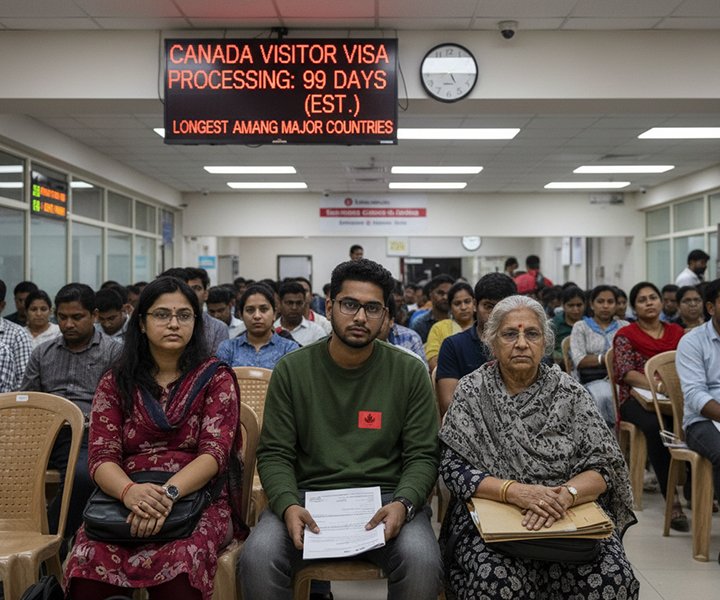
Toronto: Indian nationals applying for Canadian visitor visas are now facing the longest wait times in the world — an average of 99 days, according to data from Immigration, Refugees and Citizenship Canada (IRCC). This marks a notable increase in delays, highlighting ongoing bottlenecks in Canada’s immigration processing system despite recent promises to improve efficiency.
The update, first reported by Immigration News Canada, shows that processing times for visitor visa applications filed from outside the country continue to vary dramatically depending on the applicant’s location.
For instance, applicants from Pakistan currently wait 59 days, those from the United States only 36 days, from Nigeria just 27 days, and from the Philippines around 21 days. But for Indians — who represent one of Canada’s largest sources of visitors, students, and immigrants — the wait time has ballooned to nearly three and a half months.
India Faces Longest Visitor Visa Delays in Canada’s System
According to IRCC’s November update, the average processing time for visitor visa applications submitted from India increased by 13 days compared to the previous reporting period. The figure underscores ongoing challenges in managing the high volume of applications Canada receives from India.
The visitor visa, officially called a Temporary Resident Visa (TRV), is required for travelers from visa-mandatory countries to enter Canada for tourism, visiting relatives or friends, or short business trips.
The delays come at a time when Canada’s immigration system is already under significant strain. The IRCC is handling record-high application volumes across multiple categories, including study permits, work permits, and permanent residency applications.
Super Visa Wait Time for Indians Rises to 169 Days
The processing delays are even more severe for Super Visa applicants — a long-term visa designed for parents and grandparents of Canadian citizens or permanent residents.
For Indian applicants, the average processing time for Super Visas has now climbed to 169 days — almost six months. The Super Visa allows multiple entries for up to 10 years and permits extended stays of up to five years per visit, making it a popular option among families of Indian immigrants living in Canada.
Immigration experts cite multiple reasons for the delay, including:
- High volume of applications from India and other South Asian countries.
- Extensive background and security checks required for applicants from specific regions.
- Resource constraints at Canadian visa offices in India.
- Post-pandemic backlogs still affecting processing efficiency.
IRCC Backlogs Continue Despite Digital Upgrades
While IRCC has made several public commitments to streamline its application system, the backlog persists.
As of November 2025, over 290,000 individuals are still waiting for citizenship grants, with an unchanged processing timeline of around 13 months.
In addition, many applicants for visitor visas and temporary permits have complained of limited communication from IRCC during the waiting period. Although the department has introduced digital tools and automated updates, applicants continue to report delays in biometric appointments, background checks, and eligibility assessments.
The imbalance between Canada’s immigration targets and processing capacity has drawn criticism from both applicants and immigration consultants, especially in countries like India, where the demand for travel and study visas remains high.
Study and Work Permits See Slight Improvement
Not all immigration categories are facing increased delays. According to the same report, study permit processing times have improved, now averaging four weeks — one week faster than earlier this year. This is seen as a positive development for international students, particularly from India, who make up a significant portion of Canada’s student population.
Meanwhile, work permits are being processed in around 10 weeks, a figure that remains stable compared to previous months.
However, experts warn that while processing times may have improved for some categories, visa approval rates tell a different story — especially for Indian applicants.
High Rejection Rates for Indian Study Visa Applicants
Earlier this year, data from IRCC revealed a sharp rise in study permit rejections for Indian students. In August 2025, around 74% of study visa applications from India were denied, compared to 32% during the same period in 2023.
The overall global rejection rate remains around 40%, while 24% of Chinese applicants faced denials in August this year. The steep increase in rejections for Indian students has raised concerns about policy shifts, document scrutiny, and possible geopolitical factors influencing immigration decisions.
The IRCC has attributed part of the increase to fraudulent applications and incomplete documentation. However, critics argue that the process lacks transparency and disproportionately affects Indian applicants, who form the largest group of international students in Canada.
Government Considering Tougher Visa Controls
Amid mounting concerns over fraudulent visa applications and a surge in asylum claims, reports suggest the Canadian government is considering new powers for IRCC to cancel batches of temporary visas collectively.
According to a report from CBC News, this proposal primarily targets applicants from India and Bangladesh, where authorities have reported an increase in visa misuse and overstays.
The new rules would allow IRCC to revoke visas en masse if large-scale irregularities are detected, without requiring individual case reviews.
While the government maintains this measure is necessary to protect the integrity of Canada’s immigration system, immigration lawyers warn it could unfairly penalize genuine applicants who follow all rules and procedures.
Outlook: Delays May Persist Through 2026
As of late 2025, there are few signs that Canada’s visa processing delays for Indian applicants will ease soon. Despite efforts to modernize systems and hire additional staff, high demand and stringent screening procedures continue to stretch processing times.
Immigration consultants recommend applicants to plan ahead, submit complete and error-free documentation, and monitor IRCC’s official processing time tool for the most accurate updates.
Until systemic improvements take hold, travelers from India seeking Canadian visitor or Super Visas should expect longer waiting periods — sometimes extending well beyond the official estimates.