
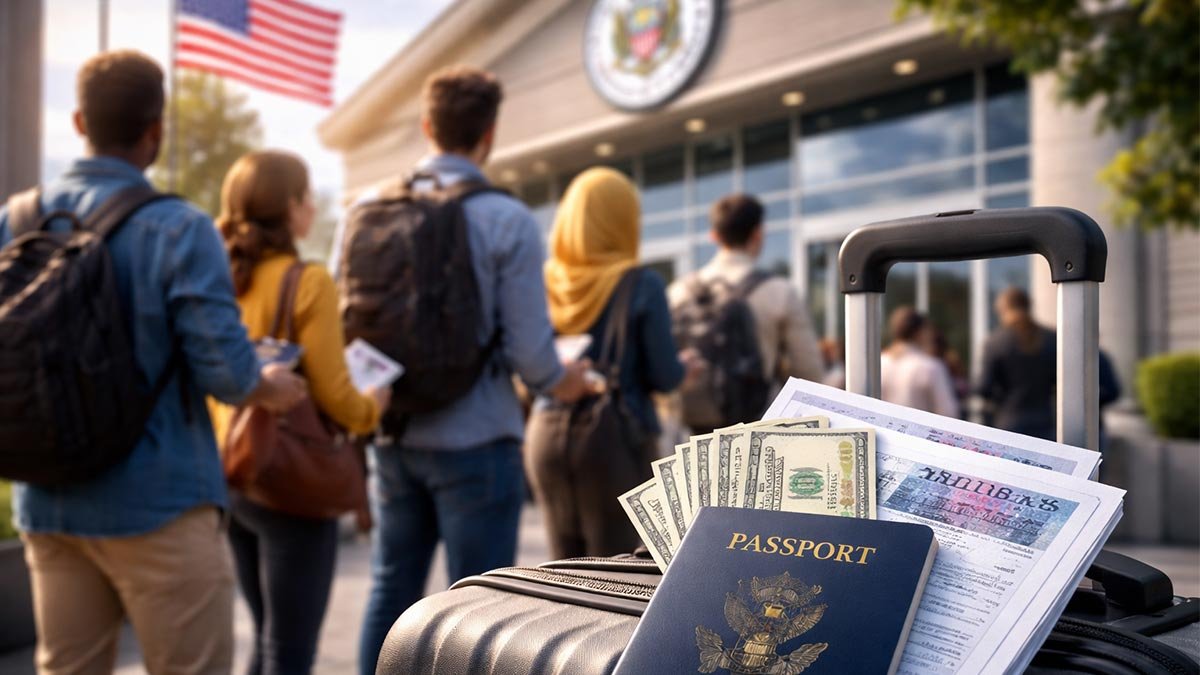

A Major Policy Shift in U.S. Immigration Controls
In 2026, the United States is introducing a stricter approach to visa compliance that could significantly impact travellers from dozens of countries. Under a new policy announced by the U.S. Department of State, certain applicants for B1 (business) and B2 (tourist) visas may be required to pay a refundable security bond of up to $15,000.
This move is part of a broader effort to address visa overstays and enforce immigration rules more effectively. The policy is being implemented under provisions of the Immigration and Nationality Act and targets countries identified with higher overstay rates based on data from the Department of Homeland Security.
What Is the Visa Bond and How Does It Work?
The visa bond is not an additional fee, but rather a financial guarantee. Depending on the applicant’s risk profile, consular officers may require a deposit of $5,000, $10,000, or $15,000 during the visa process.
If the traveller complies fully with visa conditions—particularly by leaving the United States within the permitted time—the bond will be refunded. However, paying this amount does not guarantee visa approval. Applicants must first qualify for the visa, after which the bond requirement may be imposed.
Who Will Be Affected by the New Rule?
The policy applies to nationals from 50 countries across Africa, Asia, the Caribbean, Eastern Europe, and Oceania. Implementation dates vary, with some countries already subject to the rule and others joining throughout 2026.
Countries such as Bangladesh, Nigeria, Nepal, Cuba, Venezuela, and Cambodia are among those included, with several—like Ethiopia, Georgia, and Mongolia—scheduled to be added starting April 2, 2026.
This targeted approach reflects the U.S. government’s strategy of focusing on regions where visa overstays have been more common.
Application Process and Payment Method
Applicants who are instructed to pay the bond must complete Form I-352, known as the Immigration Bond form, and make payment through the official government platform, Pay.gov.
Authorities have emphasized that payments should only be made after receiving clear instructions from a consular officer. Using unauthorized third-party services could result in non-recognition or loss of funds.
Stricter Travel and Entry Conditions
Travellers who post a visa bond will face tighter travel restrictions. They must enter and exit the United States only through designated commercial airports, including those equipped with U.S. preclearance facilities.
Alternative entry points such as land borders, seaports, private aircraft, or charter flights are not permitted for bond holders. Failure to comply with these conditions could lead to denial of entry or complications in departure records.
When Will the Bond Be Refunded?
The bond amount will be returned under specific conditions. Travellers must leave the United States within the authorized period, avoid overstaying, and comply with all visa rules.
Refunds may also be issued if the visa expires unused or if entry into the U.S. is denied at the port of entry.
Consequences of Violating Visa Conditions
Failure to comply with visa terms can lead to serious consequences. Cases involving overstays or violations may be referred to U.S. Citizenship and Immigration Services (USCIS) for review.
If a violation is confirmed, the bond may be forfeited. Situations that could trigger this include remaining in the U.S. beyond the permitted stay or attempting to change immigration status, such as applying for asylum after entry.
A New Direction in U.S. Travel Policy
This policy marks a significant shift in how the United States manages temporary visas. By introducing financial accountability, authorities aim to reduce visa overstays and ensure greater compliance with immigration laws.
However, the measure also raises concerns about increased financial barriers for travellers, particularly those from developing countries.
Conclusion
The introduction of visa bonds of up to $15,000 represents a major change in U.S. immigration policy in 2026. While the initiative is designed to strengthen compliance and reduce overstays, it also places additional financial responsibility on travellers from selected countries. As the rollout continues, applicants must stay informed, follow official procedures carefully, and ensure full compliance to avoid penalties and secure refunds.
- → UK Visa Fees Set to Increase Significantly from April 8, 2026
- → The New Wage-Based H-1B Lottery for FY 2027: What It Means for HR Compliance
- → South Korea Expands Long-Term Multiple-Entry Visa Access for Chinese Travelers in 2026
- → Three CRA Benefit Payments Coming to Ontario Residents in April 2026
- → Express Entry Draw on March 30, 2026: 356 Candidates Receive Invitations for Permanent Residence
- → Canada Begins Mass Cancellation of Asylum Claims Under New 2026 Law
- → Bringing Your Family to New Zealand on a Work Visa: Complete 2026 Guide
FAQs
What is the purpose of the U.S. visa bond?
It serves as a financial guarantee to ensure that travellers comply with visa conditions and leave the U.S. on time.
Is the visa bond refundable?
Yes, it is refunded if the traveller follows all visa rules, including timely departure.
Does paying the bond guarantee visa approval?
No, applicants must first qualify for the visa before being asked to pay the bond.
Who decides the bond amount?
A consular officer determines the amount based on the applicant’s risk assessment.
What happens if someone overstays their visa?
The bond may be forfeited, and the case could be reviewed by immigration authorities.
