
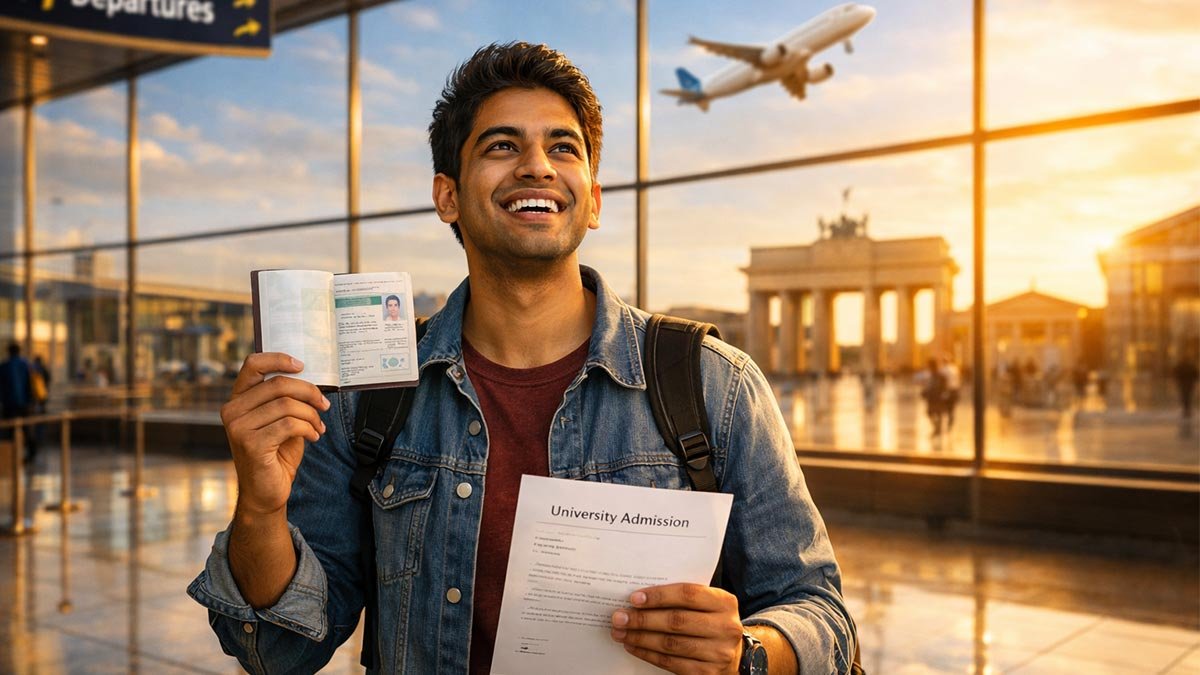

German consulates across India are now processing student visas in as few as six days — a remarkable turnaround compared to the 6–10 week wait times that plagued most of the 2025–26 application cycle. This acceleration is the result of a quiet but significant decision by Germany’s Federal Foreign Office to temporarily redeploy additional visa officers from lower-traffic posts to its busiest Visa Application Centres (VACs) in South Asia. The move is part of a three-week “surge” operation timed to the March/April intake window. For Indian students still awaiting a visa decision — or those gearing up for Winter Semester 2026/27 — this is the most consequential processing update of the year. There’s just one catch: it comes with a firm expiry date.
The additional staffing is strictly temporary. Once Easter arrives on April 20, 2026, the deployed officers are scheduled to return to their original postings, and processing timelines are expected to snap back to the standard 6–10 week window. Students who already have an appointment scheduled or are close to document submission have a rare, narrow opportunity to benefit from the quickest German visa processing India has seen in recent memory.
What Changed at Indian Consulates This Month
Real-world data from applicants confirms the shift. Three separate students reported on March 17 receiving their German national student visas within days of attending their VAC appointments:
- A student from Bengaluru who lodged documents on March 11 had their visa stamped by March 17 — just six days later.
- A Chennai applicant reported an identical turnaround following a March 9 appointment.
- A third Bengaluru applicant received their stamped passport in under three weeks.
Historically, the post-appointment processing window for a German student visa from India has stretched across 6–10 weeks, with VFS Global appointment wait times adding a further 4–6 weeks on top of that. The surge operation has effectively compressed the post-appointment phase to under a week — provided all documents are in order.
The impetus for this change came from sustained pressure applied by German universities since January 2026. Universities flagged to the Foreign Office that delayed visas were forcing Indian students — particularly those admitted to engineering and computer science Master’s programmes — to give up their places. Given Germany’s well-documented structural shortage of skilled engineers, there is a clear national interest in getting these students through the door.
- → New Canada Benefit Payments Arriving This Week in May 2026
- → Canada Bread Settlement Payments Begin Rolling Out Across Canada in 2026
- → Canada Immigration Backlog Update 2026: IRCC Application Inventory Crosses 2.15 Million
- → Canada Expands Visa-Free Travel Access for Citizens of Indonesia and Malaysia in 2026
- → Canada’s 365-Day Maintained Status Work Rule in 2026: What Foreign Workers Need to Know
- → Canada Launches Early Retirement Incentive Program in 2026: Eligibility, Benefits, and Application Process Explained
- → Bringing Your Family to New Zealand on a Work Visa: Complete 2026 Guide
Why This Matters for Indian Students Right Now
Germany has emerged as the fastest-growing study destination among Indian students. According to DAAD (German Academic Exchange Service) figures, Indian enrolment at German universities grew from around 20,810 in 2018/19 to nearly 60,000 in 2023/24. India now ranks among the top two countries of origin for international students in Germany.
The timing of this surge is especially significant for two groups of applicants:
March/April 2026 intake applicants: If your appointment is booked and your documents are complete, you could receive your visa in days rather than weeks. Do not postpone attending your appointment or submitting your paperwork.
Winter Semester 2026/27 applicants (October start): The surge itself will not directly benefit you, as it wraps up before your application window opens. However, it signals Germany’s willingness to intervene when demand spikes — and the broader processing environment has improved considerably. Combined with the APS digital overhaul (which slashed APS certificate processing from 4–6 months down to just 3–4 weeks), the total end-to-end visa timeline for Winter 2026/27 is now more predictable than it has been in years.
There is also a meaningful financial development running alongside this. Germany has raised the part-time work allowance for international students from 120 to 140 full days per year, effective March 2026 — a 16% increase. At standard student wage rates in Germany (roughly €12–14 per hour), those extra 20 working days translate to approximately €2,000–€2,800 in additional annual income, or around ₹2.16–₹3.03 lakh at the current exchange rate (1 EUR = ₹108.24, as of March 23, 2026). For students managing the cost of living in cities like Munich or Berlin, this is far from a minor adjustment.
Who Is Affected: At-a-Glance Impact Table
| Student Group | Impact |
|---|---|
| March/April 2026 intake applicants | Immediate — visa turnaround possible within days if appointment is booked |
| Winter 2026/27 applicants (October start) | Indirect — improved overall processing environment; must apply by June |
| STEM/Engineering Master’s applicants | Highest priority group for German university lobbying efforts |
| Students with complete documents at VFS | Best positioned to benefit before the Easter deadline |
| Students yet to book a VFS appointment | Surge likely will not apply; standard 6–10 week timeline resumes post-Easter |
What Students Should Do Right Now
If You Have a March/April 2026 Intake
- Attend your VFS appointment without delay. Do not reschedule. The surge window closes on Easter, April 20, 2026.
- Ensure your documents are fully complete before your appointment. Any missing item resets the processing clock entirely. Cross-check against the German Embassy India checklist available at new-delhi.diplo.de.
- Carefully verify your visa annotation before leaving India. Your national visa (Category D) must display the correct 90-day validity period and the correct university city. Any errors must be rectified by the issuing consulate before you travel — local Foreigners’ Authorities (Ausländerbehörden) in Germany will not convert a visa containing errors into a residence permit.
If You Are Planning for Winter Semester 2026/27 (October Start)
- Start your APS application now at aps-india.de. The revamped digital system processes applications in 3–4 weeks. April is effectively the last safe window to initiate this.
- Book your VFS appointment as soon as you receive your admission letter — do not wait until your APS certificate arrives. Slots fill up fast; book early and reschedule later if needed.
- Open your blocked account simultaneously. A blocked account holding a minimum of €11,208 (approximately ₹12.13 lakh at current rates) is a mandatory visa requirement, and the setup process takes 2–4 weeks.
- Track your 140-day annual work allowance carefully. Now that the limit has been increased, use a dedicated tracking tool to stay compliant — breaching the limit can jeopardise your visa status.
The Bigger Picture: Germany’s Improving Visa Landscape
Taken together, the surge operation, the APS digital transformation, and the expanded part-time work allowance represent the most student-friendly package of reforms Germany has rolled out in a single season. For Indian students who have historically been put off by Germany’s slow and often opaque visa process, 2026 marks a genuine turning point.
Context matters here. US F-1 visa issuances to Indian students fell sharply by 69% in summer 2025, and UK university tuition costs continue to climb. Germany’s public universities, by contrast, charge little to no tuition. The post-study Chancenkarte (Opportunity Card) provides a structured, transparent pathway to employment after graduation. And the visa process is now measurably faster than it was just a year ago. The combination is accelerating a sustained shift in where Indian students are choosing to pursue higher education.
Conclusion
The current surge in German student visa processing at Indian consulates is a time-sensitive opportunity that applicants cannot afford to overlook. Whether you are finalising plans for an imminent March/April intake or laying the groundwork for Winter Semester 2026/27, Germany’s visa environment in 2026 is significantly more navigable than it has been in recent years. The key deadline is April 20, 2026 — after Easter, standard timelines resume. Act now, keep your documents watertight, and take advantage of what may be the most accessible window to a German student visa that Indian applicants have seen in a long time.
Frequently Asked Questions (FAQs)
Q1. How fast are German student visas being processed at Indian consulates right now? A. During the current surge period (until April 20, 2026), several applicants have received their visas within 6–21 days of their VFS appointment, compared to the standard 6–10 week processing window.
Q2. Why is Germany processing visas so quickly right now? A. Germany’s Federal Foreign Office has temporarily deployed additional visa adjudicators from lower-volume overseas posts to its busiest South Asian centres, creating a short-term surge capacity ahead of the March/April academic intake.
Q3. When does the fast-track processing window end? A. The additional staffing is scheduled to conclude after Easter on April 20, 2026, after which processing is expected to revert to the normal 6–10 week timeframe.
Q4. I am applying for Winter Semester 2026/27 — does the surge help me? A. Not directly, since the surge ends before your application window opens. However, broader systemic improvements — particularly the faster APS digital process — mean the overall timeline is more predictable for October 2026 starters than it has been previously.
Q5. How much money do I need in my blocked account for a German student visa? A. You must demonstrate a minimum balance of €11,208 (approximately ₹12.13 lakh) in a German blocked account. Setting this up takes 2–4 weeks, so you should initiate it in parallel with other application steps.
Q6. Has Germany changed the part-time work rules for international students? A. Yes. Effective March 2026, the annual part-time work allowance for international students increased from 120 to 140 full days — a 16% rise that can yield an additional €2,000–€2,800 per year at typical student wage rates.
Q7. What is the APS certificate, and how long does it take now? A. The APS (Academic Evaluation Centre) certificate verifies your Indian academic qualifications for German university admission. Following a recent digital overhaul, processing has been reduced from the previous 4–6 months down to approximately 3–4 weeks.
Q8. What happens if my visa has an error in it? A. Any inaccuracies — such as wrong validity dates or incorrect university city — must be corrected by the issuing Indian consulate before you depart. German local authorities will not issue a residence permit on the basis of a flawed visa.
