

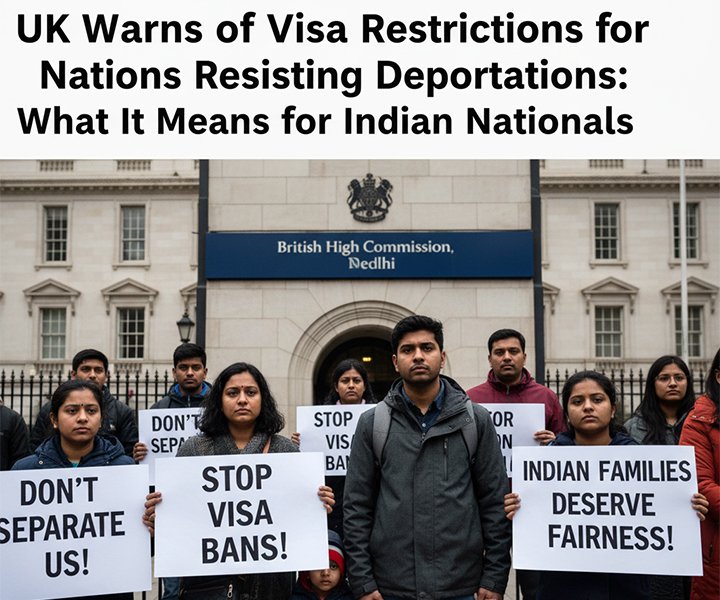
The United Kingdom has issued a strong warning that could significantly impact Indian nationals applying for visas. On September 8, Home Secretary Shabana Mahmood announced a new international agreement linking visa access to how well countries cooperate with deportation requests. This policy shift signals a tougher stance by London, particularly toward nations that delay or refuse to take back their citizens living unlawfully in the UK.
The announcement is especially relevant for India, which remains one of the largest migrant-sending countries to Britain. With more than half a million UK visas granted to Indian nationals last year alone, any changes in the UK’s visa policy could have major consequences for students, workers, and families seeking opportunities in the UK.
The New Policy Explained
The UK has partnered with the United States, Canada, Australia, and New Zealand—its “Five Eyes” intelligence-sharing allies—to implement a coordinated framework for faster returns of unlawful migrants. The agreement sets out specific obligations for countries to accept the return of their citizens who have no legal right to remain abroad.
The key provisions of the agreement focus on:
- Speeding up deportations: Reducing prolonged delays in returning citizens without valid immigration status.
- Travel documents: Ensuring countries quickly issue the necessary paperwork to facilitate removals.
- Visa penalties: Imposing restrictions on visa access for nations that fail to cooperate fully.
The UK government made it clear that countries refusing to accept their nationals will face “appropriate adjustments” in visa issuance policies, effectively using visa access as leverage to enforce compliance.
The UK’s Message: No Tolerance for Immigration Abuse
Home Secretary Shabana Mahmood framed the new policy as part of a wider effort to protect public safety. She stated that the UK would act firmly against non-cooperative countries, making it clear that individuals with no legal right to remain will be deported. For governments unwilling to accept enforced repatriations, there will be direct consequences in the form of reduced or restricted visa access.
Mahmood stressed that abuse of the immigration system is a “serious threat to public safety.” By linking visa issuance to deportation cooperation, the UK hopes to create a strong incentive for countries to comply and prevent prolonged disputes over removals.
The Digital Battle Against Irregular Migration
Interestingly, the joint agreement does not only address deportations but also takes aim at the role of online platforms in facilitating irregular migration. UK authorities estimate that nearly 80% of migrants arriving by small boats rely on social media during their journeys. Migrants often respond to adverts for illegal crossings and maintain contact with smuggling networks via encrypted apps.
The UK’s National Crime Agency has been working to combat this trend aggressively. Since 2021, it has removed more than 23,000 posts or accounts promoting organised immigration crime. In the past year alone, over 8,000 removals have been carried out. This highlights the government’s recognition that the digital space plays a key role in sustaining irregular migration flows.
Why India is Directly Affected
India’s massive migrant population in the UK makes it one of the most affected countries under this new enforcement strategy. Official data shows that between 2020 and 2024, 311 Indian nationals were deported from the UK. While this number may appear modest, it must be seen against the backdrop of rising overstays and increasing irregular arrivals.
Indian Overstayers
In 2020, more than 20,700 Indian nationals were identified as overstaying their visas. This figure translates to roughly one in every 20 Indian visa holders at the time. Overstaying remains a major concern for UK authorities, as it undermines the integrity of the visa system and places pressure on public services.
Small Boat Crossings
Another emerging trend is irregular arrivals across the English Channel. Since 2018, just over 2,000 Indian nationals have been recorded as crossing the Channel in small boats. Strikingly, more than half of these cases occurred in 2023 alone, when 1,194 Indians made the dangerous journey. This sharp rise indicates a new pattern of movement that has caught the attention of UK policymakers.
With both overstays and unauthorised entries on the rise, the relatively low deportation numbers suggest a gap between enforcement and reality. This is exactly the gap that the new policy seeks to close.
India’s Central Role in Legal Migration
Despite these concerns, India remains vital to the UK’s legal migration system. The statistics underline India’s significance:
- Visitor visas: In 2024, Indian nationals were granted over 540,000 visitor visas, representing about 25% of all such visas issued by the UK.
- Work visas: Indians account for around 16% of main applicant slots, topping the charts for skilled worker visas.
- Student visas: Nearly 100,000 Indian students were granted study visas in the year ending June 2025. This makes India the second-largest source of international students after China.
These figures highlight the dual reality: while India is central to the UK’s legal migration system, it is also a key focus in the fight against irregular migration.
Possible Consequences of the Policy
If the UK follows through on its threat to curb visa access for non-cooperative countries, Indian nationals could experience several consequences:
- Tighter visa quotas: A reduction in the number of visas granted annually to Indian nationals.
- Stricter vetting: Enhanced scrutiny during application processes, potentially leading to longer waiting times.
- Priority shifts: More preference given to applicants from countries seen as more cooperative with deportation agreements.
- Increased deportations: A stronger push to enforce removals of Indian nationals living unlawfully in the UK.
For Indian students, workers, and families hoping to move to the UK, this could translate into greater uncertainty and reduced opportunities.
Supporters’ Viewpoint
Supporters of the UK government’s new approach argue that it is long overdue. They believe that linking visa access to deportation cooperation is a practical and necessary step to ensure immigration laws are respected.
From this perspective, overstaying a visa or entering irregularly is not just a violation of immigration rules but a breach of trust. By enforcing stricter consequences, the UK hopes to discourage such practices and preserve public confidence in its migration system.
Critics’ Concerns
Critics, however, warn that the new policy could have unintended consequences. They argue that penalising entire national groups for the actions of a few undermines the spirit of international cooperation and punishes law-abiding migrants.
There are also concerns that the move could strain diplomatic ties between the UK and India. India is a strategic partner for Britain in trade, education, and technology. Restricting visas could negatively affect these areas of cooperation, especially given the high demand for UK education and work opportunities among Indians.
Human rights advocates also caution that stricter deportation policies could expose vulnerable individuals to harm if returned to unsafe conditions. They argue that deportation policies should take into account humanitarian concerns, not just enforcement priorities.
The Bigger Picture: UK’s Immigration Strategy
This announcement reflects a broader shift in UK immigration policy under the current government. With rising public concern over small boat crossings and irregular migration, the government is under pressure to demonstrate tough action.
By linking deportation cooperation with visa access, the UK is sending a message not just to India but to all countries: immigration privileges come with responsibilities. If nations want their citizens to enjoy smooth access to UK visas, they must also be willing to accept the return of those who break immigration rules.
Final Thoughts
For Indian nationals, the UK’s new visa-deportation linkage policy represents both a challenge and a warning. While India remains a cornerstone of Britain’s legal migration system, rising overstays and irregular entries have placed it under scrutiny.
The sheer scale of Indian migration to the UK means that any visa restrictions could have widespread implications—not just for individuals but also for families, educational institutions, and businesses. As the UK government moves forward with its strategy, close attention will be paid to how India responds.
Ultimately, this policy underscores the delicate balance between fostering international mobility and enforcing national immigration laws. For now, Indian nationals planning to study, work, or travel to the UK must stay alert to these developments and prepare for possible changes in visa processes.