

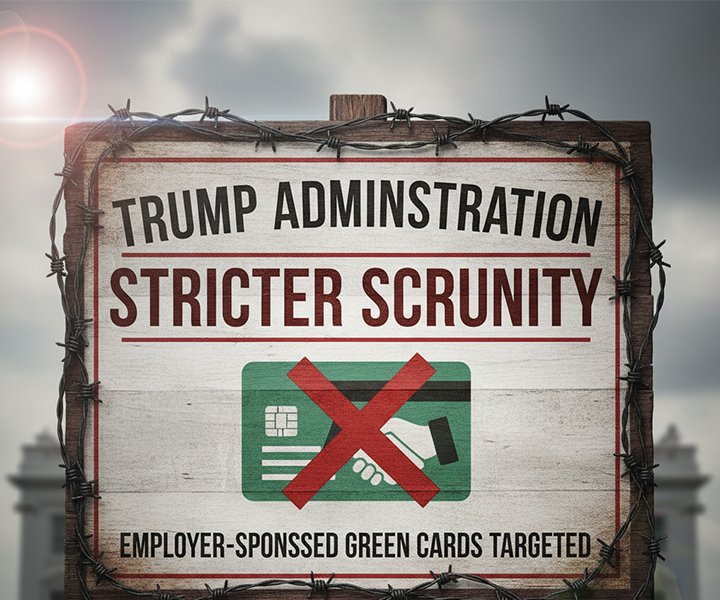
Meta Description: The Trump administration is planning major reforms for employment-based green cards (EB-1, EB-2, EB-3, EB-5). Learn how stricter rules, site visits, and tougher eligibility may impact skilled professionals, Indian applicants, and sponsoring employers.
Introduction: A New Chapter in U.S. Green Card Rules
The U.S. green card has always been one of the most coveted immigration benefits in the world, offering permanent residency and a path to citizenship. For decades, highly skilled professionals, researchers, and investors have relied on employer-sponsored categories such as EB-1, EB-2, EB-3, and the EB-5 investor visa program to secure permanent residency in the United States.
Now, under the Trump administration’s regulatory agenda, sweeping changes are being prepared that could make the journey to a green card more complex than ever. The reforms, set to take effect over the coming years, aim to tighten scrutiny of employer-sponsored petitions, redefine eligibility standards, and increase compliance obligations for companies.
While the government says these measures are meant to ensure integrity and transparency in the immigration process, critics believe they could add layers of bureaucracy, create uncertainty for skilled workers, and raise costs for sponsoring employers.
Let’s break down what these changes mean, who will be most affected, and why Indian applicants may feel the biggest impact.
Employer-Sponsored Green Cards: The Big Picture
Employment-based green cards are divided into preference categories:
- EB-1: For individuals with extraordinary ability, outstanding professors, and certain multinational executives.
- EB-2: For professionals with advanced degrees or exceptional ability, including those applying under a National Interest Waiver.
- EB-3: For skilled workers, professionals, and other workers sponsored by U.S. employers.
- EB-5: For investors who put significant capital into U.S. businesses that create jobs.
Each year, only 140,000 employment-based green cards are issued, with a 7% per-country cap. This means countries like India and China, which send large numbers of skilled workers to the U.S., face massive backlogs.
A Cato Institute study revealed that as of March 2023, India’s backlog in EB-2 and EB-3 categories had reached 1.07 million applicants, leading to estimated wait times of 54 to 134 years in some cases. With reforms on the horizon, the path forward may get even tougher.
Stricter Definition of a “Bona Fide Job Offer”
One of the central changes expected in January 2026 is the definition of a “bona fide job offer” in employer-sponsored cases.
Under the proposed rule, U.S. immigration authorities will gain clearer powers to:
- Closely examine whether the job being offered is legitimate and permanent.
- Review job descriptions, recruitment practices, and wage offers more rigorously.
- Conduct site visits to verify that the sponsoring company actually exists, is operational, and can employ the applicant.
Mitch Wexler, senior counselor at Fragomen, a leading immigration law firm, explained that these rules would give immigration officers stronger authority to conduct workplace inspections.
For employers, this could mean extra documentation, longer processing times, and higher compliance costs. For employees, it introduces greater uncertainty, since a small discrepancy in job roles or pay could trigger delays or denials.
The Challenge for Smaller Companies
Another area of reform focuses on “successorship-in-interest” and “ability to pay.”
Currently, if a sponsoring company merges, is acquired, or restructures, the new entity can take over the green card sponsorship process. The updated rules, however, may demand stricter financial documentation and proof of continuity.
This could disproportionately affect smaller companies and startups, which often operate with lean budgets. An immigration consultant noted that such firms may struggle to meet tougher financial thresholds, potentially limiting their ability to sponsor foreign talent.
For applicants, this means that if their employer undergoes a merger or restructuring, their green card process may stall or even collapse — forcing them to restart the long and costly journey.
EB-1 and EB-2: Tougher Standards for Top Talent
The EB-1 category, long considered a “fast track” for extraordinary professionals, may soon face stricter evidentiary requirements. Applicants will likely need to provide stronger documentation to prove international recognition, research impact, or leadership in their field.
Similarly, EB-2 applicants seeking a National Interest Waiver (NIW) — a popular option for scientists, researchers, and entrepreneurs — could face heightened scrutiny. Immigration officers may demand clearer proof that granting the waiver benefits the U.S. economy or national interest.
While these categories were designed to attract the world’s top talent, the proposed reforms could raise the bar significantly, making approval harder to secure.
The Indian Backlog: A Crisis in the Making
No group is more affected by employment-based green card delays than Indian professionals.
With over 1 million Indians stuck in EB-2 and EB-3 backlogs, many face decades-long waits that often outlast their professional careers. Families remain in limbo, with children “aging out” of dependent visas and losing eligibility.
The new reforms may not directly solve the backlog issue. In fact, by tightening eligibility and increasing documentation requirements, the wait could become even more uncertain for Indians already in line.
For highly skilled Indian workers in sectors like IT, engineering, and healthcare, these reforms raise pressing questions: Will the American dream remain achievable, or will alternative destinations like Canada and Australia become more attractive?
EB-5 Investor Visa: Higher Costs Ahead
It’s not just employees who are under the spotlight. The EB-5 investor program — which allows foreign investors to obtain green cards by investing in U.S. businesses — is also on the Trump administration’s agenda.
DHS plans to implement provisions from the EB-5 Reform and Integrity Act of 2022 and introduce a new rule to raise fees. While this is intended to strengthen program integrity and prevent misuse, it also means higher costs for investors, making the EB-5 route less accessible to smaller investors.
For wealthy applicants from India, China, and the Middle East, EB-5 will likely remain an option — but the bar is being raised.
The Regulatory Process: Nothing Changes Overnight
It’s important to note that these reforms are not final yet. According to immigration experts, the process will follow several steps:
- Draft publication of the rule.
- Public comment period of 30–60 days.
- Review of feedback by DHS.
- Final clearance from the Office of Management and Budget.
This process typically takes months, if not years. However, the fact that these proposals are on the DHS agenda means that companies and applicants should prepare for stricter rules in the near future.
What Employers and Applicants Should Do Now
For companies:
- Start reviewing job descriptions and recruitment practices to ensure compliance.
- Keep detailed records of wages, financials, and employment history.
- Be prepared for site visits and possible audits.
For applicants:
- Gather extensive documentation for your EB-1, EB-2, or EB-3 application.
- Stay updated on policy changes and consider alternative immigration pathways (such as Canada PR, Australia PR, or O-1 visas).
- If eligible, explore investment-based routes like EB-5, but budget for higher costs.
Conclusion: The Future of U.S. Employment-Based Immigration
The Trump administration’s upcoming reforms represent one of the most significant overhauls of employment-based green card processes in recent history. While the stated goal is to strengthen program integrity, the practical effect will likely be tougher eligibility, stricter oversight, and longer processing times.
For employers, it means higher compliance costs and more bureaucracy. For skilled professionals — especially Indians facing decades-long backlogs — the dream of U.S. permanent residency may feel increasingly out of reach.
Yet, as immigration experts point out, regulatory agendas are only the beginning. The rules will undergo scrutiny, revisions, and public feedback before they take effect. Until then, applicants and employers alike should stay informed, prepared, and proactive in navigating the evolving U.S. immigration landscape.