

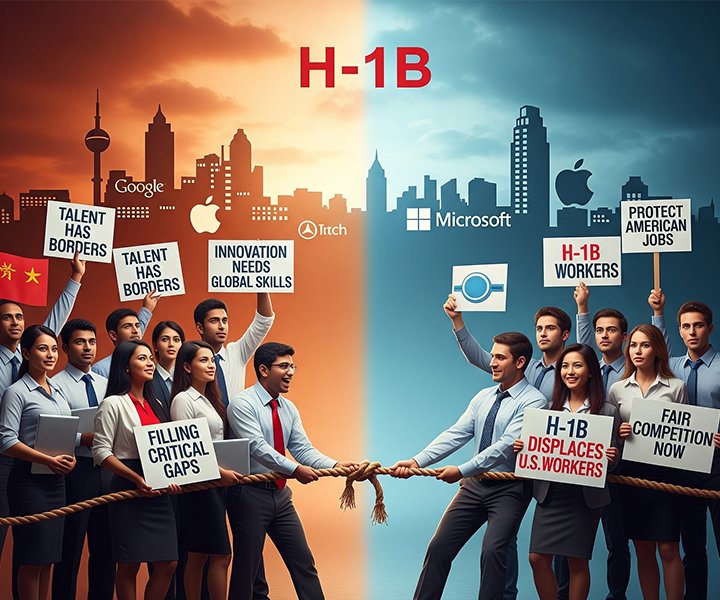
The H-1B visa program has long been one of the most talked-about immigration policies in the United States. It allows American companies to hire foreign professionals in specialized fields, especially in science, technology, engineering, and mathematics (STEM). Over the years, the program has been praised for attracting global talent and fueling innovation in Silicon Valley.
But recently, voices of dissent are growing louder. Many U.S. citizens, particularly those working in software engineering, argue that the program is hurting their chances of landing good jobs. Social media platforms have become a battleground where debates over H-1B visas and their impact on American workers are heating up.
One story, in particular, has captured attention: the account of a U.S. citizen software engineer’s wife, who took to X (formerly Twitter) to share her husband’s struggles in finding employment despite his three decades of experience in the tech industry. Her post sparked a wave of heated discussions about whether the H-1B system is fair to American workers.
A U.S. Citizen’s Struggle in the Tech Job Market
The woman explained that her husband, an experienced software professional with 30 years in the industry, has been unemployed for more than a year. Despite applying widely and attending multiple interviews every week, he has not been able to secure a job.
According to her, the situation is not about his lack of skill but rather about a hiring system she claims is biased in favor of H-1B visa holders. She described how her husband was given multiple coding tests during interviews but faced nitpicking over minor details. She believes the process was deliberately designed to fail American applicants, giving preference to foreign workers instead.
Her frustration was clear in her post:
“My husband is a U.S. citizen, software engineer with about 30 years of experience. He was unemployed for over a year. In that time, he had multiple interviews every week, but no job offers. He was given coding tests that he didn’t ‘quite’ pass. His work was nitpicked because it wasn’t the way the interviewer would have done it. The process is a scam. HR and interviewers are gatekeepers. H-1B visas must end and only American citizens should be in charge of hiring decisions.”
This personal story echoes a sentiment shared by many American professionals who feel sidelined by a system they believe prioritizes cheaper labor from overseas.
What Is the H-1B Visa Program?
Before diving deeper into the debate, it’s important to understand what the H-1B program actually is.
The H-1B visa is a non-immigrant visa that allows U.S. employers to hire foreign workers in specialized fields. To qualify, applicants typically need at least a bachelor’s degree or equivalent experience in areas such as IT, engineering, finance, or healthcare.
- Duration: The visa is valid for three years and can be extended up to six years.
- Employer-Sponsored: Applicants must be sponsored by an employer who petitions for their visa.
- Dual Intent: H-1B holders can pursue permanent residency, making it a pathway to a green card.
Each year, there is a cap of 85,000 visas (65,000 regular and 20,000 for advanced degree holders). Because demand is so high, visas are distributed through a lottery system.
Supporters argue that the program fills labor shortages, especially in industries where there aren’t enough skilled U.S. workers. Critics, however, claim it displaces qualified Americans and keeps wages low.
Why Are Some Americans Calling for the End of H-1B?
The wife’s post highlights some of the common criticisms aimed at the H-1B system:
- Preference for Foreign Workers:
Some believe companies use the program to prioritize foreign workers over American citizens, citing cost savings and perceived loyalty. - Unfair Hiring Practices:
There are allegations that interviews for American workers are deliberately toughened or designed to exclude them, making it easier for H-1B hires to be justified. - Lower Wages:
Critics argue that H-1B workers are paid less than their American counterparts, creating downward pressure on salaries in the tech industry. - Management Bias:
Several online users suggested that when hiring managers themselves are foreign-born, American candidates are at a disadvantage.
Voices from Social Media: A Divided Debate
The woman’s post sparked hundreds of responses online, and the comments show just how divided people are on this issue.
Supportive Reactions
Many users agreed with her, saying interviews were often “a show” to justify bringing in foreign talent. One commenter wrote:
“Yes, you are right. The interviews are just for show. They want to prove they can’t find qualified Americans, so they get approval to hire from abroad. I’ve seen cases where an American worker was fired and replaced by someone less qualified from India.”
Another suggested legal action, encouraging American workers to file complaints with the Department of Justice if they feel excluded:
“Every U.S. citizen in tech should apply for jobs in their specialty. When they get passed over, they should file complaints with DOJ. Start the avalanche now.”
Critical Reactions
Not everyone agreed, though. Some pointed out that the husband may have failed to keep up with modern software engineering skills:
“I don’t want to offend, but it’s possible your husband didn’t grow his skillset over the past 30 years. Declaring that Americans should be prioritized because of that doesn’t make you the good guy.”
This response reflects another side of the debate: while some argue the system is flawed, others believe that continuous upskilling is necessary in the ever-changing tech industry.
Is the Hiring Process Biased?
One of the biggest concerns raised is whether hiring managers deliberately exclude American candidates. The wife’s post accused HR departments and interviewers of being “gatekeepers,” suggesting that American applicants are scrutinized more harshly while H-1B candidates are favored.
Critics of this view, however, argue that modern software engineering roles require updated skillsets, and many seasoned professionals may struggle to meet current expectations in areas like cloud computing, artificial intelligence, and cybersecurity.
The truth likely lies somewhere in the middle: while some companies may exploit the system to cut costs, others are genuinely in need of specialized skills that aren’t always readily available in the U.S. labor market.
The Bigger Picture: H-1B and the U.S. Job Market
The debate around H-1B visas is not new. Every year, discussions intensify as the lottery season approaches. Policymakers, labor unions, and industry leaders have clashed over whether the program benefits or harms the U.S. economy.
- Supporters say: The H-1B program fuels innovation, keeps the U.S. competitive, and fills gaps in industries with talent shortages. Without it, companies may relocate jobs overseas.
- Critics say: The program allows companies to prioritize cheaper foreign workers, undermining U.S. professionals and depressing wages.
With unemployment in tech fluctuating and layoffs affecting thousands of workers, these criticisms have only grown stronger in recent years.
A Path Forward: Reform Instead of Elimination?
While the wife’s post calls for the outright end of the H-1B program, experts suggest that reform might be a more balanced approach. Possible changes could include:
- Wage Protection Rules: Requiring companies to pay H-1B workers at or above market wages to avoid wage suppression.
- Transparency in Hiring: Ensuring companies demonstrate genuine efforts to hire U.S. workers before turning to H-1B candidates.
- Skill-Based Allocation: Prioritizing visas for fields where genuine shortages exist, rather than general IT roles where local talent is abundant.
- Regular Audits: Holding companies accountable through audits to prevent misuse of the program.
Such reforms could help balance the needs of the tech industry with the protection of American workers.
Final Thoughts
The story of the unemployed U.S. software engineer and his wife’s frustration highlights a larger, ongoing debate about the role of H-1B visas in the American job market. While some see the program as a lifeline for innovation, others feel it has become a tool that disadvantages local talent.
As the tech industry evolves and competition grows fiercer, the demand for fair and transparent hiring practices will only increase. For now, one thing is certain: the H-1B visa debate is far from over, and stories like this will continue to fuel conversations about the future of American workers in a globalized job market.