

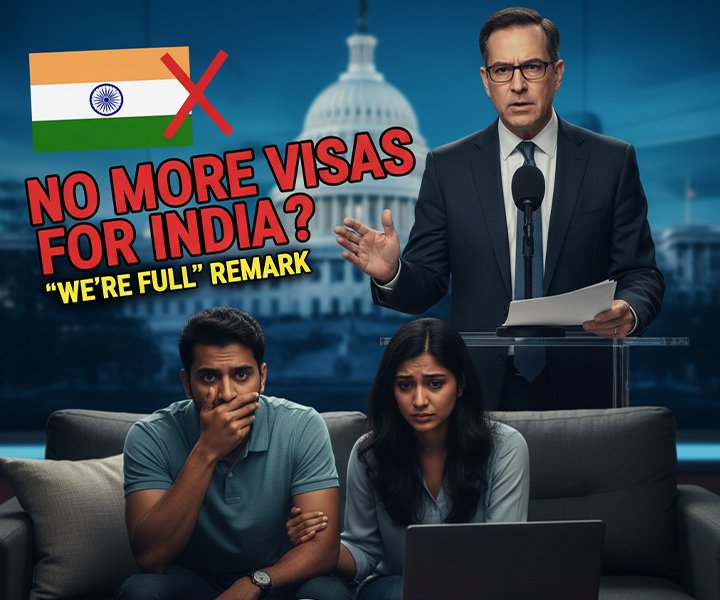
The recent statement by conservative commentator Charlie Kirk, where he bluntly said “we’re full” in response to the possibility of more US work visas for Indians, has stirred debates across policy, education, and business circles.
His remarks came at a time when future US–India trade negotiations were expected to include provisions for easier visa access for Indian professionals. By dismissing Indian immigration as a “threat,” Kirk has cast a shadow on one of the most vital pipelines of talent that fuels America’s economy — skilled workers from India in technology, healthcare, and engineering.
But what would it mean if rhetoric like this actually influenced policy? To answer that, let’s explore the role Indian professionals play in the US, the ripple effects of restricting visas, and the broader consequences for the American economy and global competitiveness.
Indian Professionals: The Backbone of America’s Skilled Workforce
Every year, tens of thousands of Indian students and professionals arrive in the United States to study, research, and work. Many of them come on student visas and eventually transition to work visas such as the H-1B.
Their contributions are undeniable:
- Universities Thrive on Indian Talent: Indian students make up one of the largest international student groups in the US, particularly in STEM fields (science, technology, engineering, and mathematics). They pay significant tuition fees, contribute to groundbreaking research, and strengthen entire graduate programs.
- Healthcare Workers: From doctors and nurses to medical researchers, Indian-origin professionals fill critical shortages in hospitals and labs.
- Technology & Innovation: In Silicon Valley and beyond, Indian engineers, coders, and product managers drive innovation, power startups, and lead some of the biggest tech companies in the world.
In fact, many of America’s most successful companies — including Microsoft, Adobe, and Google — are led by Indian-born CEOs who first came to the US as students or young professionals.
Restricting visas for Indians doesn’t just mean fewer foreign workers. It means undercutting the very talent that keeps the US economy globally competitive.
What Would Happen If Visas Were Restricted?
If Charlie Kirk’s vision of “no more visas for Indians” were to turn into policy, the consequences would be far-reaching. Let’s break it down:
1. Impact on US Universities
Graduate STEM programs depend heavily on international students, especially from India. Without them:
- Graduate enrolments could plummet.
- Universities would struggle with funding gaps, since international students pay higher tuition rates.
- Entire research labs and projects could be destabilized, slowing scientific progress.
2. Drying Up the Skilled Workforce
US companies are already struggling to find qualified workers in key fields like AI, cybersecurity, biotech, and data science. Cutting off visas for Indian professionals would:
- Reduce the supply of highly trained workers.
- Force companies to either leave roles unfilled or outsource jobs overseas.
- Push innovation hubs and R&D centers outside the US.
3. Brain Drain — But in Reverse
Instead of America benefiting from the best and brightest of India, countries like Canada, Australia, and Germany — which have far more welcoming immigration systems — would become the winners.
Talented young Indians would simply choose other destinations, leaving the US behind in the global race for talent.
4. Message to Future Students and Professionals
The biggest loss might be psychological. A message of “You’re not welcome here” could discourage generations of ambitious Indian students from even considering America. The damage to America’s reputation as the land of opportunity would be lasting.
Economic Consequences: Who Really Loses?
Kirk frames immigration as a battle for American jobs — but that’s not what the data shows.
Studies consistently prove that skilled immigrants complement, not compete with, US workers. Here’s how:
- Boosting Productivity: Indian professionals often take on specialized roles that are hard to fill, which makes teams more productive overall.
- Job Creation: Immigrants start businesses, hire employees, and open new markets. Indian-born entrepreneurs have founded or led countless startups in the US.
- Tax Contributions: They pay billions in federal, state, and local taxes each year, strengthening public services and infrastructure.
If the US turns away this talent, companies may move investments overseas, depriving the American economy of growth, jobs, and tax revenue. Ironically, this would weaken the very system Kirk claims to protect.
Why Linking Visas to Trade Talks is Problematic
Another issue with Kirk’s remark is the policy confusion it creates. He suggested visas could be bargaining chips in trade negotiations. In reality:
- Immigration and Trade Are Separate: Immigration is handled by agencies like USCIS and DHS, while trade is managed by the USTR and Commerce Department.
- Mixing Them Creates Uncertainty: Businesses, universities, and families are left unsure about future rules, discouraging long-term planning.
- Wrong Message to Partners: Using visas as leverage sends a negative signal to India — one of America’s most important allies in trade, security, and technology.
Good governance requires clear, consistent policies, not political slogans that conflate different issues.
The Real Workforce Challenges in the US
Blaming Indian professionals for America’s job market problems is misleading. The real challenges are homegrown:
- Outdated Education Systems: US schools and colleges are not producing enough graduates in critical STEM fields.
- Underfunded Training Programs: Workforce retraining for automation and AI has lagged far behind.
- Stagnant Wages: Many American workers feel left behind not because of immigrants, but because wages haven’t kept up with inflation and living costs.
Instead of targeting hardworking immigrants, policymakers should focus on fixing these systemic issues.
Why the US Still Needs Indian Professionals
The reality is simple: The US is not full. It is short of skilled workers.
In fact, the US faces a serious talent shortage in the coming decade. According to research from Korn Ferry, by 2030, America could be short of over 6 million highly skilled workers, costing the economy trillions in lost productivity.
Indian professionals are not replacing Americans — they are filling gaps, driving innovation, and keeping the US competitive in a world where talent is the most valuable resource.
A Global Race for Talent
Countries around the world understand the value of skilled immigration:
- Canada has introduced pathways like the Global Talent Stream to attract STEM workers.
- Australia actively recruits professionals for its tech and healthcare sectors.
- Germany has revamped its immigration laws to attract foreign engineers and IT specialists.
If the US shuts its doors to Indians, it won’t stop global talent from moving. It will just redirect it elsewhere — and America will lose the race.
Conclusion: Words Have Consequences
Charlie Kirk’s remark that “we’re full” may resonate with certain political audiences, but the implications are dangerous.
- It risks undermining America’s universities, which rely on Indian students.
- It threatens innovation and competitiveness in industries like tech, healthcare, and engineering.
- It ignores the fact that skilled immigrants grow the economy, rather than shrink opportunities.
The US is not full — it is in desperate need of talent. Indian professionals are not a threat. They are an asset, a bridge between two of the world’s most dynamic economies, and a key driver of America’s future prosperity.
Instead of shutting the door, policymakers should focus on modernizing immigration systems, expanding work visa options, and retaining global talent.
Because in the end, turning away the best minds doesn’t make America stronger. It only makes it weaker — while competitors like Canada, Europe, and Australia reap the benefits.