
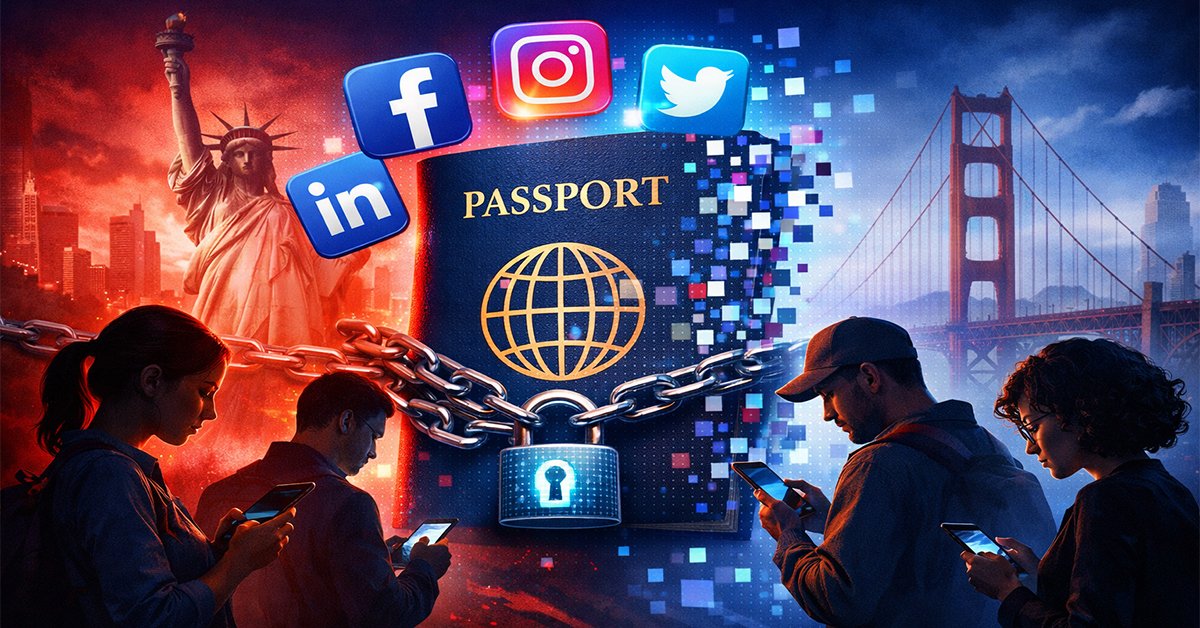

The American dream vacation just got a lot more complicated. A controversial new policy requiring international visitors to hand over five years of social media history has triggered alarm bells across the global travel industry, with experts warning it could cost the United States billions in lost tourism revenue and over 150,000 jobs.
The World Travel & Tourism Council’s latest survey reveals a troubling reality: one in three frequent international travelers would reconsider visiting America if forced to disclose their digital footprints. As the February 9, 2026 comment deadline approaches, the U.S. finds itself at a crossroads between national security concerns and economic prosperity.
What’s Actually Changing with ESTA?
The Electronic System for Travel Authorization (ESTA) has long been the golden ticket for visa-free travel to the United States. Citizens from 42 countries—including the UK, Australia, Japan, Germany, France, and South Korea—currently enjoy a streamlined process requiring basic biographical information and a simple online application.
But that’s about to change dramatically.
U.S. Customs and Border Protection proposed sweeping changes in December 2025 that would transform ESTA from a straightforward authorization into an invasive digital background check. The new requirements mandate:
Five years of social media identifiers across all platforms—Facebook, Instagram, Twitter (X), TikTok, LinkedIn, and more. Every username, every account, public or private.
A decade of email addresses used for personal and business purposes, creating an unprecedented digital trail of your online communications.
Five years of phone numbers, including those you may have long forgotten or discarded.
Extensive family information including names, birthdates, and contact details for parents, siblings, spouses, and children—extending the scrutiny beyond the traveler themselves.
IP address metadata from photos submitted with applications, potentially revealing your physical location history.
Mandatory selfie uploads in addition to passport information, introducing facial recognition technology into the screening process.
The proposal stems from Executive Order 14161, signed by President Donald Trump in January 2025, aimed at strengthening vetting procedures for international visitors. While supporters frame these measures as essential for national security, critics see them as an overreach that threatens both privacy rights and America’s tourism competitiveness.
The Numbers Don’t Lie: Survey Results That Should Worry Washington
The World Travel & Tourism Council didn’t just speculate about potential impacts—they went straight to the source. Their comprehensive survey of 4,563 frequent international travelers from ESTA-eligible countries paints a stark picture of changing sentiment toward U.S. travel.
The findings are eye-opening:
34% of respondents said they would be somewhat or much less likely to visit the United States if these requirements are implemented. That’s more than one in three travelers actively reconsidering their American travel plans.
By contrast, only 12% indicated they would be more likely to visit, creating a net negative sentiment that should concern anyone invested in American tourism.
Two-thirds of travelers were already aware of the proposed changes, demonstrating how quickly concerns about privacy and data collection have spread across international markets.
Perhaps most damning: travelers consistently reported that the new requirements would make the United States feel less welcoming for both leisure and business travel. In an increasingly competitive global tourism landscape, perception matters just as much as policy.
The $15.7 Billion Question: Economic Modeling Reveals Devastating Projections
The WTTC didn’t stop at surveys. They combined traveler sentiment data with sophisticated economic modeling to project the real-world impact of these policy changes. The results should send shivers down the spine of anyone involved in American hospitality, tourism, or travel services.
Under the most likely scenario, the United States could lose:
Up to 4.7 million international arrivals in 2026 alone—representing a staggering 23% drop in visitors from ESTA countries. To put that in perspective, that’s roughly equivalent to losing the entire annual visitor count of a major tourist destination like Hawaii.
$15.7 billion in direct visitor spending, money that would have flowed through American hotels, restaurants, attractions, and retail establishments. This doesn’t even account for the multiplier effect as those dollars ripple through the broader economy.
Over 150,000 jobs across the tourism sector—the same number of positions typically created in an entire quarter. These aren’t just statistics; they represent livelihoods for hotel workers, restaurant staff, tour guides, and countless others who depend on international tourism.
$21.5 billion in overall Travel & Tourism GDP losses when accounting for indirect and induced economic impacts. This represents a significant blow to sectors already recovering from pandemic-related disruptions.
Gloria Guevara, President of the WTTC, didn’t mince words when speaking to CNN: “This could cost the US more than 150,000 jobs and put the US at a competitive disadvantage.” She emphasized that international travelers have options, and many are increasingly willing to take their business—and their dollars—elsewhere.
Why This Matters More Than You Think
The timing couldn’t be worse for American tourism. The industry has been fighting an uphill battle to recover from both pandemic losses and growing international competition. Several European countries, Canada, and even Mexico have been aggressively marketing themselves as more welcoming alternatives with simpler entry requirements.
The United States already saw concerning trends in 2025. According to the U.S. Travel Association:
International visitor arrivals dropped to 67.9 million in 2025, down from 72.4 million in 2024—a decline attributed to stricter entry rules and “America First” policies.
This represented a $12.5 billion decline in travel revenue year-over-year, demonstrating the economic cost of deterring international visitors.
The second half of 2025 showed consistent declines, with a 3.5% drop in inbound overseas travel in November 2025 compared to November 2024.
And this happened before the social media requirements were even implemented.
The Privacy Paradox: What Travelers Are Really Worried About
It’s not just about inconvenience. The proposed requirements raise fundamental questions about privacy, free expression, and the relationship between governments and citizens’ digital lives.
Content misinterpretation is a major concern. Social media posts are highly context-dependent, shaped by cultural nuances, humor, slang, and even emoji usage. What seems innocuous in one culture might be flagged in another. Immigration lawyers warn that reviewers without cultural context could easily draw incorrect conclusions about a traveler’s intent.
Self-censorship effects are already emerging. Even before implementation, travelers report feeling pressure to “sanitize” their social media presence. Some are deleting old posts, closing accounts, or even avoiding political discussions online. This chilling effect on free expression extends beyond applicants—Americans might self-censor when communicating with friends and family abroad, knowing their contacts may face scrutiny.
Ineffectiveness concerns plague the policy. Security experts point out that individuals with genuine ill intent can simply hide problematic accounts or create sanitized profiles for official review. Meanwhile, honest travelers who forget an old MySpace account or use different usernames risk complications.
Algorithmic bias introduces another layer of concern. If social media screening involves automated content analysis, historical data shows such systems can produce discriminatory outcomes, particularly affecting people from certain regions or those who post in languages other than English.
What About the Competition?
While the United States moves toward more stringent entry requirements, competitor destinations are doing the opposite. The United Kingdom, Japan, Canada, and Western European nations maintain simpler processes that don’t require social media disclosure for short-term visitors.
Several countries have even issued travel advisories about visiting the United States:
Ireland, the Netherlands, Denmark, the United Kingdom, Germany, Finland, and Canada all updated their travel guidance in 2025, warning citizens about increased scrutiny and potential delays at U.S. borders.
This creates a perfect storm: American entry requirements become more burdensome just as alternatives become more attractive. For international tourists planning their next vacation or business travelers deciding where to hold conferences, the calculus is shifting.
The Events at Stake: Why 2026 Matters
The timing is particularly unfortunate given the major international events scheduled on American soil:
America’s 250th birthday celebration in July 2026 was expected to draw millions of international visitors eager to participate in this historic milestone.
FIFA World Cup matches in 2026, with the United States co-hosting alongside Canada and Mexico, represent one of the world’s biggest sporting events and a massive tourism opportunity.
The 2028 Olympic Games in Los Angeles loom on the horizon, requiring the U.S. to maintain its reputation as a welcoming destination for international visitors.
If the social media requirements dampen international enthusiasm, these events may not deliver the expected economic windfall. Athletes, fans, and tourists might reconsider travel plans or shorten their stays to avoid the intrusive vetting process.
What Business Travelers Need to Know
The impact extends far beyond leisure tourism. Business travelers—who attend conferences, negotiate deals, and maintain international partnerships—face particular challenges under the new regime.
Corporate travelers worry about:
Proprietary information exposure if business email addresses and communications come under scrutiny during the vetting process.
Professional social media complications, as platforms like LinkedIn contain sensitive information about business relationships, negotiations, and competitive intelligence.
Extended processing times that could interfere with time-sensitive business travel, making it harder to respond quickly to opportunities or attend last-minute meetings.
Reputational concerns about what immigration officials might infer from professional posts, opinions, or industry discussions.
The U.S. Travel Association emphasized this point: “Visa Waiver Program travelers come here to do deals with American businesses, buy American products and experience the beauty of our great nation. If we get this policy wrong, millions of travelers could take their business and the billions of dollars they spend elsewhere, only making America weaker.”
What Happens Next: The February 9 Deadline
The public comment period for the proposed rule closes on February 9, 2026—just days away. After this deadline, U.S. Customs and Border Protection will review submitted comments before finalizing the rule.
Immigration lawyers and travel industry groups are urging affected parties to submit comments through the Federal Register, emphasizing economic concerns, privacy issues, and practical implementation challenges.
If finalized as proposed, the changes could be implemented in phases starting in spring 2026, though exact timelines remain unclear. CBP has indicated that the current $40 ESTA fee and two-year authorization validity would remain unchanged during the initial rollout.
What Travelers Should Do Now
Whether you’re a frequent flyer or planning your first American adventure, here’s what experts recommend:
Review your digital footprint now, not later. Compile a comprehensive list of all social media accounts you’ve used in the past five years, including usernames and platforms. Don’t forget that account you created once and abandoned—it could cause complications if discovered during vetting.
Gather historical contact information including old phone numbers and email addresses. If you’ve changed providers, moved internationally, or simply upgraded accounts, make sure you have records dating back to the required timeframes.
Consider applying earlier than usual if you have U.S. travel plans. Processing times are likely to increase significantly once the new requirements take effect, and you don’t want to be caught in a backlog when your trip approaches.
Consult immigration counsel if you have complex situations—extensive international travel history, multiple citizenships, or concerns about content in your social media history. Professional guidance can help you navigate the process and avoid complications.
Stay informed about the final rule and implementation timeline. Requirements may change based on public comments and further review.
The Bigger Picture: Privacy vs. Security in the Digital Age
This controversy reflects a broader tension playing out worldwide: how do we balance legitimate security concerns with privacy rights in an increasingly digital world?
The United States isn’t the first country to explore social media screening. China has long monitored foreign visitors’ digital activity, and some Middle Eastern countries request social media access during visa processing. However, among Western democracies with established tourism industries, the proposed U.S. requirements are unprecedented in scope and intrusiveness.
Critics argue that the policy represents overreach that undermines the very freedoms America claims to protect. Supporters counter that in an era of international terrorism and transnational threats, governments need every available tool to identify potential risks before they reach U.S. soil.
The debate extends beyond travel policy into fundamental questions about digital privacy, government surveillance, and individual liberty. What precedent does this set? If ESTA applicants must disclose five years of social media history, will other visa categories follow? Will the requirement eventually extend to ten years, or encompass even more invasive data collection?
Industry Response: Tourism Sector Fights Back
The travel industry hasn’t taken these developments lying down. Trade associations, hotel chains, airlines, and destination marketing organizations have mobilized to oppose or modify the proposed requirements.
The World Travel & Tourism Council’s research represents just one part of a coordinated effort to demonstrate the economic consequences of deterring international visitors. Industry groups argue that policymakers must consider whether the security benefits justify the massive economic costs.
Some propose alternative approaches:
Targeted screening that focuses enhanced vetting on travelers from specific regions or those who trigger other risk factors, rather than applying blanket requirements to all ESTA applicants.
Voluntary disclosure that maintains current ESTA procedures while offering expedited processing for those willing to provide additional information.
Technology solutions leveraging artificial intelligence and advanced analytics to screen travelers without requiring them to manually compile five years of digital history.
Risk-based frameworks that adjust scrutiny levels based on individual traveler profiles rather than treating all visitors as potential threats.
What This Means for America’s Global Standing
Beyond dollars and cents, the policy debate raises questions about America’s image abroad. For decades, the United States marketed itself as a welcoming destination where people from around the world could pursue opportunities, experience freedom, and participate in the American story.
Requiring visitors to hand over five years of social media history sends a different message—one of suspicion, surveillance, and distrust. Even travelers who have nothing to hide may resent the implication that they’re guilty until proven innocent.
This matters because tourism competitiveness isn’t just about price or convenience; it’s about emotional connection and perceived welcome. Destinations that make travelers feel valued and respected earn repeat visits and positive word-of-mouth. Those that create anxiety, frustration, or resentment lose out to friendlier alternatives.
Several countries have already capitalized on America’s increasingly restrictive reputation:
Canada has actively marketed itself as a welcoming alternative, emphasizing easier entry requirements and cultural diversity.
Mexico benefits from proximity and simplified entry procedures for many nationalities.
European destinations highlight privacy protections and less invasive screening processes.
Asian tourism powerhouses like Japan and South Korea promote their unique cultures while maintaining straightforward visa processes for Western travelers.
The Path Forward: Can Common Ground Be Found?
As the February 9 deadline approaches, the question remains: is there a middle path that addresses legitimate security concerns without decimating American tourism?
Some immigration experts suggest that more targeted measures—focusing enhanced screening on specific risk factors rather than requiring all travelers to submit years of digital history—could achieve security goals with less economic fallout.
Technology might offer solutions as well. Advanced screening systems that leverage artificial intelligence and big data analytics could identify genuine threats without forcing every traveler through the same invasive process.
International cooperation represents another avenue. If security is truly the goal, working with allied nations to share intelligence and coordinate vetting procedures might prove more effective than unilateral measures that alienate friendly populations.
Ultimately, the decision rests with U.S. policymakers who must weigh competing priorities: national security, economic prosperity, privacy rights, and America’s standing in the world.
The Bottom Line: What’s Really at Stake
The proposed ESTA social media requirements represent far more than a bureaucratic policy change. They embody fundamental questions about the kind of country America wants to be and how it engages with the rest of the world.
Will the United States prioritize maximum security screening even if it costs billions in lost tourism revenue and damages the country’s reputation as a welcoming destination? Or will policymakers find ways to maintain security while preserving the openness that has long been central to the American identity?
For the 4.7 million international travelers who might reconsider their U.S. visits, for the 150,000 workers whose jobs depend on international tourism, and for the American businesses that serve international customers, these aren’t abstract questions—they’re urgent realities that will shape their livelihoods and futures.
As the comment period closes and the final rule takes shape, one thing is clear: the decision made in the coming weeks will echo through America’s tourism industry for years to come. The world is watching, wallets in hand, waiting to see whether the United States will remain an accessible destination or become a fortress that few want to visit.
The American dream has always included the promise of welcome—that anyone, from anywhere, could come to experience the opportunities and freedoms this country offers. The question now is whether that promise extends to the digital age, or whether the price of entry has become too high for the world to pay.
