
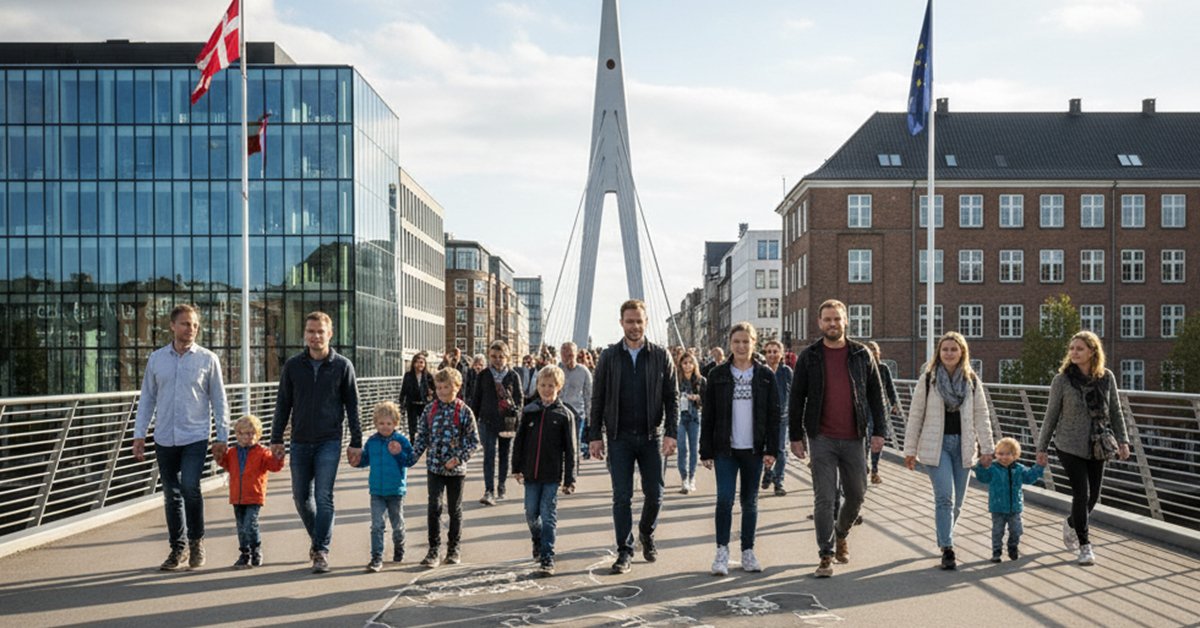

Britain is preparing to implement one of the most significant immigration reforms in decades, modeling its asylum system after Denmark’s controversial approach that has dramatically reduced refugee applications while maintaining center-left political power. Home Secretary Shabana Mahmood announced the radical overhaul on November 18, 2025, following months of pressure over record asylum claims and rising support for the populist Reform UK party.
Why Britain Is Looking to Denmark
Denmark’s Prime Minister Mette Frederiksen has achieved what many center-left governments have found impossible: getting reelected multiple times despite implementing tough immigration policies. Her Social Democrats won elections in 2019, 2022, and polls show they’re on course to win again in 2026—a remarkable feat in an era when incumbent governments across Europe face electoral punishment.
The Political Context
In the year ending June 2025, the UK received 111,000 asylum claims, which was 14% higher than the previous year and nearly twice as high as 2021 numbers. Britain’s Labour government has been under mounting pressure from Reform UK, led by Nigel Farage, which has gained ground by emphasizing immigration’s impact on public services and infrastructure.
As of November 2025, a total of 38,223 people had crossed the Channel in small boats this year, fueling public concern. Approximately 57% of UK residents consider immigration an important issue, making it a top political priority.
What Is the Danish Model?
Denmark has developed what many consider Europe’s toughest asylum system over the past decade, transforming its approach following the 2015 migration crisis.
Historical Turning Point
In 2015, Europe received its most asylum requests in a single year since World War II, as civil wars in Syria and Libya helped spur around 1.3 million people to travel to the region. When Germany’s Chancellor Angela Merkel said “Wir schaffen das (We can do it)!” urging Germans to welcome refugees, Denmark took a different approach.
Denmark’s Results
Denmark’s policies reduced asylum claims to a 40-year low and resulted in the removal of 95% of rejected asylum seekers. The numbers tell a dramatic story:
- 2014: Denmark granted refugee status to 6,031 people
- 2019: That figure dropped to 1,737
- 2024: Just 859 asylum seekers received residence permits (less than 1% of all permits granted)
Of the 99,811 residence permits Denmark granted last year, the vast majority went to students and workers, not refugees.
In 2024, there were four new asylum claims per 10,000 people in Denmark, compared to 16 per 10,000 in Britain.
Key Features of Denmark’s Immigration System
1. Temporary Refugee Status
Before 2015, refugees in Denmark could stay for five years, after which their residence permits would automatically become permanent. Now the system operates differently:
- Residence permits last only one or two years
- Refugees must wait eight years before applying for permanent status
- Permanent status is not guaranteed even after eight years
- Applicants must be fluent in Danish and have held full-time employment for several years
2. Strict Family Reunification Rules
Denmark has implemented some of Europe’s toughest family reunion requirements:
- Both refugee and family member must be aged 24 or above
- Both must pass a Danish language test
- The refugee cannot have claimed government benefits for three years
- A financial guarantee must be provided
3. “Parallel Societies” Policy
Denmark’s controversial approach to housing integration allows the state to sell off or demolish housing estates where more than 50% of residents are from “non-Western” backgrounds. Those living in these designated areas are barred from being granted family reunification rights.
4. Asset Seizure (“Jewelry Law”)
Under Denmark’s “jewelry law,” authorities can seize assets worth over 10,000 Danish Krone (approximately $1,500) to help cover asylum support costs. While applied only 17 times over six years, the policy has drawn criticism for its historical resonances with Nazi-era confiscations.
Britain’s Proposed Changes
The UK plans to go even further than Denmark in some areas while adopting its core principles:
Extended Settlement Period
Britain will quadruple the wait for permanent settlement from five years to 20 years—significantly longer than Denmark’s eight-year requirement. This represents one of the longest pathways to permanent residency in any Western democracy.
Regular Status Reviews
Refugee status will be reviewed every two-and-a-half years. If a refugee’s home country is deemed safe during these reviews, they face deportation back to their country of origin.
Asset Seizures
Following Denmark’s example, asylum seekers in Britain could be stripped of assets including jewelry to cover accommodation costs.
Suspended Family Reunion
The UK’s refugee family reunion scheme has been temporarily suspended since September 2025 pending new regulations, signaling forthcoming restrictions aligned with Denmark’s conditional approach.
How Does Britain’s Current System Work?
Understanding the proposed changes requires context about existing UK asylum policy:
Current Framework
- Successful applicants receive refugee status or humanitarian protection for an initial five-year period
- After five years, they can apply for Indefinite Leave to Remain (ILR)
- The system is grounded in the UN Refugee Convention and European Convention on Human Rights
- Family reunion rights are currently protected, though temporarily suspended
What’s Changing
The reforms shift from automatic pathways to permanent residence toward conditional, temporary status with regular review mechanisms—prioritizing contribution and self-sufficiency over humanitarian protection duration.
Expert Perspectives and Criticism
Integration Concerns
Michala Clante Bendixen, head of Refugees Welcome Denmark, warns that removing the assumption of permanent status has been detrimental: “It creates a feeling of hopelessness. I’ve met so many refugees who say, ‘No matter what we do, it’s never good enough. I have done everything they require of me, and still it’s not enough.'”
She argues the 20-year British pathway would be catastrophic: “Integration fails when you give young people the feeling that they don’t belong. That’s where you see gangs and crime and areas where people have their own rules.”
Political Division Within Labour
Indian-origin Labour MP Nadia Whittome called the plans “policies of the far right,” questioning why a Labour government would take such actions.
Labour MP Stella Creasy stated: “Plans to leave refugees in a state of perpetual uncertainty about where and if they can rebuild their lives are not just performative cruelty, they are counterproductive to integration and the economy.”
Alf Dubs, a Labour member of the House of Lords who came to Britain via the Kindertransport in 1939 fleeing Nazi persecution, told the BBC he was “depressed” by Labour’s hardline turn and called the measures “a shabby thing.”
Employer and Economic Impacts
Immigration experts warn that reduced family reunion rights could limit the UK’s competitiveness for global talent, particularly in sectors already struggling with worker shortages.
Employers sponsoring workers should prepare for a policy climate linking residence to contribution and self-sufficiency, with compliance teams needing to ensure employment records, pay levels and job duties remain accurate and consistent with visa conditions.
The Humanitarian vs. Political Effectiveness Debate
Denmark’s Electoral Success
Prime Minister Frederiksen’s approach has neutralized far-right opposition while maintaining Social Democratic power—precisely what Starmer’s Labour hopes to replicate in Britain.
A Bruegel think tank report noted: “Denmark in recent decades has shown that it is politically and practically feasible to transition to a system of overall higher migration, and more employment- and education-intensive immigration.”
Human Rights Concerns
Human rights organizations argue the Danish model:
- Creates perpetual uncertainty for refugee families
- Disproportionately affects vulnerable populations
- May violate EU anti-discrimination principles
- Undermines integration through insecurity
In February 2025, a senior adviser to the EU’s top court suggested Denmark’s “parallel societies” policy may constitute discrimination based on ethnic origin.
The Integration Paradox
Critics point to a fundamental contradiction: policies designed to improve integration may actually undermine it by:
- Creating hopelessness and disengagement
- Discouraging language learning and skill development among those uncertain of their future
- Preventing family stability necessary for successful settlement
- Fostering resentment in communities feeling permanently excluded
What Happens Next: Implementation Timeline
Immediate Steps
November 2025: Official announcement and policy review period Early 2026: Expected publication of revised immigration rules Mid-2026: Parliamentary debate and potential legislation Late 2026: Phased implementation begins
Ongoing Developments
Home Secretary Mahmood has already begun implementing preparatory measures:
- Full review of Refugee Family Reunion policy ordered
- Continuation of temporary suspension of new family reunion applications
- Enhanced cooperation with European partners on returns and deportations
- Increased enforcement against irregular migration routes
Implications for Different Groups
Current Asylum Seekers
Those with pending applications may face:
- Longer processing times during system transition
- Uncertainty about which rules will apply to their cases
- Changed expectations for settlement timelines
- New integration requirements
Refugees Already in the UK
Existing refugees with settled status should not be affected retroactively, though future policy changes remain possible.
Prospective Applicants
The reforms aim to deter asylum applications by:
- Making long-term settlement extremely difficult
- Creating uncertainty about family reunification
- Establishing high barriers to permanent residency
- Implementing regular status reviews with deportation risk
Employers and Businesses
Companies will need to adapt to stricter visa conditions, with potential impacts on talent recruitment and retention in sectors dependent on international workers.
Broader European Context
Britain’s move reflects a wider European trend toward restrictive asylum policies:
Other Countries Watching Closely
- Netherlands: Considering similar temporary status provisions
- Austria: Already implementing stricter integration requirements
- Sweden: Reversed its previously liberal refugee policies
- Germany: Debating tougher asylum rules despite Merkel’s 2015 stance
The Post-2015 Shift
The 2015 migration crisis fundamentally altered European asylum politics. What was once considered compassionate refugee policy is now politically untenable in many countries, with center-left parties adopting positions previously associated with the right.
What Advocacy Groups Are Saying
Refugee Council Chief Executive Enver Solomon criticized plans to place asylum seekers on military sites as neither viable nor humane.
- → 7 Essential Business Strategies Transforming Success in 2024
- → AI and Machine Learning in 2026: Transforming Business Through Intelligent Innovation
- → Canada Immigration Backlog Update 2026: What the Latest IRCC Data Really Means
- → Mass Flight Disruptions Across Asia: 2,186 Delays and 134 Cancellations Hit Major Airports in India, Japan, Thailand, Malaysia, UAE, Singapore, and Qatar
- → $800 CRA Payment in March 2026: Which Canadian Families Qualify and When to Expect Their Direct Deposit
- → $533 GST/HST Credit for March 2026: Payment Dates, Eligibility, and Everything Canadians Need to Know
- → Canada Medical Expense Tax Claims 2026: Everything You Need to Know Before Filing
National Immigration Law Center: Warns the reforms prioritize political expediency over humanitarian obligations and international law commitments.
Refugee Welcome Denmark’s Michala Clante Bendixen: Emphasizes that successful integration requires reasonable pathways to permanence and family stability.
Key Takeaways
- UK announces major asylum system overhaul modeled on Denmark’s restrictive approach
- 20-year wait for permanent settlement proposed, far exceeding Denmark’s eight years
- Denmark reduced asylum grants by 72% from 2014-2019 through tough policies
- 95% of rejected asylum seekers removed from Denmark under current system
- Family reunion suspended in UK since September 2025 pending new rules
- Labour party deeply divided between progressive members and those facing Reform UK pressure
- Integration experts warn long uncertainty periods undermine successful settlement
- Political aim: Neutralize far-right opposition while maintaining center-left power
- Economic concerns: Potential impact on UK’s ability to attract global talent
The UK’s adoption of the Danish model represents a fundamental shift in how Britain approaches asylum and refugee protection. Whether it will achieve Denmark’s electoral success while maintaining humanitarian standards remains one of the most contentious questions in British politics heading into 2026.
