
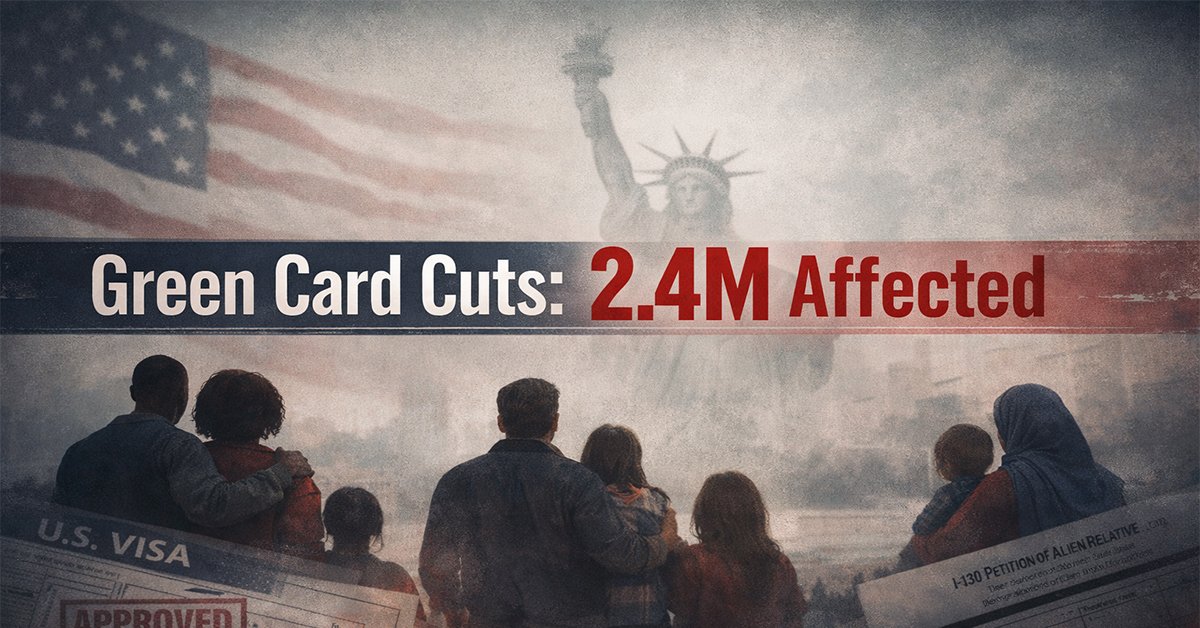

If you’ve been waiting to sponsor a family member, planning to apply for a diversity visa, or helping a loved one navigate the green card process, the ground just shifted beneath your feet.
A new analysis from the National Foundation for American Policy (NFAP) estimates that up to 2.4 million fewer people will receive green cards during President Trump’s second term, which runs through January 2029. That’s not a typo—we’re talking about millions of legal immigration slots potentially vanishing over the next four years.
Let me break down what’s happening, who gets hit hardest, and what this means if you’re caught in the middle of it.
This Isn’t About Illegal Immigration
Here’s something that gets lost in the headlines: these restrictions target legal immigration pathways. We’re not talking about border enforcement or deportations of undocumented immigrants. This is about people following the rules, filing the paperwork, paying the fees, and waiting their turn—only to find the door closing anyway.
In fiscal year 2023, the U.S. issued 1,172,910 green cards. If nothing had changed, we’d expect roughly 4.7 million green cards over four years. Instead, the NFAP projects somewhere between 2.3 million and 3.1 million will actually be issued.
That gap represents real families separated, jobs unfilled, and dreams deferred.
The Four Big Changes Driving the Cuts
1. Family Sponsorship Gets Gutted
This is the big one. Nearly half of all green cards—48% in 2023—went to immediate relatives of U.S. citizens. We’re talking about American citizens trying to bring their spouses, parents, or minor children to live with them in the United States.
The NFAP estimates that between 941,000 and 1.65 million fewer immediate relatives will get green cards under Trump’s policies. The main culprit? Expanded “public charge” rules that scrutinize whether immigrants might potentially use public benefits down the road.
Think about what this means practically. A U.S. citizen married to someone from one of the 39 countries on the expanded travel ban list might not be able to bring their spouse home. An elderly parent who worked their whole life overseas might be deemed a potential public charge because they’re not entering the workforce.
The system that used to prioritize keeping American families together is now doing the opposite.
2. Refugee Admissions Slashed by 94%
The Biden administration set a refugee ceiling of 125,000 per year. Trump capped it at 7,500.
That’s a 94% reduction, and it translates to roughly 470,000 fewer refugees resettled over four years. These aren’t economic migrants or people choosing between countries—refugees are fleeing persecution, war, and violence. The legal process to qualify as a refugee is already incredibly rigorous, often taking years.
Now there are barely enough slots for even the most desperate cases.
3. The Diversity Visa Lottery Gets Frozen
After a shooting at Brown University in December, the administration froze the Diversity Visa Program—a lottery system that awards 50,000-55,000 green cards annually to people from countries with low immigration rates to the U.S.
The NFAP estimates this freeze could eliminate between 55,000 and 165,000 green cards, depending on whether the freeze lasts one year or three. As of now, nobody knows when or if it will resume.
For someone in Ghana, Nepal, or Ukraine who won the lottery and was preparing to move, this freeze isn’t just disappointing—it’s devastating. These winners already beat astronomical odds, only to have their opportunity snatched away.
4. Expanded Travel Bans Hit 39 Countries
In December, Trump signed a proclamation expanding travel restrictions to 39 countries. Citizens of these nations face severe limitations on obtaining immigrant visas, including green cards.
The administration hasn’t published the complete list of affected countries, which creates its own nightmare. Imagine being mid-process in your green card application and not even knowing for certain whether your country is banned.
In January, the State Department announced it was suspending immigrant visa processing for citizens of 75 countries under tightened public charge rules. The overlap between these policies creates a bureaucratic maze that even immigration lawyers struggle to navigate.
Who Actually Gets Hurt?
Let’s get specific about who loses under these policies:
American families. U.S. citizens who thought they had the right to live with their foreign-born spouses or aging parents are discovering that right isn’t as solid as they assumed.
Employers. Companies that wanted to sponsor skilled workers for permanent positions now face longer waits and higher rejection rates. The green card backlog was already years long for some countries; these restrictions make it worse.
Universities. International students who hoped to transition from F-1 student visas to green cards face steeper odds. Universities also lose out on recruiting talented graduate students and researchers from affected countries.
Refugees in crisis. People fleeing genuine persecution now have a 94% smaller chance of finding safety in America. The 7,500 annual cap means horrific triage decisions about who gets those precious few spots.
Diversity visa winners. Imagine winning a lottery with 1-in-100 odds or worse, selling your possessions, telling your family goodbye, and then having the government cancel the whole thing.
What’s Actually Happening Right Now (January 2026)
We’re now a year into Trump’s second term, and the impacts are becoming clear:
The travel ban expansion from December 2024 is fully in effect, though the complete list of 39 banned countries still hasn’t been made public in some official channels. Immigration attorneys report clients from countries across Africa, Asia, and the Middle East facing outright denials or indefinite processing delays.
The diversity visa freeze continues with no announced end date. The DV-2025 lottery winners selected in May 2024 have been left in limbo, and there’s no indication whether DV-2026 will even happen.
Refugee admissions are running at the 7,500 annual cap. To put this in perspective, the U.S. resettled around 60,000 refugees in fiscal year 2023 under Biden—already down from the 125,000 ceiling. Now it’s down to 7,500.
Family sponsorship applications face unprecedented scrutiny under expanded public charge rules. Applicants must now demonstrate they won’t become dependent on government assistance using stricter financial thresholds and broader definitions of “public benefits.” Many families who would have qualified two years ago are being denied today.
The Numbers Behind the Analysis
The NFAP based its projections on actual data from fiscal year 2023, when 1,172,910 green cards were issued. Over a typical four-year presidential term, that would mean roughly 4.7 million green cards.
Their analysis predicts:
- Family-based reductions: 941,625 to 1,654,770 fewer immediate relative green cards
- Refugee cuts: ~470,000 fewer green cards due to the 7,500 annual cap
- Diversity visa freeze: 55,076 to 165,228 fewer green cards (depending on freeze duration)
- Travel ban impacts: Included in family-based numbers but affecting multiple categories
The range exists because nobody knows exactly how aggressively the administration will enforce these policies or whether some might be modified. The low estimate (1.5 million fewer) assumes some moderation; the high estimate (2.4 million fewer) assumes full enforcement through 2029.
Based on what we’ve seen in the first year, the higher number looks increasingly realistic.
What This Means If You’re In Process
If you’re currently navigating the immigration system, here’s the hard truth: the rules changed mid-game, and there’s no grandfather clause protecting applications filed before these policies took effect.
For family sponsorships: Even if you filed your I-130 petition years ago and have been patiently waiting, you could still face public charge denials at the final stage. If your relative is from one of the 39 banned countries, you might hit a wall regardless of your financial situation.
For diversity visa winners: If you won DV-2025, you’re stuck waiting for the freeze to lift with no guarantee it will happen before your selection expires. DV-2026 and potentially DV-2027 might not occur at all.
For employment-based green cards: While not the primary target of these policies, you’re affected too. The backlog grows longer as family-based and humanitarian cases compete for processing resources, and public charge scrutiny has expanded to all categories.
For refugees: If you’re in the pipeline, your chances dropped by 94% overnight. Priority categories still exist, but competition for those 7,500 annual slots is brutal.
The Legal and Political Battle
Several legal challenges to these policies are working through the courts. Immigration advocacy groups argue that some of Trump’s executive actions exceed presidential authority or violate existing immigration law.
But here’s the thing: immigration law gives the president enormous discretion over refugee admissions and entry restrictions. Many of these policies will likely survive legal challenges, especially with the current composition of federal courts.
Congressional Democrats have criticized the policies but lack the votes to pass legislation overriding them. Some Republican senators from states with agricultural industries dependent on immigrant labor have expressed concern, but not enough to form a coalition that could force change.
Unless court rulings block specific policies or public pressure forces modification, these restrictions will probably remain in place through January 2029.
What You Can Actually Do
This situation feels helpless, especially if you’re directly affected. But there are some concrete steps:
Stay informed about your specific situation. Immigration policy is changing rapidly. What’s true today might not be true next month. Follow reliable legal sources, not just news headlines.
Consult an immigration attorney. If you’re in process or planning to apply, professional guidance is more important now than ever. Policies are complex, exceptions exist, and small mistakes can be fatal to your case.
Document everything. Keep copies of all communications, filing receipts, and status updates. If policies change again or if you need to challenge a decision, you’ll need a complete record.
Explore alternative pathways. If family sponsorship looks blocked, could you qualify through employment? If refugee resettlement seems impossible, are there other humanitarian programs? An attorney can help you identify options you might not know exist.
Connect with advocacy organizations. Groups like the American Immigration Lawyers Association (AILA), the International Refugee Assistance Project (IRAP), and others provide resources and sometimes direct assistance.
Manage your expectations. This is the painful part. If you’re from one of the banned countries or in a frozen category, you might be waiting years. Make backup plans. Don’t put your entire life on hold for an outcome that might not come.
The Bigger Picture
Step back from the individual tragedies for a moment and consider what this means for America as a country.
The U.S. has always balanced competing visions of itself—a nation of immigrants versus a nation that controls its borders; a place of refuge versus a society that prioritizes its citizens first. These tensions aren’t new.
- → 7 Essential Business Strategies Transforming Success in 2024
- → AI and Machine Learning in 2026: Transforming Business Through Intelligent Innovation
- → Canada Immigration Backlog Update 2026: What the Latest IRCC Data Really Means
- → Mass Flight Disruptions Across Asia: 2,186 Delays and 134 Cancellations Hit Major Airports in India, Japan, Thailand, Malaysia, UAE, Singapore, and Qatar
- → $800 CRA Payment in March 2026: Which Canadian Families Qualify and When to Expect Their Direct Deposit
- → $533 GST/HST Credit for March 2026: Payment Dates, Eligibility, and Everything Canadians Need to Know
- → Canada Medical Expense Tax Claims 2026: Everything You Need to Know Before Filing
What is new is the scale and speed of these restrictions on legal immigration. Previous administrations tightened enforcement against illegal immigration or shifted priorities within the system. This is different—it’s a fundamental contraction of legal pathways that existed for decades.
The economic impacts will ripple for years. Industries dependent on immigrant labor will struggle. Universities will lose international talent to Canada, Australia, and Europe. American families will remain separated.
The human cost is harder to quantify but no less real. Every one of those 2.4 million green cards represents a person who wanted to build a life in America, contribute to American society, and become part of the American story.
Now they can’t.
Looking Ahead to 2029
Trump’s second term ends in January 2029, but the effects of these policies will last far longer.
Refugee resettlement infrastructure—the network of nonprofits, sponsorship programs, and community support systems—has already begun to collapse. You can’t mothball these organizations for four years and expect them to spring back to life.
The green card backlog, already measured in decades for some countries, grows longer every month. People who filed applications in 2026 might not see resolution until the 2030s.
International perception of America as a welcoming destination has shifted. Talented students, skilled workers, and refugees increasingly look to Canada, Germany, or other countries instead. Rebuilding that reputation will take more than just reversing policies.
And families separated now—children growing up without parents, spouses living apart, elderly parents aging alone—can’t get those years back even if the policies eventually change.
The Bottom Line
Whether you support or oppose these immigration restrictions, the numbers are clear: 1.5 to 2.4 million fewer people will receive green cards during Trump’s second term compared to what would have happened under previous policies.
If you’re one of the millions affected—or if you love someone who is—that statistic isn’t abstract. It’s your life, your family, your future.
The system is now stacked against you in ways it wasn’t two years ago. That’s just the reality. Understanding what changed, why it matters, and what options remain is the first step to navigating it.
The doors haven’t closed completely. They’ve just gotten much, much narrower.
Note: Immigration policies continue to evolve. This article reflects the situation as of January 2026. Consult with a qualified immigration attorney for advice specific to your situation.
