
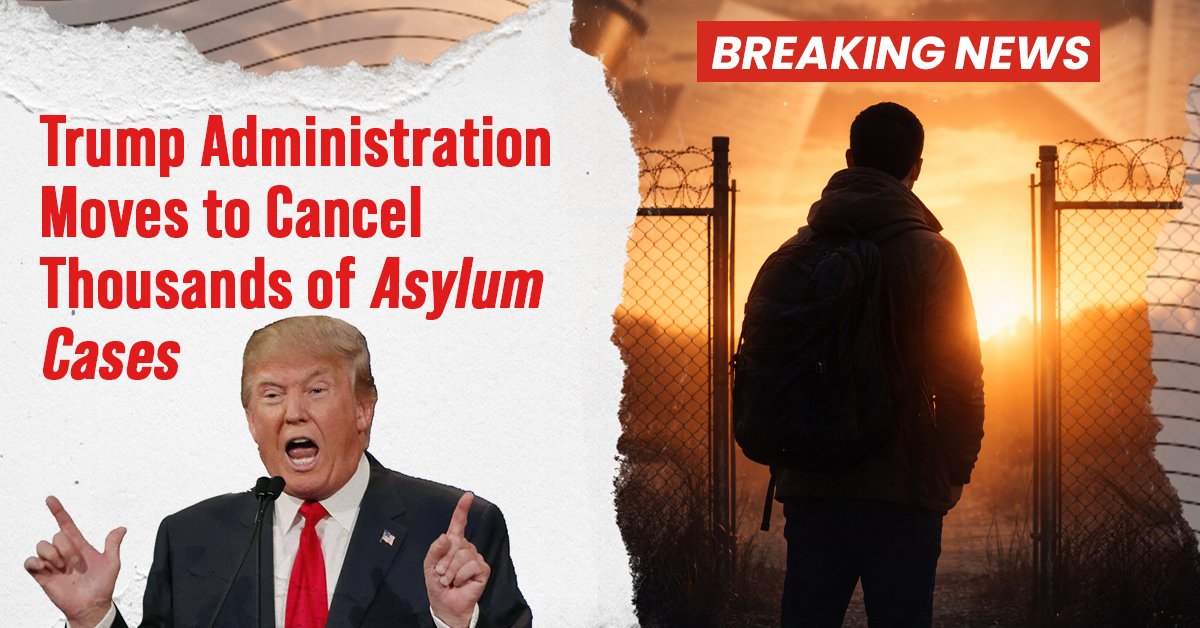

The Trump administration has launched a controversial nationwide campaign affecting thousands of asylum seekers currently navigating America’s immigration courts. The strategy represents one of the most aggressive shifts in U.S. asylum policy in recent history, and it’s leaving many immigrants who thought they were following the rules scrambling to understand what happens next.
What’s Actually Happening with Asylum Cases?
Immigration and Customs Enforcement attorneys are filing motions in immigration courts across the country asking judges to dismiss asylum claims without ever hearing them on their merits. According to internal government data obtained by CBS News, ICE attorneys had filed over 8,000 of these dismissal motions as of early December 2025.
But here’s where this gets particularly alarming for asylum seekers: ICE isn’t just trying to dismiss these cases. The agency is simultaneously requesting that immigration judges order these individuals deported to countries that aren’t their own—places like Guatemala, Honduras, Ecuador, and Uganda.
Think about that for a moment. Someone fleeing persecution in Iran could potentially be ordered deported to Uganda. A Nicaraguan political dissident could face removal to Honduras. An asylum seeker from Russia might be sent to Ecuador.
- → 7 Essential Business Strategies Transforming Success in 2024
- → AI and Machine Learning in 2026: Transforming Business Through Intelligent Innovation
- → Canada Immigration Backlog Update 2026: What the Latest IRCC Data Really Means
- → Mass Flight Disruptions Across Asia: 2,186 Delays and 134 Cancellations Hit Major Airports in India, Japan, Thailand, Malaysia, UAE, Singapore, and Qatar
- → $800 CRA Payment in March 2026: Which Canadian Families Qualify and When to Expect Their Direct Deposit
- → $533 GST/HST Credit for March 2026: Payment Dates, Eligibility, and Everything Canadians Need to Know
- → Canada Medical Expense Tax Claims 2026: Everything You Need to Know Before Filing
These requests, known as “pretermit motions,” essentially argue that because the U.S. has agreements with certain third countries to accept deportees who aren’t their citizens, asylum seekers can be removed there instead of having their claims heard in American courts.
Why This Matters More Than You Think
This isn’t just about legal procedure. It’s about fundamentally reshaping who gets to seek asylum in the United States and how.
Immigration attorneys across the country report that the campaign has intensified dramatically in recent weeks, affecting clients with active cases in immigration courts in Atlanta, New York, Miami, Los Angeles, San Francisco, Texas, and numerous other cities. The pattern is nationwide, systematic, and accelerating.
What makes this particularly troubling is that many of these cases involve people with strong asylum claims who fled genuine persecution. Multiple immigration lawyers report that the tactic has affected clients from Iran, Nicaragua, and Russia—countries known for political persecution and human rights abuses.
“This is a flat-out attempt to eliminate the path to asylum in the U.S.,” one immigration attorney explained. Several lawyers believe the government’s campaign is designed to coerce asylum seekers into withdrawing their claims by frightening them with the prospect of deportation to unfamiliar countries.
The Legal Foundation—Or Lack Thereof
Under the Refugee Act of 1980, entering the United States without proper authorization does not disqualify someone from seeking asylum. This reflects the reality that people fleeing persecution often can’t navigate complex immigration legal systems before migrating—they’re running for their lives.
For decades, U.S. law and international agreements have recognized that forcing asylum seekers to prove they wouldn’t face persecution in third countries places an impossible burden on them. How do you prove you’ll be safe in a country you’ve never visited and know nothing about?
That’s exactly the situation immigration attorneys now face. One Atlanta-based lawyer received notice that the Department of Homeland Security had filed a motion to dismiss her Iranian client’s case and deport him to Uganda just four days before his scheduled hearing.
She and her client had spent months preparing a detailed case demonstrating he would face persecution and danger in Iran due to his previous same-sex relationships. Suddenly, they had to pivot and rapidly prove he would also suffer in Uganda—a country her client had never been to and knew virtually nothing about.
The Numbers Tell a Disturbing Story
The scale of this operation is staggering. As of December 31, 2024, approximately 1.45 million asylum applications were pending with U.S. Citizenship and Immigration Services. Another 1.48 million asylum applications were pending as part of immigration removal proceedings.
Based on self-reporting data, at least 250,000 asylum seekers in the last decade entered the U.S. unlawfully—exactly the population being targeted by this new policy. If the administration successfully dismisses even half of these cases, we’re talking about potentially 125,000 people or more suddenly becoming eligible for expedited removal.
Expedited removal is a fast-track deportation procedure that allows immigration authorities to remove individuals without a hearing before an immigration judge. It strips away due process protections that have been fundamental to American immigration law for generations.
This Isn’t Happening in Isolation
The asylum dismissal campaign is part of a much broader immigration enforcement expansion. In July 2025, President Trump signed the “One Big Beautiful Bill Act,” which provides approximately $170 billion for immigration enforcement and border security through September 2029.
To put that in perspective: that’s more than the annual spending on police by state and local governments in all 50 states and the District of Columbia combined.
Here’s where that money is going:
$45 billion for detention expansion — This represents a 265% increase over ICE’s current detention budget and would allow the agency to detain potentially over 116,000 people per year. That’s more than the entire federal prison system, which holds approximately 155,000 individuals.
$30 billion for ICE enforcement operations — This triples ICE’s previous annual budget and includes funding to hire 10,000 new deportation officers. ICE is now positioned to become the single largest federal law enforcement agency in U.S. history.
$47 billion for border wall construction — This dwarfs the $5 billion Congress appropriated plus $10 billion diverted by Trump during his first administration.
$13.5 billion in state and local reimbursements — This incentivizes state and local governments to participate in immigration enforcement, effectively nationalizing what was previously federal responsibility.
The administration has set a goal of deporting one million immigrants per year. To meet that target, officials are pursuing a daily arrest quota of 3,000 immigration arrests.
Real People, Real Consequences
The human cost of these policies extends far beyond statistics. Immigration attorneys report clients who have lived and worked legally in the United States for years suddenly receiving dismissal notices for asylum applications they filed as far back as 2019.
Take the case of one Venezuelan man who entered through the CBP One app in January 2025, just before Trump was inaugurated. He finally received his work permit and Social Security number in December—only to watch some of his friends receive emails from the government telling them to self-deport.
Or consider asylum seekers who filed applications years ago but never received their mandatory “credible fear” interview at the border because the U.S. didn’t have enough asylum officers to conduct them. The massive influx of border crossers during the COVID-19 pandemic and afterward overwhelmed the system. Now, years later, USCIS is administratively closing their applications due to that missing interview—making them start the entire process over.
These are people who have been working, contributing to their communities, paying taxes, and waiting patiently for their day in court. Many have employers who depend on them. They have children in schools, apartments they rent, lives they’ve built while following what they believed were the rules.
The Judicial Pushback
Not everyone agrees these tactics are legal or constitutional. In July 2025, a federal judge struck down Trump’s proclamation aimed at completely shutting down asylum at the southern border.
U.S. District Judge Randolph D. Moss wrote in his 128-page ruling that “The President cannot adopt an alternative immigration system, which supplants the statutes that Congress has enacted.” The ruling affirmed that the right to seek asylum is a fundamental protection provided by Congress and ingrained in U.S. law for over 40 years.
The ACLU and other immigrant rights groups successfully argued that Trump’s actions ignored protections that Congress put in place and that courts have backed for generations. The ruling was seen as a hugely important decision that reaffirmed the separation of powers and saved lives of families fleeing grave danger.
However, the administration is appealing these decisions, and the legal battles will likely continue for months or years. Meanwhile, the policy of dismissing cases and pursuing third-country deportations continues unabated.
What Changed at USCIS?
Perhaps the most significant shift involves U.S. Citizenship and Immigration Services (USCIS), the agency that traditionally processes immigration benefits rather than enforces deportations.
In a controversial move, Homeland Security Secretary Kristi Noem gave USCIS new authority to fast-track deportation proceedings and “take additional actions to enforce civil and criminal violations of the immigration laws.” This fundamentally changes USCIS’s role from a benefits-processing agency to an enforcement arm of ICE.
The implications are profound. USCIS now reviews pending asylum applications looking for any technical deficiencies or missing elements. If they find issues, they can administratively close the application and turn the person over to ICE for deportation—without that person ever getting their day in court.
This marks a dramatic departure from decades of practice. As one ACLU attorney put it: “They’re turning the agency that we think of as providing immigration benefits into an enforcement arm for ICE.”
The Chilling Effect on Future Asylum Seekers
Beyond those currently in the system, these policies are having a broader chilling effect. More than 1.6 million immigrants have lost their legal status in the first 11 months of Trump’s presidency—exceeding the entire population of Philadelphia.
This includes people who were accepted into various immigration parole, visa, asylum, and Temporary Protected Status programs. Many entered legally under Biden-era programs and were working lawfully while awaiting final determinations.
In early December 2025, the administration paused all asylum decisions following a National Guard shooting in Washington involving an Afghan national who had been granted asylum earlier in the year. Secretary Noem indicated asylum reviews would restart when the agency has “dealt with the backlog”—but with over one million cases pending at USCIS, that timeline is indefinite.
The message being sent is clear: even following the rules offers no guarantee of protection.
Where Third-Country Deportation Agreements Come From
The administration’s ability to pursue third-country deportations relies on agreements negotiated with countries willing to accept deportees who aren’t their citizens. These agreements typically involve some combination of financial incentives, foreign aid considerations, and diplomatic pressure.
Guatemala, Honduras, and Ecuador have accepted such arrangements in exchange for various considerations from the U.S. government. These countries agree to receive and process individuals the U.S. wants to remove, even if those individuals have no connection to those nations.
The legal and ethical questions surrounding these agreements are significant. Can someone truly receive a fair asylum hearing in a country they’ve never been to, whose language they may not speak, and where they have no support network? What happens if that third country also experiences political instability or violence?
What This Means for the Immigration Court System
The push to dismiss cases en masse compounds an already overwhelming backlog. The Executive Office for Immigration Review (EOIR) had more than 4 million pending cases in the last quarter of 2024, including 1.5 million pending asylum cases.
Yet the “One Big Beautiful Bill Act” caps the number of immigration judges at 800, despite the growing caseload. A 2023 Congressional Research Service analysis estimated over 1,300 judges would be necessary to eliminate the backlog over several years.
Now, instead of hiring more judges to fairly adjudicate cases, the administration is pursuing dismissals and expedited removals that circumvent the judicial process entirely. It’s faster, certainly, but it raises fundamental questions about due process and justice.
Immigration attorneys estimate it takes an experienced lawyer 50 to 75 hours to prepare a strong asylum application. People awaiting decisions typically wait just over four years. That’s four years of uncertainty, of building a life while wondering if it will be torn away.
The Bigger Picture: What’s Really at Stake
At its core, this controversy is about what America stands for. Since 1980, when Congress passed the Refugee Act, the United States has maintained a legal commitment to provide refuge for those fleeing persecution.
That commitment recognized that people escaping violence, political oppression, or targeted harm often can’t wait for perfect paperwork. They run. They seek safety. They hope the country they reach will give them a chance to tell their story and prove their fear is real.
The current administration’s approach fundamentally challenges that tradition. By arguing that asylum seekers can be sent to any country willing to accept them—regardless of whether they’d be safe there—it threatens to make asylum in America effectively unavailable.
As one immigration policy expert noted: “When you’re applying for asylum, it literally is a matter of life and death.”
Looking Ahead: What Happens Next?
Legal challenges to these policies are ongoing and likely to reach higher courts. Immigrant rights organizations are documenting cases and building evidence of harm. Immigration attorneys are working overtime trying to protect their clients while navigating a rapidly changing legal landscape.
Meanwhile, the administration shows no signs of slowing down. With $170 billion in new enforcement funding spread over four years and a stated goal of deporting one million people annually, the infrastructure for expanded enforcement is being built rapidly.
Private detention companies CoreCivic and GEO Group are receiving the majority of contracts to build new detention facilities. ICE has been putting out bids for this work for months in anticipation of the funding, some of them no-bid contracts that bypass competitive procurement processes.
The stated aim is removing dangerous criminals who pose threats to public safety. But the vast majority of those affected by these policies have not committed crimes beyond immigration violations. Many have lawful status and are contributing members of their communities.
What You Need to Know If This Affects You
If you or someone you know has an asylum case pending in immigration court, understanding your rights is critical:
Know your rights: Under federal law, you still have the right to legal representation in immigration proceedings, though the government is not required to provide it. Organizations like the American Immigration Lawyers Association and various nonprofit legal aid groups offer resources and referrals.
Document everything: Keep copies of all paperwork, filing receipts, and correspondence with immigration authorities. If you receive any notice of dismissal or deportation order, consult an attorney immediately.
Don’t ignore notices: Missing a court date or failing to respond to official correspondence can result in automatic deportation orders, even if you would have won your case on the merits.
Understand your options: Even if your asylum application is dismissed, you may have other forms of relief available. An experienced immigration attorney can evaluate whether you qualify for other protections.
Stay informed: Immigration policy is changing rapidly. What’s true today may not be true tomorrow. Follow reputable news sources and immigrant rights organizations for updates.
The Bottom Line
The Trump administration’s campaign to dismiss thousands of asylum cases by arguing for third-country deportation represents one of the most aggressive shifts in U.S. immigration policy in modern history. Combined with unprecedented enforcement funding and expanded detention capacity, it’s creating what some experts call a “deportation-industrial complex” that will be difficult to dismantle regardless of future administrations.
For the thousands of asylum seekers caught in this system, the consequences are immediate and potentially life-altering. For American society, the implications touch on fundamental questions about who we are as a nation and what obligations we hold toward those seeking refuge.
As legal battles continue and policies evolve, one thing remains certain: the human cost of these decisions extends far beyond statistics and policy debates. Behind every case number is a person with a story, a family with hopes, and a life hanging in the balance.
