
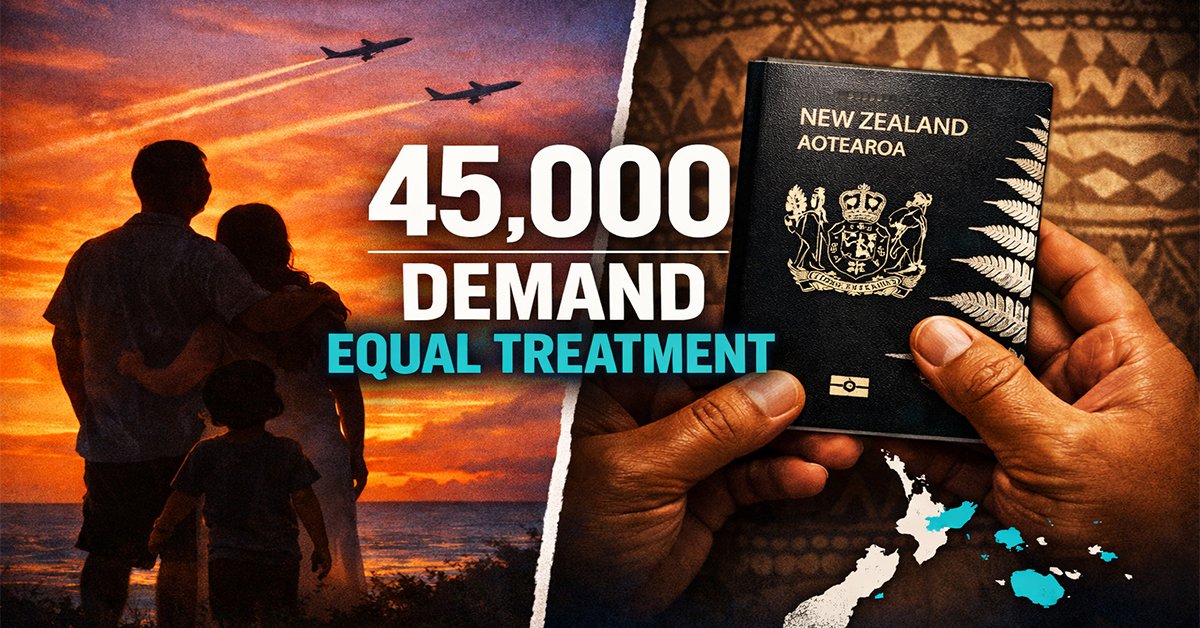

When tragedy strikes and a loved one passes away, most people can jump on a plane without thinking twice about paperwork. But for Pacific Islanders wanting to attend a funeral in New Zealand, there’s an agonizing wait—application forms, fees, medical checks, and no guarantee they’ll arrive in time to say goodbye.
It’s this exact scenario that’s pushed more than 45,000 people to sign a petition calling for change. And the man leading the charge isn’t mincing words about who’s to blame.
The Current Reality
Right now, if you’re from Samoa, Tonga, Fiji, or several other Pacific nations, visiting New Zealand means jumping through significantly more hoops than travelers from 60 other countries around the world.
You’ll need to:
- Apply for a full visitor visa
- Provide proof you’ve got enough money for your entire stay
- Potentially undergo x-rays or medical examinations
- Pay substantial fees
- Wait for processing—time you might not have in an emergency
Meanwhile, 3.2 billion people from countries like the UK, US, and most of Europe can waltz through with a simple electronic travel authority or get a visa on arrival at Auckland Airport.
“Why Are We Discriminated Against This Way?”
Former National MP Arthur Anae, who’s spearheading the petition, didn’t hold back when speaking to RNZ’s Checkpoint programme.
“Close your eyes and put yourself in this position,” Anae said. “Your mother’s died, your father’s died, or your brother or sister or your child, and you can’t come to the funeral.”
It’s not just about funerals, though that’s where the inequity cuts deepest. Pacific families separated by a few hours of flight time face barriers that European tourists never encounter.
“All I am asking for, treat the people of the Pacific equal,” Anae stated simply.
The Government’s Silence
Anae’s frustration extends beyond the policy itself. He’s written to both the Immigration Minister and the Prime Minister. Their response? Nothing.
- → AI and Machine Learning in 2026: Transforming Business Through Intelligent Innovation
- → Canada Immigration Backlog Update 2026: What the Latest IRCC Data Really Means
- → Mass Flight Disruptions Across Asia: 2,186 Delays and 134 Cancellations Hit Major Airports in India, Japan, Thailand, Malaysia, UAE, Singapore, and Qatar
- → $800 CRA Payment in March 2026: Which Canadian Families Qualify and When to Expect Their Direct Deposit
- → $533 GST/HST Credit for March 2026: Payment Dates, Eligibility, and Everything Canadians Need to Know
- → Canada Medical Expense Tax Claims 2026: Everything You Need to Know Before Filing
- → Canada Pension Plan (CPP) and Old Age Security (OAS): 2026 Payment Updates Every Canadian Retiree Should Know
“The minister hasn’t responded to anything I have asked in anyway at all,” he said.
He was blunt about where he thinks responsibility lies: “It is the New Zealand Immigration Office and the minister responsible who doesn’t give a damn about us.”
The Ministry of Business, Innovation and Employment and Immigration Minister Erica Stanford’s office have been approached for comment but haven’t yet responded.
The Overstayer Argument
Critics often point to overstayer statistics—Pacific Island nations do have higher percentages of people staying beyond their visas. But Anae argues this is looking at the problem backwards.
“If you made it easier for people to come and go, they don’t need to overstay,” he said, suggesting that the current restrictive system actually creates the problem it’s supposedly designed to prevent.
When people can visit freely and return home without bureaucratic nightmares, there’s less incentive to overstay. The numbers being cited also represent a small fraction when you consider that fewer than 16 million Pacific people currently have these restrictions, compared to billions who don’t.
What Happens Next?
Anae plans to present his 45,000-signature petition to Parliament on February 11th. But he’s not just looking for acknowledgment—he wants action.
Specifically, he’s calling for:
- A full select committee process where MPs can hear directly from affected families
- A conscience vote in Parliament on the issue
- Pacific visitors to be granted the same electronic travel authority available to other nations
“I believe 95 percent of people [in] this country have no idea, no idea, how the Pacific people are treated by New Zealand immigration,” Anae said.
Why This Matters
New Zealand loves to position itself as a Pacific nation. Politicians regularly speak about our special relationship with our island neighbors. We talk about the Pacific family.
But family doesn’t make family get medical clearances and prove they have enough money before attending a tangi. Family doesn’t charge family substantial fees for the privilege of being together during the hardest moments of life.
The petition has clearly struck a nerve—45,000 signatures suggest this isn’t a fringe issue. These are New Zealanders, Pacific communities, and supporters who recognize that our current system doesn’t reflect our values.
As Anae pushes for his select committee hearing, one question hangs in the air: If we truly see Pacific nations as family, why do we treat them like strangers at the door?
