
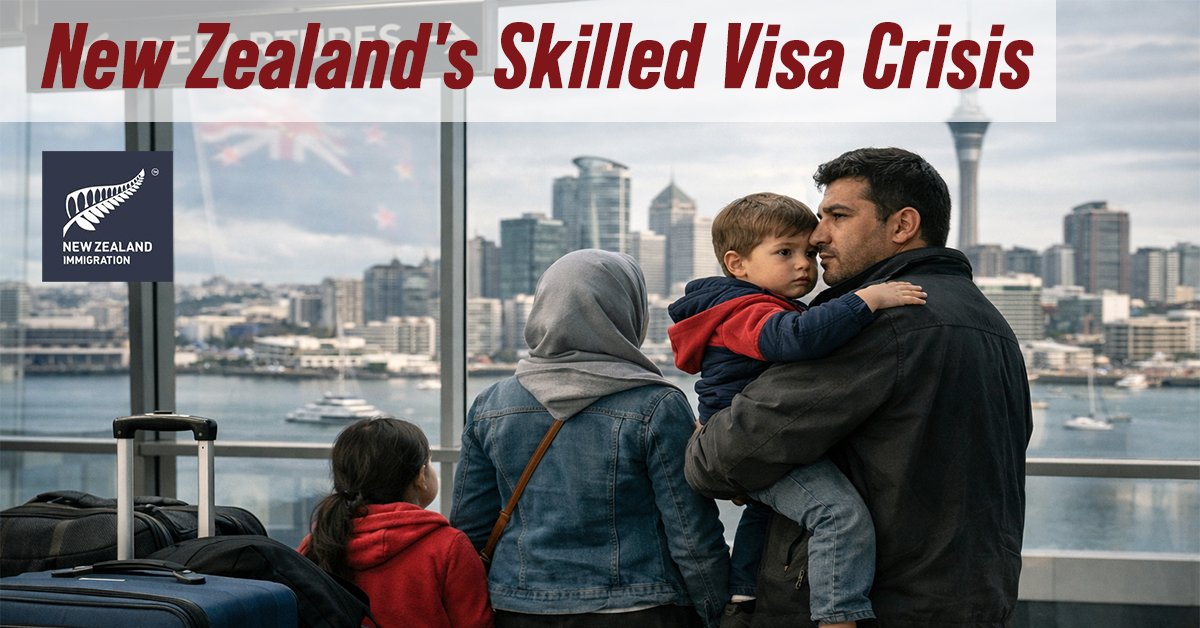

Aaron Pasion did everything right.
He came to New Zealand three years ago as a swim instructor—a job that was officially classified as “skilled” at the time. He built a life in Auckland. His five-year-old son, Andreus, made friends. They found a home. Parents loved him. His swim school valued him. He was on the pathway to residency, just like he was told.
Then, without warning, the rules changed.
Now Aaron and his family are moving to Australia by the end of the month, not because he did anything wrong, but because the New Zealand government changed how it defines “skilled work”—and his job no longer qualifies.
This isn’t just Aaron’s story. It’s happening to hundreds, possibly thousands, of migrants across New Zealand. And it’s creating what immigration advisers are calling a “brewing storm” that could seriously damage the country’s reputation.
What’s Actually Happening Here
Let me break this down because the situation is more complicated—and frankly, more frustrating—than it first appears.
New Zealand is currently using two different classification systems to decide whether a job counts as “skilled”:
- ANZSCO (Australian and New Zealand Standard Classification of Occupations) – the traditional system
- NOL (National Occupation List) – the new system being phased in
Here’s where it gets messy: a job might be classified as skilled under one system but not the other. And depending on which visa you’re applying for and when, Immigration New Zealand might use either classification.
It’s like being told you passed the exam, only to find out later that they changed the grading system and you actually failed.
Real People, Real Consequences
Let’s go back to Aaron’s story because it perfectly illustrates why this matters.
Aaron worked as a swim school teacher. When he arrived in New Zealand in 2022, his job was classified as skill level 3—officially skilled work. That classification meant he could:
- Get a work visa
- Potentially extend that visa
- Work toward residency
His employer was happy. The parents of the kids he taught were thrilled. Nicole Pryor, one of those parents, described him as “genuinely exceptional.”
“He’s singing, he’s joking,” she told reporters. “You can hear him when you walk into the swimming facility. He’s larger than life, he’s amazing with the kids.”
And it’s not just about being fun. Aaron teaches critical water safety skills to children in a country surrounded by water. In Pryor’s words: “In a country like New Zealand, where we really do need that for the safety of our kids, it just seems wild to me that they’re not considered really important technical skills.”
But none of that matters anymore. Under the new classification system, swim instruction apparently doesn’t count as skilled work. Aaron’s visa won’t be extended. His family has to leave.
The kicker? Australia wants him. He’s already secured a visa there and will be teaching swim lessons in Sydney by February.
It’s Not Just Swim Teachers
Aaron’s situation is part of a much bigger pattern.
Immigration advisers report that professionals across multiple industries are being caught in this classification limbo:
- Office managers
- Retail managers
- Restaurant managers
- Various trade professionals
- Service industry supervisors
These are people who came to New Zealand on 3-to-5 year work visas, believing they were on a path to residency. They put down roots. Their kids started school. They became part of their communities.
Now they’re finding out that when they apply for residency—after years of working here—their jobs no longer qualify as “skilled” under the criteria being used.
Why This Is Worse Than It Sounds
Immigration adviser Tobias Tohill, who’s been working in this space for years, believes there’s a “storm brewing” that most people aren’t seeing yet.
Here’s the scenario he’s seeing repeatedly:
- An employer hires a migrant for a role classified as skilled
- That person gets a 3-5 year work visa
- The employer thinks, “Great, we’ve got this key person for the long term”
- Three years later, the employee applies for residency
- Application gets declined—job no longer counts as skilled
- Employee realizes they can’t stay and leaves for another country
- Employer loses a valuable team member they invested years in training
“It’s actually kind of counterproductive in economic terms,” Tohill says, and he’s right. Businesses lose trained staff. Communities lose contributing members. New Zealand loses skilled workers to countries like Australia that are happy to take them.
And here’s what really gets me: the migrants did nothing wrong. They followed the rules as they existed. They came here legally, worked hard, paid taxes, contributed to their communities. The government just moved the goalposts while they were mid-field.
The Industry Perspective
Kristy Phillips, chief executive of Hospitality New Zealand, acknowledges the difficulties but is more diplomatic than calling it a broken promise.
“The National Occupation List, that integration, that’s quite a significant change,” she explains. “Immigration New Zealand is rolling that out gradually. So I think that’s where some of that discrepancy and disparity is coming in between those skill levels being recognised on the National Occupations List versus the ANZSCO list.”
Translation: the government is changing systems mid-stream, and people are falling through the cracks.
Hospitality has been particularly affected since November 2024, when some of these classification changes started taking effect. Managers and supervisors who were previously considered skilled workers suddenly found themselves reclassified.
- → AI and Machine Learning in 2026: Transforming Business Through Intelligent Innovation
- → Canada Immigration Backlog Update 2026: What the Latest IRCC Data Really Means
- → Mass Flight Disruptions Across Asia: 2,186 Delays and 134 Cancellations Hit Major Airports in India, Japan, Thailand, Malaysia, UAE, Singapore, and Qatar
- → $800 CRA Payment in March 2026: Which Canadian Families Qualify and When to Expect Their Direct Deposit
- → $533 GST/HST Credit for March 2026: Payment Dates, Eligibility, and Everything Canadians Need to Know
- → Canada Medical Expense Tax Claims 2026: Everything You Need to Know Before Filing
- → Canada Pension Plan (CPP) and Old Age Security (OAS): 2026 Payment Updates Every Canadian Retiree Should Know
What Immigration New Zealand Says
Immigration New Zealand’s official response is essentially: “We know this is complicated, we’re working on it.”
They acknowledge they’re using two classification systems during this “transition period” and say they’re “committed to providing clear, timely information.”
But here’s the thing: if migrants are finding out their jobs no longer qualify only when they try to extend visas or apply for residency—after years of working here—that’s not clear or timely information. That’s a nasty surprise.
INZ says the full transition to the National Occupation List will happen gradually, with major changes to the Skilled Migrant Category (SMC) coming in August 2026. But as of now, the industry is “in the dark” about what those changes will actually look like.
What This Means If You’re a Migrant Worker
If you’re currently in New Zealand on a work visa, or planning to come here, this situation should concern you. Here’s what you need to know:
Check Your Classification Under Both Systems
Don’t assume that because your job was classified as skilled when you arrived, it still is. Check how it’s classified under:
- ANZSCO (the old system)
- NOL (the new system)
Your immigration adviser should be able to help with this, but don’t wait until visa renewal time to find out.
Document Everything
Keep records of:
- Your job description when you were hired
- The classification level you were told about
- Any communications from Immigration NZ or your employer about your visa pathway
- Evidence of your contributions to your workplace and community
This won’t necessarily change the outcome, but it’s important to have this documentation.
Have a Plan B
I hate saying this, but the reality is that immigration rules can change. If your long-term plan depends on getting residency in New Zealand, you need to consider what happens if that doesn’t work out.
Some migrants in this situation are:
- Looking at alternative visa pathways
- Considering Australia (which has different classification criteria)
- Exploring other countries with points-based immigration systems
- Preparing for the possibility of returning home
Stay Informed
Immigration policies are changing throughout 2026. Major SMC changes are coming in August, but we don’t yet know the full details.
Follow official Immigration New Zealand channels, join migrant community groups, and consider working with a licensed immigration adviser who can help you navigate this shifting landscape.
What Aaron Wants (And Why It Matters)
Before Aaron leaves for Australia, he shared what he thinks needs to change.
“When I got here to New Zealand, the swimming instructors were in skill level three and we understood that we can extend our visa here, we have a pathway to residency,” he said. “We teach important life skills. So yes, I definitely think that it should be considered as a skilled profession.”
But beyond just his own occupation, Aaron wants something more fundamental: consistency.
“I would like the government to offer more consistency in its visa rules, so migrants can plan their futures.”
He also thinks Immigration should look beyond just job classifications and consider the actual contribution migrants make to their communities.
And you know what? He’s got a point.
The Bigger Question: What Kind of Country Does NZ Want to Be?
Here’s what bothers me about this whole situation: New Zealand is developing a reputation for promising one thing and delivering another.
You invite people to come work here. You tell them their job is skilled. You imply there’s a pathway to residency. They uproot their lives, bring their families, become part of communities, and then—surprise!—the rules changed and they have to leave.
Immigration adviser Tohill puts it bluntly: New Zealand is at risk of getting a reputation for “scamming people with false promises.”
That’s harsh language, but is it unfair?
When Nicole Pryor talks about Aaron leaving, she calls migrants like him “a treasure” and says his departure is “a loss to New Zealand.” She’s right. But losses like this are happening over and over, and they’re entirely preventable.
Australia isn’t changing its classification systems mid-stream. Canada has a clearer pathway. Even the UK, for all its immigration complexity, tends to honor the terms people entered under.
New Zealand is shooting itself in the foot. These aren’t unskilled workers gaming the system—these are exactly the kind of people most countries want: employed, community-minded, contributing members of society.
What Should Actually Happen
If I were advising the government (which, to be clear, I’m not), here’s what I’d suggest:
1. Grandfather existing visa holders If someone entered New Zealand when their job was classified as skilled, honor that classification for their visa pathway. Don’t change the rules on people mid-stream.
2. Provide clear transition timelines If you must change classification systems, give people at least 12-24 months notice before it affects their visa status. Let them plan.
3. Look at contribution, not just classification Aaron’s right—Immigration should consider what migrants actually bring to their communities, not just which box their job fits into on a spreadsheet.
4. Stop the dual-system confusion Having two classification systems running simultaneously is creating chaos. Either delay the transition or commit to it fully, but this half-and-half approach is hurting real people.
5. Communicate clearly and early Don’t wait until someone applies for visa renewal to tell them they no longer qualify. If their job classification changes, tell them immediately.
The Human Cost
Let’s end where we started: with Aaron and his family.
His five-year-old son, Andreus, had adapted to life in New Zealand. He was supposed to start “big school” this year—his first year of formal education.
Instead, he’s moving to another country where he’ll have to start over again. New school, new friends, new home.
Aaron’s employer has been scrambling since early 2025 trying to find options to keep him. The parents of his students rallied around him. The community support was, in Aaron’s words, “overwhelming.”
But it doesn’t matter. The classification changed, and that’s that.
“We love your country. We love the people. We love everything. We love the promise of the future for me and my family,” Aaron said. “That’s why it’s so hard.”
Australia’s gain is New Zealand’s loss.
And it didn’t have to be this way.
What You Can Do:
If you’re a migrant affected by this:
- Consult with a licensed immigration adviser immediately
- Join migrant community groups for support and information
- Document your situation thoroughly
- Explore all available visa options
If you’re an employer:
- Check the classification status of your migrant workers under both systems
- Communicate openly with affected employees
- Consider providing letters of support for visa applications
- Advocate for clearer immigration policies
If you’re a concerned New Zealander:
- Contact your MP about this issue
- Support migrants in your community facing visa uncertainty
- Share accurate information to counter misinformation
Resources:
- Immigration New Zealand: www.immigration.govt.nz
- Licensed Immigration Advisers: www.iaa.govt.nz
- ANZSCO Classification: www.abs.gov.au/ANZSCO
- Immigration Advice Line: 0508 558 855
Note: Immigration policies are actively changing throughout 2026. Always verify current requirements with Immigration New Zealand or a licensed immigration adviser before making decisions based on this information.
