
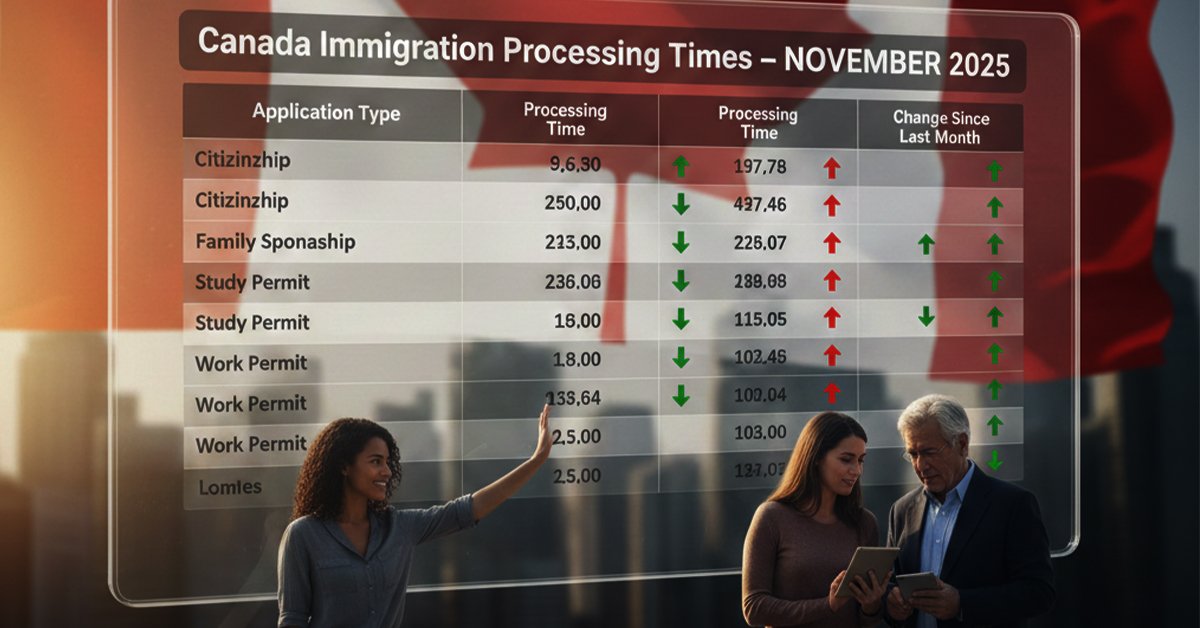

Canada’s immigration system is the cornerstone of its national growth, and the latest processing time update from Immigration, Refugees and Citizenship Canada (IRCC), released on November 19, 2025, provides crucial insights into the current state of application queues. These processing times are not just numbers; they are the clock governing reunification, career launches, academic pursuits, and the final steps to Canadian citizenship.
This comprehensive, 1,500-word guide breaks down the November 2025 data across all major categories, contrasts these figures with previous months and historical trends, and delivers strategic advice for applicants navigating the system. The new figures reflect the time it takes for 80% of applications to be finalized, offering the most realistic snapshot of IRCC’s operational capacity.
1. Permanent Residence: The Economic Class Engine
The Economic Class remains the largest intake category, designed to fill labor market gaps. Processing times here directly indicate the efficiency of Canada’s talent acquisition pipeline. November 2025 presents a mixed picture: high-skilled, Express Entry programs remain fast, while non-Express Entry and niche business categories are suffering from extreme backlogs.
1.1 Express Entry Programs (The Competitive Fast Lane)
Express Entry manages applications for three federal high-skilled programs: Federal Skilled Worker Program (FSWP), Canadian Experience Class (CEC), and Federal Skilled Trades Program (FSTP).1
| Program | People Waiting | Processing Time (as of Nov 6, 2025) | Change Since October |
| Federal Skilled Worker Program (FSWP) | ~24,500 (⬆ +700) | 6 months | No change |
| PNP (Express Entry) | ~10,700 (⬇ -800) | 6 months | ⬇ -1 month (Improvement) |
| Canadian Experience Class (CEC) | ~19,800 (⬆ +1,900) | 7 months | ⬆ +1 month (Slight Increase) |
Analysis: FSWP and Express Entry-aligned PNP remain rock-solid at 6 months, a timeframe reflecting IRCC’s commitment to rapidly onboarding high-scoring candidates. This consistency makes Express Entry the most predictable pathway. However, the one-month rise in the CEC queue is directly correlated with an increase of nearly 2,000 applicants waiting, suggesting minor pressure on the system’s capacity to transition temporary residents to permanent status. Applicants should aim to submit complete, error-free applications to stay within the 6-7 month target.
1.2 Non-Express Entry and Business Immigration: Backlog Crisis
The contrast between Express Entry and other economic streams is stark. These longer timelines are indicative of programs with lower annual quotas, complex documentation requirements, and historical backlogs.
| Program | People Waiting | Processing Time (as of Nov 6, 2025) | Change Since October |
| Non-Express Entry PNP | ~96,000 (⬆ +1,300) | 16 months | No change |
| Quebec Skilled Worker (QSW) | ~26,400 (⬆ +1,600) | 11 months | No change |
| Atlantic Immigration Program (AIP) | ~13,300 (⬆ +200) | 37 months | No change |
| Quebec Business Class | ~4,100 | 84 months (7 years) | No change |
| Start-Up Visa | ~43,800 (⬆ +600) | More than 10 years | No change |
| Federal Self-Employed | ~8,500 (⬇ -100) | More than 10 years | No change |
Strategic Warning: The Start-Up Visa and Federal Self-Employed programs are effectively inaccessible for anyone requiring PR in the short or medium term, with wait times exceeding the decade mark. The Atlantic Immigration Program (AIP), despite its regional focus, is struggling, sitting at 37 months. This massive delay is likely due to the complexity of provincial endorsement combined with security and medical checks. Applicants considering these streams must pivot to more expedited programs, such as Express Entry or specific Provincial Nominee streams that align with federal targets.
2. Family Sponsorships: Reaching a Critical Juncture
Family reunification applications are highly prioritized but still face significant operational hurdles, especially for complex cases or those in Quebec.2
2.1 Spousal and Common-Law Sponsorship
| Sponsorship Category | People Waiting | Processing Time (as of Nov 6, 2025) | Change Since October |
| Spouse/Common-Law (Outside Canada, non-Quebec) | ~45,200 (⬇ -700) | 14 months | ⬇ -1 month |
| Spouse/Common-Law (Inside Canada, non-Quebec) | ~49,900 (⬆ +400) | 20 months | ⬇ -2 months |
| Spouse/Common-Law (Quebec) | ~32,300 total (⬇ -200 out, ⬆ +100 in) | 37 months | ⬇ -2 months |
The Quebec Hurdle: The most concerning trend here is the 37-month wait time for spousal applications destined for Quebec. This 2-3 year disparity compared to the rest of Canada is due to the mandatory, additional provincial approval process (Certificat de sélection du Québec or CSQ). This emphasizes that provincial coordination introduces significant, often unpredictable, delays. Applicants should anticipate this lengthy wait and use the time for language acquisition or professional planning.
2.2 Parents and Grandparents Sponsorship (PGP): The Backlog Bomb
The PGP saw the most alarming increase in this November update, signaling a major disconnect between application intake and processing capacity.
- → 7 Essential Business Strategies Transforming Success in 2024
- → AI and Machine Learning in 2026: Transforming Business Through Intelligent Innovation
- → Canada Immigration Backlog Update 2026: What the Latest IRCC Data Really Means
- → Mass Flight Disruptions Across Asia: 2,186 Delays and 134 Cancellations Hit Major Airports in India, Japan, Thailand, Malaysia, UAE, Singapore, and Qatar
- → $800 CRA Payment in March 2026: Which Canadian Families Qualify and When to Expect Their Direct Deposit
- → $533 GST/HST Credit for March 2026: Payment Dates, Eligibility, and Everything Canadians Need to Know
- → Canada Medical Expense Tax Claims 2026: Everything You Need to Know Before Filing
| Sponsorship Category | People Waiting | Processing Time (as of Nov 6, 2025) | Change Since October |
| Parents/Grandparents (non-Quebec) | ~47,100 (⬆ +5,600) | 42 months (3.5 years) | ⬆ +16 months (Massive Increase) |
| Parents/Grandparents (Quebec) | ~12,900 (⬆ +1,100) | 50 months (over 4 years) | ⬆ +6 months (Major Increase) |
Critical Insight: The non-Quebec stream’s jump of 16 months in a single month is unprecedented. This is likely the result of a larger pool draw earlier in the year combined with operational capacity limits, pushing the wait time far beyond the typical 2-3 year cycle. For families hoping to reunite, the Super Visa (discussed below) remains the only viable short-term option, as the PGP is now effectively a 4-year plan.
3. Citizenship and Residency Document Processing
These categories concern individuals already living in Canada, confirming their status or securing travel documents.
| Application Type | Number of People Waiting | Processing Time as of Nov 6, 2025 | Change Since October |
| Citizenship Grant | ~290,700 (⬆ +7,000) | 13 months | No change |
| Citizenship Certificate | ~39,000 (⬆ +3,600) | 9 months | ⬆ +1 month |
| PR Card Renewal | N/A | 30 days | No change |
| New PR Card | N/A | 58 days | ⬇ -5 days |
Observation: The Citizenship Grant timeline is holding steady at 13 months, despite nearly 300,000 people in the queue. This is a positive sign, indicating high-volume processing is being maintained. The efficiency in PR Card Renewal (30 days) is outstanding and critical for allowing permanent residents to travel seamlessly. The minor increase in the Citizenship Certificate backlog is often due to the time required for comprehensive record checks.
4. Temporary Resident Visas (TRVs) and Permits
Temporary visas—for students, workers, and visitors—are the lifeblood of Canada’s short-term economy. Their processing times are volatile, tied closely to geopolitical events, localized backlogs, and regional application volumes.
4.1 Visitor Visa (TRV) Processing: Regional Disparity
Visitor visa processing is highly country-dependent. IRCC must contend with varying security risks and administrative loads across its global network of visa offices.
| Country | Processing Time (Nov 19, 2025) | Change Since October 29 |
| India | 106 days | ⬆ +20 days (Significant Increase) |
| Pakistan | 85 days | ⬆ +29 days (Significant Increase) |
| United States | 35 days | ⬇ -3 days |
| Philippines | 21 days | ⬇ -3 days |
The South Asia Challenge: The major increases in processing times for India and Pakistan are concerning. These two key source countries are seeing wait times of 3 to 3.5 months, suggesting a substantial rise in applications and a strain on visa officer capacity in the region. This highlights the need for applicants from these regions to submit applications well in advance of planned travel.
4.2 Super Visa Processing
The Super Visa, a multi-entry temporary visa for parents and grandparents, offers a more predictable route than the PGP.
| Country | Processing Time (Nov 19, 2025) | Change Since October 29 |
| India | 171 days (approx. 5.7 months) | ⬆ +3 days |
| Pakistan | 202 days (approx. 6.7 months) | ⬇ -1 day |
Super Visa Strategy: While the processing time is long (5-7 months), the Super Visa remains a predictable alternative to the 4-year PGP wait, allowing elderly family members to stay in Canada for up to five years per entry.
4.3 Study and Work Permits
Stability in these categories is paramount for supporting the Canadian economy and education sector.
| Permit Type | Location | Processing Time (Nov 19, 2025) | Change Since October 29 |
| Study Permit | India, US, Philippines | 4 weeks | ⬇ -1 week |
| Study Permit | Inside Canada | 12 weeks | ⬆ +1 week |
| Work Permit | Outside Canada (Most Countries) | 6-10 weeks | Mixed |
| Work Permit | Inside Canada (Initial & Extension) | 229 days (7.6 months) | ⬆ +3 days |
Work Permit Backlog: The most persistent and troubling temporary resident backlog is the 229-day (7.6 months) wait for work permit applications submitted from inside Canada. This forces current temporary workers—a critical labor source—to wait nearly eight months for extensions or changes to their permits, leading to job insecurity and potential lapses in work authorization.
5. Humanitarian, Compassionate, and Refugee Processing
These pathways involve high case complexity, extensive document review, and often mandatory security checks, leading to the longest processing periods in the entire system.
| Category | People Waiting | Processing Time (as of Nov 6, 2025) |
| H&C Outside Quebec | ~49,300 (⬇ -100) | More than 10 years |
| Protected Persons (Outside Quebec) | ~141,300 (⬆ +4,200) | About 100 months (8.3 years) |
| Protected Persons (In Quebec) | ~54,900 (⬆ +1,200) | About 106 months (8.8 years) |
The Humanitarian Reality: The Humanitarian and Compassionate (H&C) stream is almost stalled, with processing times exceeding a decade. Similarly, protected persons can expect to wait nearly nine years. These figures represent the most challenging area of IRCC’s operations, driven by a combination of high intake volume and the extreme complexity of individual cases requiring judicial review and extensive background checks.
6. Strategic Advice for Applicants in Late 2025
The November 2025 update demands that applicants adopt a strategic, rather than hopeful, approach. The core factors influencing your wait time are: Application Completeness, Country of Residence, and Program Selection.
I. Prioritize Application Quality
The difference between the IRCC posted time (e.g., 6 months for FSWP) and the real time you experience often boils down to a single Request for Information (RFI). An RFI for a missing document, an outdated police certificate, or an unclear work reference can add months to the process. Always assume your application will be scrutinized and prepare all documentation meticulously.
II. Understand the Quebec/Provincial Impact
If your immigration stream requires provincial certification (like Quebec Skilled Worker, AIP, or any Quebec-destined family sponsorship), add at least 1-2 years to the federal processing time. The delay is not a federal issue, but a critical provincial coordination hurdle you must account for.
III. Pivot Away from Backlogged Programs
Given the multi-year delays for Start-Up Visa and the massive surge in PGP waiting times, applicants whose primary pathway is severely backlogged should explore alternatives immediately:
- For Business: Explore provincial entrepreneur streams that may offer faster processing, or high-level work permits like the Global Talent Stream.
- For Family: Utilize the Super Visa for long-term visits instead of waiting for the PGP lottery and subsequent 4-year processing time.
IV. Monitor the Global Context
The sharp rise in visitor visa times for South Asia (India/Pakistan) shows that global events and regional volumes are highly influential. Applicants from high-volume countries should submit applications early and be prepared for potential, localized security check delays.
Final Summary
The IRCC update from November 2025 paints a picture of targeted efficiency (Express Entry, PR Card Renewals) coupled with critical backlogs in specialized (Business) and high-volume demand (PGP, H&C) streams. Canada continues to welcome applicants at record volumes, but this immense demand has made it more crucial than ever to monitor these timelines, prepare accurate documents, and choose the most efficient pathway available
