
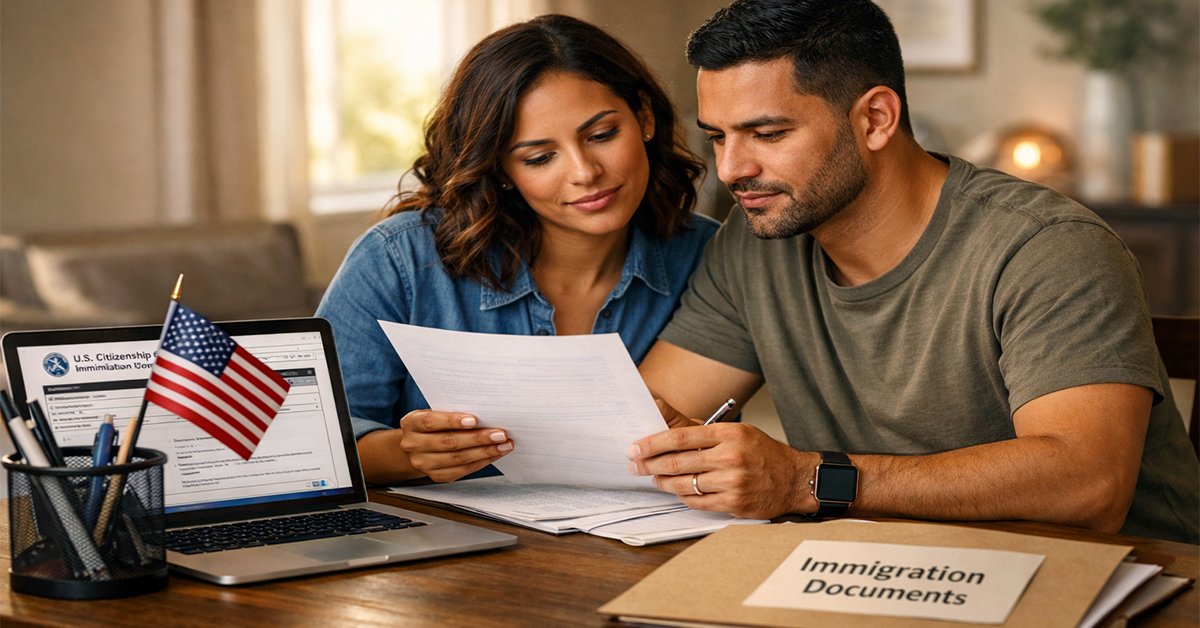

If you’re planning to apply for a marriage-based green card this year, there’s something critical you need to understand: immigration authorities have fundamentally changed how they’re evaluating these applications, and couples who don’t share the same address are walking into a completely different process than they would have faced even two years ago.
I’ve been following immigration policy throughout the second Trump administration, and what we’re seeing in early 2026 represents one of the most aggressive shifts in marriage-based immigration enforcement in recent memory. Here’s what’s happening behind the scenes at USCIS and what it means for your application.
The Blunt Truth About Cohabitation in 2026
Immigration attorney Brad Bernstein recently said something that made headlines across immigration law circles: “Being in a relationship does not get you a green card. Living together gets you a green card.”
That’s not legal advice—it’s a warning about the current climate at U.S. Citizenship and Immigration Services. While couples who maintain separate residences can technically still qualify for marriage green cards, they’re essentially entering a process where officers assume the relationship might be fraudulent until you prove otherwise with overwhelming evidence.
Kevin J. Stewart, another experienced immigration attorney, confirms what many practitioners are seeing: cohabitation has always mattered, but the level of scrutiny has reached unprecedented levels. USCIS now examines couples who live apart with what insiders describe as “maximum attention”—meaning your application will likely trigger additional investigation, possible home visits, and intensive questioning during interviews.
What Changed Between 2025 and Now
This escalation didn’t happen overnight. Throughout 2025, USCIS quietly implemented a series of procedural changes that have collectively transformed marriage-based immigration:
New form requirements took effect in early 2025. Starting April 3, 2025, USCIS began accepting only the January 20, 2025 edition of Form I-485 (Adjustment of Status). By May 1, 2025, the same applied to Form I-129F (Fiancé Visa). Immigration officers have been rejecting applications that use older editions, even if they were only weeks out of date.
Medical examination rules changed dramatically. As of January 20, 2025, COVID-19 vaccination is no longer required for the I-693 medical form. However, starting December 2024, the medical examination must now be submitted with Form I-485 rather than separately. Submitting it later can result in outright rejection of your application.
Processing times have gotten significantly longer. As of January 2026, Form I-130 processing now takes 9.5 to 13 months at most USCIS service centers. When you factor in adjustment of status or consular processing, couples are looking at total timelines of 8 to 14 months or more—and that’s for straightforward cases without complications.
Updated policy language signals renewed enforcement priorities. In late 2024, USCIS quietly updated its marriage green card guidance pages to emphasize fraud detection. The language echoes the heightened enforcement approach from the first Trump administration, and attorneys report that this isn’t just symbolic—they’re seeing it reflected in how officers handle cases.
Read More : Trump’s H-1B Visa Overhaul: How New Wage-Based Selection Affects Foreign Workers and US Companies in 2026
The Numbers Behind the Crackdown
USCIS isn’t being subtle about its fraud-detection priorities. The agency recently reported some striking statistics:
They made over 29,000 fraud referrals and investigated more than 19,300 marriage-based cases. What really stands out is that they identified potential fraud in approximately 65 percent of those investigations. Whether that percentage reflects actual fraud or overzealous enforcement is a matter of significant debate within the immigration law community, but it’s clear the agency believes there’s a widespread problem.
To support this enforcement push, USCIS has dramatically expanded site visits to couples’ homes and increased social media monitoring. They’re not just reviewing paperwork anymore—they’re actively investigating whether couples actually live the way married people typically do. Officers might show up unannounced at the address you listed on your application. They’ll check social media profiles to see if they tell a different story than your paperwork. They’ll analyze your photos for inconsistencies in backgrounds or timing.
What Living Apart Really Means for Your Application
Let me be absolutely clear: maintaining separate residences doesn’t automatically disqualify you from getting a marriage green card. Plenty of legitimate married couples live separately for perfectly valid reasons—job assignments in different cities, caring for elderly parents, educational programs, military deployments, or financial constraints during the early years of marriage.
The problem is that USCIS doesn’t particularly care about your reasons, regardless of how legitimate they are. Their operating assumption in 2026 is that married couples live together, period. If you don’t, you need to prove your marriage is genuine through other means, and the bar for that proof has gotten considerably higher.
Here’s what you absolutely must do if you’re not living together:
First, provide a detailed written statement from both spouses. This needs to explain specifically why you live apart, when you plan to consolidate households, where you intend to live permanently, and how often you currently see each other. Immigration officers have heard every excuse imaginable, so vague explanations like “work commitments” or “family obligations” won’t cut it. You need specific, verifiable details.
Second, compensate for the lack of shared residence with overwhelming evidence in every other category. Think of your application as needing to score points across multiple categories. If you’re scoring zero for cohabitation, you need to score extremely high everywhere else.
The Documentation That Actually Carries Weight in 2026
When USCIS can’t verify daily cohabitation, officers dig deeper into every other aspect of your marriage. Based on current adjudication patterns and recent attorney experiences, here’s what matters most in 2026:
Financial entanglement is absolutely critical. Joint bank accounts with regular activity from both spouses, credit cards listing both partners with actual usage patterns, shared auto insurance or health insurance policies, life insurance naming each other as beneficiaries, and joint investments or retirement accounts all demonstrate merged financial lives.
One-time transfers or accounts opened just before filing won’t satisfy scrutiny. Officers want to see months or years of consistent financial partnership. They’re looking for patterns that would be difficult to fake—recurring deposits, shared bill payments, grocery purchases, everyday spending.
Property documentation weighs heavily. Joint leases or mortgages showing both names represent some of the strongest evidence you can provide. If you genuinely can’t show this because you maintain separate residences, that’s precisely why your application faces increased scrutiny. Utility bills, rental agreements, or property deeds showing both spouses at the same address would be the next best option, but again, if you’re living apart, you won’t have these.
Tax filings carry enormous weight. Filing jointly for multiple years demonstrates to the government that you’ve presented yourselves as a married couple in official contexts where lying has serious legal consequences. USCIS views tax fraud as unlikely, so joint tax returns are considered highly reliable evidence.
Children together represent some of the strongest possible evidence. If you’re raising children together—whether from your current marriage or previous relationships—that significantly strengthens your case. Birth certificates listing both spouses, school records, medical records, and childcare arrangements all help.
Communication records help but can’t stand alone. Phone logs showing regular contact, text message exchanges, email threads, and video call records support your story but won’t compensate for missing financial documentation. These are relatively easy to fabricate or arrange temporarily.
Photos and affidavits rank at the bottom. While you should definitely include them, USCIS considers these the weakest form of evidence because they’re the easiest to stage or fabricate. Immigration attorneys consistently warn couples not to rely heavily on these.
What to Expect During the Interview
If you’re applying for a marriage green card in 2026, plan on having an interview. The previous administration waived many marriage interviews during COVID-19, but that practice has essentially ended under the current enforcement climate.
These interviews have gotten considerably more intensive and personal. Officers have wide latitude in their questioning, and they frequently ask remarkably intimate questions. You might be asked about:
- Intimate details of your relationship and physical relationship
- Specific physical characteristics like birthmarks, scars, or tattoos
- Sleeping arrangements and bedroom setup
- Daily routines—who wakes up first, what you eat for breakfast, who does which chores
- Arguments you’ve had recently and how you resolved them
- Your spouse’s family members, including names and relationships
- Financial details like who pays which bills and how much money you each earn
- Future plans including children, where you’ll live long-term, career goals
The questions aren’t designed to embarrass you—they’re designed to see if your answers match your spouse’s responses and whether you answer with the natural ease of someone actually living these experiences.
Here’s something critical that many couples don’t realize: officers are specifically trained to spot rehearsed answers. If you and your spouse tell identical stories using nearly identical phrasing, that actually raises red flags rather than alleviating concerns. Genuine couples remember details differently, tell stories from different perspectives, and occasionally contradict each other on minor details.
- → 7 Essential Business Strategies Transforming Success in 2024
- → AI and Machine Learning in 2026: Transforming Business Through Intelligent Innovation
- → Canada Immigration Backlog Update 2026: What the Latest IRCC Data Really Means
- → Mass Flight Disruptions Across Asia: 2,186 Delays and 134 Cancellations Hit Major Airports in India, Japan, Thailand, Malaysia, UAE, Singapore, and Qatar
- → $800 CRA Payment in March 2026: Which Canadian Families Qualify and When to Expect Their Direct Deposit
- → $533 GST/HST Credit for March 2026: Payment Dates, Eligibility, and Everything Canadians Need to Know
- → Canada Medical Expense Tax Claims 2026: Everything You Need to Know Before Filing
Authenticity matters more than perfection. Minor inconsistencies in non-essential details are normal and expected. Major contradictions about fundamental aspects of your relationship are serious problems.
Read More : 100,000 Visas Canceled in One Year: What Trump’s Record-Breaking Crackdown Means for You
The Broader Enforcement Context in Early 2026
Understanding the marriage green card changes requires seeing them within the larger shift in immigration enforcement we’re experiencing in early 2026.
The Department of Homeland Security paused the Diversity Visa lottery program following a high-profile incident at Brown University in late 2025 involving an immigrant who entered through that pathway. Secretary Kristi Noem’s DHS hasn’t provided a timeline for when—or if—the program might resume. Some immigration policy experts, including former USCIS official Ricky Murray, believe the administration would prefer to permanently end various green card programs but is limited by existing federal law without congressional action.
Additionally, USCIS implemented temporary enhanced security reviews for applications from 19 specific countries following the Brown University attack. While the agency hasn’t publicly disclosed which countries are affected, applicants from these nations should expect significantly longer processing times and potentially additional documentation requests or security interviews.
Perhaps most concerning for many applicants: immigration attorneys report that immigrants are increasingly being detained during what should be routine green card interviews or check-ins at USCIS offices. Even applicants whose previous immigration violations were supposedly forgiven under provisions for immediate relatives of U.S. citizens are finding themselves in detention. This represents a significant and alarming departure from past practice, and it’s happening with increasing frequency in early 2026.
One attorney told me off the record that their clients are now being advised to bring contact information for immigration bail bondsmen to their USCIS interviews, something that would have been unthinkable just three years ago.
Current Costs and Timeline Realities
The total cost for a marriage-based green card application now runs approximately $3,005 for couples living in the United States. This breaks down to Form I-130 ($675), Form I-485 ($1,440), biometrics ($85), and medical examination fees ($200-$500).
That doesn’t include potential attorney fees, which many couples are now considering essential given the heightened scrutiny. Immigration attorneys typically charge between $2,500 and $5,000 for marriage green card cases, with more complex situations costing more.
As for timelines, here’s what you’re realistically looking at in early 2026:
- Form I-130 processing: 9.5 to 13 months
- Overall process for adjustment of status cases: 8 to 14 months
- Additional delays for Request for Evidence (RFE): 2 to 4 months
- Processing times at specific field offices vary widely—some offices like Cleveland and Cincinnati run 2 to 4 months slower than national averages
If your case gets flagged for enhanced fraud review, all bets are off regarding timing. Some couples are reporting total timelines exceeding 18 to 24 months from initial filing to green card in hand.
What You Should Do Right Now
If you’re currently planning a marriage-based green card application in 2026, particularly if you don’t live with your spouse full-time, here’s my practical advice:
Start gathering documentation immediately. Don’t wait until you’re ready to file. Begin collecting evidence of your shared life today—open joint accounts if you haven’t already, add each other to insurance policies, create a paper trail of your relationship, and keep copies of everything.
Seriously consider your living situation. If it’s at all possible to establish a shared residence before applying, that will dramatically simplify your case. I fully understand this isn’t always feasible due to work, family obligations, or financial constraints, but it’s worth serious consideration given the current enforcement climate.
Consult with an immigration attorney before filing. This has always been good advice, but it’s especially critical in 2026. An experienced attorney can review your specific situation and identify weaknesses before USCIS does. Many immigration law firms offer free initial consultations, and some provide flat-fee services rather than hourly billing.
Prepare for significantly longer timelines. With mandatory interviews, enhanced fraud detection measures, and field office backlogs, processing times are extending substantially. Don’t make life plans that depend on getting your green card within a specific timeframe.
Never attempt to fabricate evidence. Immigration officers have literally seen every trick imaginable. Attempts to create false evidence or stage a relationship invariably backfire, often with permanent consequences including inadmissibility to the United States and potential criminal prosecution.
Make sure you’re using the current form editions. As of January 2026, you must use the January 20, 2025 editions of Forms I-485 and I-129F. Using older editions will result in automatic rejection of your application. USCIS has been enforcing this strictly with no exceptions.
Submit your medical examination with your initial application. Don’t send Form I-693 separately or plan to bring it to your interview. New rules require it to be included with Form I-485, and failure to include it can result in rejection.
The Reality Check
Marriage-based green cards remain one of the most common and reliable pathways to permanent residence in the United States. Despite the heightened scrutiny, approval rates remain relatively strong—recent data shows approval rates between 84% and 90% for Form I-130 petitions.
But the process has become significantly more adversarial, particularly for couples who don’t fit traditional patterns of daily cohabitation. USCIS isn’t necessarily trying to prevent legitimate couples from staying together, but their intensified focus on fraud detection means that innocent applicants often get caught up in processes designed to catch fraudsters.
If your marriage is genuine—and I mean genuinely genuine, not just legally valid—you can still succeed. You’ll just need to work considerably harder to prove it, document it far more extensively, and potentially navigate more intensive questioning than applicants faced in previous years.
The current enforcement climate reflects the administration’s broader immigration priorities, which emphasize security concerns and fraud prevention over family reunification. Whether you agree with these priorities politically is irrelevant to your application—you need to work within the system as it exists in 2026, not as you wish it would be.
Remember: immigration officers can’t read minds, and they can’t observe your daily life. They can only evaluate what you put in front of them. In 2026, that means showing them not just that you’re married on paper, but that you’re building a life together in all the tangible, verifiable ways that matter to federal immigration law.
The couples who succeed are those who understand that USCIS isn’t taking their word for anything. Every claim needs documentation. Every document needs to tell a consistent story. And that story needs to reflect the reality of a genuine marital relationship, not just the legal formality of a marriage certificate.
If you’re in this situation, take it seriously, prepare thoroughly, and don’t underestimate how much the landscape has changed. The marriage green card you could have gotten with minimal documentation in 2022 requires significantly more proof in 2026—and couples who don’t recognize that reality are setting themselves up for delays, denials, and considerable frustration.
