
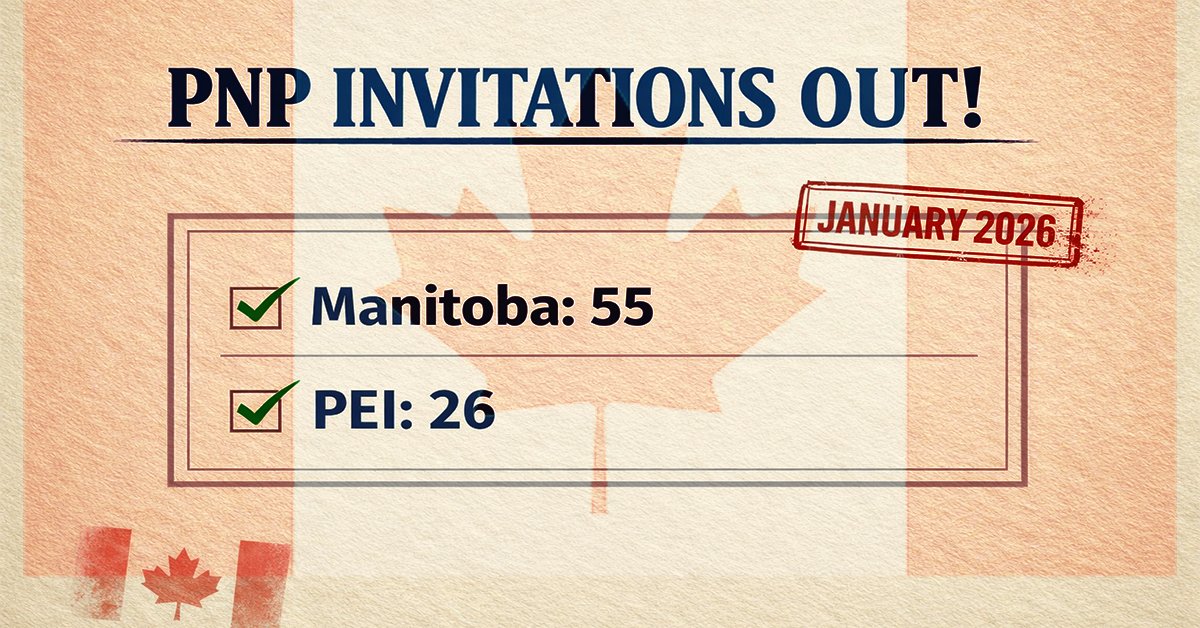

The 2026 PNP season is officially underway. On January 15, both Manitoba and Prince Edward Island released their first invitation rounds of the year—and if you’re sitting in either EOI pool wondering why you didn’t get selected, this breakdown will tell you exactly why.
Here’s what happened: Manitoba issued 55 Letters of Advice to Apply (LAAs) under extremely targeted criteria, and PEI sent out 26 invitations with a laser focus on international graduates from specific institutions.
If you weren’t directly invited through one of Manitoba’s strategic recruitment channels, or if you didn’t graduate from UPEI, Holland College, or Collège de l’Île, your chances of getting picked in these rounds were basically zero.
Let me walk you through who actually got invited, what went wrong for everyone else, and what you need to do before the next draw.
Manitoba’s First Draw: Only 55 Invitations, and They Were All Pre-Selected
Manitoba’s January 15 draw wasn’t a general pool competition. It was a highly targeted selection that only considered candidates who had already been directly invited by the province through specific recruitment initiatives.
Here’s the breakdown of who got the 55 LAAs:
- 21 invitations → Employer Services initiative
- 15 invitations → Regional Communities initiative
- 9 invitations → Ethnocultural Communities initiative
- 7 invitations → Francophone Community initiative
- 3 invitations → Temporary Public Policy (work permit facilitation)
Notice what’s missing from that list? A general “Skilled Worker” category where anyone with a high EOI score could compete.
This was invitation-only, and if you weren’t part of one of those recruitment streams, you weren’t even in the running.
What About Express Entry Candidates?
Of those 55 LAAs, only 10 went to candidates with active Express Entry profiles.
That’s important because a lot of people assume having an Express Entry profile gives you an edge in provincial draws. In Manitoba’s case, it helps with processing speed after you get nominated—but it didn’t determine who got invited in the first place.
Manitoba controlled the selection based on their strategic recruitment channels first. Express Entry was just a bonus for faster federal processing later.
Why You Didn’t Get an LAA (Even If You Thought You Qualified)
Manitoba made it very clear in their announcement: a lot of candidates are getting skipped because of profile hygiene issues—basically, errors or missing information that disqualify you before the system even looks at your score.
Here are the two most common problems:
1. Invalid or Missing Language Test Information
You indicated you took an approved language test (IELTS, CELPIP, TEF, or TCF), but:
- You didn’t enter a valid test reference number in your EOI, OR
- Your test results have expired
Manitoba’s system won’t consider you if it can’t verify your language scores. Even if you have a valid test, if the number isn’t in your profile correctly, you’re out.
2. Invalid or Missing Invitation Number
You claimed you were invited under a strategic recruitment initiative, but you didn’t provide the correct invitation number Manitoba gave you.
If you can’t prove you were actually invited, Manitoba won’t include you in the draw—even if everything else in your profile looks good.
The fix: Go back into your EOI right now and make sure your language test number and invitation number (if applicable) are entered correctly. Don’t wait until the next draw to figure this out.
The Regulated Occupation Warning You Need to Take Seriously
Manitoba issued a direct warning to anyone who claimed they’re working in a regulated occupation and are fully licensed in Manitoba.
Here’s the situation: some candidates in this draw claimed they were licensed and working in regulated professions (like healthcare, engineering, or trades). Manitoba selected them based on that claim.
But here’s the catch: if you’re not actually licensed, or you’re not actively working in that regulated role, Manitoba may refuse your full application—even after issuing you an LAA.
Manitoba’s advice? If you claimed a regulated occupation but you’re not actually licensed or working in it, you should seriously consider declining the LAA instead of submitting an application that’s going to get rejected anyway.
Why does this matter? Because getting refused can hurt your credibility for future applications. Better to fix your profile and wait for a legitimate opportunity than to push forward with a claim you can’t support.
PEI’s First Draw: 26 Invitations, Zero Business Invitations
PEI’s January 15 draw was small and highly focused. Here’s what they issued:
- → 7 Essential Business Strategies Transforming Success in 2024
- → AI and Machine Learning in 2026: Transforming Business Through Intelligent Innovation
- → Canada Immigration Backlog Update 2026: What the Latest IRCC Data Really Means
- → Mass Flight Disruptions Across Asia: 2,186 Delays and 134 Cancellations Hit Major Airports in India, Japan, Thailand, Malaysia, UAE, Singapore, and Qatar
- → $800 CRA Payment in March 2026: Which Canadian Families Qualify and When to Expect Their Direct Deposit
- → $533 GST/HST Credit for March 2026: Payment Dates, Eligibility, and Everything Canadians Need to Know
- → Canada Medical Expense Tax Claims 2026: Everything You Need to Know Before Filing
- 26 invitations → Labour & Express Entry categories
- 0 invitations → Business Work Permit (Entrepreneur) category
PEI made it clear that they prioritized international graduates from three specific institutions:
- University of Prince Edward Island (UPEI)
- Holland College
- Collège de l’Île
If you didn’t graduate from one of those schools, your odds of getting invited in this round were slim—unless you had a job offer in a high-priority sector that PEI is actively targeting.
What PEI Is Actually Looking For
PEI doesn’t just throw invitations at the highest-scoring profiles. They rank candidates based on factors that signal you’ll actually contribute to the province’s economy:
- Language ability (English or French)
- Education level, field, and where you studied (PEI institutions get priority)
- Skill level and work experience
- Strategic priorities tied to immediate labour market needs
- Employment prospects (job offer in PEI, previous Canadian work experience)
PEI also flat-out said that some sales and service workers may not receive invitations at this time—which tells you that not all NOC codes are being treated equally, even if they’re technically eligible.
PEI’s Full 2026 Invitation Schedule (Mark Your Calendar)
PEI published their expected invitation dates for the entire year. These aren’t guarantees, but they give you a roadmap for when to expect activity.
Here’s the full schedule:
- January 15, 2026 ✅
- February 19, 2026
- March 19, 2026
- April 16, 2026
- May 21, 2026
- June 18, 2026
- July 16, 2026
- August 20, 2026
- September 17, 2026
- October 15, 2026
- November 19, 2026
- December 17, 2026
Important note: Your EOI profile stays valid for 6 months after submission. If you don’t get invited in one draw, you’ll automatically be reconsidered in future draws—as long as your profile is still active and you still meet the requirements.
What Manitoba and PEI Are Really Telling You With These Draws
Both provinces are sending the same message with their first 2026 invitations: targeted recruitment is the priority, not open competition.
Manitoba didn’t run a general draw where high EOI scores automatically win. They picked candidates who were already on their radar through specific recruitment channels.
PEI didn’t just select the top-ranked profiles. They gave preference to graduates from local institutions and people working in sectors the province needs right now.
If you’re waiting for a “general draw” where your score alone gets you invited, you might be waiting a long time. The game has shifted to strategic alignment—showing that you fit what the province is actively looking for, not just meeting minimum eligibility.
What You Need to Do Right Now to Improve Your Chances
If you’re in either EOI pool and you didn’t get invited, here’s your action plan:
1. Fix Your Profile Hygiene Issues Immediately
Go through your EOI line by line and check:
- Is your language test reference number entered correctly?
- Are your test results still valid (not expired)?
- If you have an invitation number from a recruitment initiative, is it in your profile?
- Are all your dates (employment, education, travel) consistent and accurate?
These aren’t minor details. They’re the difference between being considered and being automatically filtered out.
2. Stop Claiming Things You Can’t Prove
If you listed yourself as working in a regulated occupation but you’re not actually licensed, remove that claim. Same goes for job duties, work hours, or connections to the province that you can’t back up with documentation.
Manitoba and PEI both emphasized that applications get refused when claims don’t match reality. Don’t shoot yourself in the foot by overstating your qualifications.
3. Understand What “Strategic Recruitment” Actually Means
For Manitoba, strategic recruitment includes:
- Direct invitations from employers working with Manitoba’s Employer Services
- Community-driven invitations (Francophone, ethnocultural, regional)
- Pathways tied to specific policies (like the temporary work permit facilitation)
If you’re not part of one of these streams, your path into Manitoba PNP is going to be harder. Consider whether you can build a connection through one of these channels—like attending a Manitoba recruitment event, connecting with a Francophone community organization, or exploring employer-driven opportunities.
4. For PEI: Focus on What Actually Moves the Needle
PEI is prioritizing:
- Graduates from PEI institutions
- Workers in high-demand sectors
- Candidates with job offers in PEI
If you don’t have a PEI education, your next best move is securing a job offer in a priority sector. PEI publishes guidance on what sectors they’re targeting—use that to guide your job search.
5. Keep Your Express Entry Profile Active (If You Have One)
If you’re in the Express Entry pool, make sure your profile is up to date and linked to your provincial EOI. Even though Express Entry didn’t determine who got invited in these draws, having an active profile can speed up processing once you do get a provincial nomination.
Common Mistakes That Are Killing PNP Applications
Since both provinces flagged documentation issues, let’s talk about the most common reasons PNP applications get refused:
1. Work Experience Letters That Don’t Match Your Claims
Your reference letter needs to spell out your exact duties, hours worked per week, job title, and dates of employment. If any of that contradicts what you claimed in your EOI, you’re getting refused.
2. Unverifiable Employment or Funds
If the province can’t verify your work history or your settlement funds, your application stops dead. Use official documents—pay stubs, tax records, employment contracts, bank statements with clear source documentation.
3. Inconsistent Personal History
If your dates don’t line up across different parts of your application (work history, travel history, addresses), it raises red flags. Provinces will ask for explanations, and if you can’t provide them, they’ll refuse the application.
4. Language Scores That Drop Below Requirements
Your language test results need to be valid at the time of assessment, not just when you submitted your EOI. If your scores expire or you can’t provide updated results when asked, you’re done.
5. Claiming Ties to the Province You Can’t Prove
If you say you have family in Manitoba or connections to PEI, you need solid documentation—birth certificates, proof of relationship, evidence of their status in Canada. Don’t claim ties you can’t back up with paper.
The Bottom Line
Manitoba and PEI have set the tone for 2026: small, targeted draws focused on candidates who align with specific provincial priorities.
If you’re sitting in an EOI pool hoping your score alone will get you invited, you need to rethink your strategy. These provinces are selecting people who:
- Were directly invited through recruitment initiatives
- Graduated from local institutions
- Have job offers in priority sectors
- Can prove every single claim in their profile
The candidates who got invited on January 15 didn’t just have decent scores. They had strategic alignment with what the provinces are actively looking for right now.
Fix your profile, verify your documents, and start thinking about how you can position yourself as someone the province wants—not just someone who technically qualifies.
Because based on these first draws, “technically qualified” isn’t going to cut it in 2026.
Frequently Asked Questions
Can I apply to Manitoba PNP without a job offer?
Yes, in some cases. Manitoba can nominate you based on strong provincial connections—like close relatives in Manitoba, prior study or work in the province, or invitations through Manitoba-led recruitment. But you need to prove you can economically establish yourself there.
How long does Manitoba PNP processing take after I submit my application?
It varies, but delays usually happen when your documents don’t match what you claimed in your profile. The fastest applications are the ones that are fully consistent, complete, and easy to verify. Expect longer processing if Manitoba needs to request additional documents or clarification.
What are the most common reasons Manitoba PNP applications get refused?
The big ones are:
- Work experience letters that don’t match your claimed duties or hours
- Unverifiable employment or settlement funds
- Inconsistent personal history (dates, addresses, jobs)
- Language results that don’t meet requirements at assessment time
- Claiming Manitoba ties you can’t prove with documentation
Do I need a job offer to get invited by PEI PNP?
Having a PEI job offer is one of the strongest factors for selection, especially if you didn’t graduate from a PEI institution. While it’s not always mandatory, it dramatically improves your chances.
If I get a PEI nomination, can I move to another province instead?
No. A PEI nomination is issued based on your stated intention to live and work in PEI. If you move to another province immediately after landing, it can create serious complications—including questions about whether you committed misrepresentation. If your plans change, you need to demonstrate you still genuinely intend to settle in PEI.
How long is my EOI profile valid for PEI?
Your PEI EOI profile stays active for 6 months after submission. If you don’t get invited in one draw, you’ll automatically be considered in future draws—as long as your profile is still valid and you meet the requirements.
Does having an Express Entry profile help with provincial draws?
It can help with processing speed after you get a provincial nomination, but it doesn’t automatically improve your chances of getting selected by the province. Manitoba and PEI both prioritize other factors (recruitment channels, local education, job offers) over Express Entry status.
