
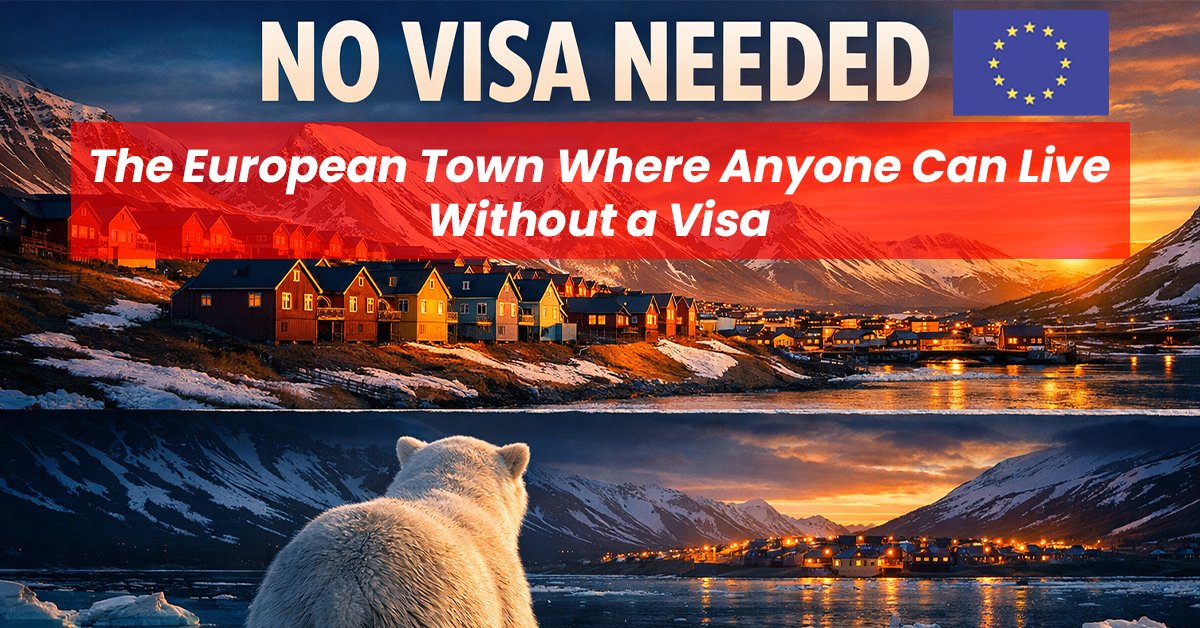

I’m going to tell you about the strangest loophole in European immigration law—one that involves polar bears, midnight sun, and a town where you legally need a gun permit just to take a walk outside city limits.
Let me back up.
Last summer, I found myself aboard the Greg Mortimer, an expedition ship navigating through Arctic sea ice at 83 degrees north. I was supposed to be focused on the polar bear I’d spotted through my telephoto lens—a magnificent creature lounging on an ice floe like he owned the place (which, honestly, he kind of does).
But my mind kept wandering back to something I’d learned days earlier in Longyearbyen, the largest settlement in Svalbard. A place where the rules of European immigration simply… don’t apply.
The Place Where Visas Don’t Exist
Here’s the deal: Svalbard is technically part of Norway, but it operates under a unique international treaty from 1920 that gives it semi-autonomous status. And buried in that treaty is a provision that essentially makes it one of the only places in Europe—maybe the world—where anyone from any country can move and stay indefinitely without a visa.
No application process. No points-based system. No waiting in line at an embassy.
Sounds too good to be true, right?
Well, it kind of is. But also kind of isn’t.
Let me explain what living in this Arctic outpost actually entails, because after spending time there and talking with locals, I realized this “loophole” comes with some pretty serious asterisks.
Where Exactly Is Svalbard?
Before we go further, let’s get our bearings.
Svalbard is an archipelago—a group of islands—sitting roughly halfway between mainland Norway and the North Pole. We’re talking about 400 miles north of the Norwegian coast, deep in the Arctic Ocean. It’s as far north as northern Alaska or the northernmost parts of Canada.
The main island is Spitsbergen, and on its western coast sits Longyearbyen, home to about 2,500 year-round residents. That makes it the world’s northernmost permanent settlement of its size.
To put this in perspective: Longyearbyen is further north than any point in Alaska, Iceland, or mainland Russia. It’s a place where the sun doesn’t rise at all for four months in winter, and doesn’t set for four months in summer.
The landscape? Imagine mountains that look like they’ve been carved by gods, fjords cutting deep into the coastline, glaciers everywhere, and a stark, otherworldly beauty that makes you feel like you’ve stepped onto another planet.
It’s also freezing. Even in summer, temperatures hover just above or below freezing. In winter? We’re talking minus 20 Celsius (minus 4 Fahrenheit) on a good day.
The Reality Check: Why Everyone Doesn’t Just Move There
So if there are no visa requirements, why isn’t Svalbard flooded with people looking to establish European residency?
Because Mother Nature and basic economics have their own immigration policies.
The Housing Nightmare
Here’s catch number one: you can’t just show up and rent an apartment.
Longyearbyen is essentially a company town. Most of the housing is owned by the mining companies, research institutions, and government entities that operate there. These apartments exist primarily for employees.
There’s no real estate market as you’d understand it. You can’t buy land and build a house—the Norwegian government owns virtually all the land, and they’re not selling. Private property ownership is extremely limited.
So how do you get housing? Basically, you need a job with one of the companies or organizations that own accommodations. Land that job, and housing comes with it. No job? No housing. No housing? You can’t stay, visa-free status or not.
The Job Situation
Which brings us to employment.
Jobs in Svalbard fall into a few categories:
Norwegian government positions: These make up a decent chunk of employment—maintaining infrastructure, running services, administration. Problem? They’re almost exclusively for Norwegian citizens.
Mining and research: Historically, coal mining was Svalbard’s economic heart. While that’s winding down, there’s still some mining work, plus various scientific research stations. These jobs often require specialized skills.
Tourism and hospitality: Hotels, tour operators, restaurants. This is growing as Svalbard becomes more popular with adventurous travelers. These jobs are more accessible to foreigners.
University: The University Centre in Svalbard (UNIS) employs professors and staff, mostly on contracts.
Here’s what’s interesting: many of these non-government jobs don’t require Norwegian language skills. The community is incredibly international—I met people from Thailand, the Philippines, Ukraine, Germany, and a dozen other countries, all living and working there. English is widely spoken.
But—and this is important—these jobs are rare. Longyearbyen isn’t exactly hiring hundreds of people every month. Positions open up, but competition is fierce because, well, it’s one of the few visa-free options in Europe.
The Remote Work Fantasy
“What about working remotely?” you might be thinking. “I’ll just bring my laptop and work for my company back home!”
In theory, yes. The visa-free rule applies to remote workers too.
In practice? You’re back to the housing problem. No employer housing means you need to find accommodation on the private market, which barely exists. The few long-stay options that do exist—basically extended hotel stays—will cost you upward of $250 USD per night.
That’s $7,500 per month. For a room.
You’d also need to prove sufficient income to support yourself (Svalbard isn’t cheap—everything has to be shipped in), show proof of health insurance, and still somehow secure accommodation. Svalbard isn’t part of Norway’s social welfare system, so if things go wrong, you’re on your own.
The Governor Has Final Say
Here’s another wrinkle: while there’s technically no visa requirement, the Governor of Svalbard (the Sysselmannen) has the authority to determine who can stay.
If they decide you don’t have adequate means to support yourself, or adequate housing, or that you’re causing problems, they can tell you to leave. It’s not a visa denial, exactly, but it has the same effect.
This prevents people from showing up with a backpack and trying to squat indefinitely.
The Norway Transit Issue
To get to Svalbard, you must fly through Norway—usually Oslo or Tromsø. Which means you need the right to enter Norway in the first place.
For Americans and most Western passport holders, this isn’t a problem for visits up to 90 days within the Schengen Area. But if you’re from a country that needs a visa to enter Schengen, you’ll need that visa just to transit through to reach Svalbard.
Interestingly, Svalbard itself is not part of the Schengen Area—there are border controls when traveling between Norway and Svalbard. This creates a weird situation where time spent in Svalbard doesn’t count against your 90-day Schengen limit.
Some long-term travelers use Svalbard as a “reset” location when nearing their 90-day limit, though given the costs, there are much cheaper places to wait out those days.
What It’s Actually Like to Live There
During my days in Longyearbyen before boarding the expedition, I got a glimpse of daily life in what might be Earth’s most unusual community.
The Polar Bear Problem
First thing you notice: the town has this cheerful, well-maintained primary school with colorful playground equipment. All behind a 10-foot industrial fence.
That’s not to keep the kids in. It’s to keep the polar bears out.
- → AI and Machine Learning in 2026: Transforming Business Through Intelligent Innovation
- → Canada Immigration Backlog Update 2026: What the Latest IRCC Data Really Means
- → Mass Flight Disruptions Across Asia: 2,186 Delays and 134 Cancellations Hit Major Airports in India, Japan, Thailand, Malaysia, UAE, Singapore, and Qatar
- → $800 CRA Payment in March 2026: Which Canadian Families Qualify and When to Expect Their Direct Deposit
- → $533 GST/HST Credit for March 2026: Payment Dates, Eligibility, and Everything Canadians Need to Know
- → Canada Medical Expense Tax Claims 2026: Everything You Need to Know Before Filing
- → Canada Pension Plan (CPP) and Old Age Security (OAS): 2026 Payment Updates Every Canadian Retiree Should Know
Polar bears occasionally wander into town. They’re the apex predator here, and they don’t fear humans. In fact, they sometimes view humans as food.
If you want to leave the settlement boundaries—even just to hike a few miles out—you’re legally required to carry a firearm and know how to use it. There are mandatory courses on polar bear safety. You learn to shoot flares, make noise, and as a last resort, defend yourself with a rifle.
Think about that. You need weapons training just to go for a walk.
The Darkness and Light
From late October to mid-February, the sun doesn’t rise. At all. It’s called polar night—constant darkness, with maybe some twilight around midday.
Then from April to August, the opposite happens: midnight sun. The sun doesn’t set. It just circles the sky 24/7.
This messes with your body in ways you can’t fully appreciate until you experience it. Sleep schedules become suggestions. Vitamin D supplementation becomes essential. Mental health challenges are real—seasonal affective disorder hits hard during the dark months.
Many residents leave during the winter darkness. The population actually fluctuates seasonally because not everyone can handle four months of night.
The Community
What surprised me most was how international and tight-knit the community is.
In a town of 2,500, everyone kind of knows everyone. There’s a palpable sense of adventure and self-selection—nobody ends up in Svalbard by accident. Everyone there chose an extreme lifestyle, which creates a particular kind of camaraderie.
The town has restaurants, bars, a supermarket, a hospital (small but functional), schools, and even a university. There’s a brewery, a cinema, and various clubs and activities. People make it work.
But it’s isolated. Really isolated. If you need something that’s not on the island, you’re waiting for the next shipment or flight. Medical emergencies beyond what the local hospital can handle require evacuation to mainland Norway.
The Cost of Living
Everything is expensive because everything has to be imported.
Groceries cost substantially more than mainland Norway (which is already pricey). Gas is expensive. Clothing suitable for the climate is expensive. Housing costs—if you could even find something—would be astronomical without employer support.
On the flip side, Svalbard has extremely low taxes—one of the lowest in Europe—to offset the high cost of living. But you’d need a very good salary to make it work, especially if you’re supporting yourself without employer-provided housing.
So Who Actually Does This?
After talking with various residents, I found a few profiles of people who make Svalbard work:
The young adventurer: Usually in their 20s or early 30s, takes a tourism/hospitality job for a year or two. They’re there for the experience, not to settle permanently.
The researcher: Scientists on contracts doing Arctic research. They’re housed by the university or research institutions.
The career specialist: Mining engineers, heavy equipment operators, or other specialized roles that companies desperately need and will pay well for.
The Norwegian returnee: Norwegians who want adventure but don’t want to leave Norway entirely.
Very few people move to Svalbard thinking it’s a permanent life plan. For most, it’s a chapter—an adventure, a unique work experience, a story to tell.
Could You Actually Do It?
Let’s be practical. If you’re seriously considering this, here’s what you’d need:
Option 1: Land a Job
- Search job boards for Svalbard positions (Visit Svalbard, UNIS, Store Norske, and government listings)
- Target tourism, hospitality, or roles matching your specific expertise
- Understand that competition is fierce
- Housing typically comes with the job
- Most contracts are temporary (1-2 years)
Option 2: Remote Work
- Have a stable remote income (well over $4,000/month after taxes)
- Secure long-term accommodation (good luck)
- Obtain comprehensive health insurance
- Be prepared to prove financial stability to the Governor
- Have a backup plan for when accommodation runs out
Option 3: Start a Business
- Technically possible under the treaty
- Practically very difficult
- Tourism is the most viable sector
- Still need to solve housing
- Requires significant capital
Reality check: For 99% of people, Svalbard isn’t a practical immigration solution. It’s not a backdoor to Europe or an easy life. It’s an extreme environment that demands specific skills, high tolerance for isolation and darkness, and usually, a job offer.
The Bigger Picture: Why This Matters
So why did I spend 2,000+ words telling you about a place most people will never move to?
Because Svalbard represents something fascinating: a genuine anomaly in our increasingly restricted global immigration system.
In an age where borders are tightening, visa requirements are multiplying, and moving between countries requires jumping through endless bureaucratic hoops, here’s a place where those rules simply don’t apply.
It exists because of a quirk of history—a 1920 treaty that recognized Norwegian sovereignty over Svalbard while guaranteeing equal access to all signing nations. It’s a remnant of a more open era, preserved in Arctic ice.
Could you actually move there? Maybe, if you really wanted to and had the right circumstances.
Should you? That depends on whether you’re prepared for one of the most extreme living environments on Earth, both physically and psychologically.
My Takeaway
Standing on the deck of the Greg Mortimer, watching a polar bear swim between ice floes under the midnight sun, I understood the appeal.
Svalbard is otherworldly. It’s beautiful in a harsh, unforgiving way. It represents freedom from some rules, but submission to others—the rules of nature, of darkness and light, of cold and isolation.
For the right person, at the right time of life, it could be an incredible adventure.
For most of us? We can appreciate it, visit it, marvel at it—and be grateful we have the option to leave.
The people who make Svalbard work aren’t looking for an easy immigration loophole. They’re looking for something else entirely: a life less ordinary, in a place unlike anywhere else on Earth.
And honestly? That might be the only good reason to move to a place where you need a gun to take a walk.
