
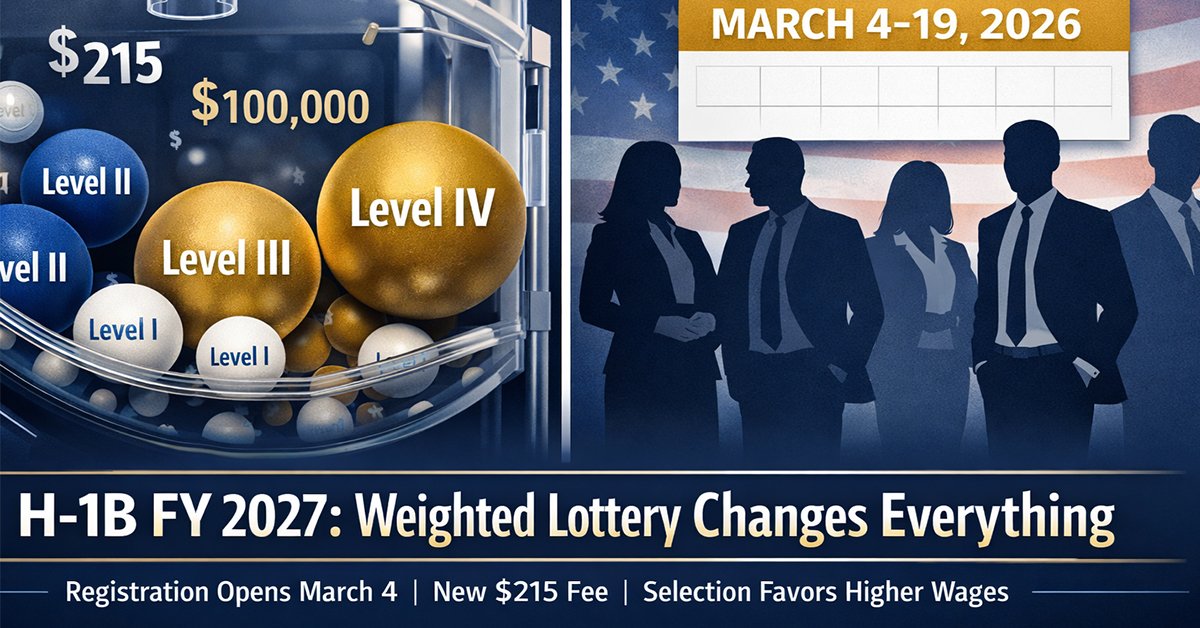

The H-1B visa landscape is undergoing its most dramatic transformation in years. If you’re an employer planning to hire international talent for October 2026, the clock is already ticking. On January 30, 2026, U.S. Citizenship and Immigration Services (USCIS) announced that the registration window for fiscal year 2027 H-1B visas opens on March 4 and closes just 15 days later on March 19—giving companies barely a month to prepare for changes that could fundamentally alter their hiring strategies.
Here’s what’s different this year, why it matters, and what you need to do right now.
The Registration Window: Mark Your Calendar
When: March 4, 2026 (12:00 PM ET) through March 19, 2026 (12:00 PM ET)
Registration Fee: $215 per beneficiary (non-refundable)
Selection Notifications: By March 31, 2026
Petition Filing Window: April 1 through June 30, 2026
Employment Start Date: October 1, 2026 or later
This 15-day window is your only chance to get into the lottery. Miss it, and you’ll have to wait another year. What makes this year particularly consequential isn’t just the compressed timeline—it’s what happens after you submit your registration.
The Game-Changer: Weighted Lottery System
For the first time in H-1B history, not all registrations will have an equal shot at selection. Under a final rule published December 29, 2025, and taking effect February 27, 2026, USCIS will implement a weighted selection process that dramatically favors higher-paid positions.
How the Weighted System Works
Think of it as a multiplier based on your prevailing wage level:
- Level I (Entry-level): 1 lottery entry
- Level II (Qualified): 2 lottery entries
- Level III (Experienced): 3 lottery entries
- Level IV (Fully competent): 4 lottery entries
What does this mean in practical terms? An employer offering a Level IV position gets four times the selection odds of an employer offering a Level I position for the same person. If you’re competing against other employers for the same candidate, the higher wage offer doesn’t just make your company more attractive—it quadruples your chances of winning the lottery.
Why DHS Made This Change
According to the Department of Homeland Security, the weighted system aims to “allocate H-1B visas to higher-skilled and higher-paid aliens while maintaining opportunity for employers at all wage levels.” Translation: they want to reduce the practice of mass-filing low-wage registrations that has dominated recent years.
In fiscal year 2024, USCIS received over 780,000 registrations for just 85,000 available visas—a selection rate below 11%. Many suspected that companies were gaming the system by filing multiple low-wage registrations through different entities. The weighted lottery is designed to make that strategy far less effective.
What the $215 Fee Really Means
You’re probably doing the math: $215 is more than 20 times the $10 fee that’s been in place since 2020. For companies that typically register dozens or hundreds of beneficiaries, this adds up fast.
But here’s what many employers are missing: the $215 registration fee is just the beginning. If your registration gets selected, you’ll still need to pay the standard petition filing fees, which currently include:
- Form I-129 base fee: $460
- American Competitiveness and Workforce Improvement Act (ACWIA) fee: $750 or $1,500
- Fraud Prevention and Detection fee: $500
- Premium processing (optional): $2,805
And then there’s the elephant in the room: the potential $100,000 integrity fee.
The $100,000 Question Nobody’s Answering Yet
On September 19, 2025, President Trump issued a proclamation that could require certain H-1B petitioners to pay an additional $100,000 fee before filing their petition. Current USCIS guidance indicates this fee applies to:
- Beneficiaries who are outside the United States and don’t have a valid H-1B visa
- Cases requesting consular processing (not change of status)
Critical exemption: Petitions requesting change of status from F-1 to H-1B appear to be exempt from the $100,000 fee, provided USCIS grants the change of status and the beneficiary remains in the U.S. through the effective date.
This creates a significant split in the market. Companies hiring international students already in the U.S. on F-1 visas might face total costs around $5,000. Companies hiring talent from abroad could be looking at $105,000+ per petition. That’s not a typo.
The proclamation doesn’t directly affect the registration process—you won’t pay this fee in March—but employers absolutely need to factor it into their 2026 hiring budgets and decide which candidates justify this level of investment.
Who This Helps (and Who It Hurts)
Winners in the New System
Big Tech and High-Paying Employers: Companies that routinely offer Level III and IV wages have just seen their selection odds triple or quadruple. Google, Meta, Microsoft, and similar tech giants that typically pay above prevailing wages are clear beneficiaries.
Experienced Professionals: Senior engineers, specialized researchers, and executives commanding premium salaries are more likely to be selected.
U.S. Master’s Degree Holders: The advanced degree exemption (20,000 additional visas) still exists, and when combined with Level III or IV wages, these candidates get both the separate lottery pool and the wage multiplier.
Losers in the New System
Startups and Small Businesses: Early-stage companies that can’t match big tech salaries will find it harder to compete in the lottery, even for genuinely skilled positions.
Nonprofits and Research Institutions: Universities and research organizations often pay lower wages than private industry. A brilliant researcher at a nonprofit could have worse odds than a mid-level engineer at a tech company.
Entry-Level Specialized Roles: Even positions requiring bachelor’s degrees and technical skills might struggle if they’re classified as Level I.
Consulting Firms: Companies that have historically filed large numbers of Level I registrations will see dramatically reduced selection rates.
What You Need to Do Right Now
Step 1: Verify Prevailing Wage Levels Immediately
Don’t wait until March. Log into the Department of Labor’s Foreign Labor Certification Data Center right now and determine the wage level for every position you plan to file. The job title you use, the specific duties you list, and the location all affect the prevailing wage determination.
Small changes in how you describe the role can move you from Level I to Level II—doubling your lottery odds. This isn’t about gaming the system; it’s about accurate job descriptions that reflect the actual requirements and responsibilities.
Step 2: Consider Wage Increases Where Justified
If you have critical positions currently pegged at Level I, now is the time to ask: Is this genuinely an entry-level role, or have we been under-valuing it?
Raising the offered wage to meet Level II or III thresholds could be the difference between a 10% selection rate and a 40% selection rate. For truly mission-critical hires, that’s money well spent.
Step 3: Audit Your Beneficiary List
The rule is strict: one beneficiary, one registration per employer. If you’re working with third-party vendors, staffing agencies, or multiple related entities, make absolutely certain you’re not creating duplicate registrations for the same person. USCIS will deny or invalidate duplicate registrations, wasting your $215 fee and eliminating those entries from the lottery entirely.
Step 4: Set Up Your USCIS Organizational Account Now
Don’t wait until March 4. If you don’t already have a USCIS online organizational account, create one today. Representatives can add company clients anytime, but you can’t enter beneficiary information or submit registrations until the window opens.
The system has been known to experience heavy traffic on opening day. Having your account set up and tested in advance will save you from last-minute technical headaches.
Step 5: Budget for the Full Cost
Map out your realistic total cost per hire:
For change of status (F-1 students in the U.S.):
- Registration: $215
- Petition fees: ~$2,000-$4,000
- Premium processing (if needed): $2,805
- Total: ~$5,000-$7,000
For consular processing (candidates abroad):
- Registration: $215
- Petition fees: ~$2,000-$4,000
- Integrity fee: $100,000 (if applicable)
- Premium processing (if needed): $2,805
- Total: ~$105,000-$107,000
The gap is staggering. Some companies are already shifting strategy to prioritize candidates who are currently in the U.S. and can file for change of status.
The H-2B Surprise: 64,716 Additional Visas
While everyone’s focused on H-1B, there was another major announcement on January 30, 2026. The Department of Homeland Security and Department of Labor jointly released a temporary rule adding 64,716 supplemental H-2B visas for fiscal year 2026.
This is significant because initial announcements in December suggested only 35,000 supplemental visas would be available—the final number nearly doubled. For employers in hospitality, landscaping, seafood processing, and construction, this is excellent news, though there’s a catch: 46,226 of these visas are restricted to returning workers who held H-2B status in fiscal years 2023, 2024, or 2025.
The supplemental visas are divided into three allocations:
- First allocation (January 1 – March 31): 18,490 visas for returning workers
- Second allocation (April 1 – April 30): 27,736 visas for returning workers
- Third allocation (May 1 – September 30): 18,490 visas (open to all workers, not just returning)
To qualify, employers must attest they’re suffering “irreparable harm” without the ability to employ all requested H-2B workers. This standard is being enforced more strictly than in past years.
Timeline: Key Dates for Your Calendar
- Now – March 3: Verify wage levels, set up accounts, finalize beneficiary list
- March 4, 12:00 PM ET: Registration window opens
- March 19, 12:00 PM ET: Registration window closes
- By March 31: USCIS sends selection notifications
- April 1 – June 30: Filing window for selected petitions
- October 1, 2026: Earliest employment start date for FY 2027 cap cases
What About F-1 Students? Cap-Gap Still Applies
If you’re sponsoring F-1 OPT holders whose work authorization is expiring before October 1, 2026, cap-gap regulations remain in effect. Selected beneficiaries can continue working on their F-1 status until April 1, 2027, or until their H-1B petition is denied—whichever comes first.
This is crucial for maintaining continuous work authorization. Make sure your beneficiaries understand they need to maintain their F-1 status and not violate any terms of their OPT while waiting for their H-1B to take effect.
Common Mistakes to Avoid
1. Waiting Until March to Check Wage Levels
By then it’s too late to make strategic decisions about compensation or job descriptions.
2. Assuming All Your Past Beneficiaries Are Still Eligible
People change jobs, leave the country, or adjust their immigration plans. Verify current eligibility before paying the $215 fee.
3. Filing Multiple Registrations for the Same Person
This will get all registrations for that beneficiary denied or invalidated. One person, one registration, one employer.
4. Underestimating the $100,000 Fee Impact
If you’re planning to hire from abroad, this fee could apply. Don’t get caught off-guard when it’s time to file the actual petition.
5. Ignoring the Selection Odds
With a weighted lottery, some positions now have materially better chances than others. Adjust your expectations and backup plans accordingly.
Looking Ahead: What This Means for 2027 and Beyond
The weighted lottery isn’t a one-year experiment—it’s the new reality. Unless Congress changes the law or a future administration rolls back the rule, employers need to adapt their long-term immigration strategies.
We’re likely to see:
- Wage inflation in H-1B-dependent roles as companies compete to reach higher wage levels
- Increased focus on F-1 recruiting to avoid the $100,000 fee
- Alternative visa strategies (O-1, L-1, TN) for candidates who might not make it through H-1B
- More strategic use of cap-exempt employers (universities, research nonprofits, government contractors) as stepping stones
The days of treating H-1B as a volume game are over. This is now a quality-over-quantity system that rewards employers willing to pay competitive wages and make smart strategic choices about which candidates to sponsor.
Final Thoughts
The FY 2027 H-1B season represents the biggest structural change to the program in more than a decade. The weighted lottery, the $215 fee, and the looming $100,000 integrity charge have fundamentally altered the economics and strategy of H-1B hiring.
Companies that adapt quickly—verifying wage levels now, making strategic compensation decisions, and carefully selecting which candidates to register—will have a distinct advantage. Those that treat this like business as usual are in for a rude awakening when selection notices arrive on March 31.
The registration window is just 15 days long. The decisions you make in the next few weeks will determine whether your critical hires start in October 2026 or get delayed another year.
The time to prepare isn’t in March. It’s right now.
