
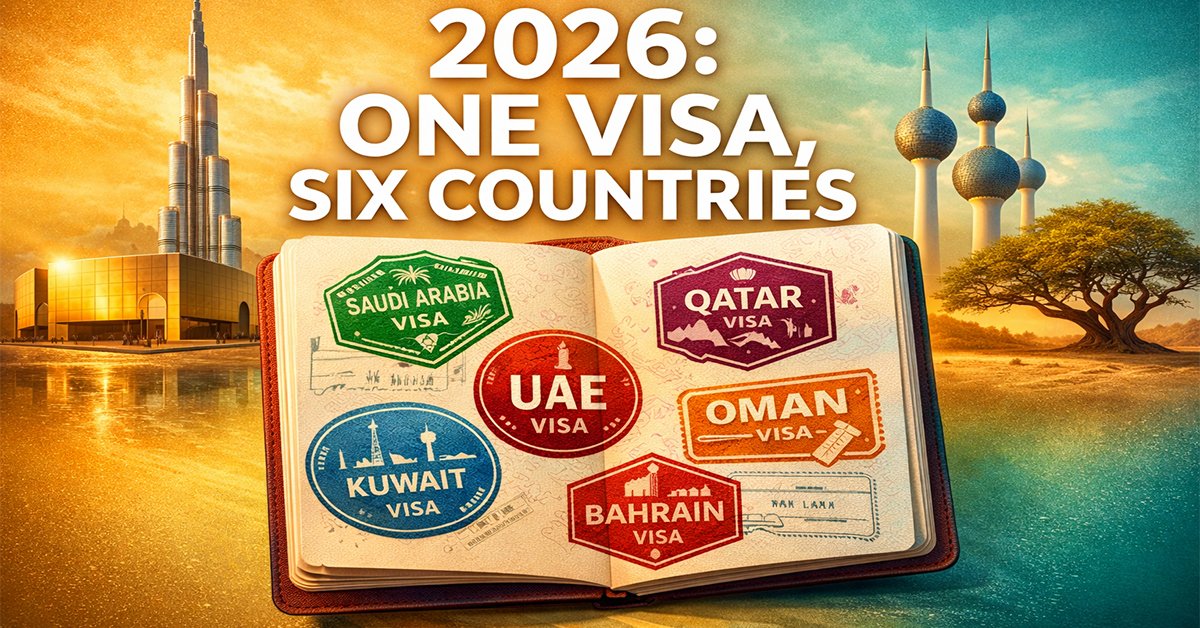

Remember when planning a trip across Europe meant juggling multiple visa applications for France, Italy, and Spain? The Schengen visa changed all that. Now, the Gulf region is working on something similar—but it’s taking a bit longer than expected.
If you’ve been holding your breath for the GCC unified tourist visa in 2025, you’ll need to wait a little longer. Gulf officials recently confirmed that the much-anticipated “Grand Tours Visa” won’t launch until sometime in 2026. Saudi Tourism Minister Ahmed Al-Khateeb explained that deeper technical and security alignment is still required among the six member countries before the system can go live.
What’s the Hold-Up?
Think about it: you’re trying to connect six different countries—the UAE, Saudi Arabia, Qatar, Oman, Kuwait, and Bahrain—each with its own immigration system, security protocols, and data-protection standards. That’s not something you can rush.
Officials are prioritizing precision over speed, making sure the system actually works seamlessly when it launches rather than dealing with technical glitches later. The last thing anyone wants is a half-baked system that creates more problems than it solves.
The main challenges? Security integration is at the top of the list. Real-time data exchange between national databases must track traveler movements while maintaining individual country oversight. Each nation needs to ensure its sovereignty and security requirements aren’t compromised while still participating in a unified system.
Then there’s the technical side. Building a shared digital platform that can handle visa applications, biometric data, fee processing, and document verification across six sovereign nations is incredibly complex. Add to that the need to harmonize watch-lists, agree on revenue-sharing formulas, and standardize everything from application forms to insurance policies—and you start to see why this is taking time.
Why This Visa Matters
Here’s the exciting part: once it’s up and running, this visa could transform how people experience the Gulf. Instead of applying for separate visas to visit Dubai’s futuristic skyline, Oman’s stunning wadis, Saudi Arabia’s historic sites, and Qatar’s world-class museums, you’ll need just one application.
The numbers tell an interesting story. The GCC region welcomed over 68 million international visitors in 2023, but travel within the region accounted for just over a quarter of that total. Officials believe the unified visa could boost intra-GCC tourism by at least 20%.
For Dubai alone, projections suggest the scheme could extend average stays by three days and generate an additional $50 billion in cross-border visitor spending over its first five years. Officials expect the visa to extend stays from an average of 3.5 nights to nearly a week, which is a huge win for regional hospitality and tourism businesses.
What to Expect When It Launches
Based on current plans, travelers will likely have two options: a single-country visa or a multi-country “Grand Tour” visa. The multi-country version is expected to allow stays of 30 to 90 days, making it perfect for travelers who want to explore multiple Gulf destinations in one trip.
The application process should be straightforward—think of a single online portal where you submit your passport details, travel itinerary, proof of accommodation, and financial documents. Pay one fee, get one visa, visit six countries. Simple.
Cost-wise, the multi-country visa is expected to range from approximately $109 to $131, which is significantly cheaper than obtaining separate visas for each country.
- → 7 Essential Business Strategies Transforming Success in 2024
- → AI and Machine Learning in 2026: Transforming Business Through Intelligent Innovation
- → Canada Immigration Backlog Update 2026: What the Latest IRCC Data Really Means
- → Mass Flight Disruptions Across Asia: 2,186 Delays and 134 Cancellations Hit Major Airports in India, Japan, Thailand, Malaysia, UAE, Singapore, and Qatar
- → $800 CRA Payment in March 2026: Which Canadian Families Qualify and When to Expect Their Direct Deposit
- → $533 GST/HST Credit for March 2026: Payment Dates, Eligibility, and Everything Canadians Need to Know
- → Canada Medical Expense Tax Claims 2026: Everything You Need to Know Before Filing
What Happens in the Meantime?
For now, if you’re planning a Gulf adventure, you’ll need to stick with the current system—meaning separate visa applications for each country you want to visit. It’s a bit of a hassle, but at least you know what you’re working with.
Business travelers who frequently cross Gulf borders should maintain their existing multi-entry visa arrangements. Corporate travel managers might actually appreciate the delay—it gives them more time to update booking systems and travel policies before the big switchover.
One silver lining? The UAE and most Gulf countries have already streamlined their individual e-visa processes significantly over the past few years. Many countries now offer user-friendly online application systems that make the process much simpler than it used to be.
The Bigger Picture
This delay isn’t necessarily a bad thing. Remember when the EU tried to rush its Entry/Exit System upgrade in 2024? That didn’t go smoothly. Gulf officials seem to have learned from those mistakes. As travel-security firm International SOS noted, getting the data-sharing, dispute-resolution, and revenue-clearing mechanisms right is worth the extra time.
The UAE is already upgrading its systems in preparation. Dubai Airports is enhancing its Advance Passenger Information system so that a single QR-coded visa can be scanned at both immigration e-gates and airline check-in counters. The UAE’s Federal Authority for Identity, Citizenship, Customs & Port Security is even testing a blockchain-based watch-list exchange that could become the backbone of the region-wide security layer.
Looking Ahead
While 2026 might feel far away if you’re eager to explore the Gulf, the wait will likely be worth it. Once operational, this unified visa won’t just make travel easier—it’ll signal a new era of cooperation among Gulf nations.
For countries like Saudi Arabia, which aims to welcome 150 million visitors annually by 2030, and Dubai, which exceeded 18 million visitors in 2024, this visa is central to their long-term tourism strategies. It’s not just about convenience; it’s about positioning the Gulf as a truly integrated, world-class tourism destination.
So while we wait for 2026, start dreaming about that multi-country Gulf adventure. Whether you’re drawn to Dubai’s innovation, Saudi Arabia’s ancient heritage, Oman’s natural beauty, Qatar’s cultural offerings, Bahrain’s historic sites, or Kuwait’s growing attractions—soon enough, you’ll be able to experience them all with just one visa in your passport.
And trust me, when it finally launches, it’s going to be worth the wait.
