
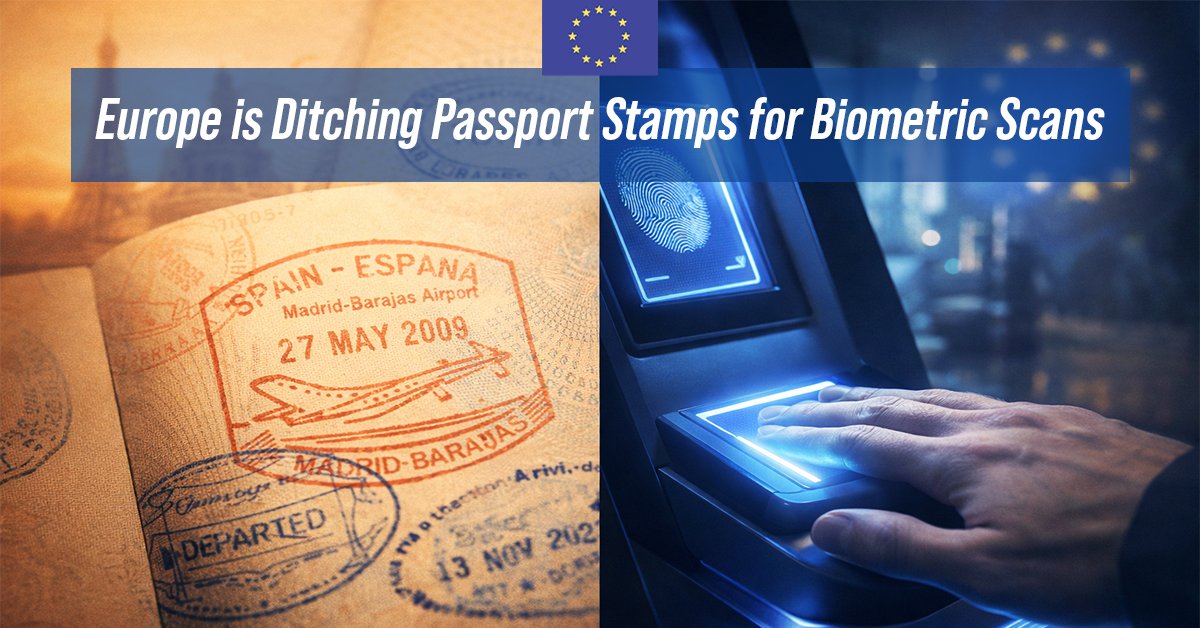

If you’ve ever flipped through your passport and smiled at those colorful stamps from Paris, Rome, or Athens, I’ve got some bittersweet news for you: that tradition is coming to an end.
Starting October 12, 2025, the European Union is rolling out a completely new way of tracking who enters and exits the Schengen area. Instead of getting that satisfying thunk of a stamp in your passport, you’ll be scanning your face and fingerprints at a kiosk.
Welcome to the future of European travel—whether you’re ready for it or not.
What Exactly is Changing?
The European Union is launching something called the Entry/Exit System, or EES for short. It’s a massive biometric database that will replace those physical passport stamps we’ve all come to know and love (or at least tolerate during long immigration lines).
Here’s the timeline you need to know:
- October 12, 2025: The system starts rolling out
- April 10, 2026: Full implementation across all participating countries
Once it’s fully up and running, every non-EU traveler entering the Schengen area will need to register their biometric data. We’re talking facial scans, fingerprints, passport details, and entry/exit dates—all stored digitally.
Who Does This Affect?
If you’re not an EU citizen and you’re planning a European vacation, this affects you. That includes travelers from:
- United States
- United Kingdom
- Canada
- Australia
- Japan
- And basically any other non-EU country
The system covers all 29 countries in the Schengen area. That’s most of Europe’s biggest tourist destinations: France, Italy, Spain, Germany, Greece, Portugal, Netherlands—you name it.
Two notable exceptions: Ireland and Cyprus aren’t part of the Schengen area, so they won’t be using this system.
How Will It Actually Work at the Border?
Alright, so you’ve just landed in Barcelona or Amsterdam. What happens next?
Instead of heading straight to a border officer with a stamp, you’ll first interact with a self-service kiosk. Think of it like checking in for a flight, but with a bit more… scanning involved.
Here’s what the process will look like:
Step 1: Find a Kiosk or Officer You’ll either use a self-service kiosk or go to a border officer equipped with a biometric tablet.
Step 2: Scan Your Face The system will take a facial scan. Quick, painless, but definitely a bit sci-fi.
Step 3: Provide Fingerprints You’ll place your fingers on a scanner to record your fingerprints.
Step 4: Submit Passport Info Your passport details get logged into the system.
- → AI and Machine Learning in 2026: Transforming Business Through Intelligent Innovation
- → Canada Immigration Backlog Update 2026: What the Latest IRCC Data Really Means
- → Mass Flight Disruptions Across Asia: 2,186 Delays and 134 Cancellations Hit Major Airports in India, Japan, Thailand, Malaysia, UAE, Singapore, and Qatar
- → $800 CRA Payment in March 2026: Which Canadian Families Qualify and When to Expect Their Direct Deposit
- → $533 GST/HST Credit for March 2026: Payment Dates, Eligibility, and Everything Canadians Need to Know
- → Canada Medical Expense Tax Claims 2026: Everything You Need to Know Before Filing
- → Canada Pension Plan (CPP) and Old Age Security (OAS): 2026 Payment Updates Every Canadian Retiree Should Know
Step 5: Record Entry Date The system automatically records when you entered the Schengen area.
The good news? EU officials claim this will actually speed up border crossings once everyone gets used to it. The system is designed to track your 90-day stay limit within any 180-day period more accurately than stamp-counting ever could.
One important note: You only need to register your biometric data once every three years. After that initial registration, subsequent entries should be faster since your data is already in the system.
Why is the EU Making This Change?
Look, I get it. Change is annoying, especially when it involves something as straightforward as a passport stamp. But EU officials have their reasons:
Security Enhancement Biometric data is much harder to fake than a physical stamp. This makes it tougher for people to overstay their visas or commit identity fraud.
Accurate Tracking The current system relies on border officers manually stamping passports and calculating stay durations. It’s prone to human error. The EES will automatically track exactly how many days you’ve spent in the Schengen area, making overstays easier to identify.
Efficiency Once the initial setup phase is done and travelers are familiar with the system, border crossings should theoretically move faster. No more waiting for an officer to flip through every page of your passport looking for space to stamp.
Standardization Right now, there’s variation in how different Schengen countries handle entry and exit procedures. The EES creates one unified system across all 29 countries.
Data Collection Let’s be honest—governments love data. This system gives EU authorities comprehensive information about travel patterns, which they argue helps with everything from security to tourism planning.
The End of a Travel Tradition
Here’s where things get a little sentimental.
For more than a century, passport stamps have been more than just bureaucratic necessities. They’ve been souvenirs. Proof of your adventures. A visual diary of everywhere you’ve been.
I’ve talked to countless travelers who’ve shown me their passports with genuine pride—stamps from all seven continents, exotic locations, places most people only dream about visiting. Some people even frame old passports when they expire, turning them into wall art.
Travel experts are comparing this shift to what happened with checkbooks. Remember those? Probably not, if you’re under 30. They served a purpose, people had emotional attachments to them, but ultimately, digital systems replaced them because they were more efficient.
The same thing is happening here.
But there’s a silver lining: Some airports and tourist information centers are planning to offer commemorative stamps for travelers who still want that physical memento. They won’t have any legal value, but at least you’ll have something to show for your trip besides photos and credit card bills.
Europe Isn’t Alone in Going Digital
If you’re thinking, “Great, now I have to deal with biometric scans in Europe too?”—well, you’re probably already dealing with them elsewhere.
The global trend away from physical passport stamps has been building for years. Here are some places already using digital entry systems:
Australia: No more passport stamps. They switched to a fully digital system called SmartGate years ago.
United Kingdom: Automated eGates use facial recognition for entry. Most travelers don’t get stamps anymore.
United States: While you still get stamps in some situations, the US primarily uses electronic I-94 records to track entries and exits.
Singapore: One of the first countries to go fully automated with immigration clearance.
Hong Kong: Digital entry records have been standard for years.
Argentina: Moved to electronic immigration cards and digital tracking.
The writing has been on the wall for a while. Physical passport stamps are going the way of floppy disks and paper airline tickets.
What Should Travelers Do to Prepare?
If you’re planning a European trip in 2025 or 2026, here’s my advice:
1. Expect Delays During the Transition The initial rollout period (October 2025 through April 2026) is probably going to be messy. Border officers will be learning the system, travelers will be confused, and lines will be longer than usual. If you’re traveling during this time, build in extra time at the airport.
2. Make Sure Your Passport is in Good Shape The system will need to scan your passport’s chip, so make sure your passport is undamaged and has plenty of validity left (at least 6 months beyond your travel dates is the general rule).
3. Understand the 90/180 Day Rule The EES will strictly enforce the Schengen area’s 90-day rule: you can spend 90 days within any 180-day period in Schengen countries. The system will automatically calculate this for you, so there’s no fudging it. If you’re a frequent visitor to Europe, you’ll need to track your time carefully.
4. Be Ready for the Biometric Scan Remove glasses, hats, and anything that might interfere with facial recognition. Have your fingers clean for the fingerprint scan. This isn’t the time to be difficult.
5. Get One Last Stamp if You Care If you’re sentimental about passport stamps, plan a European trip before October 2025. Get those stamps while you still can.
Privacy Concerns Worth Considering
Not everyone is thrilled about this change, and privacy advocates have raised some legitimate concerns.
The EU is creating a massive database of biometric information on millions of travelers. Questions people are asking include:
- How secure is this data?
- Who has access to it?
- How long is it stored?
- What happens if there’s a data breach?
The EU insists the system has robust security measures and complies with strict European data protection laws. Your biometric data will supposedly be stored for three years, then deleted.
Whether that makes you feel better or worse probably depends on how much you trust large government databases with your personal information.
The Bigger Picture
Look, I’m not going to pretend I’m thrilled about losing passport stamps. There’s something genuinely satisfying about collecting them—a tangible connection to places you’ve been.
But I also understand why this is happening. Border security is more important than nostalgia. Digital systems are more efficient than stamps. And let’s be real: most of us already give up biometric data when we apply for our passports in the first place.
The world is becoming more connected, and with that comes more sophisticated tracking systems. The EU’s EES is just the latest example.
For travelers, the key is to stay informed, be prepared, and adjust. The process itself probably won’t be that bad once everyone gets used to it. And who knows? Maybe in 20 years, we’ll be explaining to young people what passport stamps were, the same way we now explain what dial-up internet sounded like.
Europe will still be Europe—beautiful, historic, full of incredible food and culture. You just won’t have a stamp to prove you were there.
But you’ll have the memories. And honestly, isn’t that what travel is really about?
