

Introduction
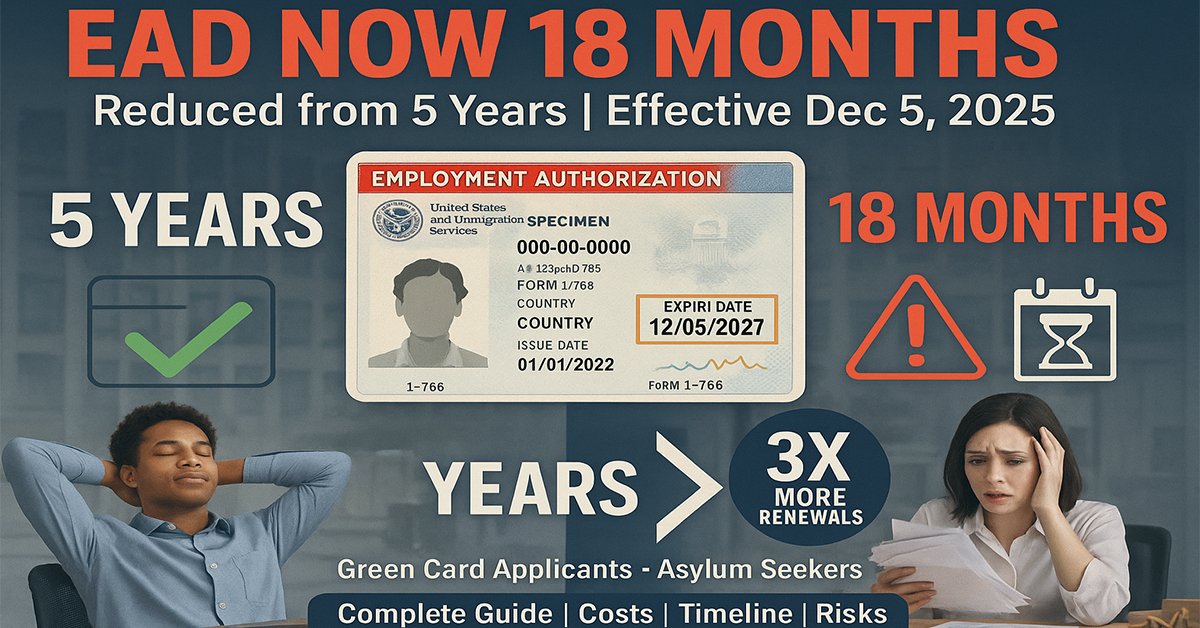
On December 4, 2025, U.S. Citizenship and Immigration Services (USCIS) announced a significant policy change that will fundamentally alter employment authorization for hundreds of thousands of immigrants. Effective December 5, 2025, the maximum validity period for Employment Authorization Documents (EADs) drops from five years to just 18 months for multiple immigration categories—including green card applicants, asylum seekers, refugees, and others awaiting permanent status decisions.
This policy reversal eliminates a September 2023 reform that extended EAD validity to reduce administrative burden and processing delays. Now, applicants must renew their work permits nearly three times as often, facing increased costs, paperwork, and potential employment gaps while USCIS grapples with historically high case backlogs.
This comprehensive guide explains who is affected, why the change was made, how much it will cost, what risks it creates, and most importantly—why securing a green card has become more urgent than ever for maintaining stable employment in the United States.
What Changed: From 5 Years to 18 Months
The New 18-Month Maximum
Effective Date: December 5, 2025
Previous Policy (September 2023 – December 2025):
- Maximum EAD validity: 5 years
- Reduced renewal frequency
- Lower administrative burden
- Fewer opportunities for employment gaps
New Policy (December 5, 2025 onward):
- Maximum EAD validity: 18 months
- Nearly 3x more frequent renewals required
- Increased administrative burden and costs
- Higher risk of employment interruptions
Transition Rules:
- EADs issued before December 5, 2025 remain valid through their expiration date
- Applications pending as of December 4, 2025 receive 18-month maximum
- All applications filed on or after December 5, 2025 receive 18-month maximum
- Future renewals for everyone will have 18-month limit
Who Is Affected by the 18-Month EAD Limit
Category-by-Category Breakdown
USCIS identified six specific eligibility categories subject to the new 18-month maximum validity period:
1. Adjustment of Status Applicants (c)(9) – Most Impacted
This is the largest affected population—immigrants with pending green card applications under Section 245 of the Immigration and Nationality Act.
Who This Includes:
- Employment-based green card applicants (EB-1, EB-2, EB-3, EB-4, EB-5)
- Family-based green card applicants (immediate relatives, family preference categories)
- Anyone with a pending Form I-485 (Application to Register Permanent Residence)
- Spouses and children of primary green card applicants
Critical Impact: This category previously received EAD/Advance Parole combo cards valid for up to five years. The change to 18 months represents a dramatic reduction for hundreds of thousands of people—particularly Indian and Chinese nationals facing decades-long employment-based backlogs.
2. Refugees (a)(3)
Foreign nationals admitted to the United States as refugees under the Refugee Act of 1980.
Who This Includes:
- Individuals fleeing persecution who were granted refugee status abroad
- Refugees resettled through U.S. Refugee Admissions Program
- Refugees awaiting green card processing (typically receive LPR status after 1 year)
3. Asylees (a)(5)
Foreign nationals granted asylum in the United States after proving persecution or fear of persecution in their home country.
Who This Includes:
- Individuals granted asylum by USCIS Asylum Office
- Individuals granted asylum by Immigration Judge
- Asylees awaiting green card eligibility (can apply after 1 year)
4. Withholding of Deportation/Removal (a)(10)
Foreign nationals granted protection from removal but not full asylum status.
Who This Includes:
- Individuals granted withholding of removal under INA § 241(b)(3)
- Individuals granted withholding under Convention Against Torture (CAT)
- Those who met persecution standard but have disqualifying factors for asylum
5. Pending Asylum Applications (c)(8)
Foreign nationals with pending applications for asylum or withholding of removal who have been waiting at least 150 days (eligibility waiting period).
Who This Includes:
- Affirmative asylum applicants (filed proactively with USCIS)
- Defensive asylum applicants (in removal proceedings before Immigration Judge)
- Individuals with pending withholding of removal applications
Important Note: Asylum case backlogs exceed 1.5 million cases. Many applicants wait years for decisions, during which they rely on EAD renewals for employment.
6. Suspension of Deportation/Cancellation of Removal (c)(10)
Foreign nationals with pending applications for suspension of deportation, cancellation of removal, or relief under the Nicaraguan Adjustment and Central American Relief Act (NACARA).
Who This Includes:
- Long-term residents seeking cancellation of removal
- NACARA applicants from Nicaragua, Cuba, El Salvador, Guatemala, former Soviet states
- Individuals in removal proceedings seeking relief
Additional Categories with Even Shorter Limits (H.R. 1 Requirements)
The “One Big Beautiful Bill Act” (H.R. 1), signed into law July 4, 2025, mandated even shorter EAD validity for certain categories:
1-Year Maximum (or end of authorized period, whichever is shorter):
- Parolees (individuals granted parole for urgent humanitarian reasons or significant public benefit)
- Refugees paroled into the U.S.
- Temporary Protected Status (TPS) beneficiaries
- Pending TPS applicants
- Alien spouses of entrepreneur parole recipients
Implementation: These restrictions took effect July 22, 2025
Why USCIS Made This Change
Official Justification: Enhanced Vetting and National Security
USCIS Director Joseph Edlow released a statement framing the policy change as a national security measure:
“Reducing the maximum validity period for employment authorization will ensure that those seeking to work in the United States do not threaten public safety or promote harmful anti-American ideologies. After the attack on National Guard service members in our nation’s capital by an alien who was admitted into this country by the previous administration, it’s even more clear that USCIS must conduct frequent vetting of aliens.”
The Triggering Incident: On November 27, 2025, two West Virginia National Guard members were shot in Washington, D.C. First Lieutenant Hunter D. Kelley, 27, died from her injuries. Sergeant Bethany Derr remains in critical condition. The alleged attacker, Rahmanullah Lakanwal, a 29-year-old Afghan national, entered the U.S. in September 2021 under the Biden administration’s Afghan evacuee program but received asylum approval in April 2025 under the Trump administration.
USCIS’s Stated Goals:
- More Frequent Vetting: Forcing renewals every 18 months creates additional background check opportunities
- Fraud Detection: More frequent applications allow USCIS to detect fraudulent claims or changed circumstances
- Identifying Dangerous Individuals: More touchpoints to identify aliens with “potentially harmful intent”
- Facilitating Removal: Placing removable aliens into deportation proceedings more quickly
Political Context and Immigration Enforcement Priorities
President Trump posted on Truth Social:
“These goals will be pursued with the aim of achieving a major reduction in illegal and disruptive populations, including those admitted through an unauthorized and illegal Autopen approval process.”
The policy change aligns with broader Trump administration immigration enforcement initiatives:
Recent Actions:
- Frozen all asylum requests overseen by USCIS
- Paused visa and immigration applications for Afghan nationals
- Halted legal immigration cases (including citizenship ceremonies) for nationals of 19 countries on the “travel ban” list
- Eliminated automatic EAD extensions for pending renewal applications (November 2025)
- Increased interior enforcement and deportation priorities
Criticism: Administrative Burden Without Clear Benefit
Immigration attorneys and advocacy groups have criticized the policy:
Emily Neumann, Managing Partner at Reddy Neumann Brown PC:
“It would not be a big deal if renewals were processed timely. Unfortunately, it just creates more filings, which increases the backlog of cases, which increases processing times. This coupled with the elimination of the automatic EAD renewal for pending applications will just cause people to have to stop work for no good reason.”
Rahul Reddy, Founding Partner at Reddy Neumann Brown:
“Reducing validity to 18 months could further strain USCIS processing capacity and create gaps in work authorization for lawful applicants who have done nothing wrong.”
Key Criticisms:
- No Evidence It Improves Security: Most EAD holders undergo thorough background checks initially
- Creates Massive Administrative Burden: Triples workload for both applicants and USCIS
- Worsens Existing Backlogs: More applications mean longer processing times for everyone
- Punishes Lawful Applicants: People following legal processes face employment instability
- Economic Harm: Employment gaps hurt families, businesses, and the broader economy
Financial Impact: The True Cost of Shortened EAD Validity
Application Fees and Renewal Costs
Current EAD Application Fees (Form I-765):
| Category | Fee Amount | Total with Biometrics |
| Standard EAD | $[520-605]* | 605$ |
| Adjustment of Status EAD | 410$ | 495$ |
| Asylum-Based EAD | No fee | 85$ (biometrics only) |
| Refugee/Asylee EAD | No fee | No fee |
*Exact fees vary by category; adjustment applicants typically pay reduced fees
Cost Comparison: 5-Year vs. 18-Month Validity
Example: Employment-Based Green Card Applicant
Under 5-Year Validity (Old Policy):
- One EAD renewal during 5-year green card wait: $495
- Total 5-year cost: $495
Under 18-Month Validity (New Policy):
- Initial EAD: $495
- Renewal #1 (18 months later): $495
- Renewal #2 (36 months later): $495
- Renewal #3 (54 months later): $495
- Total 5-year cost: $1,980
Net Increase: $1,485 (300% increase) over 5 years
For Indian EB-2/EB-3 Applicants (Decades-Long Waits):
- Estimated wait time: 80-134 years based on current backlogs
- Realistic wait: 10-15 years before priority date current
- Total renewal cost over 10 years: $3,465
- Total renewal cost over 15 years: $5,445
Hidden Costs Beyond Application Fees
Legal Fees:
- Attorney assistance per renewal: $500-$1,500
- DIY filing reduces costs but increases error risk
Lost Wages from Employment Gaps:
- Average processing time: 4-6 months currently
- If renewal not approved before expiration: weeks to months without income
- Median household income loss per month: $5,000-$10,000+
Photo and Document Costs:
- Passport photos: $10-15
- Document copies and notarization: $25-50
- Mailing costs (certified/priority): $20-30
Time and Productivity:
- Hours spent completing forms, gathering documents, attending biometrics
- Lost work time for appointments
- Stress and anxiety affecting productivity
Total Estimated Cost per Renewal Cycle:
- DIY Application: $600-800 per renewal
- With Attorney: $1,000-2,100 per renewal
- Over 10 years: $4,000-14,000 total
Risks and Challenges Created by 18-Month Limit
1. Employment Authorization Gaps
The most significant risk is losing work authorization if renewal processing exceeds the 18-month EAD validity period.
Current USCIS Processing Times:
- Form I-765 (EAD): 4-6 months (varies by category and service center)
- During backlogs or government shutdowns: 6-12+ months
The Math Doesn’t Work:
- EAD valid for 18 months
- Can apply for renewal 180 days (6 months) before expiration
- Processing takes 4-6 months (or longer)
- Theoretical gap: possible if processing delayed beyond 6 months
Automatic Extension ELIMINATED: As of November 8, 2025, USCIS eliminated the automatic 180-day EAD extension for pending renewal applications. Previously, timely-filed renewals automatically extended work authorization for 180 days, preventing gaps. This safeguard no longer exists.
Real-World Impact:
- If you file renewal at 6-month mark and processing takes 7 months: 1-month employment gap
- If processing backlogs worsen (likely with increased applications): multi-month gaps possible
- Without work authorization: Must stop working, lose income, risk termination
2. Worsening USCIS Backlogs
Current Backlog Reality: According to Business Today India, USCIS case backlogs have reached a 10-year high, with processing delays affecting millions of applicants.
The Vicious Cycle:
- More Applications: Shorter validity = nearly 3x more EAD applications
- Longer Processing: More applications overwhelm already-strained USCIS system
- Greater Delays: Backlogs worsen, processing times increase
- More Gaps: Delayed approvals create employment interruptions
- Economic Harm: Lost wages, terminated employees, business disruption
Immigration Attorney Perspective: Emily Neumann notes that tripling the number of EAD applications will increase backlogs and processing times, creating a self-fulfilling crisis where the security measure intended to increase vetting actually reduces USCIS’s ability to process applications efficiently.
3. Employer Compliance Burdens
Form I-9 Reverification Requirements:
Employers must reverify employee work authorization when EADs expire.
Under 5-Year Validity:
- Reverification required once every 5 years
- Minimal administrative burden
- Stable employment relationships
Under 18-Month Validity:
- Reverification required every 18 months (nearly 3x more often)
- Increased HR administrative workload
- More opportunities for compliance errors
Employer Challenges:
- Tracking Systems: Must monitor hundreds or thousands of EAD expiration dates
- I-9 Updates: Complete Section 3 reverification for each expiring EAD
- Documentation: Maintain compliant I-9 forms with new work authorization documents
- Penalties: ICE fines for I-9 violations range from $281-$2,789 per violation (can multiply across employees)
Communication Gaps: If employee doesn’t notify employer of renewed EAD promptly, employer must choose between:
- Allowing employee to continue working (potential I-9 violation)
- Terminating employee until documentation provided (business disruption)
4. Impact on Career Stability and Life Planning
Professional Consequences:
- Difficulty obtaining professional licenses requiring stable work authorization
- Challenges securing mortgages or major loans
- Limited ability to plan long-term career advancement
- Employer reluctance to invest in training for temporary authorization
Personal and Family Impact:
- Constant stress and anxiety every 18 months
- Inability to plan major life decisions
- Children’s education disrupted if family must relocate
- Relationship strain from financial and legal uncertainty
Mental Health: The perpetual cycle of renewal applications, biometric appointments, and authorization uncertainty takes significant psychological toll on applicants and families.
5. Disproportionate Impact on Specific Communities
Indian Green Card Applicants: With EB-2 backlogs exceeding 134 years and EB-3 backlogs over 80 years, Indian nationals face decades of EAD renewals before receiving green cards. The 18-month limit creates perpetual instability for potentially 100,000+ families.
Chinese Green Card Applicants: Similar backlogs (though shorter than Indian) mean Chinese nationals also face multi-decade waits and constant renewals.
Asylum Seekers: The asylum case backlog exceeds 1.5 million cases. Many asylum seekers wait 5-10+ years for decisions while relying on EAD renewals every 18 months.
How to Navigate the New 18-Month EAD System
1. File Renewals as Early as Possible
USCIS Allows Filing 180 Days Before Expiration:
- Current EAD expires March 1, 2026
- File renewal as early as September 1, 2025 (6 months prior)
- DO NOT WAIT until closer to expiration
Why Maximum Lead Time Matters:
- Processing currently takes 4-6 months
- Backlogs may worsen with increased application volume
- Earlier filing = larger buffer against processing delays
- Eliminates risk of employment gap
Set Calendar Reminders:
- 7 months before expiration: Gather documents, prepare application
- 6 months before expiration: FILE RENEWAL
- 4 months before expiration: Check case status, follow up if no updates
- 2 months before expiration: Contact USCIS if not yet approved, consult attorney
2. Maintain Complete and Accurate Documentation
Required Documents for EAD Renewal:
- Copy of current EAD (front and back)
- Copy of Form I-485 receipt notice (adjustment applicants)
- Copy of passport biographical page
- Two passport-style photographs (unless filing online)
- Form I-765 completed accurately
- Filing fee payment
Critical Accuracy:
- Name exactly as it appears on Form I-485 and other USCIS documents
- Current address updated in USCIS systems
- Correct eligibility category code
- Complete work history (if required for your category)
Common Errors That Cause Delays:
- Incorrect eligibility category
- Unsigned forms
- Missing required documents
- Incorrect fees
- Name discrepancies across documents
3. Update Your Information with USCIS
Change of Address: Must notify USCIS within 10 days of moving via:
- Form AR-11 (Change of Address)
- Online through USCIS account
- Failure to update address can result in lost notices and denials
Online Account Management: Create and maintain USCIS online account to:
- Check case status
- Receive electronic notifications
- Upload documents if requested
- Update contact information
4. Consider Premium Processing (If Available)
Currently Not Available for Most EAD Categories: USCIS does not offer premium processing (15-day guaranteed processing for additional fee) for Form I-765 applications.
Monitor for Policy Changes: USCIS occasionally introduces premium processing for new categories. Check regularly for updates that might benefit your situation.
5. Maintain Employment Documentation
For Employer Reverification:
- Keep copies of all EAD renewals
- Notify employer immediately when new EAD received
- Provide HR with clear expiration dates and renewal timelines
- Establish regular check-ins with HR regarding work authorization status
For Future Green Card Interview:
- Maintain W-2s, pay stubs, tax returns
- Document continuous employment (gaps may require explanation)
- Keep records of promotions, achievements, employer letters
6. Explore Alternatives to EAD-Based Work Authorization
H-1B Visa Status: If you entered on H-1B and filed I-485, you can maintain H-1B status instead of using EAD.
Advantages of Maintaining H-1B:
- Work authorization tied to approved I-129 petition (typically 3 years)
- Not subject to 18-month EAD limitations
- Can travel on H-1B visa without advance parole
- Maintains “dual intent” allowing green card pursuit
Disadvantages:
- Tied to specific employer (less flexibility)
- Requires H-1B extensions and employer sponsorship
- H-1B transfer required for job changes
L-1 Visa Status: Similar advantages for intracompany transferees who entered on L-1.
Strategic Consideration: Consult immigration attorney about whether maintaining H-1B/L-1 status or switching to EAD makes more sense for your situation.
Why a Green Card Is More Important Than Ever
The Fundamental Problem: EAD Is Temporary, Green Card Is Permanent
Employment Authorization Document (EAD):
- Temporary work permission while awaiting permanent status decision
- Requires renewals (now every 18 months)
- Subject to policy changes and processing delays
- Can be revoked if underlying application denied
- Creates perpetual uncertainty
Lawful Permanent Residence (Green Card):
- Permanent work authorization without renewals
- Eliminates 18-month renewal cycle
- Not subject to EAD policy changes
- Provides long-term stability for career and family
- Pathway to U.S. citizenship
Green Card Benefits vs. EAD Instability
| Aspect | EAD (18-Month Validity) | Green Card |
| Work Authorization Duration | 18 months, must renew | Permanent (10-year card renewal only) |
| Renewal Frequency | Every 18 months | Every 10 years (simple card renewal, not work authorization) |
| Employment Flexibility | Authorized for any employer | Authorized for any employer |
| Travel | Requires advance parole | Unrestricted international travel |
| Renewal Costs | 495$ every 18 months | 465$ every 10 years (card renewal) |
| Processing Delays Risk | High risk of employment gaps | No work authorization processing |
| Job Stability | Potential gaps every 18 months | Complete stability |
| Employer Confidence | May hesitate to hire/promote | Full confidence in long-term employment |
| Professional Licensing | Limited/difficult | Full access |
| Mortgage/Loans | Difficult to obtain | Standard access |
| Life Planning | Perpetual uncertainty | Normal life planning possible |
| Path to Citizenship | Not applicable | Eligible after 5 years |
Green Card Processing Strategies
For Adjustment of Status Applicants:
1. Monitor Priority Date:
- Employment-based applicants: Check Visa Bulletin monthly
- When priority date becomes current: green card interview and approval possible
- Planning horizon: Know estimated wait time for your category and country
2. Consider EB-1 or NIW Options:
- EB-1A (Extraordinary Ability): No employer sponsorship required, faster processing
- EB-1B (Outstanding Researcher): Faster than EB-2/EB-3
- EB-1C (Multinational Manager): For qualifying executives
- EB-2 NIW (National Interest Waiver): No employer sponsorship, no labor certification
3. Consult with Immigration Attorney:
- Evaluate options for faster green card categories
- Explore interfiling (upgrading from EB-3 to EB-2)
- Ensure I-485 processing moving forward efficiently
For Asylum-Based EAD Holders:
1. Push for Asylum Interview:
- Contact USCIS Asylum Office for case status
- Request interview scheduling if case pending multiple years
- Consider legal representation to expedite
2. Apply for Green Card After Approval:
- Asylees eligible for green card 1 year after asylum grant
- Do not delay—file I-485 as soon as eligible
- Eliminates EAD renewal requirement once green card received
For Refugees:
1. File Green Card Application Immediately When Eligible:
- Refugees eligible for green card 1 year after admission
- File Form I-485 as soon as eligible
- Processing typically 8-12 months
Employer Responsibilities and Best Practices
Updated I-9 Compliance Requirements
Form I-9 Reverification (Section 3):
Employers must complete Section 3 when employee’s work authorization expires.
Timeline:
- Employee presents new EAD before old one expires
- Employer examines document to determine if it appears genuine
- Employer completes Section 3 with new document information and expiration date
- Must complete by expiration date of old EAD (or first day of continued employment)
Common Errors:
- Completing Section 3 too early (before expiration)
- Failing to complete Section 3 at expiration
- Accepting expired documents
- Incorrect document information
Tracking System Implementation
Best Practices for HR Departments:
1. Centralized Tracking Database:
- Maintain spreadsheet or HRIS system tracking:
- Employee name
- EAD expiration date
- 180-day renewal reminder date (6 months before expiration)
- 90-day follow-up date
- 30-day critical reminder date
2. Automated Reminders:
- Set automated email reminders to employees at 6 months, 90 days, 60 days, 30 days before expiration
- Set reminders to HR for I-9 reverification requirements
- Flag cases where employee has not provided renewal documentation
3. Clear Communication:
- Establish policy for employee notification requirements
- Provide written instructions on EAD renewal process
- Offer to connect employees with immigration attorney resources
- Create internal FAQ document
4. Contingency Planning:
- Develop protocol for potential work authorization gaps
- Consider unpaid leave policies during processing delays
- Plan for temporary work reassignments if needed
- Maintain open communication with employees facing uncertainty
Avoiding Discrimination While Maintaining Compliance
Legal Requirements:
- Cannot discriminate based on citizenship status or national origin
- Cannot demand specific documents (employee chooses which List A, B, C documents to present)
- Cannot require additional documentation from foreign nationals that wouldn’t be required from citizens
- Cannot refuse to employ someone with temporary work authorization
Protected Actions:
- Treating EAD holders differently than citizens in hiring
- Refusing to hire because work authorization expires in 18 months
- Requiring EAD holders to provide additional documentation
- Reverifying citizens or green card holders unnecessarily
Compliance Balance:
- Must reverify work authorization when EADs expire (required by law)
- Must not discriminate against employees with temporary work authorization
- Consult with employment attorney and immigration counsel for proper procedures
Looking Ahead: Potential Changes and Advocacy Efforts
Possible Legislative Solutions
EAGLE Act: The Equal Access to Green Cards for Legal Employment Act would eliminate per-country caps on employment-based green cards, drastically reducing backlogs for Indian and Chinese nationals.
Status: Introduced in multiple Congressional sessions, has not passed
Impact: Would allow hundreds of thousands currently facing decades-long waits to receive green cards within years, eliminating extended EAD dependency.
Other Potential Solutions:
- Increase overall green card allocation
- Exempt certain categories from caps (advanced STEM degrees, etc.)
- Allow “premium processing” for green card applications
- Restore automatic EAD extensions for timely-filed renewals
Advocacy and Legal Challenges
Potential Grounds for Legal Challenge:
- Arbitrary and capricious policy change under Administrative Procedure Act
- Insufficient justification for dramatic policy reversal
- Failure to consider economic impact and reliance interests
- Procedural violations in implementation
Advocacy Organizations:
- American Immigration Lawyers Association (AILA)
- Immigration Voice
- National Immigration Law Center
- Various immigrant rights organizations
Individual Actions:
- Contact congressional representatives
- Share stories of impact with media and policymakers
- Support advocacy organizations
- Participate in public comment periods on future proposed rules
Frequently Asked Questions
Does the 18-month limit apply to my EAD issued before December 5, 2025?
No. EADs issued before December 5, 2025 remain valid through their stated expiration date. However, when you renew after that date, your renewal will be subject to the 18-month maximum.
Can I still use the automatic 180-day EAD extension?
No. USCIS eliminated automatic extensions for pending EAD renewals on November 8, 2025. You must receive your renewed EAD before your current one expires to avoid work authorization gaps.
How early can I file my EAD renewal?
USCIS allows filing up to 180 days (6 months) before your current EAD expires. File as early as possible to maximize buffer against processing delays.
What happens if my EAD expires while my renewal is still pending?
Without automatic extensions, you must stop working until your renewal is approved. This creates an employment gap and income loss. File early to prevent this situation.
- → 7 Essential Business Strategies Transforming Success in 2024
- → AI and Machine Learning in 2026: Transforming Business Through Intelligent Innovation
- → Canada Immigration Backlog Update 2026: What the Latest IRCC Data Really Means
- → Mass Flight Disruptions Across Asia: 2,186 Delays and 134 Cancellations Hit Major Airports in India, Japan, Thailand, Malaysia, UAE, Singapore, and Qatar
- → $800 CRA Payment in March 2026: Which Canadian Families Qualify and When to Expect Their Direct Deposit
- → $533 GST/HST Credit for March 2026: Payment Dates, Eligibility, and Everything Canadians Need to Know
- → Canada Medical Expense Tax Claims 2026: Everything You Need to Know Before Filing
Does this change affect H-1B visa holders?
No. H-1B visa holders do not need EADs—their work authorization comes from their approved H-1B petition. However, H-1B holders who filed I-485 and switched to using EAD instead of H-1B status are affected.
Should I maintain H-1B status instead of using EAD?
This depends on individual circumstances. H-1B provides longer-term work authorization (typically 3 years) but limits you to a specific employer. EAD provides employment flexibility but now requires renewal every 18 months. Consult an immigration attorney to determine the best strategy for your situation.
How much will EAD renewals cost over 10 years?
For adjustment of status applicants: approximately $3,465 over 10 years in filing fees alone (not including photos, legal fees, or other costs). This is roughly $3,000 more than under the previous 5-year validity system.
Will this change affect USCIS processing times?
Almost certainly yes. Tripling the number of EAD applications will increase USCIS backlogs and likely lengthen processing times, creating a vicious cycle of delays.
Can I pay for premium processing to get my EAD renewed faster?
No. Premium processing is not currently available for Form I-765 EAD applications. Monitor USCIS for potential future changes.
What should I tell my employer about this change?
Inform HR that your work authorization will expire every 18 months moving forward and that you will need to complete Form I-9 reverification more frequently. Establish clear communication protocols and provide documentation promptly when renewals are approved.
Conclusion: Green Card Stability vs. EAD Uncertainty
The reduction of EAD validity from five years to 18 months represents a fundamental shift in how hundreds of thousands of immigrants must manage work authorization, financial planning, and life stability while awaiting permanent residency decisions. What was once a relatively manageable burden—renewing employment authorization every five years—has become a perpetual 18-month cycle of applications, fees, biometric appointments, and anxiety about potential employment gaps.
Key Takeaways:
- Effective December 5, 2025: Maximum EAD validity drops from 5 years to 18 months
- Widespread Impact: Affects adjustment applicants, asylum seekers, refugees, and others
- Tripled Costs: Nearly $1,500 more over 5 years; $3,500+ more over 10 years
- Employment Gap Risk: No automatic extensions; processing delays could cause work interruptions
- Worsening Backlogs: More applications will strain USCIS and increase delays
- Employer Burden: More frequent I-9 reverifications and compliance requirements
- Green Card Urgency: Permanent residence provides stability that EADs cannot
Your Action Plan:
Immediate (Within 30 Days):
- Check your current EAD expiration date
- Calculate when you can file renewal (180 days before expiration)
- Set calendar reminders for renewal timeline
- Update address and contact information with USCIS
- Create USCIS online account if you don’t have one
Short-Term (6 Months Before Current EAD Expires):
- Gather all required documents
- Prepare Form I-765 application
- Take passport photos
- FILE RENEWAL as early as possible
- Follow up regularly on case status
Long-Term (Strategic Planning):
- Consult immigration attorney about green card timeline
- Explore options to expedite green card (EB-1, NIW, etc.)
- Consider maintaining H-1B/L-1 status instead of using EAD
- Budget for increased renewal costs
- Maintain open communication with employer
Most Important: While navigating the new 18-month EAD system is crucial for immediate stability, the ultimate solution is securing a green card. Lawful permanent residence eliminates the endless renewal cycle, provides true employment stability, and allows you to plan your life and career without the constant shadow of expiring work authorization.
The path may be uncertain, but the destination—permanent residency and eventual citizenship—remains the goal worth pursuing despite increased obstacles along the way.
