

Introduction
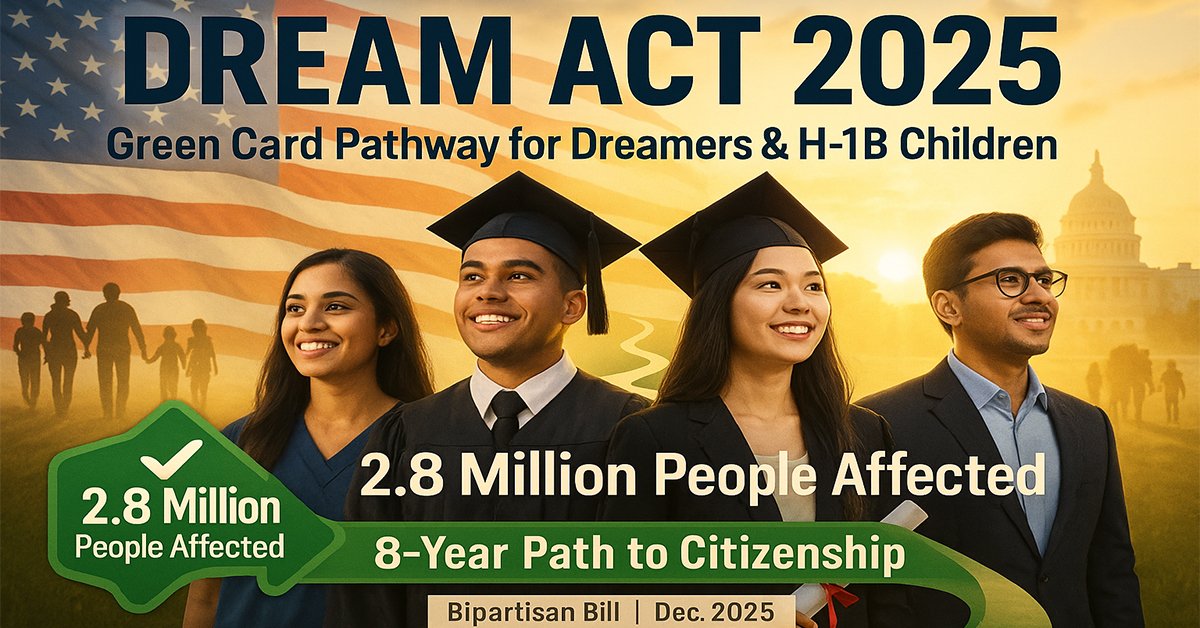
On December 4, 2025, Senators Dick Durbin (D-IL) and Lisa Murkowski (R-AK) reintroduced the bipartisan Dream Act of 2025, marking a historic 24-year effort to provide a permanent legal pathway for young immigrants brought to America as children. This landmark legislation could transform the lives of nearly 2.8 million people, including approximately 525,000 DACA recipients, two million undocumented Dreamers, and 250,000 “Documented Dreamers”—the children of H-1B, E, and L visa holders.
The Dream Act of 2025 represents Congress’s most significant effort to address the plight of young people who grew up American in every way except immigration status. For the first time, the bill extends protections beyond undocumented immigrants to include children of legal visa holders who face “aging out” of their parents’ status at age 21—a crisis particularly affecting approximately 100,000 Indian families trapped in decades-long green card backlogs.
This comprehensive guide explains everything you need to know about the Dream Act 2025, from eligibility requirements and application processes to economic impact, political prospects, and how it differs from the American Dream and Promise Act.
What Is the Dream Act of 2025?
Overview and Purpose
The Dream Act—”Development, Relief, and Education for Alien Minors”—is bipartisan legislation that would allow young immigrants brought to the United States as children to earn lawful permanent residence (green cards) and eventually citizenship if they meet specific education, military service, or work requirements.
Key Legislative Details:
- Introduced: December 4, 2025
- Primary Sponsors: Senator Dick Durbin (D-IL), Senator Lisa Murkowski (R-AK)
- Bill Number: S. [pending assignment]
- Companion House Bill: American Dream and Promise Act (H.R. 16)
- First Introduction: 2001 (Senator Dick Durbin and Senator Orrin Hatch)
Historical Context: Senator Durbin first introduced the Dream Act in 2001 with Republican Senator Orrin Hatch. Over 24 years, the bill has been reintroduced multiple times, passing the House in 2010 but failing in the Senate by five votes. The 2025 version represents Durbin’s final introduction before his planned retirement.
Who Does the Dream Act Protect?
Two Primary Groups:
1. Dreamers (Undocumented) Young immigrants without lawful status who were brought to the United States as children, lived most of their lives in America, and meet educational, military, or employment criteria.
- DACA Recipients: 525,000 people currently protected by Deferred Action for Childhood Arrivals
- DACA-Eligible Non-Recipients: ~1.16 million young people who qualified but never applied or were denied due to program limitations
- Total Potential Beneficiaries: Approximately 2.5 million undocumented Dreamers
2. Documented Dreamers (Legal Status Children) Children of long-term nonimmigrant visa holders who grew up in the U.S. but risk losing legal status when they turn 21 due to “aging out” before their families receive green cards.
- Visa Categories Covered: Children of E-1 (treaty traders), E-2 (treaty investors), H-1B (specialty occupation workers), and L (intracompany transferees) visa holders
- Total Potential Beneficiaries: Approximately 250,000 Documented Dreamers
- Primary Impact: Indian families facing 134+ year green card backlogs (approximately 100,000 affected)
Understanding Documented Dreamers: The H-1B Children Crisis
What Is “Aging Out”?
Under current U.S. immigration law, children of nonimmigrant visa holders can remain in the United States as dependents only until they turn 21. Once they reach this age, they must obtain their own visa status or leave the country—even if they’ve lived in America since infancy.
The Problem: Employment-based green card backlogs, particularly for Indian nationals, can exceed 130 years. Children who entered the U.S. legally as dependents grow up entirely American—attending K-12 schools, graduating from U.S. universities, building careers—only to face deportation to countries they barely remember when they turn 21.
Real-World Impact: The Indian Family Crisis
Green Card Backlog Statistics:
- Indian EB-2 Category: 134+ year wait time
- Indian EB-3 Category: 87+ year wait time
- Approximate families affected: 100,000+ Indian families with children at risk
Typical Scenario:
- Year 2000: Indian engineer enters U.S. on H-1B with 3-year-old daughter
- 2018: Daughter graduates high school in Texas (age 21 approaching)
- 2021: Daughter “ages out,” must find own visa or leave despite living in U.S. for 18 years
- 2025: Family still waiting for green card, daughter deported or on temporary work visa
- Projected: Family green card approval estimated for 2137
The Limbo of Documented Dreamers
Unlike undocumented Dreamers, Documented Dreamers maintain lawful status until age 21 but face unique challenges:
Educational Barriers:
- Charged international student tuition despite living in U.S. for years
- Ineligible for most financial aid
- Limited access to scholarships
- Must obtain F-1 student visas with strict limitations
Employment Restrictions:
- Cannot work off-campus on student visas
- Must find H-1B sponsorship after graduation (limited annual supply)
- Compete in lottery system with experienced professionals
- Risk deportation if unable to secure sponsored employment
Life Uncertainty:
- Cannot plan long-term careers
- Difficulty obtaining professional licenses
- Challenges buying homes or making major investments
- Family separation if forced to return to “home” country
Senator Durbin’s Statement: “Imagine growing up in America, excelling in school, only to be told at 21 that you must leave the only country you’ve ever really known. These young people did everything right—their families followed every law—yet they face deportation simply because bureaucratic backlogs prevented their parents from getting green cards in time.”
Dream Act 2025: Two-Step Pathway to Citizenship
Step 1: Conditional Permanent Residence (8 Years)
The Dream Act creates an eight-year conditional permanent resident status that provides:
Protections and Benefits:
- Protection from deportation during conditional period
- Work authorization in any field or profession
- Travel permission to leave and re-enter the United States
- In-state tuition eligibility at public universities
- Driver’s licenses and state IDs in all states
- Professional licenses in qualified fields
Initial Eligibility Requirements:
For All Applicants (Dreamers and Documented Dreamers):
- Age at Entry: Brought to the U.S. at age 18 or younger
- Continuous Residence: Lived continuously in the U.S. for at least four years before filing
- Age at Filing: Under 36 years old when applying (expanded from previous 18-35 limits)
- Good Moral Character: No serious criminal convictions
- Education Commitment: High school diploma, GED, or currently enrolled in high school
Additional for Undocumented Dreamers:
- Must not have lawful immigration status when applying
- Demonstrate they were brought to U.S. as children (not adults)
Additional for Documented Dreamers:
- Child of E-1, E-2, H-1B, or L visa holder
- “Aged out” at 21 or facing imminent aging out
- Maintained lawful status as dependent
Step 2: Lawful Permanent Residence (Green Card)
After holding conditional status, individuals can apply to remove conditions and obtain full lawful permanent residence by meeting one of these pathways:
Pathway A: Higher Education
- Complete at least two years toward bachelor’s degree or higher at accredited institution
- OR complete bachelor’s or higher degree from accredited institution
Pathway B: Military Service
- Serve at least two years in U.S. Armed Forces
- Receive honorable discharge if service completed
Pathway C: Employment
- Work for at least three years total
- Demonstrate periods of authorized employment with substantial income
Additional Requirements for All Pathways:
- Maintain continuous residence in United States
- Maintain good moral character (no serious crimes)
- Pass English language proficiency test (exceptions for disabilities/hardship)
- Pass U.S. civics test (knowledge of American history and government)
Step 3: U.S. Citizenship
After obtaining lawful permanent residence, individuals can apply for U.S. citizenship following standard naturalization processes:
Timeline:
- 5 years as lawful permanent resident (green card holder)
- OR 3 years if married to U.S. citizen
- Meet citizenship requirements (continuous residence, good moral character, language, civics)
Total Timeline from Dream Act Application to Citizenship:
- Approximately 13-15 years for most applicants
- 8 years conditional residence + 5 years LPR = citizenship eligibility
Key Differences: Dream Act vs. American Dream and Promise Act
Two major legislative efforts exist to protect Dreamers. Understanding the differences helps clarify which bill applies to specific situations.
Dream Act of 2025 (Senate Bill)
Sponsors: Senators Dick Durbin (D-IL) and Lisa Murkowski (R-AK) Introduced: December 4, 2025
Coverage:
- Undocumented Dreamers (including DACA recipients)
- Documented Dreamers (children of E-1, E-2, H-1B, L visa holders)
Conditional Period: 8 years Final Status: Lawful permanent residence (green card)
Does NOT Include:
- TPS (Temporary Protected Status) holders
- DED (Deferred Enforced Departure) beneficiaries
American Dream and Promise Act of 2025 (House Bill – H.R. 16)
Lead Sponsors: Congresswomen Sylvia Garcia (D-TX) and Pramila Jayapal (D-WA) Introduced: February 26, 2025
Coverage:
- Undocumented Dreamers (including DACA recipients)
- TPS holders from designated countries
- DED beneficiaries
Conditional Period: 10 years Final Status: Lawful permanent residence (green card)
Does NOT Include:
- Documented Dreamers (H-1B children)
Bipartisan Support:
- 201 House cosponsors (includes Republicans Maria Elvira Salazar, Lori Chavez-DeRemer, John Duarte)
- Endorsed by 120+ organizations
Which Bill Is Better?
Neither is objectively “better”—they serve different populations with some overlap:
If you are:
- Undocumented Dreamer/DACA recipient: Both bills could help (8-year vs. 10-year conditional period difference)
- Documented Dreamer (H-1B child): ONLY the Senate Dream Act includes you
- TPS or DED holder: ONLY the House American Dream and Promise Act includes you
Political Reality: For any bill to become law, it must pass both the House and Senate and receive presidential signature. Advocates hope elements from both bills will be combined in final legislation.
Economic Impact of the Dream Act
Contributions of Dreamers to U.S. Economy
Current DACA Recipient Contributions:
Tax Revenue:
- $6.2 billion in federal taxes annually
- $3.3 billion in state and local taxes annually
- $2.1 billion to Social Security and Medicare (despite being ineligible for benefits)
- $9.5 billion total annual tax contribution
Income and Spending:
- $27.9 billion in collective earnings (2022)
- $65 billion total economic contribution
- Average income increase of 45% after receiving DACA
Employment:
- 800,000+ DACA recipients in workforce
- Essential workers in healthcare, education, technology, agriculture
- Significant representation in nursing, teaching, software engineering
Projected Economic Growth from Citizenship Pathway
According to the Center for American Progress:
GDP Growth:
- $799 billion increase to national GDP over next decade
- Citizenship enables higher education completion, professional licensing, entrepreneurship
- Removes barriers to career advancement and investment
Job Creation:
- Hundreds of thousands of new jobs created
- Dreamers as employers and business creators
- Increased consumer spending stimulates broader economy
Wage Benefits:
- All U.S. workers see wage increases as economy expands
- Reducing exploitation in undocumented labor market
- Better labor standards benefit entire workforce
Industry-Specific Impact:
Healthcare:
- → 7 Essential Business Strategies Transforming Success in 2024
- → AI and Machine Learning in 2026: Transforming Business Through Intelligent Innovation
- → Canada Immigration Backlog Update 2026: What the Latest IRCC Data Really Means
- → Mass Flight Disruptions Across Asia: 2,186 Delays and 134 Cancellations Hit Major Airports in India, Japan, Thailand, Malaysia, UAE, Singapore, and Qatar
- → $800 CRA Payment in March 2026: Which Canadian Families Qualify and When to Expect Their Direct Deposit
- → $533 GST/HST Credit for March 2026: Payment Dates, Eligibility, and Everything Canadians Need to Know
- → Canada Medical Expense Tax Claims 2026: Everything You Need to Know Before Filing
- 30,000+ DACA recipients work in healthcare
- Critical during and after pandemic
- Addresses healthcare worker shortages
Education:
- 20,000+ DACA recipients work as teachers
- Addresses teacher shortages in underserved areas
- Bilingual education specialists
Technology:
- Significant representation in software engineering, IT
- Contributes to U.S. tech competitiveness
- Many work for major tech companies
Small Business:
- Thousands of Dreamer-owned businesses
- Job creators in local communities
- Entrepreneurial contributions
Political Landscape and Prospects for Passage
Current Political Reality (December 2025)
Senate:
- Republican Majority: 53-47
- Bipartisan introduction: Democrat (Durbin) and Republican (Murkowski) cosponsors
- Historical precedent: 2010 Dream Act passed House but failed Senate by 5 votes (55-41, needed 60)
House:
- Republican Majority: 220-215 (narrow margin)
- American Dream and Promise Act: 201 cosponsors including several Republicans
- Previous passage: Passed House in 117th Congress (2021)
White House:
- President Trump indicated openness to working with Democrats on Dreamer protection
- Campaign rhetoric focused on “worst of the worst” criminals, not Dreamers
- Historical unpredictability on immigration issues
Challenges to Passage
Republican Concerns:
- “Amnesty” framing: Some conservatives oppose any legal status for undocumented immigrants
- Border security linkage: Demands for increased border enforcement in exchange for Dream Act
- Chain migration fears: Concerns about family reunification provisions
- Political polarization: Immigration remains deeply partisan issue
Democratic Divisions:
- Scope disagreements: Some want broader coverage (all undocumented immigrants)
- TPS/DED inclusion: House bill includes more categories than Senate bill
- Pathway timing: Debates over length of conditional period
Procedural Hurdles:
- Filibuster: Senate requires 60 votes to overcome filibuster
- House floor control: Republican leadership determines which bills receive votes
- Budget reconciliation: Immigration reform typically excluded from reconciliation process
- Rider attachments: Poison pill amendments could sink bipartisan support
Arguments Supporters Make
Moral Arguments:
- “These young people are American in every way except on paper”
- Deporting people who grew up in U.S. to countries they don’t remember is cruel
- Punishing children for parents’ actions violates American values
- Recognizing contributions and moral desert
Economic Arguments:
- $799 billion GDP growth over decade
- Billions in annual tax revenue
- Job creation and economic growth
- Addressing labor shortages in critical fields
National Security Arguments:
- Background checks bring people out of shadows
- Creates documented population for security purposes
- Reduces exploitation and criminality in undocumented populations
- Military service opportunities for patriotic young people
Political Arguments:
- Overwhelming public support (68% of registered voters)
- Benefits spread across all 50 states
- 24-year bipartisan effort deserves resolution
- Demonstrates Congress can solve problems
Arguments Opponents Make
Legal Concerns:
- Rewarding illegal immigration encourages future violations
- Parents brought children knowing they were breaking law
- Rule of law requires consistent enforcement
- Creates “line-jumping” ahead of legal immigrants
Economic Concerns:
- Competition with American workers for jobs
- Fiscal costs of providing benefits and services
- Impact on social safety net programs
- Wage depression in certain sectors
Political Concerns:
- Democrats using immigration for political advantage
- Future Democratic voters (Dreamers lean Democratic)
- Demands for comprehensive immigration reform first
- Should be tied to border security funding
Practical Concerns:
- Difficulty verifying childhood entry claims
- Fraud potential in application process
- Administrative burden on immigration system
- Cost of processing millions of applications
Realistic Assessment of Passage Likelihood
Factors Favoring Passage:
- Strong bipartisan introduction (Durbin-Murkowski)
- Overwhelming public support across political spectrum
- President Trump’s stated openness to Dreamer protection
- 24-year legislative effort building momentum
- Humanitarian crisis of recent DACA recipient deportations
- Economic benefits widely recognized
Factors Against Passage:
- Deep partisan polarization on immigration
- Republican House majority hesitant on immigration reform
- 60-vote filibuster threshold in Senate
- Demands for border security “hostage” negotiations
- Trump administration’s mass deportation priorities
Expert Predictions: Most immigration analysts view passage as unlikely in current Congress without significant compromises, potentially including:
- Border security funding increases
- Restrictions on family reunification
- Enhanced interior enforcement
- Limitations on public benefits access
Best-Case Scenario:
- Narrower bill focused on DACA recipients only
- Strong border security measures included
- Passed as part of broader must-pass legislation
- Bipartisan deal in divided government context
How to Prepare If You Might Qualify
For Current DACA Recipients
Immediate Actions:
- Renew DACA immediately if within renewal window
- Keep renewing until Dream Act passes or DACA ends
- Maintain clean record: Avoid any criminal activity
- Document everything: Keep all DACA approval notices, work permits
- Save money: Application fees will be required
Stay Informed:
- Follow Senator Durbin’s office for updates
- Monitor FWD.us, Immigrants Rising, United We Dream
- Subscribe to immigration law newsletters
- Attend community information sessions
Prepare Documentation:
- High school diploma/GED or enrollment verification
- Employment records showing work history
- Tax returns and W-2s proving income
- Proof of continuous residence
- Character references
For Documented Dreamers (H-1B Children)
If You’re Under 21:
- Track your birthday carefully: Know exactly when you turn 21
- Explore alternative visas: F-1 student, H-1B work visa options
- Document your U.S. life: School records, employment, community ties
- Connect with advocacy groups: Improve the Dream, Presidents’ Alliance
If You’ve Already Aged Out:
- Maintain lawful status on whatever visa you hold
- Don’t let status expire: Stay legal at all costs
- Keep records: Proof of dependent status, parent’s visa history
- Document education: All U.S. schooling from childhood forward
Critical Documents to Maintain:
- Birth certificate
- Passport with visa stamps
- Parent’s visa documentation
- School transcripts from U.S. schools (K-12 and higher education)
- Medical records showing U.S. residence
- Bank statements, leases, utility bills proving continuous presence
For Other Dreamers Without DACA
If You Might Qualify but Never Applied for DACA:
- Consult immigration attorney immediately: Determine if you’re eligible
- Gather evidence now: Proving childhood entry and continuous residence
- Avoid immigration enforcement: Don’t put yourself at risk before bill passes
- Join advocacy efforts: United We Dream, local immigrant rights organizations
Documentation Needs:
- School records from U.S. schools
- Medical and dental records
- Church or community organization membership records
- Bank statements, rental agreements
- Affidavits from family, teachers, neighbors
- Photos and social media showing U.S. presence
Common Questions About the Dream Act 2025
Will the Dream Act pass in 2025?
Passage is uncertain. While the bill has bipartisan sponsorship and public support, it faces significant challenges including Senate filibuster rules, House Republican leadership skepticism, and broader immigration policy debates. Advocates are cautiously optimistic but realistic about hurdles.
What’s the difference between DACA and the Dream Act?
DACA (Deferred Action for Childhood Arrivals) is a temporary executive policy providing renewable two-year protection from deportation. The Dream Act is permanent legislation that would create a pathway to green cards and citizenship. DACA can be ended by any president; the Dream Act would require new legislation to repeal.
Does the Dream Act give “free citizenship” to illegal immigrants?
No. The Dream Act requires applicants to wait eight years in conditional status, then meet strict educational, military, or employment requirements, pass background checks, pay fees and taxes, and wait additional years as lawful permanent residents before becoming eligible for citizenship. The total process takes 13-15+ years.
How much does it cost to apply under the Dream Act?
Exact fees will be determined if the bill becomes law. However, based on current immigration application costs, expect fees ranging from $1,000-$2,500 total for the multi-step process (conditional residence application, condition removal, naturalization).
Can I be deported while my Dream Act application is pending?
The bill includes provisions to pause deportation proceedings for eligible applicants while their cases are processed. However, these protections only exist if the bill passes and you file a complete application.
What happens to my DACA if the Dream Act passes?
If the Dream Act passes, DACA recipients would be eligible to apply for conditional permanent resident status—a more secure status than DACA’s renewable two-year periods. You would likely transition from DACA to Dream Act status through an application process.
Does the Dream Act include children of H-1B visa holders?
Yes, the Senate’s Dream Act of 2025 includes “Documented Dreamers”—children of E-1, E-2, H-1B, and L visa holders who aged out at 21. This is the first Dream Act version to include this population. However, the House’s American Dream and Promise Act does not include them.
Can I travel outside the U.S. with conditional permanent residence?
Yes. Conditional permanent residents receive travel authorization to leave and return to the United States, unlike DACA recipients who need special advance parole approval. However, extended absences could affect continuous residence requirements.
What crimes disqualify you from the Dream Act?
Serious crimes including felonies, significant misdemeanors, and crimes involving moral turpitude typically disqualify applicants. Minor traffic violations and juvenile offenses are generally not disqualifying. Each case is evaluated individually.
Can my parents get green cards if I get status through the Dream Act?
Not immediately. After becoming a lawful permanent resident, you cannot petition for parents. Only after becoming a U.S. citizen (approximately 13-15 years total) could you file family-based petitions for parents. This addresses “chain migration” concerns.
Take Action: How to Support the Dream Act
Contact Your Elected Officials
Find Your Senators and Representative:
- Visit senate.gov and house.gov to find contact information
- Call congressional offices: “I’m a constituent calling to urge Senator/Representative [Name] to cosponsor and vote YES on the Dream Act of 2025.”
Effective Advocacy Tips:
- Share personal story if you’re affected
- Be polite but persistent
- Follow up with written correspondence
- Attend town halls and public events
Join Advocacy Organizations
National Organizations:
- United We Dream: unitedwedream.org
- FWD.us: fwd.us
- Immigrants Rising: immigrantsrising.org
- Define American: defineamerican.com
- Improve the Dream: improvethedream.org (Documented Dreamers focus)
Actions to Take:
- Sign petitions
- Attend rallies and events
- Share stories on social media
- Participate in phone banks
- Donate to advocacy efforts
Share Stories and Build Support
Why Stories Matter: Senator Durbin has shared 150 Dreamer stories on the Senate floor over 24 years because personal narratives humanize policy debates. Stories change minds and build political will.
Share Your Story:
- Contact advocacy organizations
- Write op-eds for local newspapers
- Post on social media with hashtags #DreamAct #HomeIsHere
- Speak at community events
- Meet with local elected officials
Resources and Additional Information
Official Government Resources
Senate Judiciary Committee:
- judiciary.senate.gov
- Contact Senator Durbin’s office for bill updates
U.S. Citizenship and Immigration Services:
- uscis.gov
- Current DACA renewal information
- Immigration forms and procedures
Advocacy and Legal Resources
Legal Assistance:
- Immigration Advocates Network: immigrationadvocates.org
- American Immigration Lawyers Association: aila.org
- Catholic Legal Immigration Network: cliniclegal.org
Know Your Rights:
- ACLU Immigrants’ Rights Project: aclu.org/issues/immigrants-rights
- National Immigration Law Center: nilc.org
DACA Renewal Information
How to Renew:
- File Form I-821D (DACA renewal)
- File Form I-765 (work permit)
- Pay $495 filing fee
- Submit required documentation
Renewal Timing:
- Apply 120-150 days before current DACA expires
- Never let DACA lapse if possible
- Processing currently takes 60-90 days
Educational Resources
College Access for Dreamers:
- TheDream.us: thedream.us (scholarships)
- Golden Door Scholars: goldendoorscholars.org
- Hispanic Scholarship Fund: hsf.net
Career Development:
- My Undocumented Life: mydocumentedlife.org
- Immigrants Rising Career Resources: immigrantsrising.org
Conclusion: The Dream Still Alive After 24 Years
Senator Dick Durbin first introduced the Dream Act in 2001 with a simple premise: young people brought to America as children, who grew up as Americans in every meaningful way, deserve the opportunity to earn legal status through education, military service, or work. Twenty-four years later, as he prepares to retire, Durbin has introduced what he calls his “final Dream Act,” joined by Republican Senator Lisa Murkowski in a powerful bipartisan statement.
The Dream Act of 2025 represents not just policy but a promise—that America judges people by their character and contributions, not circumstances beyond their control. The 2.8 million young people who could benefit are teachers, nurses, engineers, small business owners, and military service members. They pay billions in taxes, strengthen local communities, and enrich American society.
Key Takeaways:
- Who Benefits: 2.5 million undocumented Dreamers + 250,000 Documented Dreamers (H-1B children)
- Pathway: 8 years conditional residence → green card → citizenship (13-15 total years)
- Requirements: Education, military service, or work; good moral character; continuous residence
- Economic Impact: $799 billion GDP growth, billions in tax revenue, hundreds of thousands of jobs
- Political Reality: Uncertain passage despite bipartisan support and public approval
- What You Can Do: Contact Congress, join advocacy, prepare documentation, stay informed
Looking Forward:
Whether the Dream Act passes in 2025 or requires further negotiation, the momentum is undeniable. Public support is overwhelming, economic benefits are clear, and moral arguments are compelling. The question is not whether America will eventually provide a pathway for Dreamers, but when—and whether that “when” comes in time for the millions living in uncertainty today.
As Senator Durbin told the young woman he featured as his 150th Dreamer story: “Don’t give up on me. I’m not giving up on you.”
The American Dream remains alive for those willing to fight for it.
