
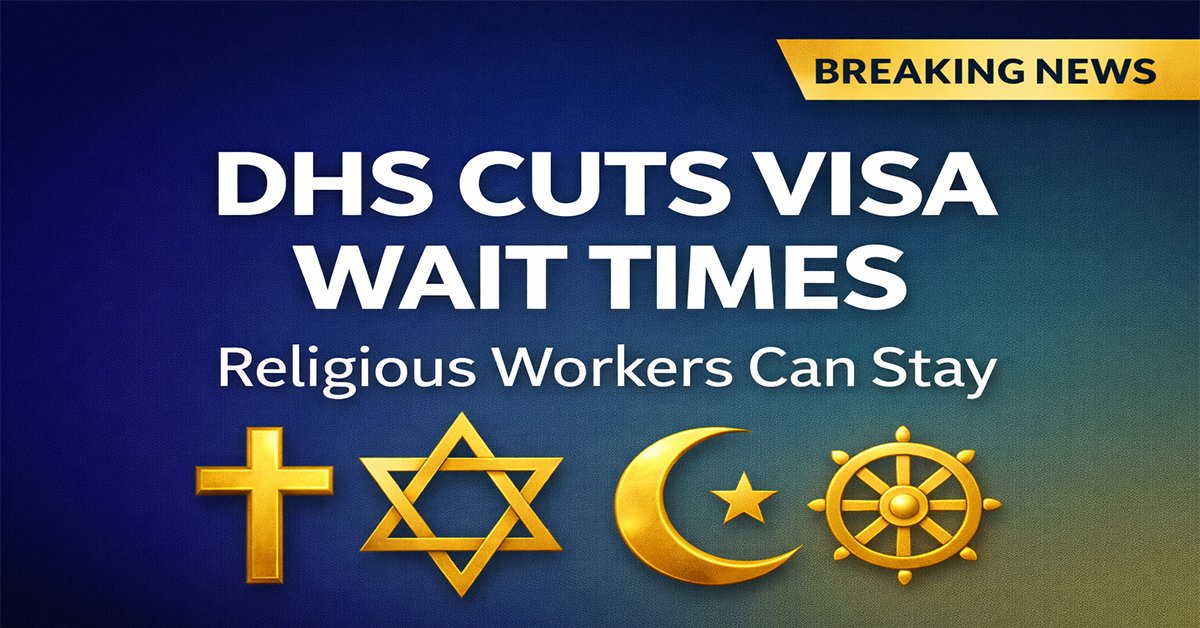

If you’ve been following immigration news lately, you know things have been complicated. But here’s something positive – the Department of Homeland Security just made life easier for thousands of religious workers serving American communities.
Recently, DHS announced they’re fixing a problem that’s been giving faith leaders headaches for the past few years. The change specifically helps pastors, priests, nuns, imams, and rabbis who come to the U.S. on R-1 religious worker visas.
The Problem That’s Been Hurting Churches
Here’s what was happening: Religious workers could come to America on R-1 visas for five years. Sounds great, right? Well, not exactly.
Most of these workers are also waiting for green cards through a special category called EB-4. That process used to take less than five years, so everything worked out fine. But in 2023, something changed.
The State Department started adding thousands of migrant children from Central America into the same green card line as religious workers. Suddenly, the wait time shot up dramatically – we’re talking about a decade or more now.
When their five-year visa ran out, religious workers had to leave the country for an entire year before they could come back. Think about what that means for a church community. Your pastor has to pack up and leave for twelve months, right in the middle of everything.
“It would potentially allow people not to disrupt the organization by having someone have to leave for a year, because that’s a major imposition now,” said Lance Conklin, a Maryland immigration attorney who works with evangelical churches.
Read More : US Freezes Visa Processing for 75 Countries: Everything You Need to Know (January 2026)
What’s Actually Changing
The new DHS rule doesn’t fix the green card backlog – that’s still there. But it does something important: religious workers no longer have to sit out for a year.
Now, when someone hits their five-year limit on an R-1 visa, they still need to leave the U.S. (that part hasn’t changed). But here’s the difference – they can immediately apply to come back. No more waiting around for twelve months.
Olga Rojas, who handles immigration cases for the Archdiocese of Chicago, had one word for the news: “Hallelujah!”
Why This Matters More Than You Think
American religious communities have always relied on people from other countries. The Catholic Church, for instance, has been dealing with a priest shortage for decades. They bring in clergy from places like Nigeria, Vietnam, and the Philippines.
It’s not just Catholics either. Buddhist temples need monks trained in ancient traditions. Pentecostal churches serve growing Spanish-speaking congregations. Jewish synagogues sometimes need rabbis with specific expertise.
These aren’t just random workers – they’re people leading communities, teaching kids, counseling families, and running food banks. When they disappear for a year, it creates real problems.
The U.S. Conference of Catholic Bishops called this change a “truly significant step to support essential religious services in the United States.”
The Bigger Picture Nobody’s Talking About
Here’s what makes this situation interesting: While immigration policies continue to evolve, this rule shows that protecting religious freedom remains a priority across different administrations.
DHS emphasized their commitment to supporting faith-based communities. In their statement, they said religious workers are “essential to the social and moral fabric of this country.”
It’s worth noting that this doesn’t solve everything. Religious workers still face that massive green card backlog. The Diocese of Paterson, New Jersey actually sued the government over this mess back in 2024. Five priests were facing uncertain futures.
The lawsuit got dropped in fall 2025 after the diocese realized the government was working on this rule change. Their attorney, Raymond Lahoud, said they got what they wanted – keeping priests in the country. But he added, “the underlying issue is they still have to wait a decade for a green card.”
What Happens Next
Some members of Congress saw this problem coming. In spring 2025, both Democrats and Republicans introduced bills to extend religious worker visas while green card applications are pending.
The DHS rule does something similar, just through administrative action instead of legislation.
For immigration attorneys and religious organizations, this feels like a win. Not a complete victory, but definitely progress.
“We’re happy the administration made this change,” said Rojas from Chicago. “It is helpful to us so we don’t have to lose valued religious workers that are contributing so much to our parishes and schools.”
- → 7 Essential Business Strategies Transforming Success in 2024
- → AI and Machine Learning in 2026: Transforming Business Through Intelligent Innovation
- → Canada Immigration Backlog Update 2026: What the Latest IRCC Data Really Means
- → Mass Flight Disruptions Across Asia: 2,186 Delays and 134 Cancellations Hit Major Airports in India, Japan, Thailand, Malaysia, UAE, Singapore, and Qatar
- → $800 CRA Payment in March 2026: Which Canadian Families Qualify and When to Expect Their Direct Deposit
- → $533 GST/HST Credit for March 2026: Payment Dates, Eligibility, and Everything Canadians Need to Know
- → Canada Medical Expense Tax Claims 2026: Everything You Need to Know Before Filing
What Religious Organizations Should Do Now
If your church, synagogue, temple, or mosque employs religious workers on R-1 visas, here’s what you need to know:
The one-year waiting period is gone, but planning ahead is still crucial. Your religious worker will still need to physically leave the U.S. when their five-year visa expires. The difference now is they can apply for re-entry immediately.
Start preparing documentation early. The green card backlog means workers might need to go through this process multiple times before getting permanent residency.
Talk to an immigration attorney who specializes in religious worker visas. Every situation is different, and professional guidance can prevent costly mistakes.
Read More : 100,000 Visas Canceled in One Year: What Trump’s Record-Breaking Crackdown Means for You
The Bottom Line
This rule change won’t make headlines like some immigration stories do. But for thousands of religious workers and the communities they serve, it’s huge.
American faith communities can breathe a little easier knowing their spiritual leaders won’t vanish for a year at a time. It’s not a perfect solution – that decade-long green card wait is still problematic. But it’s something.
As we move into 2026, this policy demonstrates that practical problems can still get practical solutions. Religious freedom remains a priority, even as immigration policies continue to evolve.
For the priests, rabbis, imams, and pastors serving communities across America, this announcement means they can focus more on their calling and less on their visa status. That’s good news for everyone involved.
