

Let me get straight to the point: if you’ve been putting off renewing your Canadian passport, this week is your last chance to do it at the old price.
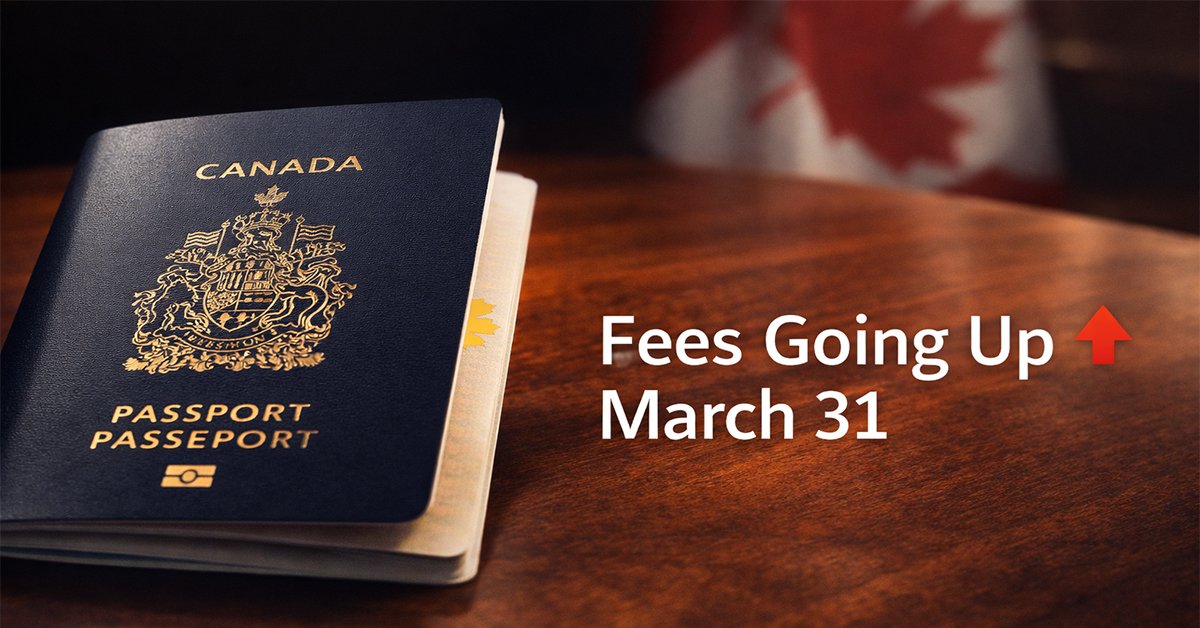
On March 31, 2026, the Government of Canada will increase passport and travel document fees for the first time in more than a decade. It’s not a massive jump — we’re talking a few dollars — but the bigger story isn’t the March 31 increase. It’s what comes after it.
Because this is the beginning of a new system where passport fees go up every single year, tied to inflation. And if IRCC’s ongoing fee review concludes that the program is still underfunded (spoiler: it almost certainly will), you could be looking at more significant hikes down the road.
Here’s everything you need to know.
Why Are Passport Fees Going Up Now?
The short answer is that the government has been quietly running a passport program that costs more than it earns — and the gap has gotten too big to ignore.
Canada’s base passport fees were introduced back in 2013, built around a business model that assumed inflation would average 2% per year through a 10-year cycle ending in March 2023. As most Canadians know all too well, actual inflation ran significantly hotter than that — especially post-pandemic.
The result? Since the last time inflation was accounted for in program fees, the CPI increased by 14.5%, leading to expenditures outpacing revenues by approximately $121 million in fiscal year 2024–2025.
That’s not a rounding error. That’s a $121 million shortfall — in a single year — on a program that processes millions of passports for Canadians every year.
On top of that, the old adjustment formulas that IRCC had used since 2013 only accounted for external costs like mailing and courier services. The fee adjustment formulas do not account for the majority of the costs to deliver passport services, as they only focus on a limited number of categories in which costs are incurred by the Passport Program on a yearly basis. Things like IT infrastructure, employee salaries, application processing systems — none of that was being captured in the old model.
The formula was so skewed, in fact, that if it had been applied for the 2025–2026 fiscal year, fees for Canadians applying from outside the country would have needed to jump by 20%, while the 90–95% of applicants who apply from within Canada would have actually gotten a one per cent reduction. That’s not a functioning pricing system. It needed to be replaced.
What Are the New Fees Starting March 31, 2026?
Here’s the clear breakdown. All relevant fees are expected to rise by 2.7%, in line with the April 2024 All-items Consumer Price Index for Canada.
For applications made inside Canada:
| Document | Current Fee | New Fee (from March 31) |
|---|---|---|
| Adult passport – 5 year | $120.00 | ~$123.24 |
| Adult passport – 10 year | $160.00 | ~$164.32 |
| Child passport (ages 0–15) | $57.00 | ~$58.54 |
For Canadians applying from outside Canada:
| Document | Current Fee | New Fee |
|---|---|---|
| Adult passport – 5 year | $190.00 | ~$195.13 |
| Adult passport – 10 year | $260.00 | ~$267.02 |
Yes, if you apply on March 30, you pay the old price. If you apply on March 31, you pay the new one. For most people, the difference is under $5. But for a family of four renewing passports together, those dollars add up — and they’ll add up again next year.
Pro tip: If you’re due for a renewal in the next few months anyway, consider submitting your application before March 31 to lock in the current rate.
This Is Not a One-Time Increase
This is the part that most coverage has glossed over, and it’s actually the most important thing to understand.
The increase will not be a one-time change, but part of a new payment structure that will see passport fees increase annually in line with inflation.
Under the new framework, passport fees are now subject to Canada’s Services Fees Act (SFA), which legally requires fee changes to track CPI movements. That means every April going forward, fees will automatically adjust up or down based on whatever Statistics Canada’s CPI figure shows.
In practical terms, that almost certainly means up. Canada’s inflation rate has been persistently above 2% for several years now.
But there’s a second layer of change coming that could be even more significant: IRCC is “in the midst of a comprehensive fee structure review, which will result in options for fee adjustments to account for the true cost of operations.”
In plain language: the government is examining whether the base fees themselves need to be repriced from scratch to reflect what it actually costs to run the passport program. That review could result in a more substantial fee overhaul separate from the annual CPI adjustment.
Nobody knows yet what that review will conclude. But given that the program ran a $121 million deficit last year, don’t expect the numbers to go down.
A New Promise: Your Passport in 30 Days or It’s Free
Now here’s the part of this story that’s getting far less attention than it deserves — and it’s actually good news.
Starting April 1, 2026, complete passport applications will be processed within 30 business days or they will be free. Refunds will be issued automatically if processing exceeds 30 business days, meaning no action is required by applicants.
That’s a significant commitment. Anyone who’s gone through the passport backlog nightmare of 2022 and 2023 knows how painful it was when the system buckled under demand. The government had to issue $40 million in passport and travel document fee refunds between January 31, 2023, and March 31, 2025, for failing to meet its service standards for processing applications.
The new policy takes that accountability to another level — if they miss the window, you don’t pay. Full stop.
- → 7 Essential Business Strategies Transforming Success in 2024
- → AI and Machine Learning in 2026: Transforming Business Through Intelligent Innovation
- → Canada Immigration Backlog Update 2026: What the Latest IRCC Data Really Means
- → Mass Flight Disruptions Across Asia: 2,186 Delays and 134 Cancellations Hit Major Airports in India, Japan, Thailand, Malaysia, UAE, Singapore, and Qatar
- → $800 CRA Payment in March 2026: Which Canadian Families Qualify and When to Expect Their Direct Deposit
- → $533 GST/HST Credit for March 2026: Payment Dates, Eligibility, and Everything Canadians Need to Know
- → Canada Medical Expense Tax Claims 2026: Everything You Need to Know Before Filing
Whether the government can actually hold to that standard amid unpredictable demand spikes is another question. But putting it in writing is a meaningful step, and it’s at least partly why the fee increase feels more politically palatable than it might otherwise.
Who Feels This the Most?
IRCC acknowledged in its January 2026 order-in-council that certain groups would be disproportionately affected even by small fee increases: low-income Canadians, families with multiple children, elderly Canadians on fixed incomes, students, refugees, and Canadians living abroad who already pay significantly higher fees than domestic applicants.
For a single adult renewing a 10-year passport, the difference between old and new is about $4.32. That’s a cup of coffee.
For a family of four — two adults and two kids renewing at the same time — you’re looking at closer to $15 extra under the new fees. Still not enormous, but multiply that by annual hikes over several years, and the cumulative impact starts to matter for households watching every dollar.
For Canadians living and working abroad, the picture is already starker. The base fee for an overseas 10-year passport was $260 before this increase — already significantly higher than the domestic price. Post-March 31, that jumps to $267.02, and future increases will compound from that higher starting point.
The Bigger Context: Why Passport Costs Matter in 2026
Canada’s passport is still one of the most valuable travel documents in the world. In the January 2026 Henley Passport Index, Canada remains one of the world’s strongest passports, landing 8th overall and giving holders access to 181 destinations without needing to secure a visa in advance. Canada again sits ahead of the United States, which placed 10th in the most recent rankings.
So Canadians are paying more for a product that remains genuinely powerful. That’s worth remembering.
But it also raises a fair question: when a government document is essentially mandatory for international travel and provides access to visa-free entry in 181 countries, should it be fully cost-recovered through user fees? Or is it a basic service that should be partly subsidized as a public good?
That debate is ongoing, and the comprehensive fee review IRCC is conducting will likely force it back into the public conversation.
What Should You Do Right Now?
Here’s the practical checklist:
1. Check your passport expiry date today. Many countries require at least six months of validity beyond your travel date. If yours is expiring in 2026 or early 2027, now is the time to think about renewal.
2. Apply before March 31 if you want the current price. The difference is small, but if you were already planning to renew, there’s no reason to pay more.
3. Budget for annual increases going forward. This is now a CPI-indexed service. Factor that into family travel planning.
4. Watch for the fee structure review results. IRCC’s comprehensive review could bring more significant changes to the base fee level — follow official IRCC announcements or check Canada.ca for updates.
5. If you’re applying close to the cutoff, pay carefully. Applications submitted on or after March 31 will be charged the new rates. Double-check the official IRCC fee table on the day you pay to confirm the exact amounts.
The Bottom Line
The March 31, 2026 fee increase is real, but for most Canadians the immediate dollar impact is modest. What matters more is the structural change underneath it: Canada’s passport program has permanently moved to an inflation-linked pricing model, and a broader review of the fee structure is in progress.
If the history of government fee reviews is any guide, that process is unlikely to conclude that Canadians are being overcharged.
Renew early if you can. And if the 30-day processing promise holds up, the trade-off may actually be worth it.
