

Let me tell you about something that might completely change your immigration strategy.
If you’ve been researching ways to move to Canada permanently, you’ve probably run into the harsh reality of the Comprehensive Ranking System (CRS). You’ve calculated your score, compared it to recent Express Entry draws, and realized with a sinking feeling that you’re nowhere close to the cutoff.
You’re not alone. Thousands of skilled professionals find themselves in the same boat—qualified, motivated, but just not scoring high enough to receive that golden Invitation to Apply (ITA) for permanent residence.
But here’s something many people don’t realize: a Canadian master’s degree isn’t just about education. It’s one of the most strategic moves you can make to dramatically boost your immigration chances.
Let me show you exactly how this works, with real numbers and a real example.
Why Your CRS Score Matters (And Why It’s Probably Not High Enough)
First, let’s talk about the elephant in the room. Canada’s Express Entry system uses the CRS to rank candidates for permanent residence. The highest-scoring candidates get invited to apply. Everyone else waits.
In 2025, the Canadian Experience Class (CEC) draws—which are for people with Canadian work experience—had cutoff scores ranging from 515 to 547 points. If you’re sitting at 400 or 450 points, that gap feels insurmountable.
The brutal truth? For many skilled workers applying from outside Canada, reaching those scores without Canadian credentials or work experience is extremely difficult, sometimes impossible.
The Master’s Degree Strategy: Real Numbers That Matter
Here’s where things get interesting. A Canadian master’s degree doesn’t just add a few points to your CRS score—it can add up to 165 points when you factor in everything it unlocks.
Let me break down exactly what you gain:
Direct Education Points:
- Canadian master’s degree: 135 points (vs. 120 for a bachelor’s)
- Additional points for Canadian education: 30 points
What It Enables:
- → 7 Essential Business Strategies Transforming Success in 2024
- → AI and Machine Learning in 2026: Transforming Business Through Intelligent Innovation
- → Canada Immigration Backlog Update 2026: What the Latest IRCC Data Really Means
- → Mass Flight Disruptions Across Asia: 2,186 Delays and 134 Cancellations Hit Major Airports in India, Japan, Thailand, Malaysia, UAE, Singapore, and Qatar
- → $800 CRA Payment in March 2026: Which Canadian Families Qualify and When to Expect Their Direct Deposit
- → $533 GST/HST Credit for March 2026: Payment Dates, Eligibility, and Everything Canadians Need to Know
- → Canada Medical Expense Tax Claims 2026: Everything You Need to Know Before Filing
- Three-year Post-Graduation Work Permit (PGWP): Opens the door to Canadian work experience
- Canadian work experience (1 year): 40 points
- Enhanced skill transferability: Up to 63 points more when you combine Canadian education with work experience
When you add it all up, the difference between having just a foreign bachelor’s degree and a Canadian master’s with one year of work experience can be over 120 points.
That’s not a small bump—that’s the difference between being invited and being stuck in the pool indefinitely.
Real Person, Real Results: Anna’s Story
Let me show you how this plays out in real life. Meet Anna (not her real name, but this is based on actual immigration cases I’ve seen).
Anna’s Starting Point:
- Age: 24 years old
- Education: Bachelor’s degree from India
- Work experience: 2 years as a project manager in India
- English: Perfect score (CLB 10)
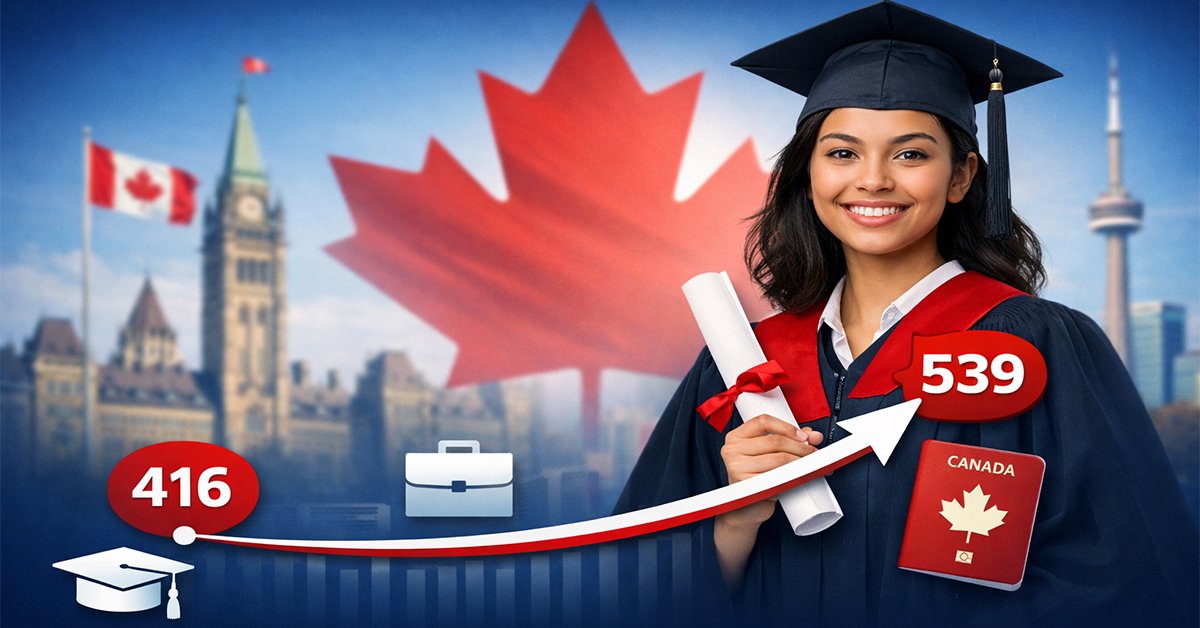
- Initial CRS Score: 416
With a score of 416, Anna had virtually zero chance of being invited under the CEC draws in 2025. She was looking at potentially years of waiting, hoping the cutoff would drop dramatically (spoiler: it won’t).
Anna’s Decision:
Instead of waiting and hoping, Anna did her research and decided to invest in a Canadian master’s degree. She:
- Applied to Canadian master’s programs
- Got accepted to the University of Toronto
- Obtained her study permit
- Completed a one-year master’s program
- Got a three-year Post-Graduation Work Permit
- Worked as a project manager in Toronto for one year
Anna’s New CRS Score: 539
Let that sink in. In roughly two years, Anna went from a score of 416 (not competitive) to 539 (highly competitive).
With a score of 539, she would have qualified for 13 out of 15 CEC draws in 2025. She went from having virtually no chance to having excellent odds of receiving an ITA.
The Detailed Breakdown: Where The Points Come From
Let’s look at Anna’s score transformation side-by-side:
| CRS Component | Before Master’s | After Master’s + 1 Year Work |
|---|---|---|
| Age | 110 | 110 |
| Education | 120 | 135 |
| Language | 136 | 136 |
| Canadian Work Experience | 0 | 40 |
| Skill Transferability (Education) | 25 | 50 |
| Skill Transferability (Foreign Work) | 25 | 38 |
| Additional Points | 0 | 30 |
| TOTAL | 416 | 539 |
The magic happens in four key areas:
- Education upgrade: +15 points
- Canadian education bonus: +30 points
- Canadian work experience: +40 points
- Enhanced skill transferability: +38 points
Total gain: 123 points
Will This Work For Everyone?
Look, I’m not going to tell you this is the perfect solution for everyone. Going back to school is a big decision—it requires time, money, and commitment.
But let’s be realistic about the alternatives:
- Waiting for scores to drop? CRS cutoffs have been steadily high, and with Canada’s immigration targets being reassessed, there’s no guarantee they’ll drop significantly.
- Improving language scores? If you’re already at CLB 9 or 10, there’s not much room left to improve.
- Gaining more foreign work experience? This adds some points, but not nearly enough to make up a 100+ point gap.
For many people, especially those under 35 with strong English skills and some work experience, a Canadian master’s is the most reliable path to permanent residence.
The Minimum Guaranteed Boost
Even if you don’t follow Anna’s exact path, here’s what any sole applicant can expect:
- From foreign bachelor’s to Canadian master’s: +45 points minimum
- From Canadian bachelor’s to Canadian master’s: +30 points minimum
And that’s before considering the work experience you’ll gain through your PGWP, which adds another 40+ points.
The Money Question: Can You Actually Afford This?
I know what you’re thinking: “This sounds great, but master’s degrees are expensive, especially for international students.”
Fair point. But here’s something many people don’t know: some Canadian universities offer funding packages for international graduate students that can cover or even exceed tuition costs.
Academic master’s programs (thesis-based) often come with:
- Teaching assistantships
- Research assistantships
- Scholarships
- Stipends
I’ve seen students receive funding packages ranging from $15,000 to $30,000 per year, which can significantly offset or even cover tuition and living expenses.
Professional master’s programs (course-based) typically don’t offer as much funding, but the programs are often just one year long, limiting your total investment.
The return on investment? Permanent residence in Canada, with all the benefits that brings: healthcare, education, job opportunities, and a path to citizenship.
What You Need to Know Before Applying
If you’re seriously considering this route, here’s what you need to do:
1. Research Programs Strategically
Not all master’s programs are created equal for immigration purposes. Look for:
- Programs at least one year long (to qualify for a three-year PGWP)
- Designated Learning Institutions (DLIs)
- Programs that match your previous education and work experience
- Schools with good international student support
2. Understand the Timeline
From start to finish, you’re looking at roughly:
- Application process: 6-12 months
- Master’s program: 1-2 years
- Work experience needed: 1 year
- Total: 2.5-4 years to PR
Yes, it’s a significant time investment, but compare that to waiting indefinitely in the Express Entry pool with a score that won’t get you invited.
3. Calculate Your Potential CRS Score
Use the CRS calculator on the IRCC website to see where you’d land with:
- A Canadian master’s degree
- One year of Canadian work experience
If this puts you above 500, you’re in strong territory.
4. Have a Backup Plan
While this strategy works for many people, immigration rules can change. Make sure you:
- Stay informed about PGWP eligibility requirements
- Understand which occupations qualify for Express Entry
- Keep your language test scores current
- Maintain a clean immigration record
The Provincial Nominee Programs (PNP) Bonus
Here’s an extra benefit I haven’t mentioned yet: many Provincial Nominee Programs (PNPs) give preference to candidates with Canadian education.
If you study in a particular province, you may become eligible for that province’s PNP streams, some of which:
- Require lower CRS scores
- Have dedicated streams for master’s graduates
- Can add an additional 600 points to your CRS score (essentially guaranteeing an ITA)
Ontario, British Columbia, and other provinces have specific streams for international master’s graduates. This gives you multiple pathways to PR, not just Express Entry.
Is This Strategy Right For You?
A Canadian master’s degree makes the most sense if you:
- Are under 35 years old (to maximize age points)
- Have strong English or French skills (CLB 8+)
- Have a bachelor’s degree and some work experience
- Are willing to invest 2-4 years in the process
- Have a CRS score currently below 480
- Want to build a life in Canada long-term
It might not be the right fit if you:
- Already have a very high CRS score (500+)
- Are over 40 (age points decrease significantly)
- Need to immigrate immediately for family reasons
- Have significant financial constraints with no funding options
The Bottom Line
Getting permanent residence in Canada is competitive. Really competitive. If you’re playing the Express Entry game with a score under 480, you’re essentially hoping for a miracle.
A Canadian master’s degree isn’t a shortcut—it’s a strategic investment. You’re not gaming the system; you’re gaining legitimate Canadian credentials and experience that make you a stronger candidate.
For someone like Anna, it was the difference between watching others get invited from the sidelines and actually receiving her ITA. The two years she invested in her education became the foundation for her new life in Canada.
If you’ve been stuck in the Express Entry pool, watching draw after draw go by with scores you can’t reach, maybe it’s time to consider a different approach. The master’s degree route requires patience and investment, but it’s one of the most reliable paths to making Canada your permanent home.
Thinking about pursuing a master’s degree in Canada? Drop your questions in the comments—I’m happy to help you figure out if this strategy makes sense for your situation.
