
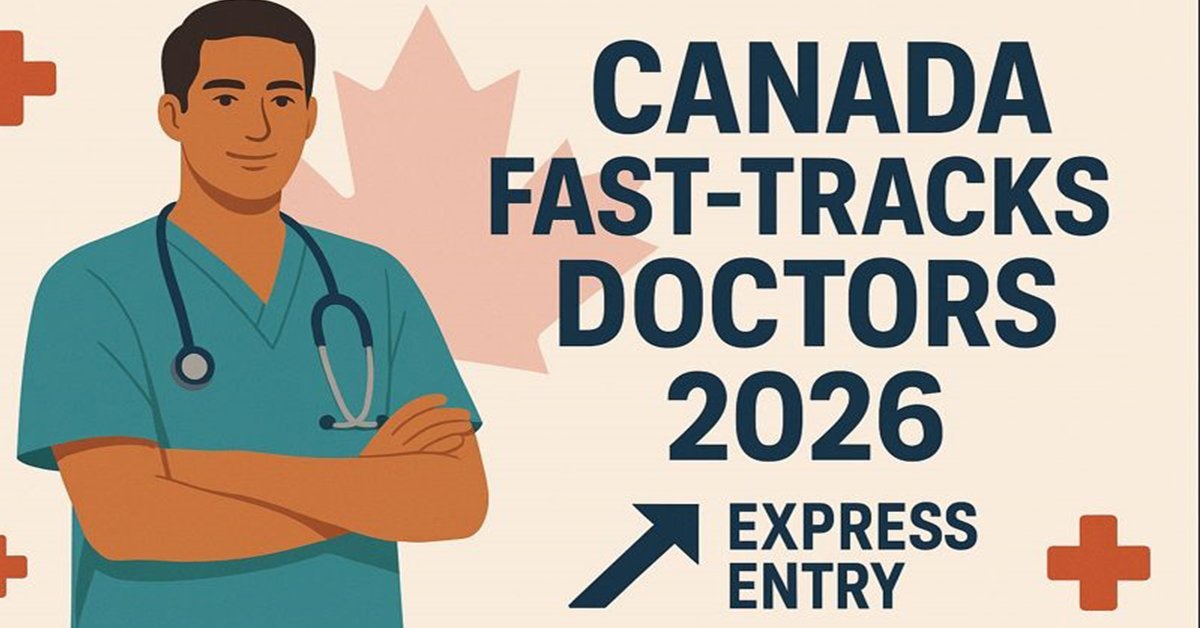

Introduction: A Game-Changer for Healthcare Immigration
Canada has unveiled its most ambitious physician recruitment strategy to date. On December 8, 2025, Immigration, Refugees and Citizenship Canada (IRCC) announced a specialized Express Entry category exclusively for doctors, set to launch in early 2026.
This groundbreaking initiative addresses Canada’s critical physician shortage by creating two parallel pathways: a dedicated Express Entry stream for doctors with Canadian experience and 5,000 reserved permanent residence spaces for provincially nominated physicians.
For international medical professionals, this represents an unprecedented opportunity to build a career in Canada while fast-tracking permanent residency.
Understanding Canada’s New Doctor-Specific Express Entry Category
Who Qualifies for the Physician Express Entry Stream?
The new category targets practice-ready doctors already integrated into Canada’s healthcare system. To be eligible, candidates must meet these requirements:
Work Experience Requirements:
- Minimum 12 months of full-time continuous Canadian work experience (or equivalent part-time hours)
- Experience gained within the past 3 years
- Employment in a single eligible medical occupation
- Compliance with all round-specific instructions issued by IRCC
This pathway eliminates the need for doctors to compete against general skilled workers under standard Comprehensive Ranking System (CRS) scores, offering a dedicated route to permanent residency.
Eligible Medical Occupations and NOC Codes
The category covers three major physician classifications under Canada’s National Occupational Classification (NOC) system:
1. General Practitioners and Family Physicians (NOC 31102)
- Family physicians
- General practitioners (GP)
- Medical doctors in community practice
- General practice residents
- Community preventive medicine physicians
2. Surgical Specialists (NOC 31101)
- Cardiac surgeons
- Neurosurgeons
- Orthopedic surgeons
- Obstetrician-gynecologists
- Plastic surgeons
- Pediatric surgeons
- Urologists
- Vascular surgeons
- Thoracic surgeons
- Ophthalmologists
- Otorhinolaryngologists
3. Clinical and Laboratory Medicine Specialists (NOC 31100)
- Cardiologists
- Emergency physicians
- Anesthetists
- Pediatricians
- Psychiatrists
- Oncologists
- Radiologists
- Dermatologists
- Endocrinologists
- Gastroenterologists
- Nephrologists
- Neurologists
- Hematologists
- Rheumatologists
- And 15+ additional specialist roles
Important Note: Eligibility depends on actual Canadian work experience in these positions, not just the primary occupation listed in your Express Entry profile.
The 5,000 Reserved PR Spaces: Provincial Nominee Fast-Track
Beyond Express Entry, Canada has allocated 5,000 dedicated permanent residence admission spaces for doctors nominated through Provincial Nominee Programs (PNPs).
Key Features of the PNP Physician Stream:
Expedited Processing:
- 14-day work permit processing for nominated doctors
- Ability to work immediately while PR application processes
- Additional allocation beyond regular PNP quotas
Provincial Control:
- Provinces maintain authority over medical licensing
- Job matching handled at provincial level
- Credential recognition managed by provincial medical boards
Ideal Candidates:
- Internationally trained doctors outside Canada
- Licensed physicians with valid Canadian job offers
- Medical professionals seeking immediate workforce integration
This dual-track approach ensures provinces can address region-specific healthcare shortages while maintaining quality control over medical credentials.
Why Canada Needs International Doctors Now
The Healthcare Crisis by Numbers
Canada faces a physician shortage that threatens healthcare access nationwide:
- 5.7 million adults (17%) lack a regular healthcare provider
- 765,000 children and youth (11%) have no consistent medical care
- Immigration accounts for nearly 100% of labour force growth
- Rural and remote communities face severe doctor shortages
These statistics paint a clear picture: Canada’s healthcare system requires immediate physician recruitment to maintain service levels.
Strategic Immigration Reform
This initiative forms part of Canada’s broader International Talent Attraction Strategy, designed to:
- Stabilize long-term healthcare workforce supply
- Fill critical skill gaps in essential services
- Support economic growth through immigration
- Strengthen public infrastructure, particularly healthcare
The physician-focused approach represents a shift toward occupation-specific immigration pathways that address urgent national needs.
- → 7 Essential Business Strategies Transforming Success in 2024
- → AI and Machine Learning in 2026: Transforming Business Through Intelligent Innovation
- → Canada Immigration Backlog Update 2026: What the Latest IRCC Data Really Means
- → Mass Flight Disruptions Across Asia: 2,186 Delays and 134 Cancellations Hit Major Airports in India, Japan, Thailand, Malaysia, UAE, Singapore, and Qatar
- → $800 CRA Payment in March 2026: Which Canadian Families Qualify and When to Expect Their Direct Deposit
- → $533 GST/HST Credit for March 2026: Payment Dates, Eligibility, and Everything Canadians Need to Know
- → Canada Medical Expense Tax Claims 2026: Everything You Need to Know Before Filing
Timeline and Implementation: What to Expect in 2026
Q1 2026:
- Express Entry physician category invitations begin (pending Budget 2025 approval)
- Detailed eligibility instructions released by IRCC
- First category-based draws for doctors
Throughout 2026:
- Provinces access 5,000 reserved nomination spaces
- 14-day work permit processing implemented
- Ongoing Express Entry draws for medical professionals
Preparation Steps for Candidates:
- Secure eligible Canadian work experience in designated NOC codes
- Obtain or maintain provincial medical licensing
- Document continuous employment for required period
- Create or update Express Entry profile
- Research provincial nomination opportunities
How This Compares to Existing Immigration Pathways
Express Entry Before vs. After
Traditional Route:
- Doctors competed in general skilled worker pool
- High CRS scores often required (470-500+ range)
- No occupation-specific priority
- Longer wait times for invitations
New Physician Category:
- Dedicated draws exclusively for doctors
- Category-based selection prioritizes medical professionals
- Lower effective competition
- Faster pathway to permanent residency
Provincial Nominee Programs Enhanced
While PNPs previously nominated doctors, the new system adds:
- Guaranteed federal PR spaces (5,000 annually)
- Expedited 14-day work permit processing
- Clear pathway from temporary work permit to PR
- Reduced processing uncertainty
Practical Steps for International Doctors
For Doctors Already in Canada:
- Verify Your Work Experience:
- Confirm your position matches eligible NOC codes
- Calculate continuous full-time hours (or part-time equivalent)
- Ensure experience falls within 3-year window
- Maintain Documentation:
- Employment letters with detailed job duties
- Proof of licensing and credentials
- Pay stubs and tax records
- Monitor IRCC Announcements:
- Watch for first draw date announcement
- Review specific eligibility requirements when published
- Prepare Express Entry profile in advance
For Internationally Trained Doctors Outside Canada:
- Research Provincial Programs:
- Identify provinces with active physician recruitment
- Review licensing requirements by province
- Connect with provincial medical boards
- Secure Job Offers:
- Apply to healthcare facilities in target provinces
- Network with recruitment agencies specializing in medical placements
- Explore rural and remote opportunities with additional incentives
- Begin Credential Recognition:
- Contact Medical Council of Canada for equivalency assessment
- Prepare for required examinations (MCCQE if needed)
- Gather translated and authenticated documents
Frequently Asked Questions
Q: When exactly will the first invitations be sent? A: Early 2026, subject to final Budget 2025 approval. IRCC will announce specific dates closer to launch.
Q: Can part-time work count toward the 12-month requirement? A: Yes, part-time hours can be combined to equal 12 months of full-time work (typically 1,560 hours total).
Q: Do I need a job offer to apply through Express Entry? A: Not for the Express Entry physician category—it’s based on past Canadian work experience. However, PNP nominations typically require valid job offers.
Q: Will my medical specialty affect my chances? A: All listed NOC codes are eligible. However, provinces may prioritize certain specialties based on regional needs.
Q: Can my family immigrate with me? A: Yes, permanent residence applications include spouse/common-law partners and dependent children.
Conclusion: Canada’s Commitment to Healthcare Strengthening
The 2026 physician-focused immigration reforms signal Canada’s recognition that healthcare sustainability requires immediate, targeted action. By creating dedicated pathways for doctors, Canada addresses both short-term staffing crises and long-term workforce stability.
For international medical professionals, this represents a rare alignment of professional opportunity and immigration accessibility. Whether you’re already practicing in Canada or preparing to make the move, these new pathways offer unprecedented clarity and speed toward permanent residency.
As healthcare demands continue growing, Canada’s investment in physician immigration positions the country as an increasingly attractive destination for global medical talent.
Stay Updated: Bookmark the official IRCC website for draw announcements and detailed program guidelines as they’re released in 2026.
