
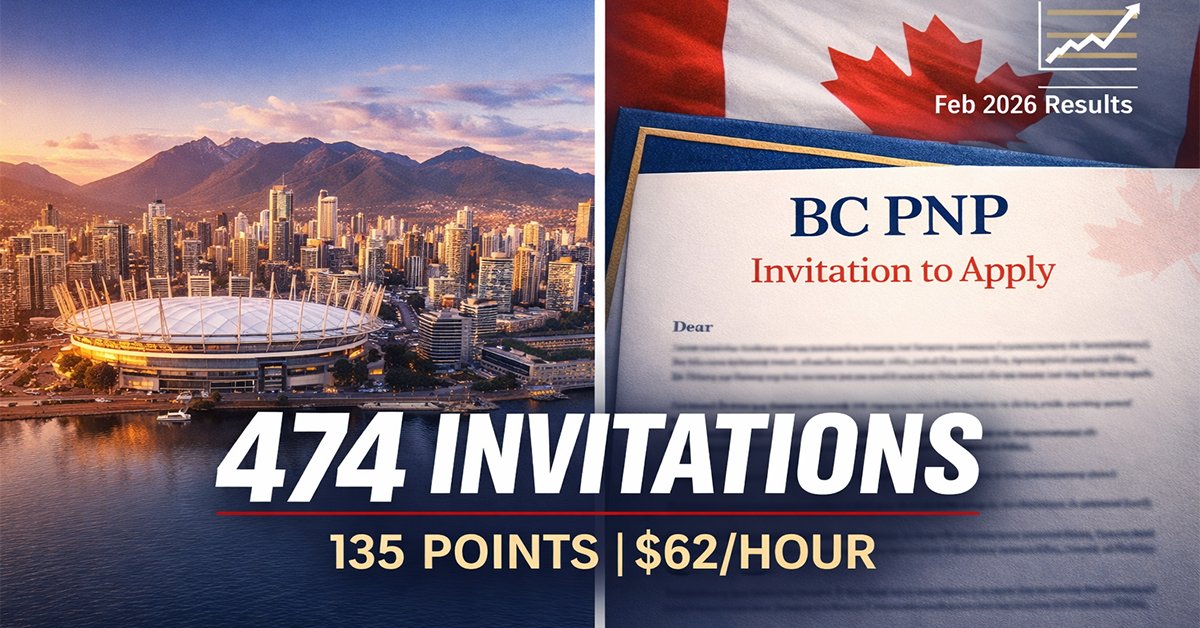

British Columbia just wrapped up two significant immigration draws that sent 474 invitations flying out to skilled workers and entrepreneurs—and the details reveal exactly what kind of candidates the province wants right now.
If you’ve been monitoring BC’s Provincial Nominee Program (BC PNP) hoping for your shot at Canadian permanent residence, these February 2026 results contain some genuinely useful information about where the program is heading.
Let me break down what actually happened, what it means for your application strategy, and whether you should be optimizing your profile right now or waiting for better conditions.
The Numbers That Actually Matter
February 10: Entrepreneur Immigration Draw
- 14 total invitations across two streams
- Base stream: 13 ITAs with a minimum score of 121 points
- Regional stream: Fewer than 5 ITAs with a minimum score of 105 points
February 11: Skills Immigration Draw
- 460 total invitations targeting “high economic impact” candidates
- 195 invitations based on wage threshold ($62/hour minimum)
- 265 invitations based on points (135 minimum score)
Combined, that’s 474 people who just moved significantly closer to becoming permanent residents of British Columbia.
But here’s what the raw numbers don’t tell you: the criteria are shifting in ways that could either help or hurt your chances, depending on your profile.
What “High Economic Impact” Really Means
BC has gotten increasingly specific about who they’re inviting, and the February 11 draw perfectly illustrates this targeted approach.
The province is essentially saying: “We want workers who will contribute significantly to our economy—and we’re measuring that through salary levels and competitive point scores.”
To qualify under the high economic impact criteria in this draw, you needed one of two things:
Option 1: The Salary Route
- Minimum wage of $62 per hour (roughly $125,000 annually)
- Job offer in a NOC TEER 0, 1, 2, or 3 occupation
- That’s it—if you meet these requirements, the points didn’t matter
Option 2: The Competitive Score Route
- Minimum of 135 points in BC’s registration system
- No specific salary threshold required
- Job offer still necessary, but more flexibility on occupation level
Here’s what’s interesting: the $62/hour threshold represents a decrease from the previous draw on February 4, which required $70/hour. That’s actually good news if you’re in the $62-$70 range—BC is signaling they’re willing to cast a slightly wider net for high-earners.
The points threshold also dropped from 138 to 135. Not a massive change, but every point counts when you’re close to the cutoff.
The Entrepreneur Draws: Small Numbers, Big Opportunity
While the skills immigration draw grabbed most of the attention with 460 invitations, the entrepreneur draws shouldn’t be overlooked—especially if you have business experience and capital.
The Base Stream is your typical high-investment entrepreneurship path:
- Minimum $600,000 net worth
- Minimum $200,000 investment required
- Can establish your business anywhere in BC
- Higher score requirement (121 points in this draw)
- Generally doesn’t require community referral
The Regional Stream offers a more accessible entry point:
- Lower net worth requirement (around $300,000)
- Lower investment threshold (approximately $100,000)
- Must locate in a participating regional community
- Requires exploratory visit and community referral
- Lower score requirement (105 points in this draw)
- Usually requires 51%+ business ownership
The fact that fewer than 5 invitations went out under the regional stream (BC intentionally keeps these numbers vague to protect candidate privacy) tells you it’s highly competitive—but also that each invitation carries significant weight.
Reading the Pool Statistics: Where Do You Really Stand?
As of February 8, 2026, here’s the brutal reality of competition in BC’s Skills Immigration pool:
| Score Range | Candidates Waiting |
|---|---|
| 150+ | 4 |
| 140-149 | 12 |
| 130-139 | 688 |
| 120-129 | 1,197 |
| 110-119 | 1,647 |
| 100-109 | 2,134 |
| 90-99 | 1,979 |
| 80-89 | 1,529 |
| 70-79 | 1,001 |
| 60-69 | 468 |
| 0-59 | 329 |
| Total | 10,988 |
Let’s put this in perspective: with a cutoff score of 135, this draw effectively invited the top 700-ish candidates from a pool of nearly 11,000 people.
If you’re sitting in the 110-119 range with 1,647 other candidates, you’re not getting invited in these high-impact draws. You need to either:
- Dramatically improve your score, or
- Wait for BC to hold more inclusive draws targeting specific occupations or lower score ranges
The good news? BC typically holds draws every 1-2 weeks, and not all draws maintain these elevated thresholds. The province has historically rotated between targeted high-impact draws and broader occupation-specific rounds.
Why These Draws Look Different Than 2025
If you’ve been following BC PNP throughout 2025, you probably noticed the program was challenging. Allocations were tight, scores were high, and draws were less frequent than many candidates hoped.
2026 is showing early signs of improvement:
- BC received a 2026 allocation of 5,254 nominations from the federal government
- While not as high as the province requested, it’s more than the initial 2025 cap
- Draw frequency appears to be stabilizing at roughly bi-weekly
- Score thresholds, while still competitive, show signs of easing (February 11’s 135-point cutoff vs February 4’s 138-point requirement)
BC has invited 914 candidates year-to-date through Skills Immigration streams—a pace that suggests they’re committed to using their full allocation, unlike some provinces that hoard nominations until late in the year.
The Occupation Priority Shift You Need to Understand
Throughout 2025 and into early 2026, BC has been experimenting with occupation-targeted draws focusing on:
- Childcare workers (NOC 42202)
- Construction occupations (various NOC codes)
- Healthcare professionals (nurses, medical lab technologists, etc.)
- Tech workers (software engineers, tech project managers)
- Veterinary care (veterinarians, vet technicians)
The February draws didn’t specify occupations—instead focusing purely on “economic impact” measured by salary and points. But BC has indicated that future high-impact draws may rotate criteria, potentially targeting:
- Specific education levels or fields
- Regional assignments outside Metro Vancouver
- Clean tech or green energy occupations
- Language capabilities (particularly French)
If you’re wondering whether to register now or wait, the answer depends entirely on whether you can meet current thresholds. There’s no indication that general requirements will suddenly drop—if anything, BC seems committed to maintaining quality standards even as they increase volume.
Your Realistic Game Plan Based on These Results
If your score is 130+: You’re in striking distance. Focus on incremental improvements:
- Retake language tests if you’re even 1 band short of maximum scores
- Complete an Educational Credential Assessment if you haven’t
- Ensure your job offer documentation is absolutely airtight
- Monitor draws weekly and be ready to respond within 30 days of receiving an ITA
If your score is 110-129: You need strategic improvements:
- Consider whether a higher-level position with the same employer would boost your wage to the $62/hour threshold
- Look at whether additional Canadian work experience could improve your score
- Evaluate if a master’s degree or additional certification makes sense for your field
- Watch for occupation-specific draws that might have lower cutoffs
If your score is below 110: Be honest about timeline:
- You’re likely 12-18 months away from being competitive in current draw conditions
- Focus on gaining Canadian experience (through LMIA work permit, PGWP, or other pathways)
- Build language scores to maximum possible levels
- Consider whether another province’s PNP might be more accessible right now
For entrepreneurs: The base stream had 13 invitations at 121 points, while regional had fewer than 5 at 105 points. This tells you:
- Competition is fierce in both streams
- Regional stream appears even more selective despite lower score requirement
- Your business proposal quality matters enormously
- Community referral relationships could be decisive for regional applicants
What Happens After You Get the ITA
Let’s say you’re one of the 460 or 14 people who received invitations in these draws. Your actual work is just beginning:
You have 30 days to submit a complete application package through BC’s online portal, including:
- Proof of valid job offer
- Current language test results
- Educational credential assessments
- Verified work experience documentation
- Application fee of $1,750 CAD
Processing takes 3-4 months for most Skills Immigration applications (80% of cases fall within this timeframe, though complexity can extend timelines).
If nominated, you receive 600 additional CRS points in Express Entry (if you’re in that pool) or can apply for PR directly through the provincial program.
If you’re already in Canada on a work permit and receive an Acknowledgment of Receipt (AOR) for your PR application, you can apply for a Bridging Open Work Permit (BOWP) to maintain legal status while your application processes.
The Larger Picture: Where BC PNP Fits in 2026 Immigration Strategy
Provincial nominee programs like BC PNP exist because provinces have specific labor market needs that federal programs don’t always address quickly enough.
BC needs:
- High-earning professionals who contribute significantly to tax revenue
- Skilled trades workers for ongoing construction and infrastructure projects
- Entrepreneurs who’ll create jobs for Canadians and PR holders
- Healthcare workers to address critical shortages
- Tech talent to maintain BC’s position as a tech hub
If your profile aligns with these needs, BC PNP offers a significantly faster path than waiting for federal Express Entry draws—especially if you’re not Canadian Experience Class eligible or sitting below 500 CRS points.
But PNPs require strategy. The days of just submitting a profile and hoping are over. You need to:
- Understand exactly how BC scores your profile
- Know which draws you’re actually competitive for
- Time your application to maximize your score
- Have all documentation ready before you receive an ITA
Should You Be Optimistic About Future Draws?
Based on these February results and broader 2026 trends, here’s my honest assessment:
Reasons for optimism:
- Draw frequency appears stable at bi-weekly
- Score thresholds are slightly declining (138 → 135 for points-based)
- Wage threshold decreased ($70/hour → $62/hour)
- BC is using its full allocation rather than holding back
- Year-to-date pace suggests consistent invitation volume
Reasons for caution:
- Pool size (10,988 candidates) remains large relative to invitation volume
- Only the top 6-7% of candidates received invitations in this draw
- “High economic impact” criteria may remain standard rather than exception
- No indication of broader, less selective draws coming soon
The reality is probably somewhere in the middle: BC will continue issuing invitations consistently, but competition will remain tough. If you’re close to threshold scores, you have a realistic shot. If you’re significantly below, you need to invest in score improvement before expecting results.
Your Next Steps
Stop obsessing over every draw result and start focusing on what you control:
- Calculate your exact BC PNP score using the official points calculator
- Identify your weakest scoring categories and create an improvement plan
- Document everything (especially work experience—vague job descriptions kill applications)
- Build relationships with BC employers if you’re not already working in the province
- Watch for occupation-specific draws that might favor your NOC code
- Keep your profile active and updated in the system
British Columbia isn’t going to suddenly open the floodgates and invite everyone. But they are consistently inviting qualified candidates who meet their current economic priorities.
The question isn’t whether BC PNP is a viable path to permanent residence—these 474 invitations prove it absolutely is. The question is whether you’re building a profile that matches what BC is actually looking for right now, in February 2026, rather than what worked three years ago.
If you can honestly answer yes to that question, these draw results should give you hope. If you can’t, they should give you clarity about what needs to change.
