
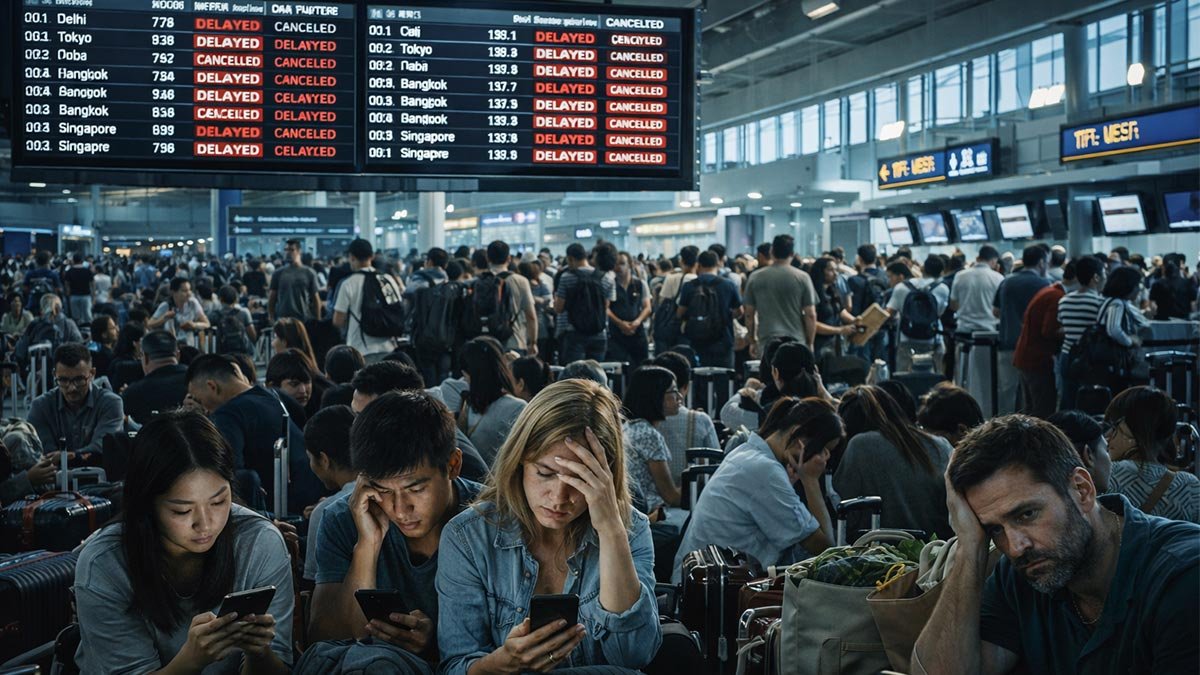

A wave of severe aviation disruptions has left thousands of passengers stranded across Asia, as a combined total of 2,186 flight delays and 134 cancellations were recorded across major airports spanning seven countries — India, Japan, Thailand, Malaysia, Singapore, the United Arab Emirates, and Qatar. The scale of the disruption has impacted some of the region’s busiest travel hubs and most prominent carriers, creating widespread chaos for travelers in cities including Delhi, Mumbai, Tokyo, Bangkok, Kuala Lumpur, Singapore, Dubai, Doha, Abu Dhabi, Fukuoka, and Osaka.
Scale of the Disruption: Key Highlights at a Glance
- A total of 2,186 delays and 134 cancellations were logged across major Asian airports
- Delhi’s Indira Gandhi International Airport emerged as the most disrupted hub with 565 delays
- Kuala Lumpur recorded 372 delays, followed closely by Bangkok with 253
- Mumbai and Tokyo Haneda each reported approximately 250 delays
- Dubai International Airport registered the highest cancellation count of any airport at 56
- IndiGo and Air India together accounted for more than 400 delays combined
- AirAsia was the dominant source of disruption at Kuala Lumpur with 172 delays
- Japan Airlines and ANA were responsible for the bulk of Tokyo’s delays
- Qatar Airways drove nearly all recorded disruptions at Doha’s Hamad International Airport
Most Disrupted Airports Across Asia
Indira Gandhi International Airport — Delhi, India
Delhi claimed the unenviable title of Asia’s most disrupted airport during this period, logging a staggering 565 delays and 7 cancellations. The disruption was largely fueled by the high volume of IndiGo and Air India operations passing through the capital’s primary gateway.
Kuala Lumpur International Airport — Malaysia
Malaysia’s main aviation hub recorded 372 delays and 4 cancellations, with budget carrier AirAsia contributing to nearly half of all delayed departures and arrivals at the airport.
Suvarnabhumi Airport — Bangkok, Thailand
Bangkok’s principal international airport reported 253 delays and 3 cancellations, with the impact distributed across multiple regional carriers operating through the Thai capital.
- → AI and Machine Learning in 2026: Transforming Business Through Intelligent Innovation
- → Canada Immigration Backlog Update 2026: What the Latest IRCC Data Really Means
- → $800 CRA Payment in March 2026: Which Canadian Families Qualify and When to Expect Their Direct Deposit
- → $533 GST/HST Credit for March 2026: Payment Dates, Eligibility, and Everything Canadians Need to Know
- → Canada Medical Expense Tax Claims 2026: Everything You Need to Know Before Filing
- → Canada Pension Plan (CPP) and Old Age Security (OAS): 2026 Payment Updates Every Canadian Retiree Should Know
- → CRA Benefit Payments March 2026: Complete Schedule, Eligibility & Deposit Dates
Chhatrapati Shivaji Maharaj International Airport — Mumbai, India
Mumbai’s international terminal recorded 250 delays and 8 cancellations, with IndiGo and Air India once again emerging as the primary contributors to the congestion.
Tokyo Haneda Airport — Japan
Tokyo Haneda logged 249 delays and 3 cancellations, with Japan Airlines and All Nippon Airways (ANA) accounting for the overwhelming majority of affected flights on domestic and international routes.
Singapore Changi Airport — Singapore
One of the world’s most celebrated aviation hubs was not immune to the disruptions, recording 152 delays and 3 cancellations, primarily driven by Scoot and Singapore Airlines operations.
Hamad International Airport — Doha, Qatar
Doha reported 55 delays and 27 cancellations, with Qatar Airways responsible for driving most of the disruption at this Gulf hub.
Dubai International Airport — UAE
Dubai stood out for a different reason — while recording 71 delays, it posted the highest cancellation count of all airports at 56, reflecting a more aggressive approach to outright cancellations rather than extended delays.
Abu Dhabi International Airport — UAE
The UAE’s secondary major hub recorded 44 delays and 13 cancellations, adding to the broader pattern of disruption across Gulf aviation corridors.
Fukuoka Airport — Japan
Fukuoka reported 112 delays and 6 cancellations, making it a notable disruption point within Japan’s domestic and short-haul regional network.
Osaka Itami Airport — Japan
Osaka’s domestic-focused airport logged 63 delays and 4 cancellations, contributing to the overall picture of significant strain across Japanese aviation infrastructure.
Airlines Most Severely Affected
IndiGo
The Indian low-cost carrier bore the heaviest burden of any single airline, recording 209 delays and 2 cancellations — making it the largest individual contributor to overall disruption, particularly at Delhi and Mumbai.
Air India
India’s flag carrier reported 196 delays and 1 cancellation, with major disruption concentrated across its primary Indian hub operations.
AirAsia
The Southeast Asian budget giant logged 172 delays, dominating the disruption landscape at Kuala Lumpur and adding considerable pressure to regional connectivity across Southeast Asia.
Japan Airlines (JAL)
Japan Airlines recorded 112 delays and 1 cancellation, with the majority of the impact felt on routes passing through Tokyo Haneda and across the Japanese domestic network.
All Nippon Airways (ANA)
ANA followed closely with 79 delays and 1 cancellation, mirroring Japan Airlines in terms of disruption concentration around Tokyo’s aviation corridors.
Malaysia Airlines
The national carrier of Malaysia reported 84 delays and 4 cancellations, significantly compounding the congestion already being experienced at Kuala Lumpur International Airport.
Qatar Airways
Qatar’s flagship carrier recorded 54 delays and 13 cancellations, accounting for the vast majority of all disruptions registered at Doha’s Hamad International Airport.
Emirates
The Dubai-based global carrier logged 47 delays and 6 cancellations, with disruption primarily centered on operations through Dubai International Airport.
Singapore Airlines and Scoot
Both carriers contributed to disruptions at Singapore Changi Airport, each recording 35 delays, with Scoot also logging 1 cancellation.
Thai Airways
Thailand’s national airline reported 59 delays, adding to the broader congestion experienced at Bangkok’s Suvarnabhumi Airport.
Full Airport Disruption Summary
| Airport | City | Delays | Cancellations |
|---|---|---|---|
| Indira Gandhi International | Delhi | 565 | 7 |
| Kuala Lumpur International | Kuala Lumpur | 372 | 4 |
| Suvarnabhumi Airport | Bangkok | 253 | 3 |
| Chhatrapati Shivaji Maharaj | Mumbai | 250 | 8 |
| Tokyo Haneda Airport | Tokyo | 249 | 3 |
| Singapore Changi Airport | Singapore | 152 | 3 |
| Fukuoka Airport | Fukuoka | 112 | 6 |
| Osaka Itami Airport | Osaka | 63 | 4 |
| Dubai International Airport | Dubai | 71 | 56 |
| Hamad International Airport | Doha | 55 | 27 |
| Abu Dhabi International Airport | Abu Dhabi | 44 | 13 |
What Affected Passengers Should Do Right Now
If you are among the thousands impacted by these disruptions, here are the most important steps to take immediately:
- Check your flight status in real time before leaving for the airport, using your airline’s app or official website
- Arrive at the airport early to allow extra time for longer queues, rebooking counters, and gate changes
- Contact your airline directly for the latest updates on rebooking options, compensation entitlements, and revised schedules
- Pack essentials in your carry-on bag, including medications, chargers, snacks, and important documents
- Stay alert to airport announcements and airline notifications via SMS or app alerts
- Explore alternative routing options or nearby airports if your original flight remains severely delayed or cancelled
The Bigger Picture: What This Disruption Reveals About Asian Aviation
The breadth and scale of this disruption event shine a spotlight on the immense operational pressure currently bearing down on Asia’s major aviation corridors. Airports in Delhi, Mumbai, Tokyo, and Kuala Lumpur emerged repeatedly as critical bottleneck points, indicating that network-wide congestion — rather than isolated incidents — is at the heart of this disruption.
Across all affected airports, a clear behavioral pattern emerged among airlines: the overwhelming preference was to delay flights rather than cancel them outright, resulting in a delay-to-cancellation ratio that heavily favors continued — if late — operations. Dubai was a notable exception, where cancellations outpaced the regional norm significantly.
The countries affected — India, Japan, Thailand, Malaysia, Singapore, Qatar, and the UAE — represent some of the most heavily trafficked aviation markets in the world, making disruptions of this scale especially consequential for both leisure and business travelers across the region.
Conclusion
The simultaneous aviation disruptions recorded across Asia’s key travel hubs underscore the fragility of high-density air travel networks when operational pressures converge across multiple markets at once. With over 2,300 combined flight events affected across eleven major airports and dozens of airlines, the impact on passengers, airline operations, and regional connectivity has been substantial. For travelers currently in or passing through Delhi, Tokyo, Dubai, Bangkok, Kuala Lumpur, Singapore, Doha, or other affected cities, staying proactive — by monitoring official airline communications, arriving early, and preparing contingency plans — remains the most effective strategy for navigating this period of disruption.
Frequently Asked Questions (FAQs)
Q1. Which airport had the most flight delays during this disruption? Delhi’s Indira Gandhi International Airport recorded the highest number of delays at 565, making it the most disrupted hub across the entire affected region.
Q2. Which airport had the most flight cancellations? Dubai International Airport recorded the highest number of cancellations at 56, significantly more than any other airport in the disruption event.
Q3. Which airline was most affected by the disruptions? IndiGo was the single most affected airline, logging 209 delays and 2 cancellations — the highest total among all carriers involved.
Q4. What countries were affected by these flight disruptions? The disruptions spanned seven countries: India, Japan, Thailand, Malaysia, Singapore, Qatar, and the United Arab Emirates.
Q5. Why did airlines delay flights rather than cancel them? Across most affected airports, airlines opted to continue operations despite significant delays, likely to minimize passenger compensation obligations and protect scheduling integrity. Dubai was a notable exception with a disproportionately high cancellation count.
Q6. What should passengers do if their flight is delayed or cancelled? Passengers should immediately check their flight status online, contact their airline for rebooking options, keep essential items in their carry-on luggage, and monitor airport announcements for real-time updates.
