
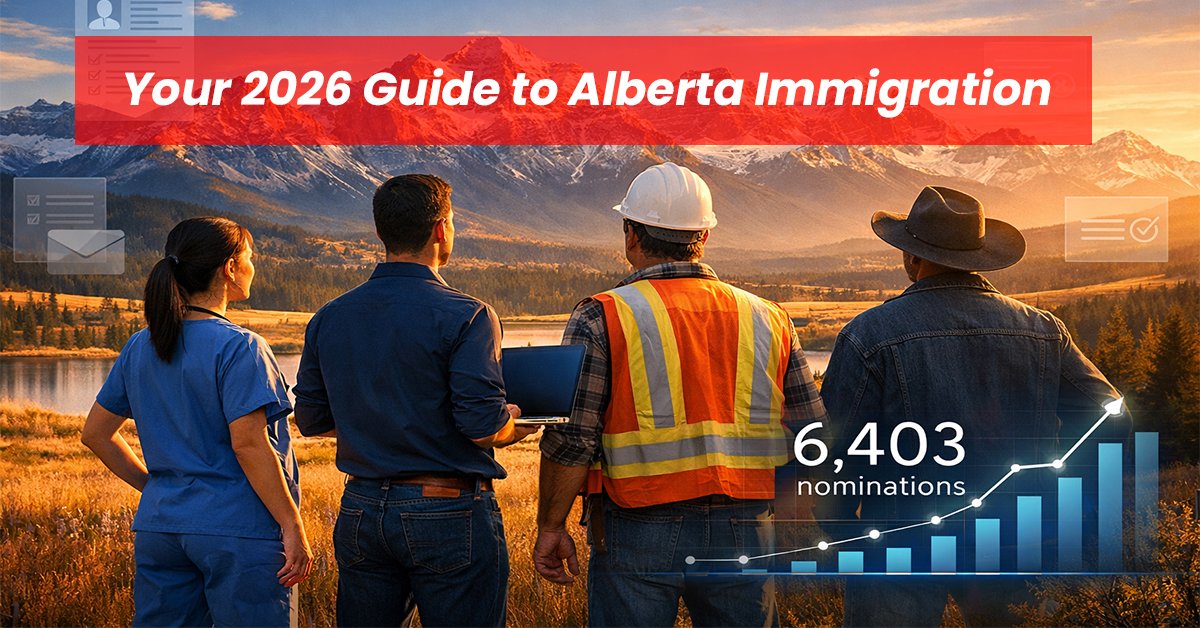

If you’ve been keeping an eye on Alberta’s immigration landscape, you already know things are shifting. The province just released its 2026 nomination allocation, and the numbers tell an interesting story—one that could completely change your immigration strategy.
Alberta received 6,403 provincial nomination spots for 2026, representing a solid 31% jump from the original 2025 allocation of 4,875. But here’s what matters more than the number itself: where these nominations are going and who’s getting them.
Let me walk you through what’s actually happening with Alberta immigration right now, because understanding these priorities could be the difference between getting your nomination or watching from the sidelines.
The Real Story Behind the Numbers
As of mid-January 2026, Alberta had already issued 111 nominations from its yearly allocation. That might not sound like much, but it reveals something important—the province is moving quickly and strategically right from the start of the year.
What sets Alberta apart from other provinces is transparency. They’re the only province publishing detailed, stream-by-stream breakdowns of exactly where nominations are going. This level of openness gives you a massive advantage if you know how to use it.
Here’s how the 6,403 nominations break down across different streams, and more importantly, what this tells us about Alberta’s real priorities.
Where the Nominations Are Actually Going
The Alberta Opportunity Stream dominates the landscape with 3,425 allocated spots—that’s more than half of all available nominations at roughly 53%. Already, 70 of these have been issued, leaving 3,355 still available.
What does this tell you? Alberta’s biggest priority is people who are already working in the province. If you’re currently employed in Alberta on a valid work permit, you’re in the strongest position possible. This isn’t just about filling jobs—it’s about keeping workers who are already integrated, already contributing, and already familiar with life in Alberta.
The Rural Renewal Stream received 1,000 nomination spots. This stream targets designated rural communities across the province, and it’s Alberta’s answer to population distribution challenges. Rural areas need workers, and the province is serious about supporting these communities.
Healthcare gets dedicated attention with 500 spots allocated specifically for health professionals through both Express Entry and non-Express Entry pathways. With aging populations and ongoing healthcare worker shortages, these nominations represent Alberta’s recognition that healthcare staffing is critical infrastructure.
The Tourism and Hospitality Stream has 150 spots, with 10 already issued and 140 remaining. While smaller than other streams, this reflects the sector’s recovery post-pandemic and Alberta’s need for experienced hospitality workers, especially in destinations like Banff, Jasper, and Calgary.
The Alberta Express Entry Stream breaks down into several targeted pathways. The Accelerated Tech Pathway received 600 spots, reflecting Alberta’s push to build its technology sector. The Law Enforcement Pathway got 38 spots—small but significant for those with policing or corrections backgrounds. Another 600 spots went to priority sectors and other initiatives, with 16 already issued and 584 remaining.
Finally, Entrepreneur Streams received 90 spots for business-minded immigrants looking to establish or buy businesses in Alberta.
But here’s where it gets really interesting—these numbers aren’t set in stone. Alberta explicitly states that allocations can shift between streams at any time without notice. This flexibility allows the province to respond quickly to labor market changes and emerging needs.
The Sectors Alberta Actually Wants
Beyond the streams, Alberta has been crystal clear about which industries they’re prioritizing in 2026. These aren’t vague suggestions—they’re direct signals about where your best chances lie.
Healthcare tops the list, as it has for years. Doctors, nurses, medical technicians, healthcare aides—if you work in healthcare, Alberta wants to hear from you. The province faces the same healthcare pressures as the rest of Canada, and they’re using immigration as a key tool to address them.
Technology comes in strong second. Alberta’s tech sector has been growing steadily, particularly in Calgary and Edmonton, and the province is competing with Toronto and Vancouver for tech talent. Software developers, IT professionals, data analysts, cybersecurity experts—these roles are in high demand.
Construction is having a moment in Alberta. Major infrastructure projects, housing development, and commercial construction are creating sustained demand for skilled tradespeople. Electricians, plumbers, carpenters, heavy equipment operators, project managers—if you work in construction, you’re on Alberta’s radar.
Here’s a new addition to 2026: manufacturing. This wasn’t on last year’s priority list, which tells us something important. Alberta is seeing growing provincial labor shortages in manufacturing, and they’ve responded by elevating it to priority status. This sector includes everything from food processing to advanced manufacturing and industrial equipment production.
Aviation remains a priority, particularly for roles supporting Alberta’s airports and the broader aerospace industry. And agriculture continues to be fundamental to Alberta’s economy, with ongoing need for farm workers, agricultural technicians, and agribusiness professionals.
But here’s the important caveat: these represent the program’s primary focus areas, but they’re not an exhaustive list, and invitations may be issued outside these sectors.
The Bonus Opportunity Nobody’s Talking About
Hidden in the allocation details is something that could completely change the game for certain applicants: the federal physician and francophone initiative.
The federal government is reserving 10,000 immigration spaces across all Provincial Nominee Programs specifically for practice-ready physicians (5,000 spots) and French-speaking foreign nationals (5,000 spots). Here’s the crucial part—these nominations don’t count against Alberta’s regular 6,403 allocation.
For physicians, you need a qualifying job offer in one of three National Occupational Classification codes: 31100, 31101, or 31102. You must also be practice-ready, meaning you meet Alberta’s Dedicated Healthcare Pathway requirements for licensure.
For francophones, the requirements are more accessible. You can work in any AAIP-eligible occupation, and you need to demonstrate NCLC level 5 in all four French language competencies. That’s a relatively achievable language threshold for native French speakers.
What makes this powerful is that Alberta could potentially nominate significantly more than 6,403 people in 2026 by tapping into these federal spaces. If you’re a French-speaking professional or a licensed physician, you’ve got access to a nomination pathway that most other applicants don’t.
Who’s Already in the Pool
Understanding competition levels matters, and Alberta’s Expression of Interest (EOI) data gives us that picture.
As of mid-January, there were 45,659 worker EOIs sitting in Alberta’s pool eligible for selection. That’s a lot of people waiting for invitations.
The breakdown shows where the heaviest competition sits. The Alberta Opportunity Stream has 28,377 EOIs—more than 60% of the total pool. The Rural Renewal Stream has 3,248 expressions of interest. Dedicated Healthcare Pathways have 1,505 EOIs waiting. Tourism and Hospitality shows 5,139 candidates in the pool.
Within the Express Entry stream, the Accelerated Tech Pathway has 2,752 EOIs, while priority sectors and other initiatives have 4,252. The Law Enforcement Pathway has just 87—making it potentially the least competitive pathway if you qualify.
These numbers tell you where you stand. If you’re competing in the Alberta Opportunity Stream, you’re facing the most competition. But with over 3,300 nominations still available in that stream, the odds remain reasonable if you have a strong profile.
The Processing Reality
Here’s something that often gets overlooked: how many applications are already waiting for decisions.
As of mid-January, Alberta had 1,386 applications being processed across all streams. The Alberta Opportunity Stream leads with 741 applications in queue. The Alberta Express Entry priority sectors pathway has 124 applications waiting, and the Accelerated Tech Pathway has 88.
Tourism and Hospitality has 73 applications being processed, healthcare pathways have 29, and entrepreneur streams have 246. The Rural Renewal Stream and Law Enforcement Pathway each have fewer than 10.
What this means practically: if you’re applying through a stream with fewer applications in queue, you might see faster processing. The processing times vary, but generally fall within four months for most worker streams. Entrepreneur streams take longer due to business plan assessments and verification requirements.
What Happened in 2025 Sets the Stage
Looking at 2025’s results helps predict 2026’s trajectory. Alberta conducted 77 draws throughout 2025, with 38 specifically targeting Alberta Express Entry candidates. Despite all these Express Entry draws, the Alberta Opportunity Stream still received the majority of nominations.
By year’s end, Alberta issued 6,603 nominations in 2025—slightly above their increased allocation due to a small federal Express Entry administrative overage. Here’s the statistic that matters most: more than 85% of all nominations issued in 2025 were granted to temporary foreign workers already in Alberta.
This pattern is almost certainly continuing into 2026. If you’re already working in Alberta, you’re in the strongest position. If you’re applying from outside Canada, your path exists but requires strategic positioning in priority sectors or through the Rural Renewal Stream.
How to Actually Use This Information
All these numbers and allocations only matter if you can translate them into strategy. Here’s how to think about your approach for 2026.
First, honestly assess where you fit. Are you already working in Alberta? Then the Alberta Opportunity Stream should be your primary focus, and your timeline should be immediate. The 3,355 remaining spots won’t last forever, and with 28,377 people in the EOI pool, competition is real.
If you’re outside Alberta but in Canada with work experience, the Rural Renewal Stream offers your best shot. Job offers from designated rural communities open doors, and you can use foreign work experience to qualify. The competition here is lighter—only 3,248 EOIs competing for 1,000 spots.
For those applying from outside Canada, align yourself with priority sectors. Healthcare, tech, and construction offer the clearest pathways. Manufacturing’s new priority status for 2026 creates opportunities that didn’t exist last year.
French speakers have a unique advantage. Even if you’re not in a priority sector, French proficiency at NCLC 5 opens access to those federal francophone nominations that don’t count against Alberta’s regular allocation. If you’re bilingual, make sure you’re highlighting French proficiency.
Express Entry candidates should focus on the Accelerated Tech Pathway if you qualify, or ensure you’re positioned within priority sectors. Remember that Alberta’s Express Entry draws target specific profiles—it’s not enough to just be in the federal pool.
The Rural Alberta Opportunity
The Rural Renewal Stream deserves special attention because it’s often overlooked, yet it offers some of the best odds.
Alberta has designated dozens of communities across the province for this stream. These aren’t remote outposts—many are thriving small cities with amenities, services, and quality of life that rivals urban centers, just with a smaller population.
Communities like Grande Prairie, Medicine Hat, Red Deer, Lethbridge, and Fort McMurray all participate. You get the benefit of Alberta’s strong economy and quality of life while facing significantly less competition than Calgary or Edmonton pathways.
The stream works through community endorsement. You need a job offer from an employer in a designated community, that employer helps facilitate your community endorsement, and with that endorsement, you can apply to AAIP.
- → 7 Essential Business Strategies Transforming Success in 2024
- → AI and Machine Learning in 2026: Transforming Business Through Intelligent Innovation
- → Canada Immigration Backlog Update 2026: What the Latest IRCC Data Really Means
- → Mass Flight Disruptions Across Asia: 2,186 Delays and 134 Cancellations Hit Major Airports in India, Japan, Thailand, Malaysia, UAE, Singapore, and Qatar
- → $800 CRA Payment in March 2026: Which Canadian Families Qualify and When to Expect Their Direct Deposit
- → $533 GST/HST Credit for March 2026: Payment Dates, Eligibility, and Everything Canadians Need to Know
- → Canada Medical Expense Tax Claims 2026: Everything You Need to Know Before Filing
New changes effective January 1, 2026, have made this stream more structured. Communities now have annual endorsement caps to prevent any single location from overwhelming the system. Endorsement letters are valid for one year, creating urgency to move quickly once endorsed. And if you’re already in Canada, you must hold a valid work permit at both application and assessment—maintained status no longer counts.
These changes make the process more competitive but also more transparent. Communities will prioritize candidates in high-demand occupations who can move quickly through the process.
Your Action Plan for 2026
If Alberta is in your immigration plans, here’s your roadmap.
Get into the EOI pool if you haven’t already. There’s no fee, and it takes time to score and rank your profile. The longer you wait, the more draws you miss.
Make sure your work experience documentation is bulletproof. Alberta scrutinizes employment verification, so gather your reference letters, pay stubs, employment contracts, and tax documents now.
If you’re in a priority sector, build evidence of your expertise. Professional certifications, licenses, specialized training—anything that demonstrates you’re exactly what Alberta is looking for.
For those considering the Rural Renewal Stream, start researching designated communities. Look at economic profiles, job markets, and quality of life factors. Connect with potential employers in these areas—networking matters.
French speakers should take official language tests if you haven’t already. NCLC 5 across all four competencies isn’t particularly demanding for native or fluent French speakers, but you need official proof.
Monitor AAIP’s processing information page. Alberta updates allocation numbers, draws, and priorities regularly. This transparency is your advantage—use it.
And most importantly, be ready to move quickly. Alberta conducts draws without regular schedules. They issue invitations based on current labor market needs and priorities. If you receive an invitation, you’ll have limited time to submit a complete application.
The Bigger Picture
Alberta’s immigration strategy for 2026 isn’t just about numbers—it’s about intentionality. The province is using immigration as a precision tool to address specific labor market gaps, support rural development, and build economic capacity in strategic sectors.
The 31% increase in nominations from the original 2025 allocation signals federal confidence in Alberta’s selection strategy. The detailed transparency around stream allocations shows a program that’s mature, organized, and data-driven.
For applicants, this creates both challenges and opportunities. Competition exists, especially in popular streams like Alberta Opportunity. But clear priorities mean you can strategically position yourself rather than hoping for the best.
The addition of manufacturing as a priority sector, the federal physician and francophone initiatives, and the structured approach to rural nominations all create multiple pathways. Your job is to identify which pathway fits your profile and circumstances, then pursue it with focus and urgency.
Alberta remains one of Canada’s most accessible provinces for immigration, particularly if you’re already in the country or working in priority sectors. The 2026 allocation demonstrates continued commitment to bringing skilled workers and their families to the province.
Your permanent residence application starts with understanding these priorities, positioning yourself strategically, and acting when opportunities arise. Alberta has made its intentions clear—now it’s up to you to respond.
