
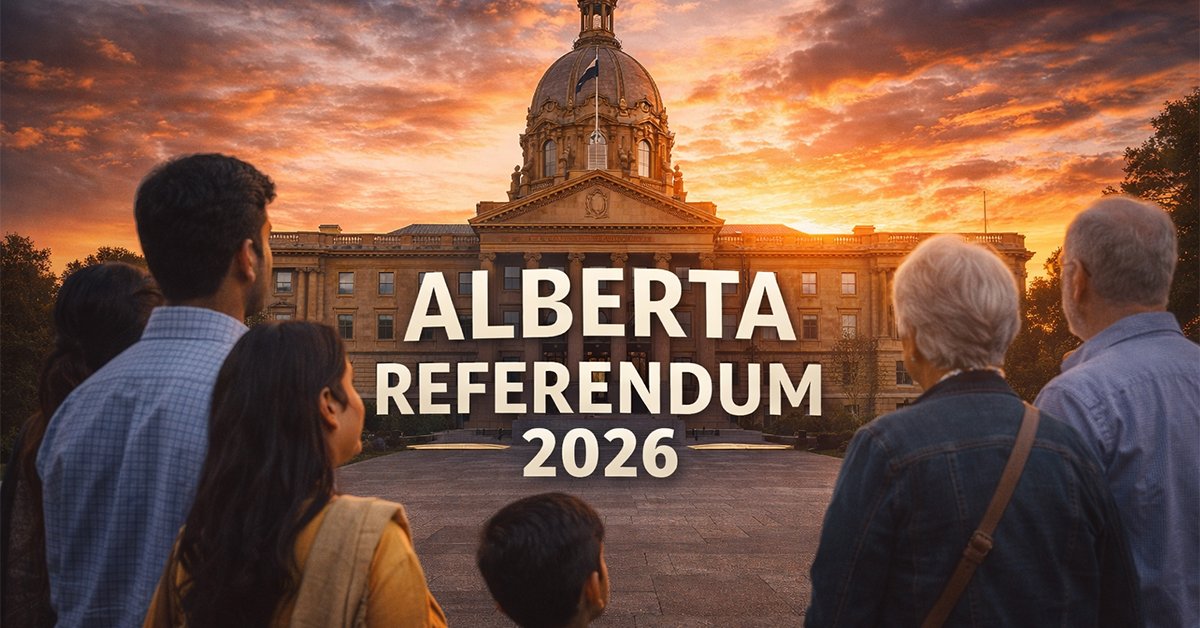

I’ll be straight with you — when Premier Danielle Smith stepped in front of the cameras on February 19, 2026, and announced a nine-question referendum for October, the immigration community in Alberta held its breath.
And they had every reason to.
Five of those nine questions deal directly with immigration. Not vaguely. Not indirectly. They target healthcare access, social program eligibility, school fees for children, and even who gets to define what “legal status” looks like in this province. If even half of these pass, life in Alberta for hundreds of thousands of newcomers — people who pay taxes, work long shifts, and built lives here — could look very different come 2027.
I’ve gone through all five questions carefully so you don’t have to wade through government-speak alone. Here’s what’s actually on the ballot, what it means in plain English, and why it matters right now.
First, Why Is This Happening at All?
To understand the referendum, you need to understand the pressure Alberta is under in 2026.
Oil prices have taken a serious hit. West Texas Intermediate is projected to sit around US$53 a barrel this year, possibly dropping to US$49 in 2027 according to the U.S. Energy Information Administration. For a province where energy revenues fund a massive chunk of public services, that’s not just bad news — it’s a budget crisis. Finance Minister Nate Horner is expected to table a deficit budget on February 27, 2026, and the numbers aren’t expected to be pretty.
At the same time, Alberta’s population has grown by nearly 600,000 people over the past five years. That’s not a small number. That’s a city. Healthcare wait times stretched. School enrollment spiked. Housing got tight. And while much of this growth happened under former federal immigration policies — policies Smith has publicly called “disastrous” — the province now says it’s carrying a burden it didn’t sign up for.
The referendum, Smith says, is about giving Albertans a say. Critics say it’s about scapegoating immigrants during a fiscal crisis. The truth probably lives somewhere uncomfortably in between.
- → Need a Passport Fast? How to Expedite Your U.S. Passport Renewal Step-by-Step
- → Want a $60K+ Salary Without a 4-Year Degree? 15 Certificates You Can Finish in Under a Year
- → Planning a Trip to Europe? 6 Essential Entry Rules to Avoid Denial at the Border
- → Heading to Border Control? Key Immigration Questions You Must Be Ready to Answer
- → Planning a European Trip? What Starkville’s Indian Community Should Know About Schengen Visas
- → 11 Countries Offering Funded Ph.D. Programs for International Students
- → U.S. Dollar Reaches Two-Week High Driven by Middle East Tensions and Fed Policy Outlook
What’s certain is that the Alberta Next panel — a government-convened group that toured the province collecting input from residents — identified immigration as the number one concern raised in public consultations. That gave Smith political cover to put these questions on the ballot.
The Five Immigration Questions, Explained Honestly
Question 1: Should Alberta Control Its Own Immigration Levels?
The exact question: “Do you support the Government of Alberta taking increased control over immigration for the purpose of decreasing immigration to more sustainable levels, prioritizing economic migration and ensuring Albertans have first priority to new employment opportunities?”
This one is about power — specifically, who gets to decide how many people come to Alberta and what kind of work they can do.
Right now, the federal government calls the shots on immigration numbers. Provinces can nominate people through their Provincial Nominee Programs (PNPs), but Ottawa ultimately controls the volume and categories. This question asks Albertans whether they want to change that arrangement.
If it passes, Alberta would push Ottawa to hand over more control — fewer nominations in family reunification categories, tighter rules for employers looking to hire temporary foreign workers, and potentially new barriers for international students hoping to stay after graduation.
The phrase “Albertans have first priority to new employment opportunities” is the part that should make employers and immigrants pay close attention. It signals a policy direction where hiring a newcomer becomes harder to justify if a local candidate exists, regardless of skills or fit.
Question 2: Who Qualifies for Provincial Services?
The exact question: “Do you support the Government of Alberta introducing a law mandating only Canadian citizens, permanent residents, and individuals with an Alberta approved immigration status will be eligible for provincially funded programs, such as health, education & other social services?”
This is the one that worries immigration lawyers and advocacy groups the most — and for good reason.
The phrase “Alberta approved immigration status” appears nowhere in current Canadian law. It’s a category that doesn’t exist yet, and the referendum question doesn’t define it. That ambiguity is exactly the problem.
Right now, most provincial services in Alberta — including emergency healthcare, K-12 education for children, and various social supports — are available to anyone physically residing in the province, regardless of their immigration status. Refugee claimants, temporary foreign workers, international students, and people in complex situations all currently have access to basic services.
If this question passes and the government creates its own “approved” status category, it could exclude anyone who doesn’t fit that narrow definition. People who are legal in Canada but not “Alberta-approved” could find themselves without healthcare coverage, unable to enroll their kids in school, and shut out of programs they may desperately need.
The lack of a definition isn’t an oversight — it’s the part that worries experts the most, because it gives future governments enormous discretion to draw those lines wherever they want.
Question 3: A 12-Month Waiting Period Before Accessing Social Programs
The exact question: “Assuming that all citizens and permanent residents continue to qualify for social support programs as they do now, do you support the Government of Alberta introducing a law requiring all individuals with a non permanent legal immigration status to be resident in Alberta for at least 12 months before qualifying for any provincially funded social support programs?”
Let me paint a picture for you. A temporary foreign worker arrives in Edmonton in January. She starts working in February. By April, she’s paying provincial income tax. But if this question passes, she’d have to wait until at least January of the following year before she can access any provincial social support program — even though she’s been contributing to the system since day one.
That’s the core tension here. You can work, pay taxes, contribute to the economy — but the safety net that those taxes help fund? That’s not for you. Not yet. Not for a year.
This also applies to international students, many of whom are already financially stretched, navigating a new country, and dealing with the very real challenges of relocation and adjustment. A 12-month exclusion window during the most vulnerable period of their time in Alberta could push many to consider other provinces with more welcoming policies — British Columbia, Ontario, or Nova Scotia come to mind.
The government frames this as a fairness measure for existing residents. Critics frame it as taxing people for services they can’t use.
Question 4: Fees for Healthcare and Education
The exact question: “Assuming that all citizens and permanent residents continue to qualify for public health care and education as they do now, do you support the Government of Alberta charging a reasonable fee or premium to individuals with a non permanent immigration status living in Alberta for their and their family’s use of the healthcare and education systems?”
Unlike Question 2, this one doesn’t propose cutting off access entirely — it proposes charging for it. Temporary residents would still be able to see a doctor or send their kids to public school, but they’d pay a “reasonable fee or premium” to do so.
Sounds fair on the surface, right? The devil, as always, is in the details.
“Reasonable” is undefined. Monthly health premiums in jurisdictions that charge them routinely run several hundred dollars per person. A family of four — two parents on temporary work permits, two kids enrolled in public school — could face thousands of dollars in annual costs on top of everything else they’re already managing: rent in a tight market, vehicle costs, food, and sending money home.
For many temporary foreign workers, especially those in agricultural or care sectors who aren’t earning high wages, these fees could make Alberta financially unworkable. And for families considering whether to bring their spouse and children along, the math might simply not add up.
There’s also an equity question that nobody’s really talking about: if you charge for K-12 education for children based on their parents’ immigration status, you’re effectively creating a two-tiered school system. One for citizens and permanent residents, one for everyone else.
Question 5: Proof of Citizenship to Vote
The exact question: “Do you support the Government of Alberta introducing a law requiring individuals to provide proof of citizenship, such as a passport, birth certificate, or citizenship card, to be eligible to vote in a provincial election?”
This one’s a bit different from the others. Permanent residents already can’t vote in Canadian elections — that’s not up for debate. So this question isn’t about keeping non-citizens from voting. They already can’t.
What this question is actually about is the documentation required to prove you’re a citizen when you show up to vote. Currently, Canadian citizens can prove their eligibility through a range of identification documents — not all of which are citizenship-specific. This question would narrow that to passports, birth certificates, or citizenship cards.
The practical impact falls on naturalized Canadians — immigrants who have gone through the full citizenship process, earned their Canadian passport in a ceremony, and now want to exercise their democratic right. Not every naturalized citizen keeps their documents current. Replacement citizenship cards take time and money. Passports expire.
If you’re a naturalized Canadian from a newcomer community where these documents aren’t always readily at hand, this creates a real, tangible barrier to voting — even if the intention is framed as “election integrity.”
What Happens Between Now and October 19?
There are a few key dates worth keeping on your radar:
February 27, 2026 — The provincial budget drops. This will tell us a lot about how deep the fiscal hole actually is, and whether these referendum questions are about genuine policy reform or political positioning ahead of tough spending cuts.
Early May 2026 — Deadline for a citizen-led petition seeking a referendum question on Alberta separation from Canada. If it gets enough signatures, a tenth question could appear on the October ballot. That would make an already complicated vote even more consequential.
October 19, 2026 — Referendum day. Nine questions, potentially ten. The results will determine whether these proposals move into actual legislation.
Post-referendum — Even if questions pass, implementation isn’t automatic. Many of these measures — especially around controlling immigration levels — would require negotiating with the federal government, which has its own views on how immigration works in this country. Constitutional constraints also apply. A “yes” vote is the beginning of a process, not the end of one.
What Should Newcomers Actually Do Right Now?
If you’re living in Alberta on a temporary work permit, as an international student, or as a refugee claimant, here’s the honest advice:
Stay informed but don’t panic. These are proposals, not laws. They still need to pass a public vote, survive potential legal challenges, and navigate federal-provincial negotiations. That’s a long road.
Get connected. Organizations like the Edmonton Immigrant Services Association, Calgary Catholic Immigration Society, and various legal aid clinics are going to be active in this conversation. They’re your best source of accurate, current information as things develop.
Know your rights today. Whatever the outcome of the referendum, you have rights under existing law right now. Emergency healthcare access, protection under the Canadian Charter of Rights and Freedoms, and due process are not going away regardless of what gets voted on in October.
Engage if you can. If you’re a Canadian citizen or permanent resident, you’ll have a vote on October 19. Your voice is part of this conversation too.
A Final Word
Immigration debates are never really just about numbers or fiscal policy. They’re about who belongs, who gets to stay, and on what terms. Alberta’s referendum is a window into a bigger argument happening across Canada — and frankly, across much of the democratic world — about how societies manage rapid change.
Reasonable people disagree on where the lines should be. What’s harder to argue is that the people most affected by these questions — the workers pulling double shifts, the students far from home, the families building something new — deserve to have the debate happen clearly, honestly, and with the full weight of their humanity in the room.
October 19 is coming. Watch this space.
