

I’ve been following the EU’s border digitisation story for over a year now, and I’ll be honest — February 15, 2026 felt like the day everything finally clicked into place. Or at least, it was supposed to.
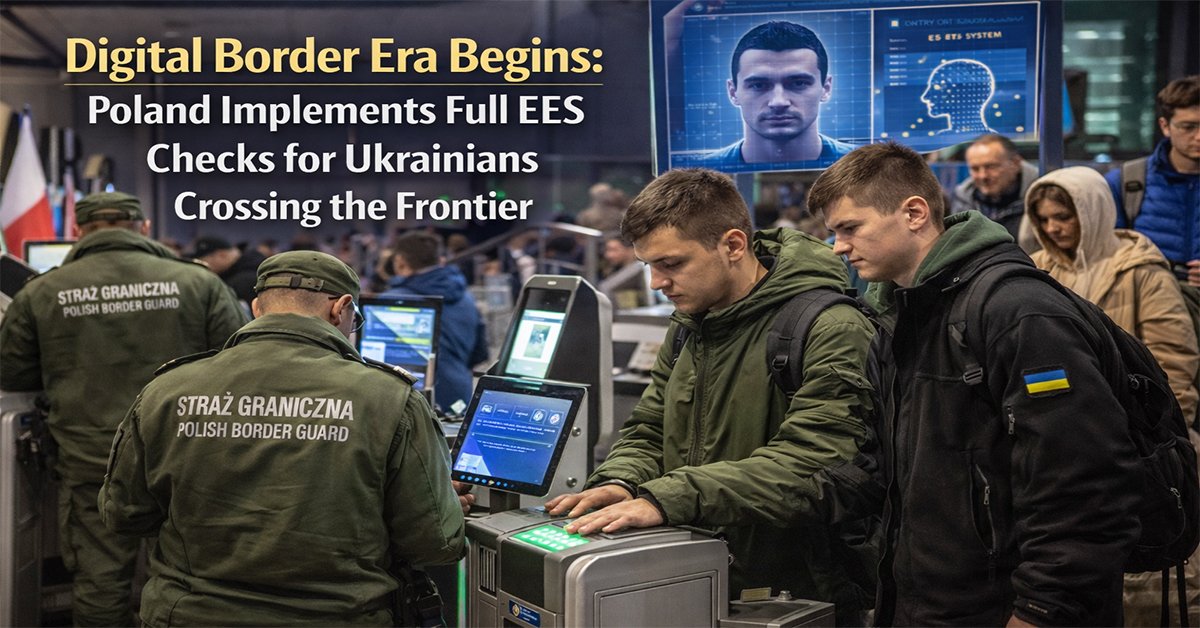
On that Saturday morning, Poland became the first EU country to bring all 38 of its external border crossings — every land gate, every rail checkpoint, every airport desk — fully online under the Entry/Exit System (EES). For the hundreds of thousands of Ukrainians who cross that frontier every single month, life at the border changed overnight. The old rubber stamp, a fixture of European travel since the Schengen Agreement was born, is gone. In its place: a biometric scan, a database record, and a future that looks radically different from the one travellers have known.
Whether you commute between Lviv and Warsaw for work, visit family in Kraków, or manage a logistics fleet running between Kyiv and the EU market, this change affects you directly. Let me break down exactly what happened, why it matters, and what you need to do about it.
What the EES Actually Does — And Why It’s a Bigger Deal Than It Sounds
The Entry/Exit System isn’t just a tech upgrade. It’s a complete rethink of how Europe tracks who comes in and who leaves.
Before EES, border officers stamped your passport. That was the record. Crude, easily falsified, and impossible to audit at scale. The new system does something fundamentally different: it photographs your face and scans your four fingerprints on your first crossing, ties that biometric data to your passport, and stores everything for three years in a shared EU database. Every subsequent crossing? A facial scan is all it takes — fast, clean, and fully automated.
The real power of the system, from the EU’s perspective, is enforcement. The Schengen Area allows visa-free or visa-holding non-EU nationals a maximum of 90 days within any 180-day rolling period. Previously, detecting overstays was a patchwork nightmare — different countries, no shared records, officers relying on passport stamps that could be worn or faked. Now, the moment you scan your face at a Polish border kiosk, the system knows exactly how many days you’ve spent in the Schengen Area. Every single one of them.
Poland’s Ministry of the Interior says this is already paying off. In January 2026 alone, Polish authorities detected 412 attempted overstays at the Dorohusk and Medyka crossings. In January 2025, that number was 67. The difference isn’t that more people were overstaying — it’s that the system can now actually see it.
The First Day Was Rough. Here’s Why That Was Predictable.
Let’s be real: February 15 was not a smooth day at Poland’s eastern frontier.
Passengers on buses reported queues stretching up to three hours. First-time EES registrants — those going through biometric enrolment for the very first time — took significantly longer to process than the system’s designers had anticipated. The Polish Border Guard was directing first-timers away from automated kiosks to staffed manual lanes, which helped the kiosks move faster but created its own bottlenecks.
This wasn’t surprising. Poland was, in fact, one of the first EU countries to actually implement EES at scale after the system launched its progressive rollout on October 12, 2025. The initial debut at Medyka-Shehyni and Przemyśl-Mostyska back in October saw chaos too — trains delayed by three to four hours, buses waiting over ten hours, infrastructure simply not built to handle simultaneous arrivals and departures under biometric registration pressure.
What’s improving is the proportion of travellers who’ve already completed their initial enrolment. The Polish Border Guard has confirmed more than 600,000 third-country nationals are now registered in the system — 40% of them Ukrainian citizens. For those 240,000-plus Ukrainians, subsequent crossings require nothing more than a quick facial scan. The long queues will thin out naturally as more people get their first enrolment behind them.
The advice right now? If you haven’t done your first EES crossing yet, budget extra time. February and March 2026 are still heavy enrolment months. Plan for it.
What Ukrainian Travellers Need to Carry — The Complete Checklist
This is where it gets practical, and it’s worth reading carefully because the requirements have changed in ways that catch people off guard.
For all travellers:
- Valid biometric passport (machine-readable; non-biometric documents cause problems)
- Proof of sufficient funds — a minimum of PLN 75 (roughly €17) per day of intended stay for adults
- Valid health insurance documentation
For drivers and vehicle owners:
- A printed international “Green Card” insurance certificate. The QR-code digital validation system is coming later in 2026, but it is not live yet. If you show up at the border with only a digital version on your phone, you may be turned back.
- CMR waybills printed on paper if you’re carrying freight. Network connectivity issues have caused data upload failures, and a paper backup has saved commercial drivers from serious delays.
For Ukrainians under temporary protection (PESEL UKR holders):
- Your biometric data is registered through the standard EES kiosk
- Your Diia.pl mobile residency document must be scanned alongside the biometric check
- Children under 13 continue to be processed at staffed booths — they are exempt from fingerprint scanning
For first-time EES crossers:
- Do not go to the automated kiosk. Head to a staffed manual lane for your initial registration. Border staff are there to walk you through it.
- The process takes longer — allow at least 20-30 extra minutes on top of normal crossing time during peak hours.
The Business Angle: What Corporate Mobility Teams Must Act On Now
If you manage employees, contractors, or logistics personnel who regularly cross between Ukraine and Poland, February 2026 is a moment that demands attention at the planning level.
The most immediate issue is transit time predictability. Until the backlog of first-time EES enrolments clears — likely through to April 2026, when full EU-wide implementation completes — crossing times will be variable. A border run that took 40 minutes in November 2025 could take three hours in February 2026, depending on how many first-timers are in the queue that day.
Practical measures worth implementing immediately:
Adjust travel scheduling. Add buffer time to any assignment itineraries involving Polish land crossings through at least the end of March 2026. Build in 2-3 additional hours for any first-time EES crossing in your team.
Pre-verify document compliance. The health insurance and proof-of-funds requirements are now actively enforced. Make sure every assignee has valid documentation. A lapsed insurance certificate is no longer just an administrative inconvenience — it’s a legitimate reason for border refusal under EES protocols.
Maintain paper backups. QR-code validation for Green Card insurance and CMR waybills is coming, but it’s not here yet. Paper copies are still the only guaranteed-to-work option.
Register your frequent crossers first. If you have employees crossing weekly or monthly, get their initial EES enrolment done during a lower-traffic period. Early mornings on weekdays are significantly faster than peak weekend hours.
What Comes Next: ETIAS and the One-Stop “Face-and-Phone” Future
Poland’s EES rollout is really just the first chapter of Europe’s digital border story.
The full EU-wide deployment of EES at all Schengen external borders is set for April 10, 2026. By that date, passport stamping will officially end across all 29 participating countries. Every non-EU national on a short stay will be in the digital system.
- → Need a Passport Fast? How to Expedite Your U.S. Passport Renewal Step-by-Step
- → Want a $60K+ Salary Without a 4-Year Degree? 15 Certificates You Can Finish in Under a Year
- → Planning a Trip to Europe? 6 Essential Entry Rules to Avoid Denial at the Border
- → Heading to Border Control? Key Immigration Questions You Must Be Ready to Answer
- → Planning a European Trip? What Starkville’s Indian Community Should Know About Schengen Visas
- → 11 Countries Offering Funded Ph.D. Programs for International Students
- → U.S. Dollar Reaches Two-Week High Driven by Middle East Tensions and Fed Policy Outlook
Then, later in 2026 — currently targeted for the final quarter — ETIAS comes online. The European Travel Information and Authorisation System is, in simple terms, Europe’s answer to the US ESTA. Most visa-exempt non-EU nationals, including Ukrainians, will need to apply for and receive an ETIAS authorisation before travelling to the Schengen Area. It’s not a visa, but it’s not nothing either — it’s a pre-travel screening step completed entirely online before you leave home.
Polish airports are already upgrading their e-gates to read an ETIAS QR code in the same transaction as the EES biometric match. The eventual vision is a “face-and-phone” crossing: one scan, a few seconds, and you’re through. Border authorities say that, once the system is fully mature, an average land crossing could be completed in under 30 seconds.
We’re not there yet. Right now, in February 2026, we’re in the messy, queue-forming middle phase. But the trajectory is clear, and travellers who understand where this is going will be much better positioned than those who don’t.
Frequently Asked Questions
Does EES change whether Ukrainians can enter Poland? No. The right to enter is unchanged. EES is a registration and monitoring system, not a new entry restriction. What it does enforce more rigorously are the existing rules — 90/180-day limits, insurance requirements, and proof of funds.
What happens to my biometric data? Your facial image and fingerprints are stored in the EES database for three years from your last recorded exit, or for five years if an overstay is detected. The system meets EU data protection standards under GDPR.
I have PESEL UKR status. Am I treated differently? Your crossing procedure is now fully digital, and you’ll use the standard EES kiosk alongside your Diia.pl mobile residency document. The temporary protection status does not exempt you from EES registration.
My first crossing took two hours. Will it always be this slow? No. The long times now are almost entirely due to first-time biometric enrolment. Once your data is registered, subsequent crossings require only a facial scan — significantly faster. Think of it as a one-time setup cost.
What is ETIAS and when do I need it? ETIAS is a pre-travel authorisation system launching in late 2026. Once live, most visa-exempt non-EU travellers — including Ukrainians — will need to apply online before travelling. Applications will be completed through an official EU portal. No applications are being accepted yet; the Commission will announce the launch date several months in advance.
The Bottom Line
Europe’s eastern frontier is being rewired, and Poland is leading that process. The EES implementation on February 15, 2026, marked a genuine turning point — not just for Poland, but as a signal of how all 29 Schengen countries will be operating by April.
For Ukrainian travellers, the practical reality right now is this: the first crossing takes longer, the paperwork requirements are stricter, and you need to carry more documentation than you did 12 months ago. But the system, once your enrolment is complete, is designed to be faster and more predictable than the old stamp-and-check process.
Understand the rules, prepare your documents, give yourself time on that first crossing, and keep an eye on ETIAS developments for later in the year.
The digital border is here. It’s worth knowing how to navigate it.
