
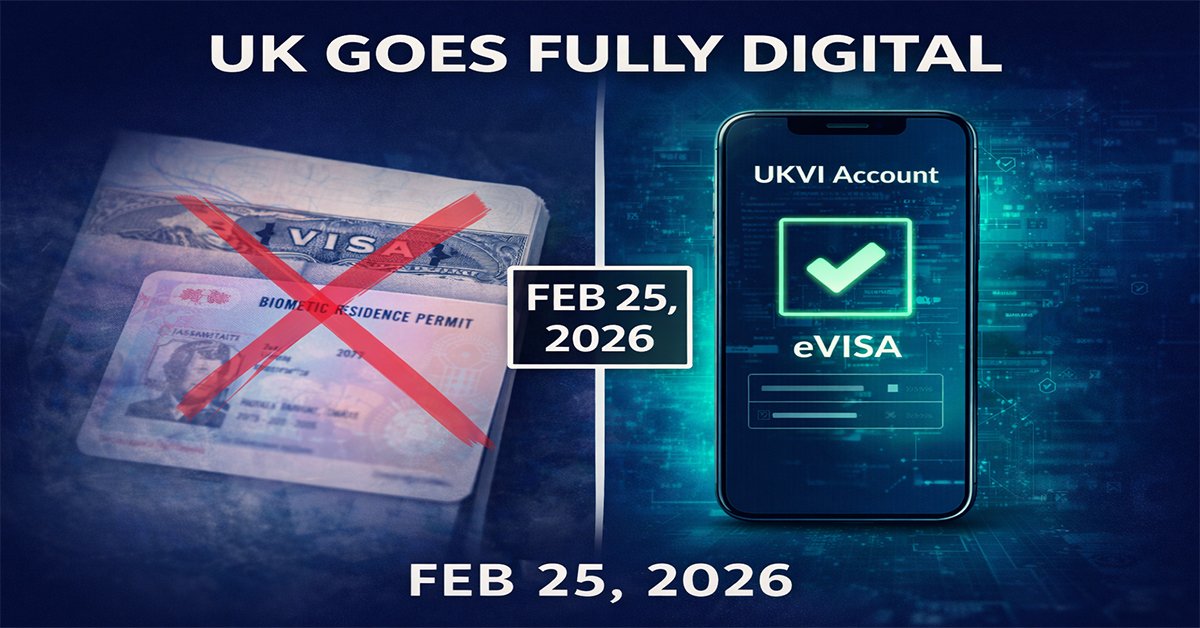

If you’re planning to come to the UK—or you’re an employer sponsoring foreign workers—you need to know this: starting February 25, 2026, the UK is ditching physical visas entirely.
No more biometric residence permits (BRPs). No more vignette stickers in your passport. No more paper letters with wet-ink stamps. From next week, if you’re granted a UK visa, you’ll receive it digitally—and only digitally.
This isn’t a pilot programme or a gradual rollout. It’s a hard switch. And while the long-term vision is streamlined and fraud-proof borders, the short-term reality is that travellers, HR teams, and immigration advisors are scrambling to understand what this actually means in practice.
Let’s break it down.
What’s Changing on February 25, 2026?
As of next Tuesday, UK Visas & Immigration (UKVI) will issue all entry-clearance documents overseas in digital format only. Here’s what that looks like:
- No physical documents. If your visa application is approved, you won’t get a sticker in your passport or a plastic BRP card in the mail.
- Email notification instead. You’ll receive an email telling you your application was successful and directing you to create (or log into) your UKVI account.
- Digital immigration status. Your visa details—permission to work, study, or settle—will be stored in a government database linked to your passport number. You’ll access and share this information through your online account.
- Share codes for employers. When you need to prove your right to work or rent a property, you’ll generate a time-limited share code from your account. Employers and landlords will use that code to check your status online.
This is the next big step in the Home Office’s “digital by default” strategy, which aims to make the entire UK border system paperless by the end of 2026.
Why Is the UK Doing This?
According to officials, going digital brings several advantages:
1. Fraud reduction. Physical documents can be forged, lost, or tampered with. A centralised digital system is much harder to fake.
2. Faster carrier checks. Airlines, ferry companies, and Eurotunnel operators will integrate their departure-control systems with the new digital-status checker. That means quicker boarding and fewer delays.
3. Real-time control. If a visa needs to be revoked for security or compliance reasons, it can happen instantly in the system—no need to physically recall a document.
4. Alignment with global trends. Countries like Australia already operate fully digital visa systems, and the EU is rolling out its ETIAS digital travel authorisation soon. The UK is joining a global shift toward pre-travel digital clearance.
In theory, it all sounds efficient. In practice? There are some bumps in the road.
What Does This Mean for Travellers?
If you’re applying for a UK visa after February 25, here’s what you need to know:
You Must Travel on the Passport Linked to Your UKVI Account
Your digital visa is tied to a specific passport number. If you renew your passport after your visa is granted but before you travel, you must update your UKVI account with the new passport details. If you don’t, automated e-gates and airline systems won’t recognise your status, and you could be denied boarding or entry.
Set Up Your UKVI Account Immediately
As soon as you get the email saying your visa is approved, create your UKVI account. Don’t wait until the day before you travel. The system can be glitchy, and you don’t want to be troubleshooting login issues at the airport.
Dependants Need Their Own Accounts
If you’re travelling with family members who also have UK visas (spouse, children), each person needs their own UKVI account. They can’t piggyback on yours. This is especially important if family members are travelling separately—without individual log-ins, they could be stranded at departure points.
No Internet? You Might Have a Problem
One concern privacy and travel advocates have raised is the lack of an offline fallback. What if you’re at the airport and your phone dies? What if you can’t get online? The Home Office says contingency kiosks will be installed at major ports, but details are vague, and it’s unclear how well-staffed or functional those kiosks will be.
Keep Screenshots and Backups
While the system is supposed to work seamlessly, it’s smart to take screenshots of your immigration status and save copies of your grant email and share codes. Technology fails. Having a backup could save you hours of stress.
What Does This Mean for Employers?
If you’re an HR manager, recruiter, or compliance officer, this change affects you directly—especially when it comes to right-to-work checks.
Paper Documents Are No Longer Valid After April 2026
Starting in April, the only acceptable proof of right to work for foreign nationals will be a share code generated from their UKVI account. You won’t be able to accept BRP cards or physical visa documents anymore (because they won’t exist).
You Need to Update Your Onboarding Processes
Make sure your HR systems and onboarding checklists reflect this change. Train your team on how to:
- Request a share code from new hires
- Use the Home Office online checker to verify immigration status
- Document the check properly for compliance audits
Graduate Intake Cohorts Need Extra Attention
If you’re hiring large numbers of international graduates on Graduate visas or Skilled Worker visas, start now. Don’t wait until their start dates to figure out the digital system. Audit your processes, run test checks, and make sure you’re not scrambling at the last minute.
Mobility Managers: Brief Your Assignees Early
If you’re relocating employees to the UK, make sure they know to set up their UKVI accounts immediately upon visa approval. Build this into your pre-departure checklists and relocation guides. The last thing you want is a key hire stuck abroad because they didn’t update their passport details.
What Are Immigration Lawyers Saying?
The consensus? Long-term efficiencies, short-term chaos.
Lawyers and consultancies like Five Star International and others have been fielding anxious calls from corporate clients. The digital system is a good idea in principle, but the rollout has been rushed, and there’s not enough public guidance yet on edge cases—like what happens if the system goes down, or how to handle expired passports mid-visa.
Privacy campaigners are also raising red flags. A centralised database of immigration status is a tempting target for cyberattacks, and questions remain about data security, government overreach, and what happens to people’s information if they leave the UK.
The Home Office insists safeguards are in place, but they haven’t been particularly transparent about specifics.
How Does This Compare to Other Countries?
The UK isn’t alone in going digital. Australia has been operating a fully digital visa system for years, and it works well—once you get used to it. The EU’s ETIAS (European Travel Information and Authorisation System) is also launching soon, requiring pre-travel digital clearance for visa-exempt visitors.
So in that sense, the UK is catching up, not leading. But the pace of the rollout—switching everything off in a single day—is more aggressive than most other countries have attempted.
Practical Tips for a Smooth Transition
Whether you’re a traveller, employer, or immigration professional, here’s how to stay ahead:
For Travellers:
- Set up your UKVI account the moment you get your approval email
- Update your passport details immediately if you renew
- Save screenshots and backups of your immigration status
- Check that your passport details match your UKVI account before every trip
For Employers:
- → New Canada Benefit Payments Arriving This Week in May 2026
- → Canada Bread Settlement Payments Begin Rolling Out Across Canada in 2026
- → Canada Immigration Backlog Update 2026: IRCC Application Inventory Crosses 2.15 Million
- → Canada Expands Visa-Free Travel Access for Citizens of Indonesia and Malaysia in 2026
- → Canada’s 365-Day Maintained Status Work Rule in 2026: What Foreign Workers Need to Know
- → Canada Launches Early Retirement Incentive Program in 2026: Eligibility, Benefits, and Application Process Explained
- → Bringing Your Family to New Zealand on a Work Visa: Complete 2026 Guide
- Update onboarding systems to require UKVI share codes
- Train HR staff on the new right-to-work checker
- Communicate changes to hiring managers and department heads
- Run test checks before your next international hire starts
For Immigration Advisors:
- Brief clients on UKVI account setup as part of the application process
- Provide clear instructions on passport updates and share codes
- Set up FAQs and guides to reduce panicked last-minute calls
The Bottom Line
Going digital is the future, and in many ways, it’s a smarter system. But the transition is happening fast, and not everyone is ready.
If you’re applying for a UK visa, travelling to the UK, or hiring foreign workers, you need to understand how the new system works—now, not next month. Because come February 25, the old way of doing things is gone for good.
So take the time this week to set up accounts, update processes, and get familiar with the digital tools. A little preparation now will save you a lot of headaches at the airport or in the office later.
Welcome to the paperless border. Let’s hope the Wi-Fi holds up.
