

If you’ve got flights to or from Italy booked for late February, you need to read this.
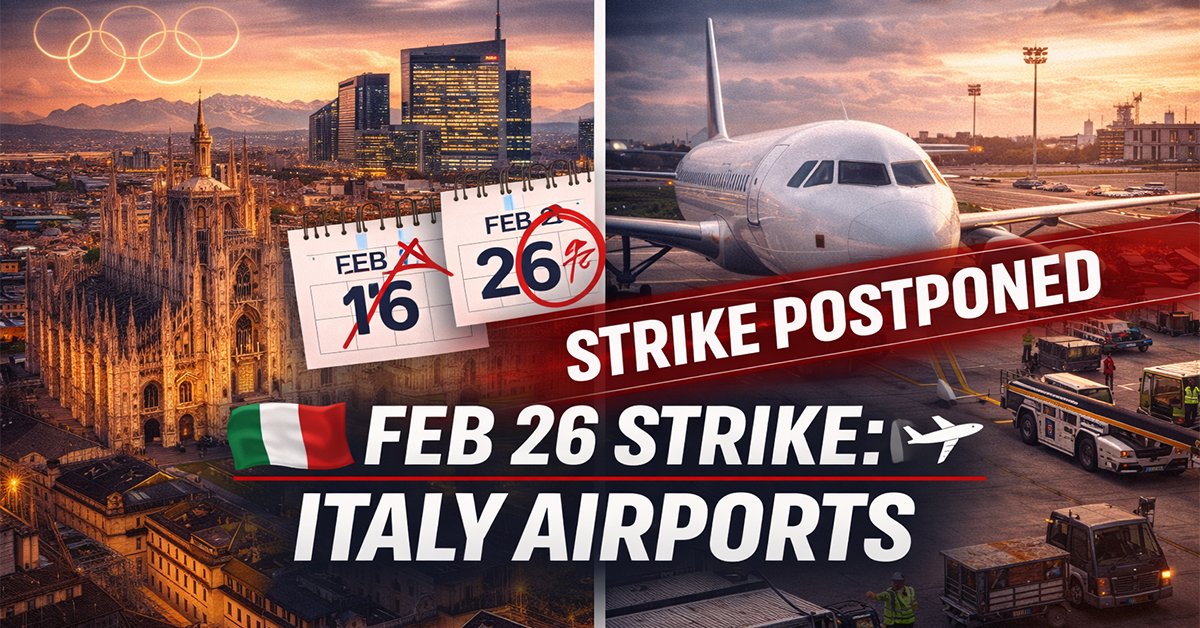
The Italian government just pulled the emergency brake on what could have been one of the biggest travel disruptions of 2026—a nationwide airport strike scheduled for February 16 that threatened to strand 27,000 passengers right in the middle of the Milano-Cortina Winter Olympics.
Transport Minister Matteo Salvini signed an emergency injunction late Friday evening, using rarely-invoked powers to postpone the strike by 10 days to February 26. While that saves Olympic travelers from chaos, it’s just moved the problem—not solved it. And if you’re flying through Italy in late February or early March, you’re now in the new risk window.
Let me break down exactly what happened, what’s coming, and how to protect your travel plans.
The Strike That Almost Crippled Italy’s Olympics
Picture this: It’s February 16, 2026. The Milano-Cortina Winter Olympics are in full swing—alpine skiing in Cortina, figure skating in Milan, hockey matches drawing sold-out crowds. Athletes, spectators, media crews, and corporate sponsors are crisscrossing Italy’s airports by the thousands daily.
Then imagine all of that grinding to a halt.
That was the scenario Italy faced. Six major aviation unions—representing pilots, flight attendants, ground handlers, baggage crews, and air traffic controllers—had called a 24-hour nationwide strike beginning at midnight on February 16.
The scope was staggering:
- ITA Airways (Italy’s flag carrier) had 314 flights scheduled that day
- 70% of those flights fell outside Italy’s legally protected time windows (7:00-10:00 AM and 6:00-9:00 PM)
- easyJet, Vueling, and multiple ground-handling companies at Milan’s two major airports were joining
- 27,000 passengers would have been directly affected—not counting the ripple effects on connecting flights across Europe
Milan Malpensa, Milan Linate, Rome Fiumicino, Venice Marco Polo, Naples, Bologna, Verona—virtually every major Italian airport would have seen simultaneous work stoppages.
For context, Italy’s civil aviation regulator ENAC warned this would have been the single biggest aviation disruption in Italy since the volcanic ash crisis of 2010.
Why Salvini Used Emergency Powers
Italy’s strike law includes a little-used provision: when “events of global public importance” are at risk, the government can invoke Article 8 of the 1990 Strike-in-Essential-Services Act to force postponement.
The Milano-Cortina Olympics, with an estimated 2 billion television viewers worldwide and Italy’s international reputation on the line, qualified.
Salvini didn’t mince words in his statement: “While understanding the workers’ demands, we must guarantee the right to mobility during an extraordinary event of global significance.”
Italy’s National Strike Commission (Commissione di Garanzia) had already recommended the unions voluntarily move their strike to the February 24-March 4 window—after the Olympics close on February 22 but before the Paralympics begin on March 6.
The unions refused. Negotiations with the government and airlines had stalled. Aviation workers are pushing for resolution of contract disputes that have dragged on for over a year, with disagreements centered on wages, working conditions, and a reported €1,000-€1,500 bonus shortfall per worker.
So Salvini issued the precettazione—an executive order that essentially forces workers to postpone their strike. It’s a legal hammer the Italian government reserves for genuine emergencies.
February 26: The New Date You Need to Mark
Here’s the uncomfortable truth: the government didn’t cancel the strike. They postponed it.
The new strike date is Wednesday, February 26, 2026.
That’s four days after the Olympics closing ceremony, right in the middle of the transition period when:
- Olympic delegations are departing Italy
- Media crews are wrapping operations
- Tourists who attended the Games are heading home
- Business travelers are returning to normal schedules
- Airlines are trying to reset operations after two weeks of elevated Olympic traffic
In other words, it’s still a terrible time for a strike—just slightly less terrible than during the Games themselves.
What we know about February 26:
- Same 24-hour duration (midnight to midnight)
- Same participants (ITA Airways, easyJet, Vueling, ground handlers at major airports)
- Same legally protected time windows (7:00-10:00 AM and 6:00-9:00 PM only)
- Same potential passenger impact (thousands of flights at risk)
The only difference? The global media spotlight will have moved on, which is precisely why the government chose this date.
The Bigger Storm: Multiple Strikes Are Coming
February 26 isn’t the only date travelers need to worry about. Italy’s transport sector is experiencing a wave of industrial action:
February 27-28: National Railway Strike
- 24-hour stoppage by Ferrovie dello Stato Italiane (FS) workers
- Begins 9:00 PM Friday, February 27
- Ends 8:59 PM Saturday, February 28
- Affects regional trains, high-speed Frecce services, and Intercity routes
- Timing note: This is the day AFTER the airport strike
March 7: Second Airport Strike (Originally Planned)
- Air traffic controllers (ENAV) and ground-handling crews
- This was also postponed by the government’s emergency order
- New date not yet confirmed, but likely between March 1-4
- Would occur during the Paralympic Games transition period
Think about the timing strategically. If you’re flying to Italy on February 26 and taking trains on February 27-28, you’re potentially hitting both strikes. That’s not coincidence—it’s coordinated labor action designed to maximize negotiating pressure.
What Airlines Are Doing Right Now
Carriers will publish revised schedules early next week Canada.ca, which means by February 17-18, you should start seeing:
Proactive cancellations: Airlines typically cancel flights several days in advance of known strikes rather than waiting until the last minute. This gives them time to rebook passengers and consolidate operations.
Schedule consolidations: Expect frequency reductions on popular routes. Instead of hourly Milan-Rome shuttles, you might see service every 2-3 hours, prioritizing flights that fall within protected time windows.
Equipment changes: Larger aircraft on fewer departures to accommodate displaced passengers.
Rebooking notifications: If your flight is impacted, you’ll receive an email or SMS with alternative options.
How to Protect Your Travel Plans (Action Steps)
If you have Italy flights between February 24-March 1, here’s your practical playbook:
1. Check your flight status obsessively starting February 17
- → Need a Passport Fast? How to Expedite Your U.S. Passport Renewal Step-by-Step
- → Want a $60K+ Salary Without a 4-Year Degree? 15 Certificates You Can Finish in Under a Year
- → Planning a Trip to Europe? 6 Essential Entry Rules to Avoid Denial at the Border
- → Heading to Border Control? Key Immigration Questions You Must Be Ready to Answer
- → Planning a European Trip? What Starkville’s Indian Community Should Know About Schengen Visas
- → 11 Countries Offering Funded Ph.D. Programs for International Students
- → U.S. Dollar Reaches Two-Week High Driven by Middle East Tensions and Fed Policy Outlook
Don’t wait for airlines to contact you. Log into your booking regularly. Airlines notify passengers in waves, and you want to know about changes as early as possible to grab the best rebooking options.
2. Understand your rights under EU261 rules
Since these are strikes by airline staff (not air traffic control), flexibility clauses and interline agreements may allow re-routing via Zurich, Munich or Vienna Canada.ca.
You’re entitled to:
- Rebooking on the next available flight (even with a different carrier)
- Full refund if you choose not to travel
- Meals and accommodation if you’re stranded overnight (though strike-related disruptions sometimes have exemptions)
3. Build in buffer time
If you have a critical meeting, important connection, or non-refundable commitment:
- Arrive a day early if possible
- Don’t book same-day connections through Italian airports
- Consider routing through alternative European hubs
4. Watch the protected time windows
Flights departing between 7:00-10:00 AM and 6:00-9:00 PM are legally guaranteed to operate even during strikes. If you can book within these windows, you dramatically reduce your risk.
However, understand the reality: everyone else is also trying to book these flights, so availability is extremely limited and prices are inflated.
5. Have a Plan B (and C)
Travellers heading to board meetings in Milan’s financial district are advised to keep same-day rail alternatives in reserve Canada.ca.
Consider:
- Rail from nearby countries: High-speed trains from Paris, Munich, or Zurich reach Milan in 4-7 hours
- Alternative Italian airports: If flying to Milan, Bologna or Turin might be viable alternatives with onward rail connections
- Premium economy or business class tickets: Often the last to sell out and may give you priority rebooking
6. Travel insurance check
Review your policy. Strike coverage is hit-or-miss:
- Some policies cover delays/cancellations due to strikes
- Others exclude “known events” (and this strike is definitely known now)
- Business travel insurance typically has better coverage than personal policies
7. Monitor airline and government announcements
Key sources to bookmark:
- ENAC (Italian Civil Aviation Authority): www.enac.gov.it
- Your airline’s strike notification page (most carriers have dedicated pages)
- Italian Ministry of Infrastructure and Transport announcements
- Rome and Milan airport websites for real-time updates
Why This Is Happening (The Labor Dispute Context)
It’s easy to get frustrated with strikes when they disrupt your travel, but understanding the underlying issues provides important context.
Italian aviation workers are striking because:
Contract negotiations have stalled for over a year. Collective bargaining agreements covering pilots, cabin crew, and ground handlers expired in 2024. Despite multiple negotiation rounds throughout 2025, no agreement was reached.
Wage disputes are significant. Workers report a bonus shortfall of €1,000-€1,500 per employee annually—substantial for mid-tier aviation workers earning €30,000-€45,000 per year.
Working conditions deteriorated. The post-pandemic recovery saw dramatic increases in flight volume but not corresponding increases in staff, leading to longer hours, compressed turnarounds, and increased job stress.
Inflation has eroded real wages. Italy’s 2024-2025 inflation, while moderate compared to 2022-2023, still outpaced wage growth in the aviation sector.
From the unions’ perspective, the government’s emergency order to protect the Olympics proves that aviation workers are essential—yet they’re not being compensated as such.
From the government’s perspective, the Olympics represent a once-in-a-generation opportunity to showcase Italy on the world stage, and labor disputes can wait a few more weeks.
Both sides have valid points. Unfortunately, travelers are caught in the middle.
The Salvini Playbook: Aggressive Use of Emergency Powers
This isn’t the first time Transport Minister Matteo Salvini has used precettazione to block strikes, and it likely won’t be the last.
Salvini, who also serves as Deputy Prime Minister and leads the right-wing League party, has made “guaranteeing mobility” a signature issue. He’s previously invoked emergency powers to block or limit strikes affecting:
- High-speed rail during August holiday weekends
- Local public transport during major political events
- Air traffic control during peak summer travel
Critics argue this undermines workers’ constitutional right to strike and tips the balance too far toward employers and government priorities.
Supporters counter that essential services shouldn’t be held hostage to labor negotiations, especially when millions of travelers and Italy’s international reputation are at stake.
The legal boundaries are legitimately murky. Italy’s Constitution protects the right to strike, but also allows limitations when public safety or essential services are threatened. Where exactly the Olympics fall on that spectrum is genuinely debatable.
What Happens Next (The March Question)
The February 26 strike is confirmed. But March remains uncertain.
The government’s emergency order also postponed the March 7 air traffic controller strike that was originally planned. However, the new date for that action hasn’t been officially announced.
The most likely scenario: unions and government negotiate intensively in late February, possibly reaching an agreement that averts the March strike entirely. If negotiations fail, expect the March strike to be rescheduled to sometime between March 1-4, still during the Paralympic Games window but after the media attention has significantly decreased.
There’s also precedent for unions announcing additional strikes if they feel the government is being heavy-handed. Don’t be surprised if a 48-hour strike gets announced for late March, after both Olympics and Paralympics conclude.
Business Travel Considerations
If you’re managing corporate travel programs, here’s what your travel policy should address:
Flexibility is worth the premium. Fully flexible tickets or business class bookings with generous change policies become cost-effective when strikes are likely.
Interline agreements matter. Ensure your travel management company books itineraries that allow reroutings across carriers if needed.
Milan alternatives. Travellers heading to board meetings in Milan’s financial district are advised to keep same-day rail alternatives in reserve Canada.ca. Consider: – Booking hotels with late check-in guarantees
- Having ground transportation backup plans
- Scheduling meetings with a 24-hour buffer after arrival
Insurance and duty of care. Update your travel risk management protocols to account for known labor disputes. Document communication with travelers about strike risks—this matters for both insurance claims and duty-of-care compliance.
The Broader European Context
Italy isn’t alone. Europe has seen elevated labor action across the transport sector throughout 2025-2026:
- France: Multiple railway and air traffic control strikes over pension reforms
- Germany: Lufthansa strikes affecting Frankfurt and Munich hubs
- UK: Ongoing rail disputes affecting Eurostar and domestic services
- Spain: Intermittent airport strikes at Barcelona and Madrid
The common thread: post-pandemic, workers feel they sacrificed during crisis years and deserve catch-up compensation now that travel has recovered. Employers and governments argue economic uncertainty requires continued wage restraint.
This tension isn’t resolving anytime soon, which means strike risk remains elevated across European transport for the foreseeable future.
Final Thoughts: What February 26 Really Means
The Italian government’s intervention saved the Olympics from a potential travel nightmare. That’s good news if you’re an athlete, Olympic organizer, or spectator who already invested thousands in tickets and travel.
But it’s temporary relief, not a permanent solution. The underlying labor disputes remain unresolved, and February 26 is fast approaching.
If you’re traveling to, from, or through Italy in late February or early March 2026, treat strike risk as a primary planning consideration—not an unlikely edge case.
The pragmatic reality:
- Best-case scenario: Negotiations succeed before February 26, and the strike is canceled or substantially limited
- Likely scenario: The February 26 strike proceeds but with significant flight reductions rather than complete shutdowns, causing delays and cancellations but not total paralysis
- Worst-case scenario: Both the February 26 airport strike and February 27-28 railway strike proceed at full scale, creating compounding disruptions for several days
Plan for the likely scenario. Hope for the best-case. Have contingencies for the worst-case.
And remember: the Milano-Cortina 2026 Winter Olympics were spectacular. Italy delivered an incredible event that showcased the country’s beauty, hospitality, and organizational capabilities. That success is exactly why the government fought so hard to keep the airports running.
Now they just need to figure out how to keep them running once the Olympic torch is extinguished and the world’s cameras turn elsewhere. For travelers caught in February 26’s strike window, that resolution can’t come soon enough.
