
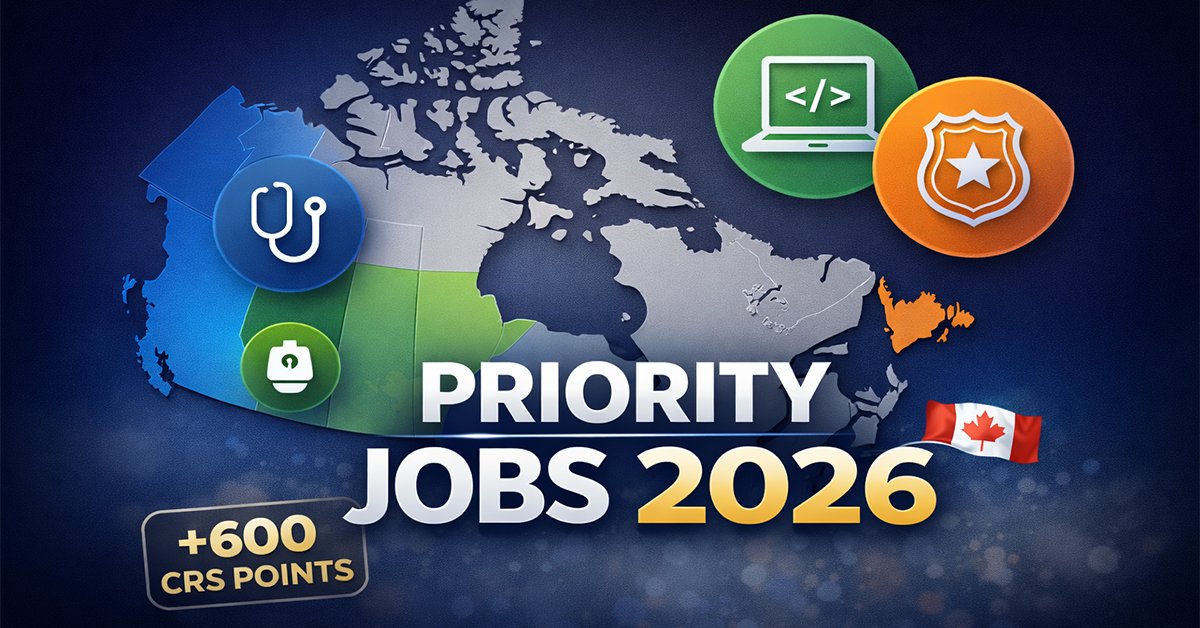

If you’re trying to immigrate to Canada through Express Entry, here’s something that could completely change your timeline: your job might be exactly what a Canadian province is looking for right now.
I’ve been following Canada’s immigration landscape for years, and I can tell you that having the right occupation on your Express Entry profile isn’t just helpful—it can be the difference between waiting months (or years) for an invitation and getting one almost immediately.
Here’s why: Provincial Nominee Programs give you an instant 600 CRS points. Let me put that in perspective. Most Express Entry draws require scores between 470-500 points. Add 600 to your existing score, and you’re essentially guaranteed an invitation to apply for permanent residence in the next draw.
But there’s a catch—provinces are selective. They’re looking for specific occupations that match their labor market needs. The good news? I’m about to show you exactly which jobs they’re prioritizing in 2026.
How Provincial Nominations Actually Work
Think of Express Entry as a waiting room full of immigration candidates. Everyone’s ranked by their CRS score based on factors like age, education, work experience, and language skills.
Provincial Nominee Programs (PNPs) allow provinces to walk into that waiting room and hand-pick candidates who have the skills their local economies need. When a province nominates you, it’s like getting a golden ticket—those 600 bonus points shoot you to the top of the list.
The key is alignment. If your occupation matches what a province is looking for, you’re not just another application in the pile. You’re solving a problem they have.
Alberta: Where Tech and Healthcare Rule
Alberta has gotten smart about this. They’ve created specific pathways targeting the exact occupations they need most.
The Tech Boom
If you work in technology, Alberta wants you. Their Accelerated Tech Pathway covers everything from software developers to cybersecurity specialists. We’re talking about:
- Software engineers and developers (NOC 21231, 21232)
- Data scientists and cybersecurity specialists (NOC 21211, 21220)
- Computer and information systems managers (NOC 20012)
- Web developers and designers (NOC 21233, 21234)
I’ve seen tech professionals get nominated within weeks of creating their Express Entry profile. Alberta’s tech sector is growing fast, and they’re not being subtle about needing talent.
The pathway also includes supporting roles that people often overlook—business development officers (NOC 41402), HR professionals (NOC 11200), and even marketing specialists (NOC 11202). If you’re in tech-adjacent fields, don’t assume you’re not eligible.
Healthcare Workers Are Gold
Alberta’s Dedicated Healthcare Pathway is equally aggressive. They’re targeting:
- Physicians (all specializations—NOC 31100, 31101, 31102)
- Nurse practitioners and registered nurses (NOC 31302, 31301)
- Licensed practical nurses (NOC 32101)
Here’s something important: Alberta wants people who can hit the ground running. They’re looking for candidates with recent healthcare experience and credentials that align with Alberta’s standards. If you’re a healthcare professional with Canadian-equivalent qualifications, you’re in an excellent position.
The Law Enforcement Wild Card
This one surprised me when it launched. Alberta created a specific pathway for police officers and investigators (NOC 42100, 41310, 40040). It’s not as commonly discussed, but if you have law enforcement experience—particularly in investigative roles—Alberta is actively seeking you.
British Columbia: Healthcare Dominance
BC takes a different approach. Their Health Authority stream is massive, covering an almost overwhelming range of healthcare occupations.
We’re talking about over 60 different NOC codes, from specialists and surgeons to dental assistants and pharmacy technicians. If you work in healthcare in any capacity, BC probably has a spot for you.
Some standout inclusions:
- Psychologists and therapists (NOC 31200, 41301)
- Pharmacists and pharmacy technicians (NOC 31120, 32124)
- Medical laboratory and radiation technologists (NOC 32120, 32121)
- Social workers and community service workers (NOC 41300, 42201)
One thing to watch: BC has specific licensing requirements for certain roles. For example, dental assistants (NOC 33100) must be licensed in BC—unlicensed chairside assistants don’t qualify. Nurse aides (NOC 33102) need to be on BC’s Care Aide & Community Health Worker registry.
Do your homework on the credential requirements before you get too excited.
The Entry-Level Opportunity
BC’s Entry Level and Semi-Skilled stream focuses heavily on hospitality and accommodation workers. If you’re a hotel manager, resort staff member, or work in tourism-related services, this could be your pathway.
The key requirement? You typically need to be directly employed by hotels or resorts—especially those connected to recreational activities like skiing, golfing, or nature tourism. BC’s tourism industry took a hit during the pandemic years, and they’re rebuilding aggressively.
Nova Scotia: Calling All Doctors
Nova Scotia keeps it simple with their Labour Market Priorities Physicians stream. They want doctors—specifically:
- → Heading to Border Control? Key Immigration Questions You Must Be Ready to Answer
- → Planning a European Trip? What Starkville’s Indian Community Should Know About Schengen Visas
- → 11 Countries Offering Funded Ph.D. Programs for International Students
- → U.S. Dollar Reaches Two-Week High Driven by Middle East Tensions and Fed Policy Outlook
- → 100-Year-Old Who Still Drives and Lives Alone Shares Her 6 Secrets to Longevity
- → What to Do Immediately If a Family Member Is Detained by ICE in Indiana
- → Flying With Flour or Coffee? TSA’s Powder Rule Could Delay Your Airport Security Screening
- Specialists in clinical and laboratory medicine (NOC 31100)
- Surgeons (NOC 31101)
- General practitioners and family physicians (NOC 31102)
This isn’t a casual invitation. Nova Scotia expects you to have certification from a Nova Scotia health authority and align with their healthcare hiring needs. But if you’re a qualified physician looking for a pathway to PR, this is about as direct as it gets.
What If Your Job Isn’t on These Lists?
Here’s the thing: these are just the streams with priority occupation designations. Many other PNP streams exist that don’t publish specific occupation lists. Instead, they focus on broader criteria like work experience in the province, job offers, or sector-based needs.
In other words, not seeing your occupation above doesn’t mean you’re out of options. It just means you’ll need to explore other provincial streams or general Express Entry draws.
How to Actually Use This Information
Knowing which occupations are in demand is only half the battle. Here’s what you should do next:
1. Verify your NOC code accuracy Make absolutely sure your occupation aligns with the NOC code you’re claiming. Immigration officers are strict about this. If your job duties don’t match the NOC description, you could face issues down the line.
2. Check your CRS score Even without a provincial nomination, you need a competitive CRS score to stay in the Express Entry pool. Calculate yours and see where you stand.
3. Assess your eligibility properly Each province has additional requirements beyond just having the right occupation—things like language test scores, work experience duration, educational credentials, and sometimes a job offer.
4. Consider using an eligibility tool Tools like CanadaVisa+ can show you which PNP streams you’re eligible for based on your specific profile. It’s free to use and can save you hours of research.
5. Create your Express Entry profile You can’t get a provincial nomination if you’re not in the pool. Get your profile created and make sure all your information is accurate and up-to-date.
The Bottom Line
Canada’s immigration system rewards strategic thinking. If your occupation appears on one of these priority lists, you have a significant advantage over other candidates.
But don’t just sit on that information. Provincial priorities can shift based on labor market changes, economic conditions, and policy updates. What’s in high demand today might be less critical next year—though healthcare and tech seem to be perpetual needs.
The smart move? Get into the Express Entry pool as soon as you’re eligible, optimize your profile, and position yourself to receive that provincial nomination. Those 600 CRS points aren’t just a boost—they’re a game-changer.
Your occupation might be exactly what Canada is looking for. The question is: are you ready to take advantage of it?
