
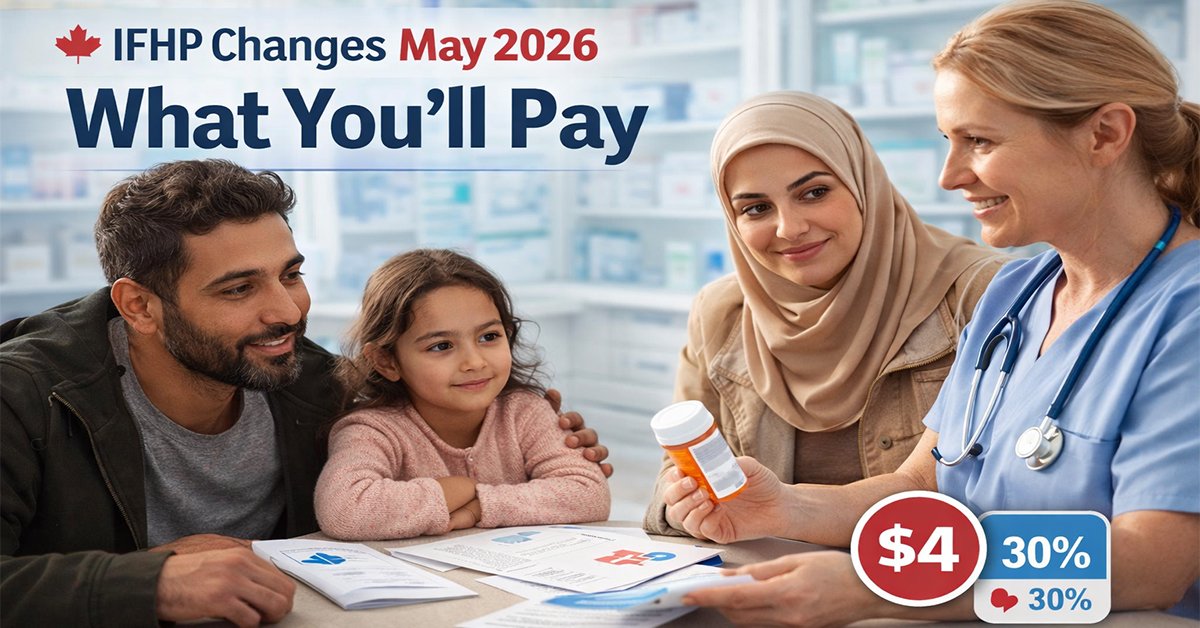

If you’re covered under Canada’s Interim Federal Health Program, there’s a change coming on May 1, 2026 that you need to know about.
Starting that date, you’ll need to pay out-of-pocket costs when you get certain health services—specifically, $4 every time you fill a prescription, and 30% of the cost for things like dental care, counselling, and vision services.
I know what you’re probably thinking: “Wait, I thought this coverage was free?” And you’re right to be confused, because up until now, most IFHP services haven’t required you to pay anything upfront.
Let me break down exactly what’s changing, what’s staying the same, and what you need to do to avoid surprise bills at the pharmacy or dentist’s office.
What Is the IFHP, Really?
Before we get into the changes, let’s make sure we’re on the same page about what the Interim Federal Health Program actually is.
The IFHP provides temporary health coverage for refugees, asylum seekers, and certain other groups until you become eligible for provincial or territorial health insurance. Think of it as a bridge—it covers you during that gap between arriving in Canada and getting regular provincial health coverage.
Most people don’t even need to apply for IFHP. If you’re a refugee claimant, a protected person, or a resettled refugee, your coverage is activated automatically based on your immigration status.
The program works through a network of registered healthcare providers across Canada. When you go to a clinic, pharmacy, or hospital, they verify your eligibility and bill the IFHP directly through Medavie Blue Cross.
That’s been working pretty smoothly for years. But on May 1, 2026, the payment structure changes for certain services.
The Two New Co-Payments You Need to Know
Starting May 1, 2026, there are two specific co-payments that will affect you:
$4 for every prescription you fill or refill
Every time you pick up medication at the pharmacy—whether it’s a new prescription or a refill of something you’re already taking—you’ll pay $4 directly to the pharmacist.
If your doctor prescribes three different medications and you fill them all at once, that’s $4 × 3 = $12 out of your pocket right there.
30% of the cost for other supplemental services
This one’s trickier because the amount varies depending on what you’re getting. You’ll pay 30% of the covered cost for services like:
- Dental care (urgent dental work, fillings, extractions)
- Vision care (eye exams, glasses, contact lenses)
- Mental health counselling and therapy
- Physiotherapy, occupational therapy, speech therapy
- Assistive devices (hearing aids, prosthetics, mobility aids, wheelchairs)
- Medical supplies and equipment
- Home care and long-term care services
So if your dentist bill for urgent dental work is $500, you’ll pay $150 (30%) and IFHP covers the remaining $350.
What’s NOT Changing (This Is Important)
Here’s the good news: basic healthcare stays completely free.
Doctor visits, hospital care, emergency room visits, specialist appointments, lab tests, diagnostic imaging—none of these require co-payments. You won’t pay anything for these services, just like before.
This distinction matters because it means your core medical care—the stuff that keeps you healthy and safe—remains fully covered. The co-payments only apply to what the government calls “supplemental benefits.”
Immigration, Refugees and Citizenship Canada describes this as keeping basic care accessible while managing the growing cost of supplemental services.
Why This Change Is Happening
The official government position is that these co-payments help ensure the program’s long-term sustainability.
According to IRCC’s announcement, introducing co-payments helps manage growing demand while keeping supplemental healthcare accessible for current and future beneficiaries.
Translation: more people are using the program, costs are rising, and the government wants beneficiaries to share some of those costs for non-essential services.
Advocacy groups have pushed back on this, pointing out that services like dental care and mental health counselling aren’t really “supplemental” for vulnerable populations—they’re essential for health and integration.
Dr. Michaela Beder, speaking to the Toronto Star, noted that many IFHP patients are on multiple medications for chronic conditions like diabetes and hypertension. Those $4 co-payments add up fast when you’re taking five or six medications regularly.
But regardless of the debate, the change is happening. So let’s focus on what you need to do.
How This Works at the Pharmacy or Clinic
Starting May 1, when you go to get a prescription filled or receive supplemental care, here’s what happens:
Step 1: The provider (pharmacist, dentist, therapist, etc.) checks that you’re still eligible under IFHP by entering your Unique Client Identifier (UCI) into their system.
Step 2: They confirm whether the service or product is covered under IFHP benefit grids.
Step 3: They tell you whether a co-payment applies and how much you need to pay.
Step 4: You pay the co-payment directly to them—cash, debit, or credit card.
Step 5: The provider bills the remaining covered portion to IFHP through Medavie Blue Cross.
The key here is Step 3. You should never be surprised by a co-payment. The provider should tell you upfront how much you’ll pay before providing the service.
The Services Most Likely to Cost You Money
Let’s be realistic about where these co-payments will hit your wallet.
Prescription Medications
If you’re on ongoing medications—things like blood pressure pills, diabetes medication, asthma inhalers, antidepressants—that $4 per prescription adds up every month.
Let’s say you take four medications and refill them monthly. That’s $16 per month, or $192 per year, just in prescription co-payments.
For someone who’s just arrived in Canada and is working on getting established, that’s not a small amount.
Dental Care
Urgent dental work can be expensive. A filling might cost $200-300, a tooth extraction could be $300-500 or more.
At 30%, you’d be paying $60-90 for a filling, or $90-150+ for an extraction.
If you need multiple dental procedures, these costs can add up quickly.
Mental Health Counselling
Many refugees and asylum seekers need mental health support to deal with trauma, displacement, and adjustment challenges.
If a counselling session costs $150 and you’re paying 30%, that’s $45 per session. If you need weekly therapy for a few months, the costs can become a barrier to getting the help you need.
Vision Care
Eye exams typically run $80-150, and glasses can cost $200-500 or more depending on your prescription.
At 30%, you’d pay $24-45 for an exam and $60-150+ for glasses.
What You Should Do Starting May 1, 2026
IRCC has provided clear guidance for beneficiaries, and honestly, it’s good advice:
1. Use IFHP-registered providers
Not every healthcare provider is registered with IFHP. Use the IFHP Provider Search tool on the Canada.ca website to find registered doctors, dentists, pharmacies, and other providers in your area.
This is important because non-registered providers won’t be able to bill IFHP directly, meaning you might have to pay the full cost upfront and then try to get reimbursed—which is a hassle you don’t need.
2. Ask about co-payments BEFORE receiving care
Don’t be shy about this. Before you get a prescription filled, before you sit in the dentist’s chair, before you start a counselling session, ask: “Will I need to pay a co-payment? How much?”
This gives you time to prepare or, if necessary, reschedule for when you have the money available.
3. Confirm the amount
Make sure you understand exactly how much you’ll pay. If the provider says “30% of the cost,” ask what the total cost is so you can calculate the co-payment.
If it’s higher than you expected, you can discuss options or alternatives.
4. Keep every receipt
Save your receipts every single time you pay a co-payment. These aren’t just for your records—they’re proof of payment if there’s ever a billing dispute or confusion about what was covered.
Keep them organized by date and type of service. Take photos and store them digitally as backup.
What Healthcare Providers Need to Do
It’s not all on you—providers have responsibilities too.
They must verify your eligibility every time you visit by checking the Medavie Blue Cross system. They need to confirm that you don’t have other public or private insurance that would cover the service first, because IFHP is a “last resort” program.
They’re supposed to tell you in advance if a service isn’t covered or if it requires pre-approval.
Here’s something useful that many people don’t know: it takes at least 2 business days for new IFHP coverage to appear in the system after it’s issued.
This means if you just got your IFHP certificate, there might be a short gap where providers can’t verify your coverage in their system yet—even though you’re eligible.
The good news is that providers can still provide services if your certificate’s effective date is within 2 business days, but they have to wait before submitting the billing claim.
This explains why some newly arrived refugees sometimes face confusion at clinics or pharmacies, even when everything is in order.
Real-World Examples to Help You Understand
Let me walk you through a few scenarios so you can see how this works in practice.
Example 1: Multiple Prescriptions
Maria’s doctor prescribes three medications: one for blood pressure ($25), one for diabetes ($60), and one for anxiety ($40). Total medication cost: $125.
Maria goes to a registered IFHP pharmacy. She pays the co-payment of $12 ($4 × 3 prescriptions).
The pharmacist bills Medavie Blue Cross for the remaining $113. Total out-of-pocket for Maria: $12.
Example 2: Urgent Dental Care
Ahmed breaks a tooth and needs urgent dental work. He finds a registered IFHP dentist nearby.
The dentist examines him and says the repair will cost $500. Ahmed will need to pay 30%, which is $150.
Ahmed pays $150 to the dentist. The dentist bills IFHP for the remaining $350. Total out-of-pocket for Ahmed: $150.
Example 3: Emergency Hospital Visit
Chen experiences severe chest pain and goes to the emergency room. He receives emergency care, tests, and follow-up appointments with a specialist. Total cost: $1,800.
Because emergency room visits, hospital care, and doctor appointments are basic health benefits (not supplemental), Chen pays nothing.
The hospital and doctors bill IFHP directly for the full $1,800. Total out-of-pocket for Chen: $0.
The Controversy Nobody’s Talking About Enough
Look, I need to be honest with you about something that isn’t getting enough attention in the official announcements.
For many refugees and asylum seekers, $4 per prescription or 30% of dental work might seem manageable on paper. But when you’re living on limited resources, still trying to find work, learning a new language, and supporting family members, these costs can become genuine barriers to care.
There’s research showing that even small co-payments can deter people from accessing necessary healthcare. They start skipping medications, postponing dental work, or avoiding mental health counselling because they can’t afford the co-payment.
And here’s the thing: when people delay or skip necessary care, their health problems get worse. That broken tooth becomes an infection. That manageable chronic condition becomes an emergency. That untreated mental health issue becomes a crisis.
Then the costs to the healthcare system are actually higher than they would have been if the person had accessed early, preventive care.
Organizations like the FCJ Refugee Centre have voiced concerns that requiring vulnerable populations to co-pay for services like trauma counselling and dental care undermines their ability to integrate and recover from displacement.
I’m not here to tell you whether this policy is right or wrong—that’s for you to decide. But I am here to tell you that if these co-payments become a barrier for you, there are people and organizations who can help. Don’t suffer in silence.
What If You Can’t Afford the Co-Payment?
This is the question that keeps me up at night, because the official government guidance doesn’t really address it.
If you show up at a pharmacy and can’t pay the $4 co-payment, technically the provider isn’t required to dispense the medication. Same with dental work or other supplemental services.
But here are some things you can try:
Talk to your healthcare provider: Many providers understand that refugees and asylum seekers face financial challenges. Some might be willing to work with you on payment plans or timing.
Contact settlement services: Organizations that support refugees often have emergency funds or can connect you with resources to help cover healthcare costs.
Check for community health programs: Some community health centres offer services on a sliding scale or have funds available for people who can’t afford co-payments.
Prioritize: If you’re on multiple medications, talk to your doctor about which ones are most critical. Sometimes there are lower-cost alternatives.
Document everything: If cost becomes a barrier to accessing care you need, document it. This information is valuable for advocacy groups working to address healthcare access issues.
Important Details You Should Know
Coverage Activation Takes Time
New IFHP coverage can take up to 2 business days to appear in the provider’s system. If you just got your certificate, give it a couple of days before trying to use it, or be prepared to explain the timing to providers.
IFHP Is Last-Resort Coverage
If you have any other public or private health insurance—even partial coverage—you must use that first. IFHP only pays for services that aren’t covered by anything else.
Pre-Approval May Be Required
Some services need pre-approval from IFHP before you can receive them. Your provider should know which services require this and can help you get authorization.
Keep Your UCI Number Handy
Your Unique Client Identifier (UCI) is how providers verify your eligibility. Keep it accessible—in your phone, in your wallet, memorized if possible.
Resources and Where to Get Help
IFHP Information and Provider Search: Visit canada.ca/en/immigration-refugees-citizenship/services/refugees/help-within-canada/health-care.html
Medavie Blue Cross (IFHP Administrator): Call 1-888-614-1880 for questions about coverage, eligibility, or billing
Downloadable Information: IRCC has created an information toolkit with posters and fact sheets. Your settlement worker should have these, or you can find them on the IFHP website.
Settlement Services: Contact your local immigrant and refugee settlement organization. They can provide guidance, support, and sometimes emergency assistance.
My Honest Take on All of This
I’ve spent a lot of time working with refugee and immigrant communities, and here’s what I think you need to hear:
These changes aren’t the end of the world, but they’re not nothing either. For some people, these co-payments will be manageable. For others, they’ll create real challenges.
The important thing is to be informed and prepared. Know what you’ll pay before you get care. Budget for these costs if you can. And if you can’t, reach out for help rather than going without necessary care.
Canada’s healthcare system isn’t perfect, but it’s generally designed to help people. The IFHP exists because there’s recognition that refugees and asylum seekers need health coverage during a vulnerable transition period.
These co-payments represent a shift in how that coverage works, but the fundamental principle—that you deserve access to healthcare—hasn’t changed.
Your Action Plan Before May 1
Here’s what I recommend you do before the changes take effect:
1. Review your current health needs
- What medications are you taking?
- Do you have any pending dental work?
- Are you receiving counselling or therapy?
- Do you need vision care or assistive devices?
2. Calculate potential costs
- Count your prescriptions and multiply by $4
- Estimate 30% of any supplemental services you use regularly
- Plan how this fits into your monthly budget
3. Find registered providers
- → New Canada Benefit Payments Arriving This Week in May 2026
- → Canada Bread Settlement Payments Begin Rolling Out Across Canada in 2026
- → Canada Immigration Backlog Update 2026: IRCC Application Inventory Crosses 2.15 Million
- → Canada Expands Visa-Free Travel Access for Citizens of Indonesia and Malaysia in 2026
- → Canada’s 365-Day Maintained Status Work Rule in 2026: What Foreign Workers Need to Know
- → Canada Launches Early Retirement Incentive Program in 2026: Eligibility, Benefits, and Application Process Explained
- → Bringing Your Family to New Zealand on a Work Visa: Complete 2026 Guide
- Use the IFHP Provider Search tool now
- Save the contact information for registered providers near you
- Confirm they’re taking new IFHP patients
4. Save information
- Bookmark the IFHP website
- Save the Medavie Blue Cross phone number: 1-888-614-1880
- Keep your UCI readily accessible
- Organize a system for storing receipts
5. Connect with support
- Contact your settlement worker and let them know about your healthcare needs
- Ask about emergency funds or assistance programs
- Connect with refugee support organizations in your community
After May 1: Stay Vigilant
Once the changes take effect, pay attention to:
Billing accuracy: Make sure you’re only being charged the correct co-payment amounts ($4 for prescriptions, 30% for other supplemental services).
Coverage verification: Confirm that services you’re receiving are actually covered under IFHP before you agree to pay co-payments.
Receipt collection: Keep every receipt organized and accessible.
Changes to your situation: If your immigration status changes or you become eligible for provincial health coverage, your IFHP coverage ends. Stay on top of these transitions.
Final Thoughts
Change is never easy, especially when it affects something as fundamental as healthcare.
These new co-payment rules are going to impact how you access certain health services, and for some people, they’ll create additional financial pressure during an already challenging time.
But here’s what I want you to remember: you still have substantial health coverage through IFHP. Basic medical care—the big stuff—remains completely free. And there are people and organizations ready to help if these co-payments become a barrier for you.
Stay informed, plan ahead, ask questions, keep good records, and don’t hesitate to reach out for support when you need it.
You’ve already shown incredible strength by coming to Canada and starting a new life. Don’t let confusion about health coverage or worry about co-payments prevent you from getting the care you need.
Your health matters. Your wellbeing matters. And the Canadian healthcare system—even with these changes—is still here to support you through this transition.
