
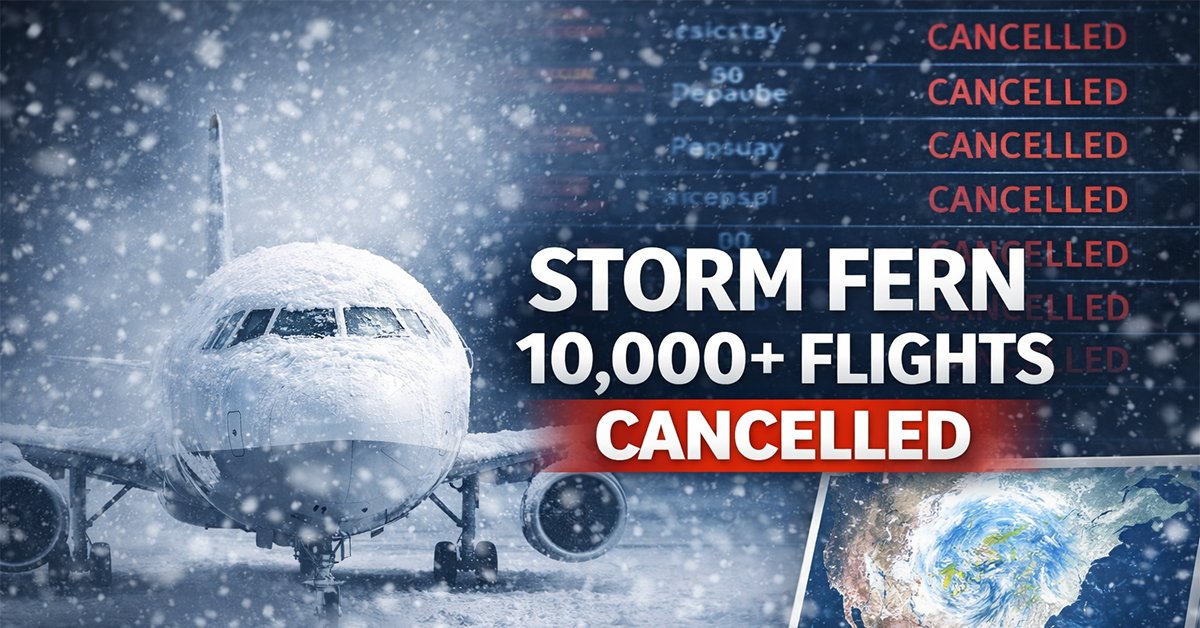

If you were supposed to fly anywhere on the East Coast this weekend, there’s a good chance you didn’t. Winter Storm Fern just delivered the biggest single-day hit to U.S. aviation since COVID started, canceling over 10,700 flights on January 25—that’s nearly one-third of all scheduled departures.
I’ve covered plenty of winter weather disruptions over the years, but this one stands out. Not just for the sheer number of cancellations, but for how it exposed the same vulnerabilities in our aviation system that we keep saying we’ll fix but never quite do.
The Numbers Are Staggering
Philadelphia International got hit hardest. By Sunday afternoon, 94% of departures were scrubbed. If you had a flight out of PHL, you basically weren’t going anywhere.
Washington-area airports (Dulles and Reagan), the New York metro airports (JFK, LaGuardia, Newark), and Boston Logan weren’t far behind. Each saw cancellation rates north of 70%.
But here’s what makes this storm different from your typical Nor’easter disruption: the cascade effect. Major hubs that didn’t even see snow—Dallas-Fort Worth, Charlotte, Atlanta—faced hundreds of cancellations because planes and crews were stuck in the Northeast. That’s the domino effect of hub-and-spoke airline networks.
When a jet that’s supposed to fly Charlotte to Miami is sitting on a snowbank in Philadelphia, that Miami flight gets canceled too. Then the crew that was supposed to take that plane to Orlando is out of position. Then the Orlando-to-Dallas leg falls apart. One storm, five airports affected.
Airlines Actually Learned Something
Here’s a bit of good news buried in this mess: airlines handled this storm smarter than they’ve handled past ones.
Remember the Southwest meltdown in December 2022? Or the JetBlue chaos during the 2022 holiday season? Those disasters happened partly because airlines waited too long to make decisions, trying to squeeze out every possible flight before admitting defeat.
This time was different. Delta pre-emptively canceled over 1,000 flights on Saturday morning—before the worst of the storm hit. They extended their travel waiver early. American, United, Southwest, and JetBlue followed suit, thinning their schedules proactively instead of reactively.
Why does this matter to you? Because pre-emptive cancellations, while frustrating, are actually better than day-of chaos. When airlines cancel ahead of time, they can:
- Rebook you on alternative flights before those fill up
- Reposition aircraft to unaffected cities to speed up recovery
- Get crews rested and in the right locations for when weather clears
- Give you time to make other plans (rent a car, book a train, postpone the trip)
Day-of cancellations leave you stuck at the airport with 200 other angry passengers competing for the same three remaining seats to your destination.
What the Airline Waivers Actually Mean
Every major carrier issued system-wide change waivers running through at least January 29. Let me translate what this actually gives you, because the airline language is deliberately vague.
You can rebook without fees. Normally, changing a ticket costs $200 on most domestic routes (international can be more). That’s waived.
You won’t pay fare differences—but there’s a catch. If your original flight was $300 and the new flight is $500, the waiver covers that $200 difference. But here’s what they don’t advertise: this usually only applies if you’re rebooking in the same cabin class within a specific timeframe. Try to move your Tuesday flight to next Saturday when prices have jumped, and you might hit limits.
You’re entitled to a full refund if the airline cancels. This is important. U.S. Department of Transportation rules say that if the airline cancels your flight—even for weather—you get your money back, not just a travel credit. The airline won’t volunteer this information. You have to ask for it explicitly.
Most people don’t know that last part. Airlines would much rather give you a credit that keeps the money in their system. But if Fern killed your trip entirely and you don’t want to rebook, demand the refund. You’re legally entitled to it.
The Hidden Ripple Effect Nobody’s Talking About
The cancellations you’re seeing right now are just Act One. Act Two hits early this week.
Here’s why: pilots and flight attendants have strict legal rest requirements. After a certain number of duty hours, they must have minimum rest periods before flying again. When a major storm disrupts operations, crews don’t just magically reset once the snow stops.
A pilot who was supposed to fly three legs Saturday but got stuck mid-rotation doesn’t just jump back into the schedule Sunday morning. They need their legally mandated rest. That plane they were supposed to fly needs a crew. Finding a replacement crew means pulling them from somewhere else, which creates another gap.
This is why smart travelers know that the three days after a major storm often have more delays and cancellations than the storm day itself. Equipment is out of position, crews are exhausted or hit their hour limits, and maintenance issues that got deferred during the chaos start surfacing.
If you have a flight Tuesday or Wednesday this week on any route that touches the Northeast, build in extra time. Don’t book a same-day connection for anything important.
What This Says About U.S. Aviation Infrastructure
Look, I love flying. I’ve probably spent more time in airports than my own living room over the past decade. But we need to talk about the elephant in the terminal: American aviation infrastructure is aging, and storms like Fern expose every crack.
De-icing capacity is inadequate. Major airports don’t have enough de-icing equipment or designated pads to handle full schedules during winter weather. Planes sit in line for de-icing the way you sit in line at airport security during Thanksgiving. That creates delays that compound into cancellations.
Too many single-runway operations. When weather forces airports to switch to single-runway ops (for safety and efficiency during low visibility), capacity instantly drops by 50% or more. LaGuardia, for example, basically becomes a bottleneck. Airlines know this, but there’s no economic incentive for them to fund infrastructure upgrades.
Air traffic control technology is stuck in the 1980s. I’m not exaggerating. The FAA has been “modernizing” ATC systems for over a decade through a program called NextGen, and we’re still years from full implementation. Meanwhile, every other developed country has leapfrogged us.
These aren’t new problems. We’ve known about them since at least the 2000s. But infrastructure is expensive and unsexy, so it keeps getting pushed down the priority list.
Analysts are estimating Storm Fern’s economic impact at over $300 million when you factor in lost productivity, emergency hotel stays, overtime pay for airport and airline staff, and supply chain disruptions from cargo delays. That’s just one storm.
Practical Advice If You’re Affected
If Fern canceled your flight, here’s your action plan:
1. Don’t wait on hold. Calling the airline will put you in a queue behind 10,000 other people. Use the airline’s app or website to rebook yourself. It’s faster and you can see all available options.
2. Check alternate airports. If you were flying out of Newark and it’s a disaster, could you get to Philadelphia (once it clears) or even Baltimore? The airline’s change waiver should let you switch without penalty.
3. Consider trains for Northeast routes. If you’re trying to get from DC to New York or Boston to New York, Amtrak is probably more reliable right now than flying. Plus no TSA line.
4. Document everything. Take screenshots of cancellation notices, save emails, keep receipts for any expenses you incur (hotel, meals, ground transport). If you have travel insurance or if your credit card provides trip protection, you’ll need this documentation for claims.
5. Know your rights. If the airline cancels, you get a refund. If YOU cancel because of weather, you don’t. Delay compensation laws in the U.S. are terrible compared to Europe, but you still have some protections. The DOT website has a dashboard showing what each airline is required to provide for controllable cancellations and delays.
6. Check international connections. If your domestic flight was the first leg of an international trip, make sure your visas and entry requirements are still valid if you’re arriving on different dates. Some countries have strict validity windows. This is where services that can quickly verify entry requirements and handle emergency travel documents become invaluable.
For Business Travelers and Corporate Travel Managers
If you manage corporate travel, this storm should be triggering a review of your policies right now.
Duty of care isn’t optional. You need to know where your traveling employees are at all times during disruptions like this. If you don’t have a system for tracking traveler locations and reaching them quickly, you’re exposed to both liability and PR risk.
Flexible ticketing should be default. The days of booking the cheapest basic economy fare for every trip need to end. Yes, it saves money upfront. But when a storm hits and you’ve got executives stuck at airports with no rebooking options, those savings evaporate.
Build storm buffers. If someone has a critical meeting scheduled, don’t have them fly in same-day during winter months. Build in arrival a day early. Yeah, it costs an extra hotel night. But it’s cheaper than a blown deal because your VP of Sales is stuck in Chicago.
Consider rail for Northeast Corridor. For Boston-NYC-DC-Philadelphia routes, train travel is often faster when you factor in airport security and transit time. It’s also more reliable in winter weather.
Review your travel insurance. Most corporate travel policies include some trip protection, but the coverage varies wildly. Make sure you understand what’s covered for weather-related disruptions and what requires additional riders.
The Long-Term Fix Nobody Wants to Pay For
Here’s the uncomfortable truth: this will keep happening until we make serious infrastructure investments.
We need more runways at congested airports. We need better de-icing infrastructure. We need air traffic control systems that don’t rely on equipment older than the pilots flying the planes. We need better coordination between airlines, airports, and weather services.
All of that costs money. Billions of dollars. And in an industry that operates on razor-thin margins and a political environment where “infrastructure spending” triggers budget battles, nobody wants to write that check.
So instead, we’ll limp along, and every few years a storm like Fern will hit and we’ll cancel 10,000 flights and write articles about how fragile the system is, and then we’ll move on until the next one.
What’s Next
Weather’s clearing across most of the affected region by Monday, but expect continued ripples through Wednesday. If you absolutely must fly this week and your route touches the Northeast, here’s my advice:
- Book the earliest flight of the day (fewer accumulated delays)
- Avoid tight connections (give yourself at least 2-3 hours)
- Have a backup plan (know the train schedule, have rental car options ready)
- Check your flight status obsessively starting 24 hours before departure
Storm Fern reminded us, once again, that our aviation system is incredibly efficient when everything works perfectly and remarkably fragile when it doesn’t. Until we fix the underlying infrastructure issues, winter weather will keep delivering these reminders.
- → Need a Passport Fast? How to Expedite Your U.S. Passport Renewal Step-by-Step
- → Want a $60K+ Salary Without a 4-Year Degree? 15 Certificates You Can Finish in Under a Year
- → Planning a Trip to Europe? 6 Essential Entry Rules to Avoid Denial at the Border
- → Heading to Border Control? Key Immigration Questions You Must Be Ready to Answer
- → Planning a European Trip? What Starkville’s Indian Community Should Know About Schengen Visas
- → 11 Countries Offering Funded Ph.D. Programs for International Students
- → U.S. Dollar Reaches Two-Week High Driven by Middle East Tensions and Fed Policy Outlook
Safe travels, and may your next flight be on time.
