
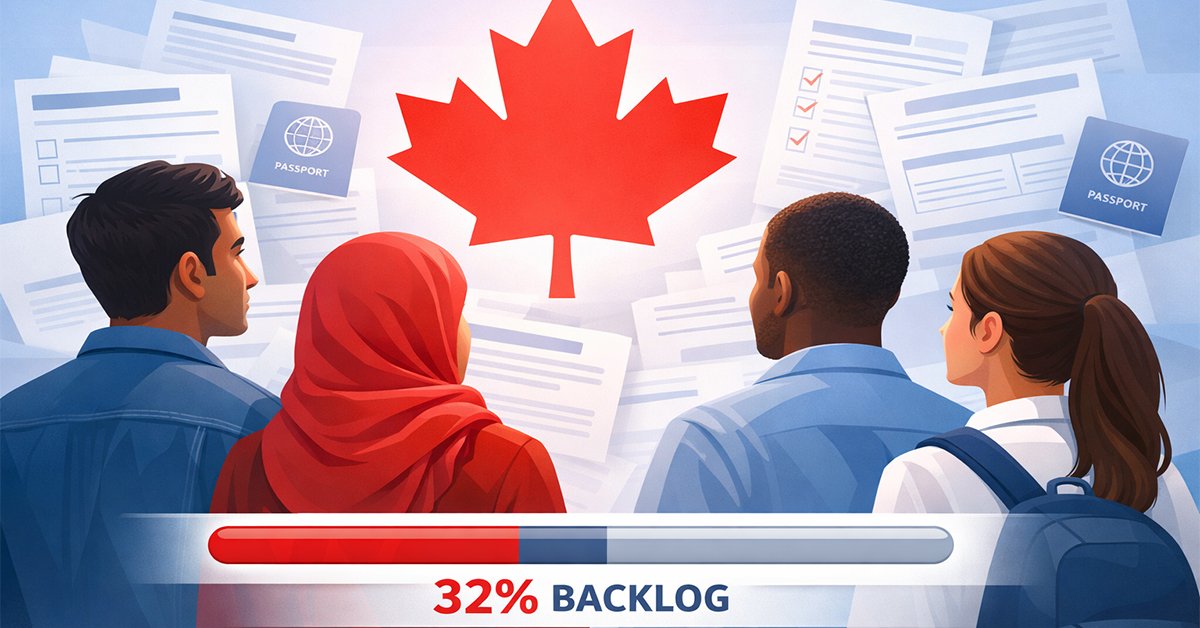

If you’re waiting for your Express Entry application to process, you’re not alone—and the wait might be longer than you expected. New government data shows Canada’s immigration backlog has climbed to levels we haven’t seen since late 2022, with Express Entry applications taking the biggest hit.
Here’s what’s really happening with Canada’s immigration system right now, and what you need to know if you’re planning to apply in 2026.
The Numbers Behind the Backlog
As of November 30, 2025, Immigration, Refugees and Citizenship Canada (IRCC) was sitting on just over 1 million applications that have exceeded normal processing times. That’s a backlog of 1,005,800 applications across all categories—the highest it’s been in three years.
What caught everyone’s attention is the Express Entry backlog specifically. It jumped from 27% in October to 32% in November, marking the worst backlog for this program since October 2022, when it hit 45%. For context, IRCC’s own target was to keep this at 25%.
Let me break down what these numbers actually mean. Out of 941,600 permanent residence applications in the system, about 515,000 are considered backlogged. That’s nearly 45% of all PR applications sitting beyond their expected processing timelines.
Why Is This Happening?
The backlog didn’t appear overnight. If you look at the trend from early 2025, there’s a clear pattern. After a promising start to the year—with backlogs dropping steadily from January through April—things reversed course starting in May. Since then, we’ve seen six consecutive months of growth.
Between January and November 2025, IRCC processed 414,700 permanent residence applications and welcomed 367,500 new permanent residents. Those numbers sound impressive until you realize applications are coming in faster than they’re being processed.
The Express Entry-linked Provincial Nominee Program (PNP) is facing similar challenges, with backlogs increasing from 51% to 53%—again, the highest since March 2022. Only family sponsorship applications seem to be holding steady at 20%, unchanged from the previous month.
Read More : Canada Faces Immigration Crisis in 2026: 2.1 Million Temporary Residents Facing Permit Expiration
What’s Actually Taking So Long?
Here’s something most people don’t understand: when IRCC sets a “service standard,” they’re not promising to process your application in that time. They’re aiming to process 80% of applications within that window. The other 20%? Those can take significantly longer due to various complications.
For Express Entry, the service standard is six months. But if your application needs additional verification, extra documentation, or happens to be more complex than average, you could be waiting much longer.
The department uses these service standards as internal benchmarks. Think of them as goals, not guarantees. An application officially becomes part of the “backlog” only when it exceeds these timelines.
Beyond Express Entry: The Full Picture
While Express Entry gets most of the attention, temporary residence applications tell their own story. The good news? The temporary resident backlog actually dropped from 999,100 applications in October to 942,000 in November.
Study permits saw the biggest improvement, with backlogs falling from 41% to 36%—better than IRCC’s projected 37%. Between January and November 2025, the department finalized 557,400 study permit applications.
Work permits improved slightly too, dropping from 50% to 49% backlog, though this is still above the target of 44%. The department processed over 1.2 million work permit applications during the same period.
Visitor visas, however, remain stubbornly stuck at 57% backlog—where they’ve been for three straight months. This overshoots the projected target of 54%.
The Citizenship Angle
If you’re planning to eventually become a Canadian citizen, you should know that citizenship grant applications are also facing increased delays. The backlog has crept up for five consecutive months, reaching 23% against a projected 21%.
- → Need a Passport Fast? How to Expedite Your U.S. Passport Renewal Step-by-Step
- → Want a $60K+ Salary Without a 4-Year Degree? 15 Certificates You Can Finish in Under a Year
- → Planning a Trip to Europe? 6 Essential Entry Rules to Avoid Denial at the Border
- → Heading to Border Control? Key Immigration Questions You Must Be Ready to Answer
- → Planning a European Trip? What Starkville’s Indian Community Should Know About Schengen Visas
- → 11 Countries Offering Funded Ph.D. Programs for International Students
- → U.S. Dollar Reaches Two-Week High Driven by Middle East Tensions and Fed Policy Outlook
As of November 30, there were 247,100 citizenship applications in the system, with 56,400 considered backlogged. The department welcomed 25,100 new citizens in November alone, but applications continue to outpace approvals.
What This Means for 2026 Applicants
Looking ahead to 2026, the landscape is shifting. Canada has introduced a new Express Entry category specifically for physicians with at least one year of Canadian work experience, signaling a focus on retaining talent already in the country. This represents a strategic shift from recruiting internationally to keeping valuable workers who are already integrated into Canadian systems.
The government is also considering three additional occupational categories: leadership roles for senior managers, research and innovation positions for scientists, and national security roles for military personnel from partner nations.
What does all this mean if you’re applying in 2026? The system is becoming more targeted and selective. General draws are giving way to category-based selections that prioritize specific occupations, French-language skills, and Canadian work experience.
Recent draws in early 2026 show this pattern continuing. In January, Canada issued 8,000 invitations in one of the largest Canadian Experience Class draws in history, with a CRS cutoff of 511. This suggests IRCC is prioritizing candidates already working in Canada.
Practical Advice for Applicants
If you’re in the Express Entry pool or planning to enter it, here’s what you need to focus on:
Don’t just chase CRS points. While a high Comprehensive Ranking System score still matters, it’s no longer the only thing that matters. You need to align your profile with IRCC’s current priorities.
Consider provincial nomination. Despite PNP backlogs, provincial nomination adds 600 points to your CRS score, which can be game-changing. Ontario, British Columbia, and Alberta have recently updated their occupation lists.
French language proficiency is golden. The government has committed to increasing Francophone immigration targets to 9% in 2026, rising to 12% by 2029. If you can demonstrate French language ability, you’re positioning yourself in a high-priority lane.
Canadian work experience counts more than ever. The new physician category and the large CEC draws show IRCC increasingly prefers candidates who are already in Canada and integrated into the workforce.
Stay informed about category-based draws. Monitor which categories IRCC is prioritizing in their draws. Healthcare, STEM, trades, agriculture, and education have all seen dedicated rounds in recent months.
Managing Expectations
Let’s be realistic about timelines. Even though the service standard for Express Entry is six months, the current backlog means many applications will take longer. Some might extend to eight, nine, or even twelve months depending on individual circumstances.
If you’re planning to apply, build buffer time into your plans. Don’t book one-way flights or give notice at your current job until you have approval in hand. The immigration process rarely moves as quickly as we’d like.
Also, understand that IRCC processes applications based on priority and category, not just on a first-come, first-served basis. Category-based draws have become the dominant selection method, though general draws continue on a limited basis.
The Bottom Line
Canada’s Express Entry backlog is real, growing, and affecting thousands of applicants. But it’s not a sign that the system is broken—it’s evolving. IRCC is shifting from volume to precision, targeting specific skills and prioritizing candidates who are already contributing to Canada’s economy.
For 2026 applicants, success will depend less on gaming the CRS system and more on strategic positioning. Understand which categories you fit into, maximize your eligibility across multiple pathways, and stay flexible in your approach.
The wait might be longer than you hoped, but for the right candidates with realistic expectations and strategic preparation, permanent residence in Canada remains an achievable goal.
Remember, while these numbers look daunting, IRCC processed over 400,000 PR applications in 2025 and welcomed more than 367,000 new permanent residents. Your application could be one of them—it just requires patience, preparation, and a solid understanding of how the system actually works right now.
