
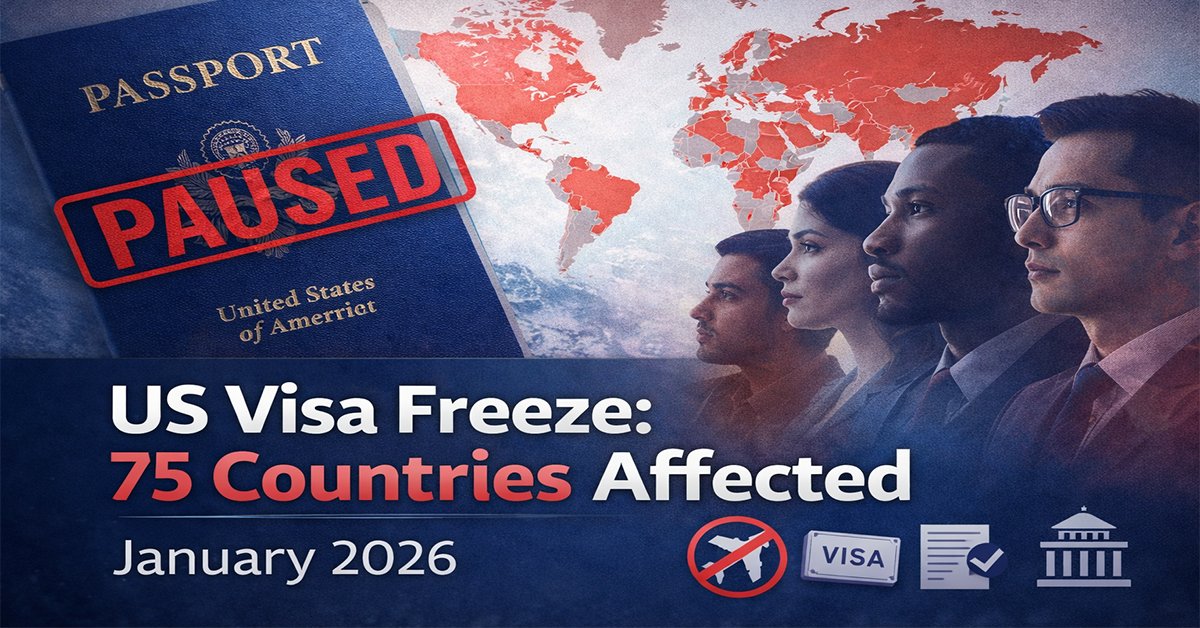

If you’re from Somalia, Russia, Brazil, Nigeria, Thailand, or one of 70 other countries—your plans to visit, work, or immigrate to the United States just got a lot more complicated.
Starting January 21, 2026, the State Department is hitting pause on all visa processing for 75 countries. Not slowing it down. Not reviewing applications more carefully. Completely pausing it.
The reason? A sweeping crackdown on what the government calls “public charge” applicants—people officials believe might rely on government benefits once they arrive in America.
And here’s what makes this different from previous travel restrictions: it’s not just about security threats anymore. It’s about age, weight, health conditions, English proficiency, and whether you’ve ever used food stamps or housing assistance.
Let me walk you through what’s actually happening, who’s affected, and what this means if you’re caught in the middle of it.
What Just Happened? The Basics
A State Department memo—first obtained by Fox News—directs consular officers to refuse visas under existing law while the department “reassesses screening and vetting procedures.”
The pause affects 75 countries and begins January 21, 2026. There’s no end date. The memo simply says it will continue “indefinitely” until the reassessment is complete.
The Countries Affected
While the State Department hasn’t released the complete list of all 75 countries, the confirmed nations include:
- Somalia
- Russia
- Afghanistan
- Brazil
- Iran
- Iraq
- Egypt
- Nigeria
- Thailand
- Yemen
And “more” according to the memo. That’s intentionally vague, which is creating massive uncertainty for applicants from countries not explicitly named.
Read More : DS-160 Just Got Harder: New Visa Rules You Need to Know Before Your Interview
Why Somalia Is Getting Special Attention
Somalia isn’t just on the list—it’s at the center of why this is happening right now.
Federal prosecutors recently uncovered what they’re calling a massive fraud scandal centered in Minnesota. The case involves widespread abuse of taxpayer-funded benefit programs, with many of those involved being Somali nationals or Somali-Americans.
The details are still emerging, but the scandal involved the “Feeding Our Future” program—a childcare nutrition initiative that prosecutors say was exploited to the tune of millions of dollars.
Whether this single case justifies freezing visa processing for an entire country is the subject of heated debate. But it’s clearly the catalyst that pushed this policy into action.
The “Public Charge” Rule: What It Actually Means
Here’s where things get complicated—and controversial.
The “public charge” provision has existed in immigration law for over 100 years. The idea is simple: the US shouldn’t grant visas to people who are likely to become dependent on government assistance.
What counts as “public charge” has changed dramatically depending on who’s in office.
Under Biden (2022-2025):
The rule was narrow. Officers could only consider:
- Cash assistance for income maintenance
- Long-term institutional care at government expense
Programs like SNAP (food stamps), Medicaid, WIC, and housing vouchers were not counted.
Under the New Guidance (November 2025-Present):
The State Department sent a cable to consular posts around the globe with sweeping new screening rules.
Now officers are instructed to deny visas to applicants deemed likely to rely on public benefits, weighing factors including:
- Health conditions (chronic illness, disability, mental health)
- Age (older applicants face scrutiny)
- Body weight (yes, seriously—overweight applicants can be denied)
- English proficiency
- Financial resources
- Potential need for long-term medical care
- Any past use of government cash assistance
- History of institutionalization
This is a dramatic expansion from the 2022 rule.
Who Can Be Denied Now
According to the guidance, consular officers have broad discretion to deny visas based on:
- Older applicants who might need Medicare or Social Security
- Overweight applicants who officers believe might need medical care
- Anyone with chronic health conditions (diabetes, heart disease, mental illness)
- People with limited English who might struggle to find work
- Anyone who’s ever used SNAP, Medicaid, housing assistance, or WIC—even if they were legally eligible at the time
The State Department frames this as preventing people from “exploiting the generosity of the American people.”
Critics call it discriminatory profiling that punishes people for circumstances beyond their control.
What’s Actually Frozen (And What Isn’t)
The January 21 pause applies to all visa types for the affected 75 countries:
Frozen:
- Tourist visas (B-1/B-2)
- Work visas (H-1B, L-1, etc.)
- Student visas (F-1, M-1)
- Family-based immigrant visas
- Employment-based immigrant visas
“Very Limited” Exceptions:
The memo says exceptions will only be allowed after an applicant has cleared public charge considerations.
Translation: if you can prove beyond any doubt that you’ll never need government assistance—and you still have a compelling reason to come to the US—you might get approved. But the bar is extremely high.
Who Might Still Get Through:
- Diplomats and government officials
- Athletes competing in major international events
- Cases deemed “U.S. national interest” (researchers, specialized engineers)
- Law enforcement priorities flagged by ICE
Everyone else? You’re waiting.
Read More : U.S. Visa Bonds: 13 Countries Now Face Up to $15,000 Entry Fee
This Is Separate From (But Related To) Other Travel Bans
If you’re confused because you’ve been hearing about multiple travel restrictions—you’re not alone. There are actually several overlapping policies in play right now.
Presidential Proclamation 10998 (Effective January 1, 2026):
This expanded the travel ban list from 19 to 39 countries, imposing full or partial entry restrictions. Countries like Afghanistan, Iran, Libya, Somalia, Sudan, Syria, and Yemen face full bans. Others like Nigeria, Angola, and Venezuela face partial restrictions.
USCIS Processing Freeze (Effective December 2025):
For people already in the US from affected countries, USCIS has frozen processing of:
- Green card applications (I-485)
- Naturalization (N-400)
- Asylum applications
- Adjustment of status
The January 21 Public Charge Pause (This One):
This is specifically about denying new visa applications based on expanded public charge grounds.
All three policies are happening simultaneously. If you’re from one of the affected countries, you’re dealing with multiple layers of restrictions.
The Minnesota Fraud Case: Why It Matters
Let me explain why one fraud case in Minnesota is being used to justify freezing visas for entire nations.
Between 2020 and 2022, prosecutors say over 70 people participated in a scheme that exploited the “Feeding Our Future” program—a federally funded initiative meant to provide meals to children.
The defendants allegedly created fake child care sites, submitted fraudulent meal counts, and pocketed the money. Prosecutors estimate the fraud exceeded $250 million.
Many (but not all) of those charged are Somali nationals or Somali-Americans. Federal investigators are now looking at whether there were broader patterns of benefit fraud within immigrant communities.
The government’s argument: if people are coming to the US specifically to exploit benefit programs, we need better screening.
The counterargument: one fraud case doesn’t justify punishing thousands of legitimate visa applicants who had nothing to do with it.
What This Means If You’re Affected
If You Haven’t Applied Yet:
Your application will likely be refused or delayed indefinitely starting January 21. The State Department says they’re “reassessing procedures,” but there’s no timeline for when processing might resume.
If You Have a Pending Application:
It depends on where you are in the process:
- Interview scheduled before January 21: It might proceed, but expect additional scrutiny
- Interview scheduled after January 21: Likely postponed or canceled
- Already approved but haven’t received your visa: You should be okay—existing approvals aren’t being revoked
- Waiting for initial review: You’re in limbo until the reassessment is complete
If You Already Have a Valid US Visa:
The memo does not revoke existing visas. If you already have a valid visa in your passport, you can still use it to travel to the US.
However, admission is always at the discretion of border control officers. Expect enhanced scrutiny at ports of entry.
The Broader Public Charge Proposal (Coming in 2026)
While the January 21 pause is happening now, there’s an even bigger policy change on the horizon.
In November 2025, the Department of Homeland Security proposed a new public charge rule that would:
- Rescind the current 2022 regulation
- Expand the types of benefits considered (SNAP, Medicaid, CHIP, housing assistance)
- Give officers even broader discretion to deny applications
- Apply retroactively to people who received benefits after January 20, 2021
The public comment period closed January 20, 2026. If finalized as proposed, this rule could affect virtually everyone seeking to immigrate or adjust status in the US—not just those from the 75 affected countries.
What People Are Getting Wrong About This
Let me clear up some common misunderstandings:
Myth: This is a complete travel ban
Reality: It’s a pause on new visa processing. People with existing valid visas can still travel.
Myth: It only affects Muslims
Reality: While several Muslim-majority countries are on the list, so are Christian-majority nations like Brazil, Russia, and several African countries. The stated basis is public charge risk, not religion.
Myth: It’s permanent
Reality: The memo says “indefinite,” not permanent. It could be lifted after the reassessment—though there’s no timeline.
Myth: Refugees and asylum seekers are exempt
Reality: While some humanitarian categories are statutorily exempt from public charge, the broader asylum freeze that started in December 2025 still applies.
Myth: This is unprecedented
Reality: The public charge provision has existed since 1882. What’s new is the dramatic expansion of how it’s being applied.
The Political Dimension Nobody Wants to Talk About
This policy didn’t emerge in a vacuum.
The Trump administration has made immigration enforcement a centerpiece of its agenda. The November 2025 attack on National Guard members in Washington, D.C.—which federal officials linked to national security concerns—accelerated the push for stricter vetting.
But using the public charge provision to effectively ban visa processing for 75 countries is a novel approach. Previous administrations used security threats, terrorism concerns, or diplomatic disputes to justify travel restrictions.
- → New Canada Benefit Payments Arriving This Week in May 2026
- → Canada Bread Settlement Payments Begin Rolling Out Across Canada in 2026
- → Canada Immigration Backlog Update 2026: IRCC Application Inventory Crosses 2.15 Million
- → Canada Expands Visa-Free Travel Access for Citizens of Indonesia and Malaysia in 2026
- → Canada’s 365-Day Maintained Status Work Rule in 2026: What Foreign Workers Need to Know
- → Canada Launches Early Retirement Incentive Program in 2026: Eligibility, Benefits, and Application Process Explained
- → Bringing Your Family to New Zealand on a Work Visa: Complete 2026 Guide
Framing it around “protecting taxpayers” from benefit fraud is a different strategy—and one that could potentially withstand legal challenges more easily than security-based bans that faced court obstacles in the past.
The political calculation seems to be: it’s easier to defend denying visas to people who “might become welfare recipients” than to defend profiling based on nationality alone.
Whether courts will see it that way remains to be seen.
What You Should Actually Do Right Now
If You’re From an Affected Country:
- Don’t panic, but don’t wait either. If you have a pending application, contact the consulate for status updates.
- Document everything. Keep records of your financial situation, health status, employment history, and family support. If and when processing resumes, you’ll want proof you’re not a public charge risk.
- Consider alternative timing. If your travel to the US isn’t urgent, you might want to wait until the reassessment is complete and processing resumes.
- Consult an immigration attorney. If you have a time-sensitive case (job offer, family emergency, medical treatment), an attorney might identify exception categories that apply.
- Check if you’re dual-national. If you hold citizenship in a non-affected country, you might be able to apply using that passport instead.
If You Already Have a Valid Visa:
- Use it before it expires. Don’t assume it will be extended or renewed easily.
- Prepare for secondary inspection. Bring documentation showing ties to your home country, financial stability, and purpose of visit.
- Stay informed about extensions. If you’re in the US on a temporary visa, start planning your extension or status change early.
If You’re Helping Someone Navigate This:
- Don’t make promises you can’t keep. The situation is fluid and exceptions are “very limited.”
- Avoid immigration scams. Fraudsters will exploit this confusion. No one can “guarantee” approval or expedite applications right now.
- Connect people with legitimate resources—accredited immigration attorneys, nonprofit legal aid organizations, or official consulate information.
The Bigger Picture: Where This Is Heading
Here’s what I think is coming (though I can’t be certain):
Short term (Next 3-6 months):
- The January 21 pause will likely extend beyond a few weeks
- DHS will finalize the expanded public charge rule, probably in a form close to the November proposal
- Legal challenges will be filed but may not immediately block implementation
- Consular posts will implement new screening procedures that remain in place even after the “pause” ends
Medium term (6-12 months):
- Some countries might be removed from the list if they cooperate with new vetting requirements
- Others might be added if they refuse
- We’ll see data on how many applications are being denied under the new public charge standards
- Congress might attempt legislative fixes, though passage is unlikely given political divisions
Long term:
- Expect the public charge provision to remain a major immigration enforcement tool
- The list of affected countries will probably fluctuate based on compliance, fraud investigations, and diplomatic relations
- This sets a precedent for using administrative tools (rather than legislative bans) to restrict immigration
Final Thoughts: What This Really Means
Look, I’m not going to pretend this is fair to everyone affected.
Yes, benefit fraud is a real problem that needs addressing. Yes, the US has the right to control who enters its borders. Yes, taxpayers have legitimate concerns about immigration costs.
But denying visas to entire countries because of a fraud case in one state? Judging applicants based on their weight or chronic health conditions? Retroactively reviewing people who legally used benefits years ago?
That’s not careful vetting. That’s broad-brush profiling that will catch thousands of legitimate applicants in its net.
At the same time, if you’re from one of these 75 countries, anger won’t help your case. The reality is that this is the system you’re dealing with right now.
Your best move is to:
- Understand the rules as they actually exist (not as you wish they were)
- Document your case thoroughly
- Be patient but persistent
- Get professional help if your situation is complex
And if you’re from a country that’s not on the list? Don’t assume you’re exempt from the broader public charge changes coming in 2026. The November proposal affects everyone seeking permanent residence, regardless of nationality.
The visa freeze for 75 countries is just the most visible part of a much larger shift in how the US approaches immigration enforcement.
Stay informed. Plan accordingly. And remember—policies can change as quickly as they were implemented.
Quick Reference Guide:
What’s Frozen (Starting January 21, 2026):
✗ New visa applications from 75 countries
✗ Tourist, work, student, and immigrant visas
✗ Most exceptions (limited to national interest cases)
What’s NOT Frozen:
✓ Existing valid visas (you can still travel)
✓ Diplomatic visas
✓ Certain athletes and major event participants
Countries Confirmed Affected:
Somalia, Russia, Afghanistan, Brazil, Iran, Iraq, Egypt, Nigeria, Thailand, Yemen, plus 65 others not yet publicly named
Public Charge Factors (Expanded):
- Age
- Health (including weight, chronic conditions)
- English proficiency
- Financial resources
- Past benefit use (SNAP, Medicaid, housing assistance)
- Potential future medical needs
What You Can Do:
- Check visa status immediately
- Document financial self-sufficiency
- Consult immigration attorney if urgent
- Monitor State Department updates
- Prepare alternative plans
Official Resources:
- State Department Travel Advisories: travel.state.gov
- Visa Status: ceac.state.gov/CEACStatTracker/Status.aspx
- Public Charge Information: uscis.gov/public-charge
- Find Immigration Attorney: ailalawyer.org
This article provides information based on available policy documents as of January 14, 2026, and is not legal advice. Immigration policies can change rapidly—always verify current requirements with official sources or licensed immigration attorneys.
