
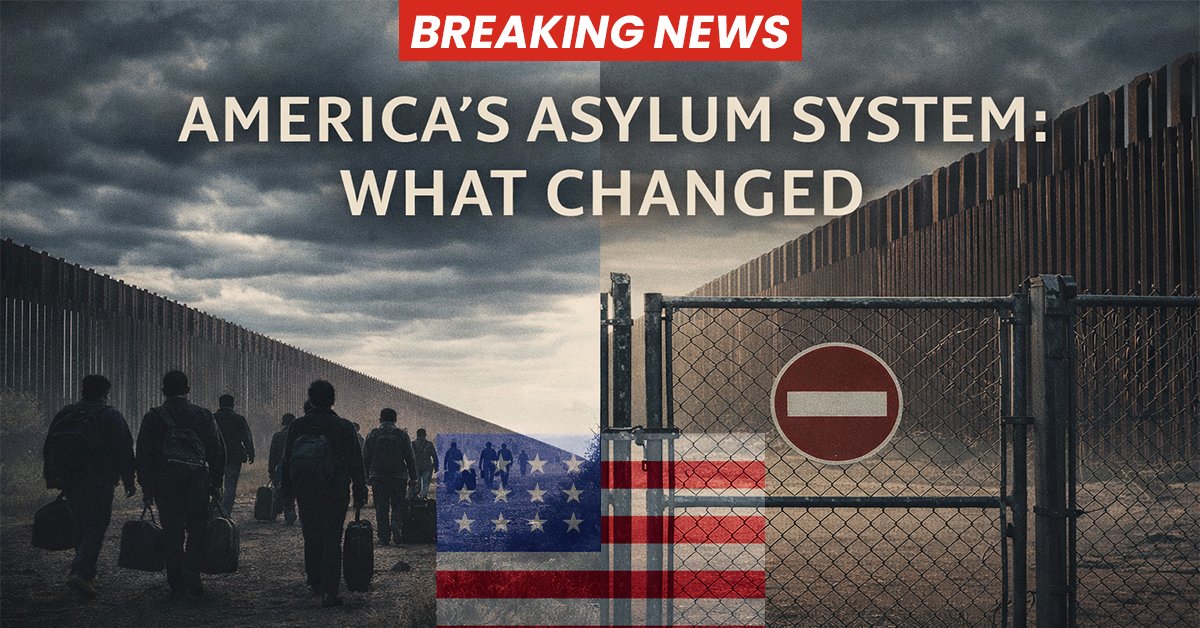

Let me be straight with you: America’s asylum system has fundamentally changed, and most people have no idea how dramatically different things are now compared to just a few years ago.
Whether you think these changes are necessary or tragic probably depends on where you sit politically. But regardless of your views, what’s happening right now is reshaping not just American immigration policy but potentially how the entire world handles refugees and asylum seekers.
I’ve spent weeks digging into this, reading court documents, talking to immigration lawyers, and trying to understand how we got here. This isn’t about picking sides—it’s about understanding what actually happened to a system that’s been in place for decades.
What Even Is Asylum? A Quick Refresher
Before we dive into the chaos, let’s make sure we’re all on the same page about what asylum actually means.
Under US and international law, asylum is legal protection granted to people who flee their home countries because they face persecution. We’re not talking about people leaving because they want better jobs or nicer weather. Asylum has a specific legal definition.
You can qualify for asylum if you’re being persecuted because of:
- Your race
- Your religion
- Your nationality
- Your political opinions
- Membership in a particular social group
Here’s the thing that makes this complicated: proving persecution is genuinely hard. If you’re running for your life, you’re probably not stopping to collect documentary evidence. You grab your kids and you go.
That’s why the US asylum system was designed to give people time—sometimes years—to gather evidence and make their case in immigration court while living in the United States.
At least, that’s how it used to work.
How Things Worked Under Biden (And Why It Became Unsustainable)
The Biden years saw something unprecedented: an absolute explosion of people showing up at the southern border specifically to claim asylum.
Border stations were overwhelmed. We’re talking about facilities designed to hold a few dozen people temporarily being crammed with hundreds. The system wasn’t just strained—it was breaking.
Here’s what typically happened during those years: People would arrive at the border, turn themselves in to border officials, claim asylum, and—after processing—many would be released into the United States to await their court dates.
The problem? Immigration courts were already backlogged for years. By the time someone got their day in court, they’d often been living in the US for so long that it became nearly impossible to deport them, regardless of whether their asylum claim was legitimate.
And this is where it gets messy: not everyone claiming asylum actually qualified under the legal definition.
Some people were absolutely fleeing genuine persecution—political dissidents, religious minorities, people targeted by gangs for reasons that met the legal criteria. But mixed in were people fleeing economic collapse, general violence, or just desperate to find better opportunities for their families.
Those are sympathetic reasons to want to leave your country. They’re understandable reasons. But they’re not technically asylum under US law.
The system became, in effect, a backdoor immigration pathway. And that’s what made it politically toxic.
How Word Spread Across Continents
You might be wondering: how did people in India, Venezuela, or West Africa figure out they could fly to Mexico and walk to the US border?
The answer is both modern and kind of shocking: social media.
WhatsApp groups shared detailed routes and advice. TikTok influencers—yes, really—created content about the best paths to the US border. Information spread faster than any government could respond to it.
People from Africa and South Asia went into debt for tens of thousands of dollars to pay for commercial flights to Nicaragua, which had relaxed visa requirements. From there, they’d travel through Mexico to the US border.
Others made the infamous trek through the Darién Gap—a genuinely dangerous jungle crossing between Colombia and Panama where people regularly die. Hundreds of thousands attempted this journey.
This wasn’t happening in a vacuum. These are people facing real hardship: economic collapse in Venezuela, political persecution in Nicaragua, violence in Haiti, poverty in parts of Africa and Asia.
But when you’ve got people from dozens of countries, speaking dozens of languages, all arriving at the border simultaneously using the same basic playbook, it created an impossible situation for border authorities.
Enter Trump: The Hammer Comes Down
When Trump took office for his second term in 2025, his administration came in with what can only be described as a blitz strategy. They weren’t interested in tweaking the system—they wanted to shut it down.
Here are the major changes they implemented:
Rapid Turnbacks to Mexico
Instead of processing asylum claims and releasing people into the US, border officials started quickly returning people to Mexico without giving them the chance to make their asylum claims in US courts.
Third-Country Deportations
This is where things got really controversial. The Trump administration started deporting asylum seekers not back to their home countries, but to third countries they’d never been to.
We’re talking about sending Central American migrants to Panama or Costa Rica. Or, in some cases, to countries even further away.
The administration signed agreements with around 20 countries—including South Sudan and Uganda—to accept deportees who weren’t their citizens.
The El Salvador Case
One of the most shocking examples: nearly 230 Venezuelan men were sent to a maximum security prison in El Salvador. The administration labeled them as dangerous gang members.
But here’s what ProPublica’s reporting uncovered: the vast majority of these men had never been convicted of any crimes in the United States. They were just rounded up and sent to a foreign prison.
They spent months there before eventually being released in a prisoner exchange. Think about that for a second—American immigration policy resulted in people being held in a foreign prison without trial.
Why Third-Country Deportations Are So Effective (And So Controversial)
From the administration’s perspective, third-country deportations solve a major problem: countries that refuse to take back their own citizens.
For years, certain countries simply wouldn’t accept deportation flights of their own nationals. It became a diplomatic standoff that meant people who’d been ordered deported just… stayed.
Third-country agreements cut through that. But they also create a legal nightmare.
Once someone is deported outside the US, they’re mostly beyond the reach of US courts. They can’t easily challenge their deportation or make asylum claims. They’re just stuck in a country they’ve never been to, often without resources or connections.
Immigration advocates call this a fundamental violation of asylum law. The administration calls it necessary border enforcement.
Has Asylum Actually Stopped?
Pretty much, yeah.
Border crossings have dropped to record lows. The number of people being released into the US to pursue asylum claims has plummeted.
Does that mean the system is working? Or does it mean the US has effectively ended asylum as we knew it?
Your answer to that question probably depends on whether you think most asylum seekers were legitimate or whether you believe the system was being abused.
What’s undeniable is this: people who would have had a chance to make their case in immigration court a few years ago now don’t get that opportunity at all.
Why Congress Won’t Fix This (And Why That Matters)
Here’s the frustrating part: everyone agrees the immigration system is broken. Republicans think it’s too easy to enter illegally. Democrats think it’s inhumane and dysfunctional. Everyone’s right about something.
But Congress hasn’t passed comprehensive immigration reform in decades.
Instead, each president shows up, issues a bunch of executive orders that swing policy wildly in one direction, and then the next president comes in and swings it back.
Trump uses executive authority to restrict asylum. Biden used it to expand processing. Trump’s back and restricting again.
This isn’t how you run a functional immigration system. But it’s where we are because Congress can’t or won’t do the hard work of actually legislating a modern immigration framework that addresses 21st-century migration realities.
There have been moments where bipartisan compromise seemed possible. There was literally a bipartisan border bill in 2024 that would have made significant changes. It died for political reasons, not policy ones.
So we’re stuck in this cycle where immigration policy changes dramatically every four to eight years based purely on who’s president.
What Happens to the People Who Can’t Come Here Anymore?
This is the question that keeps me up at night, honestly.
We’re living through a period of unprecedented global displacement. Wars in Ukraine, Sudan, Myanmar, and Gaza. Political collapse in Venezuela. Violence in Haiti. Climate disasters displacing millions.
The UN estimates there are more refugees and asylum seekers worldwide than at any point since World War II.
For decades, the United States positioned itself as a leader on refugee protection. We weren’t perfect—not even close—but we were at least trying to uphold international norms about asylum.
What happens when America steps away from that role?
Early signs suggest other countries are following our lead in the wrong direction. Politicians in Europe and even Canada are adopting similar restrictionist rhetoric. If the US closes the door on asylum, other countries feel less pressure to keep theirs open.
So where do these people go? Many end up in overcrowded refugee camps in countries that can barely handle their own populations. Others end up in dangerous situations in Mexico or Central America. Some risk their lives on different routes.
The human cost of these policy shifts doesn’t disappear just because people can’t reach the US border anymore. It just becomes less visible to Americans.
The Bigger Picture: What This Means for America
Whether you support or oppose these changes, they represent something significant: a fundamental shift in how America sees itself in the world.
For generations, part of America’s identity was as a refuge. “Give me your tired, your poor, your huddled masses” wasn’t just poetry—it was (somewhat) policy.
That doesn’t mean we had open borders or accepted everyone. We didn’t. But there was at least a recognition that America had some responsibility to people fleeing persecution.
That consensus has clearly broken down.
Part of this is practical: our immigration system genuinely couldn’t handle the numbers arriving. Part of it is political: immigration became the defining issue for millions of voters.
But part of it is philosophical: Americans are deeply divided on what obligations we have to people from other countries, especially when resources feel scarce at home.
Where Do We Go From Here?
I wish I had a tidy answer to wrap this up with. I don’t.
What I can tell you is this: the current approach isn’t sustainable either. You can’t run a functional immigration system purely through executive orders that swing wildly every few years.
At some point, Congress will need to actually legislate. They’ll need to answer hard questions:
- How many refugees and asylum seekers should the US accept annually?
- What should the criteria be?
- How do we create a system that’s both humane and enforceable?
- What do we do about economic migration that doesn’t meet asylum criteria but is driven by real desperation?
These aren’t easy questions. But pretending they don’t exist or just swinging between extremes every election cycle isn’t working for anyone.
Not for the migrants risking their lives. Not for border communities overwhelmed by arrivals. Not for Americans trying to understand what their country stands for.
My Take (For What It’s Worth)
Look, I’m just one person trying to make sense of an incredibly complicated issue. But here’s what I think after digging into this:
The Biden-era approach was unsustainable. You can’t have a functional asylum system when hundreds of thousands of people are arriving annually knowing they’ll be released into the country for years before their court date. That’s not an immigration system—it’s chaos.
But the Trump approach of effectively ending asylum completely feels like it violates something fundamental about American values and international law. There are real asylum seekers in the mix—people who will die if sent back. Removing the ability to even make your case seems wrong.
- → Need a Passport Fast? How to Expedite Your U.S. Passport Renewal Step-by-Step
- → Want a $60K+ Salary Without a 4-Year Degree? 15 Certificates You Can Finish in Under a Year
- → Planning a Trip to Europe? 6 Essential Entry Rules to Avoid Denial at the Border
- → Heading to Border Control? Key Immigration Questions You Must Be Ready to Answer
- → Planning a European Trip? What Starkville’s Indian Community Should Know About Schengen Visas
- → 11 Countries Offering Funded Ph.D. Programs for International Students
- → U.S. Dollar Reaches Two-Week High Driven by Middle East Tensions and Fed Policy Outlook
The truth probably lies somewhere in the middle: a system that processes claims quickly, removes people without valid claims promptly, but actually protects those with legitimate asylum cases.
That would require resources, political will, and Congressional action. None of which seem likely anytime soon.
So instead, we get policy by executive order, partisan warfare, and millions of people caught in the middle.
What You Can Do
If this issue matters to you—regardless of which direction you lean—here’s what actually makes a difference:
Contact your representatives: Congress won’t act unless constituents make it clear they care about immigration reform.
Educate yourself: This issue is complicated. Most social media takes are oversimplified. Read actual immigration lawyers, court documents, and on-the-ground reporting.
Support organizations doing the work: Whether that’s legal aid for asylum seekers or border security organizations, people doing actual work on the ground need support.
Vote in primaries: Immigration policy often comes down to primary elections where more extreme candidates win. Moderate, solutions-oriented candidates often lose in primaries.
Push for Congressional action: The executive order approach clearly isn’t working. Demand that Congress actually do their job and legislate.
Final Thoughts
The collapse of America’s asylum system isn’t just an immigration story. It’s a story about what America wants to be in the 21st century, how we respond to global crises, and whether our political system can still solve hard problems.
Right now, the answer to that last question doesn’t look great.
But systems can be rebuilt. Consensus can be found. It just requires leadership, compromise, and a recognition that the status quo—whichever status quo you prefer—isn’t working.
The question is whether we’ll find that, or just keep swinging between extremes until something breaks completely.
Key Questions Answered
Is asylum still possible in the United States? Technically yes, but practically it’s become extremely difficult. Border crossings and asylum grants have dropped to historic lows under current policies.
What’s the difference between an asylum seeker and an illegal immigrant? An asylum seeker is someone who enters the country and formally requests protection under asylum law. Under international and US law, seeking asylum is legal, even if you enter between official ports of entry.
Why didn’t Biden stop the surge of asylum seekers? The Biden administration faced constraints from both court orders and Congressional inaction. They implemented some restrictions but maintained more processing than the current approach.
What happened to all the people who were released into the US during Biden’s term? Most are still waiting for immigration court dates. The backlog is so severe that some cases won’t be heard for years.
Can these changes be reversed by the next president? Yes, much of this is being done through executive action, which means it can be changed by a future administration. This instability is part of why the system is so dysfunctional.
