
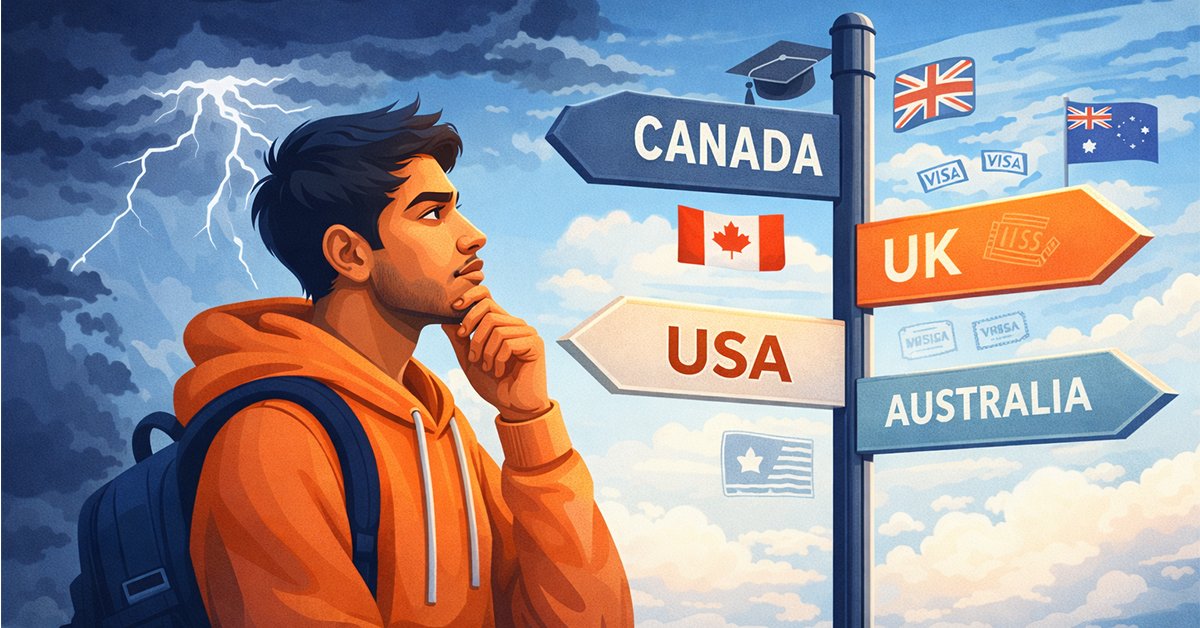

When Priya sat down to fill out her graduate school applications last fall, studying in the United States felt like the obvious choice. Top-tier universities, cutting-edge research facilities, and the promise of three years of work experience after graduation made the high tuition fees seem worth it. Today, she’s reconsidering everything.
She’s not alone. Across India, China, Vietnam, and dozens of other countries, students who once dreamed of earning American degrees are now asking themselves a troubling question: Is the United States still worth it?
The answer, unfortunately, has become increasingly complicated.
The Numbers Don’t Lie: A 17% Decline in New Students
Let’s start with the hard facts. New international student enrollment dropped by 17% in Fall 2025, according to the Institute of International Education. That’s not just a statistic on a spreadsheet—it represents thousands of empty dorm rooms, cancelled orientations, and worried university administrators wondering how they’ll balance their budgets.
Eddie West, who works in international affairs at California State University, Fresno, puts it bluntly. The situation is creating a “vicious cycle.” With fewer international students on campus, there are fewer positive stories being shared back home. Prospective students hear about visa delays and unwelcoming attitudes instead of groundbreaking research and lifelong friendships.
The total international student population in the US still hovers around 1.2 million, but that number masks a deeper problem. Many of those students enrolled years ago, when the climate was different. The real warning sign is in those new enrollment numbers—the pipeline of future students is drying up.
OPT: The Make-or-Break Factor Everyone’s Watching
If you’re not familiar with Optional Practical Training, here’s what you need to know: it’s the program that lets international students work in the US for up to three years after graduation while still on their student visa. For STEM majors, it’s particularly valuable—a bridge between classroom learning and real-world careers.
For many students, OPT isn’t just a nice perk. It’s the entire point.
“Students aren’t just buying a degree,” explains Anna Esaki-Smith from Education Rethink. “They’re investing in their future careers.” When you’re paying $50,000 or more per year for tuition, plus living expenses, you need to know there’s a return on that investment.
Right now, OPT is in the crosshairs. The program appeared on the federal government’s regulatory agenda with language about fraud prevention, national security, and protecting American workers. Boston College professor Chris Glass warns that in the worst-case scenario, the program could be eliminated entirely.
More than half of current international students said they wouldn’t have enrolled in US institutions if OPT had been eliminated, according to a recent survey. Think about what that means for university budgets, campus diversity, and America’s ability to compete globally for talent.
The best-case scenario? Stricter enforcement and more paperwork. But even that would increase the burden on both students and the companies that hire them. Google, Microsoft, Amazon, and Apple—all major employers of OPT students—would face additional compliance requirements.
Duration of Status: The Technical Change with Massive Implications
Here’s something most people outside higher education circles haven’t heard about: the Department of Homeland Security wants to replace “duration of status” with fixed-time periods for student visas.
- → Need a Passport Fast? How to Expedite Your U.S. Passport Renewal Step-by-Step
- → Want a $60K+ Salary Without a 4-Year Degree? 15 Certificates You Can Finish in Under a Year
- → Planning a Trip to Europe? 6 Essential Entry Rules to Avoid Denial at the Border
- → Heading to Border Control? Key Immigration Questions You Must Be Ready to Answer
- → Planning a European Trip? What Starkville’s Indian Community Should Know About Schengen Visas
- → 11 Countries Offering Funded Ph.D. Programs for International Students
- → U.S. Dollar Reaches Two-Week High Driven by Middle East Tensions and Fed Policy Outlook
In plain English, that means instead of being able to stay in the US for however long your degree takes, you’d get a maximum of four years. Need longer? You’d have to apply for an extension.
This might sound reasonable until you realize the actual statistics. Just over one-third of all students—including American citizens—completed their degrees in four years or less during the 2023-2024 academic year. Graduate programs often take longer. Research projects hit unexpected obstacles. Life happens.
For international students, who already navigate a maze of visa requirements, this would add another layer of complexity and uncertainty. Miss a deadline? Face deportation. Need an extra semester for your thesis? Better hope the paperwork goes through.
Travis Ulrich from Terra Dotta sums up the broader concern: “Policy turbulence threatens perceptions of the US being a welcome country of opportunity.” It’s not just about individual rules—it’s about the cumulative effect of constant uncertainty.
Where Are Students Going Instead?
Canada isn’t wasting any time. They’re reportedly developing an accelerated visa process specifically targeting H-1B visa holders in the US—essentially rolling out the welcome mat for exactly the people America is pushing away.
Australia has streamlined their post-study work programs. European universities are increasingly offering English-language programs with lower tuition. Even Asian countries are becoming more attractive alternatives.
West expects this shift to accelerate. The “big four” destinations—the US, UK, Canada, and Australia—won’t stay static. Europe and Asia are growing fast as alternatives, offering not just competitive education but also more predictable immigration policies.
Here’s what’s particularly concerning for American universities: international students don’t just bring diversity and global perspectives to campus. They contributed $43.8 billion to the US economy during the 2023-2024 academic year. That money supports jobs, local businesses, and university operations. Losing it would hurt.
The Human Cost Behind the Headlines
Let’s zoom back out and remember who we’re actually talking about: real people making life-changing decisions.
There’s the engineering student from Vietnam who’s worked since age 16 to save money for an American education. The business major from Nigeria who wants to learn management techniques to bring back home and start companies. The computer science grad from India who dreams of working at a tech startup in Silicon Valley.
These students typically spend 1-2 years planning their applications, taking standardized tests, and navigating financial aid. They say goodbye to families they might not see for years. They adapt to new cultures, time zones, and academic systems.
And increasingly, they’re asking themselves if it’s worth the risk when the rules might change halfway through their degree.
A Few Rays of Hope
Despite the doom and gloom, not everything is bleak. Some educators are finding reasons for cautious optimism.
Universities are paying more attention to quality assurance in international recruitment. The UK is “leading the way” on ensuring ethical agent practices, and American schools are following suit. That means better experiences for students and more legitimate recruitment overall.
Glass points out that even when federal policy creates chaos, individual universities can provide stability. “Institutions can actively deliver predictability, security, and a welcoming environment,” he notes. That means investing in immigration advising, helping students find affordable housing, and designing programs with clear career outcomes.
Some universities are doubling down on international partnerships—dual degree programs, research collaborations, student exchanges. These create networks that extend beyond individual visa policies.
And then there’s the political calendar. The 2026 midterm elections happen in November. While it’s far from certain, a shift in Congressional control could ease some pressure on international education. It’s a long shot, but it’s something.
What This Means for Different Groups
For prospective international students: Do your homework. Research not just universities, but also their track record with visa support, career services, and international student satisfaction. Have backup plans. Consider countries beyond the traditional options.
For current students: Stay informed about policy changes, but don’t panic. Maintain your visa status meticulously. Build relationships with professors and advisors who can support you. Document everything.
For universities: The institutions that will thrive are those that can credibly promise support through uncertainty. That means robust immigration advising, transparent communication, and programs designed with employment outcomes in mind.
For employers: Companies that hire international talent need to get vocal. Your voice matters in policy discussions. Be prepared for additional compliance requirements if you want to continue recruiting globally.
The Bigger Picture
Here’s what often gets lost in policy debates: international education isn’t just about economics or even about education. It’s about whether America wants to maintain its position as a global leader in innovation, research, and cultural exchange.
When a brilliant student from Brazil decides to pursue their PhD in Germany instead of Massachusetts, America doesn’t just lose tuition revenue. It loses the research they would have conducted, the companies they might have founded, the problems they could have solved.
Some of those students will return home and become leaders in their fields. Do we want them to have studied in America and maintained those connections? Or do we want them to have built their networks elsewhere?
The policy decisions being made right now will echo for decades.
Looking Ahead
As we move deeper into 2026, a few things seem likely. First, the scrutiny on international students and immigration more broadly won’t ease up anytime soon. Second, universities will continue to adapt, though not all will survive if enrollment drops persist. Third, global competition for international students will intensify.
What remains uncertain is whether American higher education will find a way to navigate this storm or whether we’re witnessing a fundamental shift in global education patterns.
For students like Priya, still weighing her options, the uncertainty itself has become the biggest factor. Even if nothing changes, the perception that it might has already changed the calculus.
And perception, in this case, might matter just as much as policy.
Key Takeaways
- New international student enrollment fell 17% in Fall 2025, with further declines expected in 2026
- The Optional Practical Training program faces potential major restrictions or elimination
- The proposed “duration of status” changes would limit student visas to four-year maximums
- International students contribute over $43 billion annually to the US economy
- Competing countries are actively recruiting students deterred by US policy uncertainty
- Universities are responding with increased flexibility, deferrals, and support services
- The 2026 midterm elections could potentially shift the political landscape
