
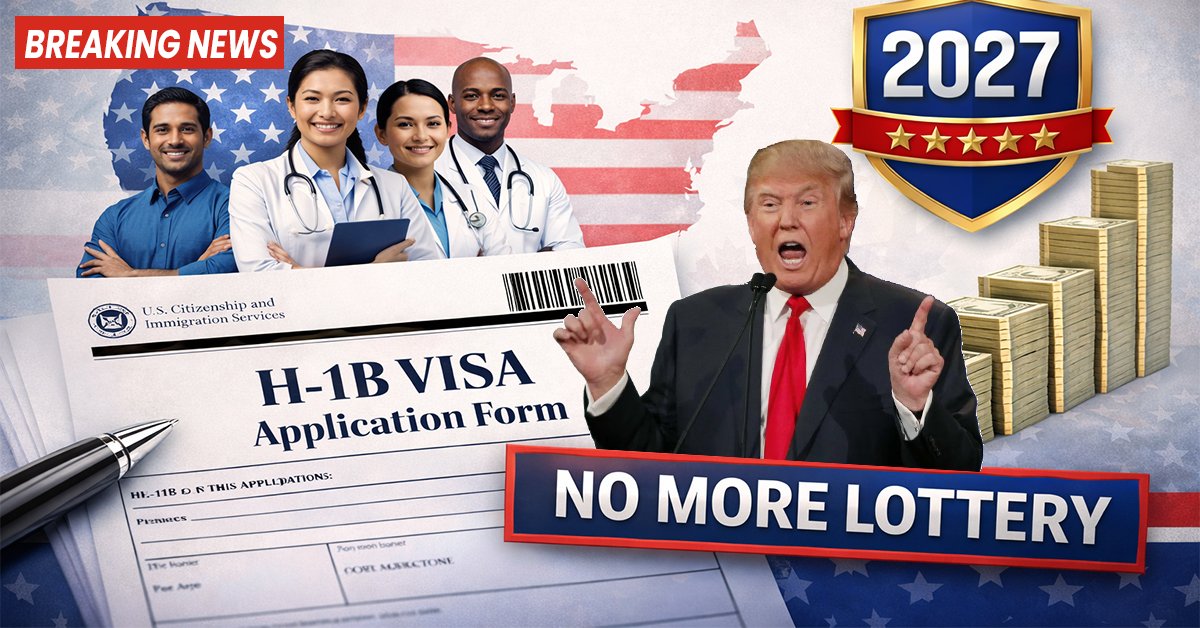

The H-1B visa lottery is officially on its way out.
In a major policy shift announced by U.S. Citizenship and Immigration Services (USCIS), the Trump administration confirmed it’s replacing the current lottery system with a wage-based weighted selection process starting in 2027. If you’re a foreign worker hoping to work in the United States, an employer sponsoring talent, or an American worker concerned about job competition, this change will affect you.
Here’s everything you need to know about what’s changing, why it matters, and how it could impact your future.
What’s Changing? The Lottery Is Out, Wages Are In
For years, the H-1B visa has operated on a straightforward lottery system. When applications exceed the annual cap of 85,000 visas, USCIS randomly selects who gets one. Your chances were the same whether you were offered $60,000 or $200,000—it was pure luck.
That’s about to change completely.
The New Weighted Selection System Explained
Starting with the 2027 application cycle (effective February 27, 2026), the H-1B selection process will prioritize applications based on the wage level of the job offer. Here’s how it works:
Four Wage Levels = Four Different Chances
- Level I (Entry-level): 1 lottery entry
- Level II (Qualified): 2 lottery entries
- Level III (Experienced): 3 lottery entries
- Level IV (Fully competent/specialist): 4 lottery entries
In simple terms: the higher your offered salary, the better your odds of getting selected. Someone offered a Level IV wage will have four times the chance of selection compared to someone at Level I.
These wage levels aren’t arbitrary—they’re determined by the Department of Labor based on job requirements, experience, education, and regional salary data for specific occupations.
Why This Change? The Official Reasoning
USCIS says the new system will “better protect the wages, working conditions, and job opportunities for American workers” by ensuring that H-1B visas go to the most highly skilled—and therefore highest-paid—foreign workers.
The agency argues this addresses long-standing criticism that employers were gaming the lottery system to bring in cheaper labor to replace American workers, particularly in the tech industry.
According to USCIS spokesman Matthew Tragesser: “The new weighted selection will better serve Congress’ intent for the H-1B program and strengthen America’s competitiveness by incentivizing American employers to petition for higher-paid, higher-skilled foreign workers.”
The $100,000 Fee: Another Massive Change
The weighted selection isn’t the only bombshell. President Trump also announced a new $100,000 application fee for H-1B visas, applicable to new applications only.
This fee—separate from existing filing costs—has sparked immediate legal challenges and warnings from business leaders and lawmakers who argue it could:
- Stifle American innovation
- Hurt economic growth
- Make the U.S. less competitive globally
- Price out smaller companies entirely
Critics say the fee is so prohibitively expensive that it essentially closes the door on many legitimate uses of the H-1B program.
Who Wins and Who Loses Under the New System?
This policy shift creates clear winners and losers, though the long-term effects remain hotly debated.
Potential Winners
Large corporations and tech giants: Companies like Google, Microsoft, and Amazon that already pay top-tier salaries will have a significant advantage. They can afford both the higher wages and the $100,000 fee.
Highly specialized professionals: Workers with rare skills in cutting-edge fields—think AI researchers, quantum computing specialists, or advanced medical researchers—who command premium salaries will see their odds improve dramatically.
Some American workers: If the system succeeds in reducing lower-wage H-1B hires, certain American workers may face less competition for entry and mid-level positions.
Potential Losers
Small and medium-sized businesses: These companies often can’t compete with corporate giants on salary or afford the $100,000 fee, even when they genuinely need specialized talent.
Startups: Early-stage companies notoriously can’t offer high salaries but often need highly skilled workers. The new system may shut them out entirely.
Nonprofits and research institutions: Universities, hospitals, and research organizations frequently need specialized talent but operate on tight budgets that make high wages and steep fees impossible.
Entry-level skilled workers: Foreign graduates from U.S. universities hoping to start their careers in America will find it much harder to get sponsored if they’re only qualified for Level I or II positions.
What the Experts Are Saying
The response to these changes has been swift and polarized.
Critics Warn of Unintended Consequences
Nandini Nair, partner at A.Y. Strauss: “This change creates an unfair burden on small and mid-size companies who are the backbone of the US economy. It rewards whoever can pay the most, not necessarily who needs the talent more. We are going to see a significant deficit in our talent pool.”
Dobrina M. Ustun, immigration attorney: “This rule risks unintentionally shutting out exactly the employers Congress intended the H-1B program to help. Startups, nonprofit organizations, and research hospitals often need highly specialized talent that is scarce in the U.S., but they simply cannot compete with large corporations on salary alone. Prioritizing wage levels as a proxy for skill ignores how innovation, medical research, and early-stage companies actually function.”
Supporters Say It Fixes Abuse
Proponents argue the current system has been exploited for too long, with some employers using H-1B visas to hire cheaper foreign workers instead of Americans or paying fair wages. They believe a wage-based system ensures that only truly specialized, hard-to-find talent gets visas.
The Reality Check
Düden Freeman, former U.S. diplomat and founder of Visas 101: “Unlike what some reports claim, there still will be a lottery system for the H-1B—however, it now becomes ‘weighted’ by wage level. The new rule gives applicants offered higher Department of Labor wage levels higher odds of selection instead of treating all registrations equally.”
This is important: it’s not entirely merit-based or first-come-first-served. There’s still randomness—just tilted heavily in favor of higher wages.
Does Higher Pay Actually Mean Higher Skill?
This is the million-dollar question critics keep asking.
The assumption: Higher wages = more specialized skills = harder to find in the American workforce.
The reality: It’s not always that simple.
Consider these scenarios:
- A PhD researcher at a nonprofit hospital might be world-class in their field but earn less than a software developer at a big tech company
- Geographic location heavily impacts salaries—a skilled worker in the Midwest might earn far less than someone doing comparable work in San Francisco
- Startups with breakthrough innovations may need rare talent but lack the funding to pay premium salaries
- Some industries inherently pay less despite requiring highly specialized knowledge
The wage-based system assumes compensation is a reliable proxy for skill and scarcity. Many immigration attorneys and business leaders dispute this correlation.
What This Means for Different Groups
If You’re an H-1B Applicant
Your strategy needs to change:
- → Need a Passport Fast? How to Expedite Your U.S. Passport Renewal Step-by-Step
- → Want a $60K+ Salary Without a 4-Year Degree? 15 Certificates You Can Finish in Under a Year
- → Planning a Trip to Europe? 6 Essential Entry Rules to Avoid Denial at the Border
- → Heading to Border Control? Key Immigration Questions You Must Be Ready to Answer
- → Planning a European Trip? What Starkville’s Indian Community Should Know About Schengen Visas
- → 11 Countries Offering Funded Ph.D. Programs for International Students
- → U.S. Dollar Reaches Two-Week High Driven by Middle East Tensions and Fed Policy Outlook
- Negotiate the highest possible wage level when discussing job offers
- Target larger companies with deeper pockets if possible
- Consider alternative visa pathways if you’re in an early career stage
- Understand that timing matters—the 2027 cycle will be the first under new rules
- Be prepared for the $100,000 fee or seek employers willing to cover it
If You’re an Employer
Your hiring strategy faces major shifts:
- Budget significantly more for foreign talent acquisition
- Justify higher wage classifications with detailed job descriptions
- Consider alternative visa categories (L-1, O-1, etc.) for key hires
- Small businesses: explore partnerships or alternative hiring strategies
- Plan ahead—the transition period is short
If You’re an American Worker
The impact depends on your field and career level:
- You may face less competition for entry and mid-level positions
- However, if your employer relies on H-1B workers to fill specialized roles, the company’s growth could be constrained
- Industries that depend heavily on immigrant talent may see hiring slowdowns
The Bigger Picture: What This Says About U.S. Immigration
The H-1B changes reflect deeper tensions in American immigration policy.
The divide:
- Those who see immigration as essential to U.S. innovation and competitiveness
- Those who prioritize protecting American workers from wage suppression and job displacement
President Trump has historically supported high-skilled immigration (“I want people to come in legally”), while some within his political base view the H-1B program as corporate exploitation that undercuts American workers.
These new rules attempt to thread that needle—keeping the program but making it much more restrictive and expensive.
Timeline: When Does This Take Effect?
February 27, 2026: New rules take effect
2027: First application cycle using the weighted selection system
Now – February 2026: Current lottery system remains in place
If you’re planning to apply for an H-1B in the near future, you have one more chance under the current lottery system before everything changes.
What About Legal Challenges?
The $100,000 fee has already sparked legal challenges, with critics arguing it’s prohibitively expensive and goes beyond the administration’s authority.
Immigration policy frequently faces court battles that can delay or modify implementation. While the weighted selection system itself seems less vulnerable to legal challenge, the fee structure could be tied up in courts for months or years.
Stay tuned for updates as lawsuits progress.
Alternative Visa Options to Consider
If the new H-1B system seems unfavorable for your situation, consider these alternatives:
O-1 Visa (Extraordinary Ability): For individuals with exceptional ability in sciences, arts, education, business, or athletics. Higher bar but no cap or lottery.
L-1 Visa (Intracompany Transfer): For employees transferring from a foreign office to a U.S. office of the same company. Requires at least one year of prior employment.
E-2 Visa (Treaty Investor): For entrepreneurs from treaty countries who are investing substantial capital in a U.S. business.
EB-2/EB-3 Green Cards: Permanent residence pathways for skilled workers, though processing times can be lengthy.
Each has its own requirements, advantages, and limitations. Consult with an immigration attorney to determine the best path for your specific situation.
Bottom Line: A New Era for H-1B Visas
The end of the H-1B lottery marks a fundamental shift in how America selects foreign workers. Whether this change achieves its stated goals—protecting American workers while attracting top global talent—remains to be seen.
What’s certain: if you’re involved with the H-1B program in any capacity, you need to adapt quickly.
For applicants, the message is clear: higher wages mean better chances. For employers, especially smaller ones, the calculus just got much more complicated and expensive. For American workers, the effects will vary by industry and role.
As with many immigration policy changes, the real-world impacts will likely take years to fully understand. But one thing is undeniable: the H-1B visa of 2027 will look very different from the one we’ve known for decades.
The countdown to change has begun.
Frequently Asked Questions
Q: Is the H-1B lottery completely gone?
Not exactly. There’s still a selection process with random elements, but it’s now “weighted” by wage level. Think of it as a lottery where some people get more tickets based on their salary.
Q: When exactly does this change take effect?
The new rules take effect on February 27, 2026, and will apply to the 2027 application cycle.
Q: How much is the new H-1B fee?
$100,000 for new applications, in addition to existing filing fees. This fee applies only to new H-1B petitions, not renewals or transfers.
Q: Can small businesses still get H-1B workers?
Technically yes, but it becomes much harder. They’ll need to either pay competitive wages to boost their lottery odds or absorb the $100,000 fee—both challenging for smaller companies.
Q: What are the four wage levels?
They’re Department of Labor classifications:
- Level I: Entry-level positions
- Level II: Qualified workers with some experience
- Level III: Experienced workers with specialized skills
- Level IV: Fully competent specialists or supervisors
Q: Does this affect H-1B renewals or transfers?
The wage-weighted system applies to new H-1B selections. Renewals and transfers have different processes, though the $100,000 fee structure for new applications could indirectly affect hiring decisions.
Stay Informed
Immigration policy changes rapidly. For the most current information:
- Visit USCIS.gov for official announcements
- Consult with a licensed immigration attorney for personalized guidance
- Follow Department of Labor updates on prevailing wage determinations
- Monitor legal challenges that could affect implementation
This article is for informational purposes only and does not constitute legal advice. Immigration rules are complex and subject to change. Always consult qualified legal professionals for guidance specific to your situation.
