
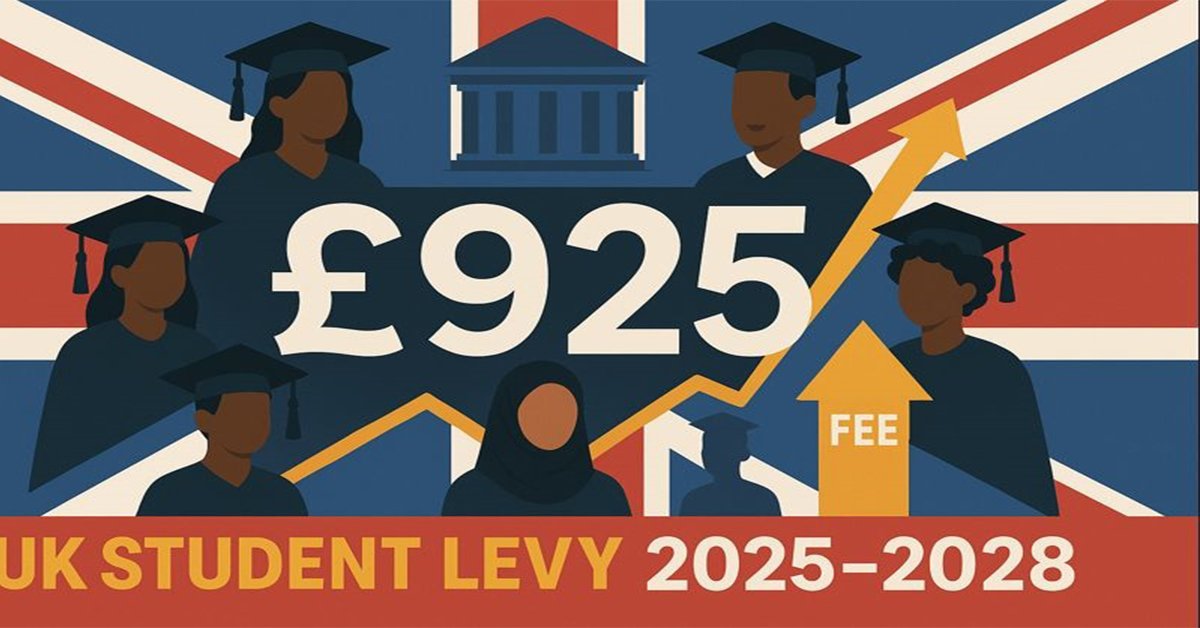

A controversial new policy will charge English universities £925 annually for every international student they enroll starting in 2028. While the government frames it as funding for disadvantaged domestic students, critics warn the levy could trigger tuition hikes, enrollment declines, and financial instability across the higher education sector.
What Is the International Student Levy?
The UK government announced in its Autumn Budget 2025 that universities in England will pay a flat fee of £925 (approximately $1,233 USD) per international student for each year of study. This charge, which takes effect from the 2028-2029 academic year, represents a significant shift in how the UK funds higher education.
Key details of the levy include:
Start Date: August 1, 2028 (2028-29 academic year)
Charge Amount: £925 per international student per year, adjusted annually for inflation
Exemption Threshold: First 220 international students per institution are exempt
Geographic Scope: Applies only to English universities; Scotland, Wales, and Northern Ireland are not affected
Collection: Administered by the Office for Students (OfS), with payments collected after enrollment data is confirmed
Revenue Target: Expected to generate £445 million ($593.7 million) in its first year
Who Pays the Levy?
This is crucial to understand: universities pay the levy, not students directly. However, sector experts warn that institutions will likely pass these costs onto international students through higher tuition fees, making it effectively an indirect student charge.
For example, a university with 700 international students would pay £444,000 annually (700 minus the 220 exempt students, multiplied by £925). For larger institutions enrolling thousands of international students, this represents millions in additional annual costs.
The Government’s Justification
The levy will fund the reintroduction of targeted maintenance grants for disadvantaged students, framed as part of the government’s Plan for Change. These grants, which were abolished in 2017, will provide up to £1,000 annually for students from households earning £25,000 or less who study “eligible subjects” (to be confirmed later).
Education Secretary Bridget Phillipson positioned the levy as making international students “contribute” more to the UK education system they benefit from. The government argues this approach supports its goal of ensuring two-thirds of young people continue education beyond secondary school.
Why Universities Are Alarmed
The higher education sector has responded with significant concern, warning of multiple unintended consequences:
Financial Pressure on Already Struggling Institutions
England’s regulator, the Office for Students, warned that 45 per cent of English universities are on course to report a financial deficit in 2025-26. The levy adds financial strain precisely when many institutions are fighting for survival.
Universities UK President Malcolm Press warned that institutions now face difficult choices: reduce cross-subsidies that support teaching and research, raise international fees further (potentially driving students away), or both. This “has the potential to drive down international numbers, ultimately limiting our ability to support UK students”.
The “Squeezed Middle” Effect
What may result is a squeezed middle set of institutions – large post-1992 institutions that charge more moderate fees to their international students will be paying proportionally more than their Russell Group counterparts.
While elite Russell Group universities can more easily absorb costs due to their prestige and ability to charge premium fees (often £30,000-40,000+), mid-tier universities charging lower international fees will be disproportionately affected. The 220-student exemption primarily benefits small specialist institutions but offers little relief to larger, less prestigious universities.
For context:
- University of Cambridge: Will lose just 2.69% of international fee income (with 7,315 international students)
- University of Huddersfield: Will lose 9.3% of international fee income
- University of Suffolk: Will lose nearly 14% of international fee income (with 750 students)
Projected Student Decline
Government estimates predict the UK will lose 14,000 international students in the levy’s first year, rising to 16,500 annually by 2030-2031. Research group Public First projects even more concerning figures: domestic enrollment could drop by as many as 135,000 places if universities lose substantial revenue and are forced to cut domestic student places to balance budgets.
This creates an ironic situation where a policy designed to help domestic students might actually reduce their access to higher education.
Impact on Vulnerable Student Support
Universities currently use international tuition revenue to cross-subsidize scholarships, mental health services, career programs, and academic support for domestic students from disadvantaged backgrounds. Far from the open-ended percentage revenue grab many had feared, the government has opted for a more predictable, contained charge, but the financial impact remains substantial.
If international revenue shrinks, these support programs—which benefit the very students the levy aims to help—may face cuts first.
Current State of International Students in the UK (2025)
Understanding the levy requires context about international student enrollment trends:
Overall Numbers
In the 2023-24 academic year, approximately 732,000 international students studied at UK universities, representing 23% of total enrollment. This was the second-highest figure ever recorded, though down 4% from the 2022-23 peak—the first decline since 2012-13.
In 2023/24 there were 732,285 overseas students studying at UK higher education providers. 75,490 of these students were from the EU and 656,795 from outside the EU.
Visa Trends Show Recovery in Early 2025
After declines in 2024, early 2025 data suggests recovery. Over 48,000 international students were issued a study visa in Q1 2025, representing a growth of 27% over Q1 2024. Monthly applications from December 2024 through April 2025 exceeded the previous year’s levels, indicating renewed confidence in UK education.
Indian students led this recovery, with visa issuances increasing 31% in Q1 2025 compared to Q1 2024, while Nigerian student visas jumped 84%.
Top Source Countries
The leading countries sending students to the UK are:
- India: 25% of new international students (leading for second consecutive year)
- China: 23% of new international students
- Nigeria: 8% of new international students
- Pakistan: Growing steadily since 2019-20
- Nepal: Showing consistent year-over-year increases
Notably, students from India and China accounted for 48% of all non-EU international students.
Economic Contribution
International students contribute approximately £42 billion annually to the UK economy—far exceeding just tuition fees. They support local businesses, housing markets, and create jobs in education-related services. Government estimates show higher education exports were worth around £21.7 billion in 2021, with real value increasing 81% between 2010 and 2021.
Many universities depend on international students for up to one-fifth of their total income, making this revenue stream critical to institutional sustainability.
Policy Context: Other Immigration Restrictions
The levy doesn’t exist in isolation. The UK government has implemented several restrictive policies affecting international students:
Graduate Visa Reduction
Originally offering 2 years of post-study work rights (3 years for PhD graduates), the government announced reducing the standard length of the post-study Graduate Visa from 24 to 18 months, though implementation timing remains unclear as of December 2025.
Dependant Restrictions
Since January 2024, postgraduate taught students (such as master’s students) cannot bring partners and children to the UK. This policy contributed to an 83% drop in student dependant visas between 2023 and 2024.
Cost Increases
Beyond the levy, international students face:
- Student visa application fees: Increased from £710 to £1,600 in July 2024, then to £2,000 in 2025
- NHS surcharge increases
- Tuition fee rises at many institutions
- Overall cost of living inflation
Immigration White Paper
The May 2025 Immigration White Paper, which introduced the levy concept, signals the government’s intent to reduce net migration numbers, with international students caught in broader political debates about immigration control.
What This Means for Different Stakeholders
For International Students
While the levy doesn’t directly appear on student bills, expect:
Higher tuition fees: Universities will likely pass costs to students, with fees already ranging from £20,000-£40,000 (£68,000 for medicine). An additional £925 represents a 2-5% increase depending on current fee levels.
Reduced scholarship availability: As universities face financial pressure, competitive scholarships may become scarcer.
Diminished services: Budget cuts could affect student support services, career counseling, and campus facilities.
Continued uncertainty: Policy instability makes long-term planning difficult for prospective students.
For UK Universities
Institutions face strategic dilemmas:
Elite universities (Russell Group): Better positioned to absorb costs through high fees and strong brand appeal, though still facing pressure on margins.
Mid-tier universities: Most vulnerable to competitive pressures. Cannot easily raise fees without losing students to competitors or alternative destinations.
Small specialist institutions: Protected by 220-student exemption, though may face other financial pressures.
Regional universities: May struggle to attract international students if fees rise significantly, potentially forcing program cuts or closures.
For Domestic Students
Paradoxically, domestic students may face negative consequences:
Reduced places: If universities cut international enrollment and lose revenue, they may reduce domestic intake to maintain financial viability.
Fewer support services: Cross-subsidies from international fees fund many services benefiting all students.
Limited maintenance grant impact: The reintroduced grants help only a narrow subset of students (lowest-income, studying “priority subjects”), while broader student populations may see reduced support.
International Competitive Context
The levy emerges as competitor nations also restrict international students:
Canada: Implemented caps on international student numbers in 2024, causing steep enrollment declines in 2025.
Australia: Previously overtook the UK as second-most-popular destination (after the US) in 2019, though the UK regained this position. Australia introduced its own international student caps for 2025.
United States: Remains the top destination despite political uncertainty around post-study work rights (H-1B visa policies).
European countries: Increasingly offering English-taught programs at lower costs, attracting students who might previously have chosen the UK.
These trends suggest the UK risks losing international students not just to traditional English-speaking competitors but to emerging education hubs in Europe and Asia.
What Happens Next?
Consultation Period
The government opened a technical consultation in November 2025 (running until mid-February 2026) seeking input on levy implementation details. Universities, sector organizations, and affected parties can provide feedback, though the core policy appears set.
Timeline
- 2026: Draft legislation published
- 2027: Legislation passes through Parliament (expected)
- August 2028: Levy takes effect for the 2028-29 academic year
- 2029-2030: First levy payments collected after enrollment data confirmation
Potential Outcomes
Best case: Universities absorb costs through efficiency gains and modest fee increases, maintaining international enrollment levels while successfully supporting more disadvantaged domestic students.
Worst case: Significant international student decline triggers financial crises at vulnerable universities, forcing institutional mergers, closures, or substantial program cuts that harm both international and domestic students.
Most likely: A mixed picture where elite universities largely weather the changes while mid-tier institutions struggle, international enrollment drops moderately, and the policy achieves some but not all of its intended goals while creating unintended negative consequences.
Expert Perspectives
University and College Union general secretary Jo Grady criticized the policy sharply: Labour is echoing Reform by scapegoating migrants instead of addressing the real, deep-rooted challenges facing higher education.
Henri Murison, chief executive of the Northern Powerhouse Partnership, warned: The contributions of international students fund cutting-edge research and sustain access to university education for students nationwide. Instead of supporting growth and innovation, this levy will strain budgets, limit opportunities, and reduce universities’ ability to deliver the world-class education and research the UK is renowned for.
However, some analysts noted relief that the flat fee proved less damaging than initially feared. Jess Lister, head of higher education at Public First, observed that while universities were “politically outmanoeuvred” when the levy was framed as funding domestic student grants, the flat fee structure is more manageable than the originally proposed percentage-based levy.
Should International Students Still Choose the UK?
Despite these challenges, the UK retains significant advantages:
World-class education: Home to 4 of the world’s top 10 universities (QS Rankings), with 18 in the top 100
English-language instruction: Natural choice for students seeking English proficiency
Cultural experience: Diverse, multicultural society with rich history and strong creative industries
Research opportunities: Leading research output in numerous fields
Post-study work rights: Even at 18 months, the Graduate Route offers valuable UK work experience
- → New Canada Benefit Payments Arriving This Week in May 2026
- → Canada Bread Settlement Payments Begin Rolling Out Across Canada in 2026
- → Canada Immigration Backlog Update 2026: IRCC Application Inventory Crosses 2.15 Million
- → Canada Expands Visa-Free Travel Access for Citizens of Indonesia and Malaysia in 2026
- → Canada’s 365-Day Maintained Status Work Rule in 2026: What Foreign Workers Need to Know
- → Canada Launches Early Retirement Incentive Program in 2026: Eligibility, Benefits, and Application Process Explained
- → Bringing Your Family to New Zealand on a Work Visa: Complete 2026 Guide
However, prospective students should:
- Research costs carefully: Factor in potential fee increases beyond 2028
- Consider alternative destinations: Compare total costs and immigration policies across countries
- Evaluate institutional stability: Research the financial health of target universities
- Plan for uncertainty: Be prepared for potential policy changes during studies
Conclusion: A Policy with Uncertain Outcomes
The £925 international student levy represents a significant policy gamble. While generating revenue for disadvantaged student support is laudable, the approach risks undermining the financial foundation that currently enables universities to serve both international and domestic students effectively.
As one of three major English-speaking study destinations facing restrictive policies (alongside Canada and Australia), the UK risks losing competitive advantage precisely when international education represents a crucial export industry and soft power asset.
The coming years will reveal whether this levy achieves its stated goals without causing the financial destabilization that critics fear. For now, prospective international students, university leaders, and policymakers must navigate unprecedented uncertainty in UK higher education.
Sources: UK Department for Education, Office for Students, Universities UK, Higher Education Statistics Agency (HESA), Times Higher Education, ICEF Monitor, Migration Observatory, House of Commons Library
Last Updated: December 2025
Note: Exchange rates mentioned (£925 = $1,233 USD) are approximate as of December 2025 and subject to change. Prospective international students should verify current requirements and costs with official UK government sources and individual universities before applying.
