
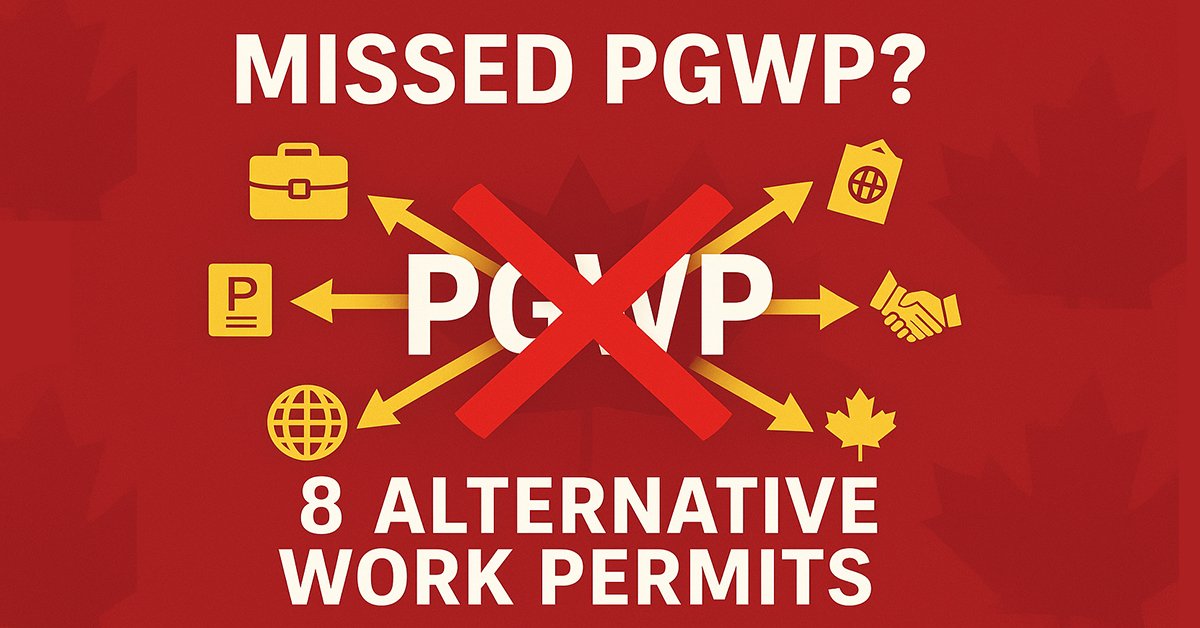

Introduction: Beyond the Post-Graduation Work Permit
Missing out on a Post-Graduation Work Permit (PGWP) doesn’t mean your Canadian career dreams are over. International students who don’t qualify for a PGWP have multiple alternative pathways to continue working in Canada legally.
This comprehensive guide explores eight viable work permit alternatives, eligibility requirements, and application strategies to help you maintain your Canadian work authorization.
Quick Comparison: PGWP Alternative Work Permits
| Work Permit Option | Best For | Permit Type | Processing Time | Key Requirement |
|---|---|---|---|---|
| TFWP (High/Low-Wage) | Anyone with LMIA job offer | Employer-specific | 2-8 weeks | Positive LMIA from employer |
| International Experience Canada | Youth aged 18-35 from treaty countries | Open or employer-specific | Varies by country | Bilateral agreement citizenship |
| Global Hypergrowth Project | Tech workers at selected companies | Employer-specific | 2-4 weeks | Job offer from participating firm |
| Free Trade Agreement Permits | Citizens of FTA countries | Usually employer-specific | 2-6 weeks | FTA citizenship + qualifying occupation |
| Spousal Open Work Permit | Partners of students/workers | Open | 4-6 months | Spouse meets program criteria |
| Atlantic Immigration Program | Workers with Atlantic job offers | Employer-specific | 6-12 months | Provincial endorsement |
| Intra-Company Transfer | Employees of multinationals | Employer-specific | 2-4 weeks | 1 year employment with company |
Can You Work While Waiting for Your Work Permit Decision?
Yes, under specific conditions. If you apply for a work permit before your study permit expires and within the designated window after receiving final grades, you can begin working full-time immediately if:
- You were authorized for off-campus work during your studies
- Your work permit application is submitted on time
- You maintain valid temporary resident status in Canada
Important: If your student status expired before applying, you must also apply to restore your status alongside your work permit application. According to correspondence between IRCC and immigration lawyers, students can apply for any work permit type (not just PGWPs) alongside status restoration.
Alternative Work Permit Options Explained
1. Temporary Foreign Worker Program (TFWP)
The TFWP allows you to work in Canada with an employer-specific work permit based on a Labour Market Impact Assessment (LMIA).
How It Works
Employers must first obtain a positive or neutral LMIA from Employment and Social Development Canada (ESDC), demonstrating that hiring a foreign worker won’t negatively impact Canadian workers. Once secured, you can apply for your work permit.
Two Streams Available
High-Wage Stream: For positions paying at least 20% above the provincial median wage Low-Wage Stream: For positions paying below the provincial median wage
Critical Update: LMIA applications for low-wage positions in regions with 6% or higher unemployment rates are currently frozen and will not be processed.
Finding LMIA Jobs
Use Canada’s Job Bank with specific filters to identify employers who have already secured LMIAs or are willing to apply for one.
Global Talent Stream (Fast-Track Option)
Certain tech occupations qualify for expedited two-week processing through the Global Talent Stream:
- Software engineers and designers
- Computer programmers and interactive media developers
- Database analysts and administrators
- Information systems analysts and consultants
- Computer and information systems managers
- Web designers and developers
- Electrical and electronics engineers
- Computer engineers
2. International Experience Canada (IEC)
IEC provides work permits for citizens aged 18-35 from countries with bilateral youth-mobility agreements with Canada.
Three IEC Programs
Working Holiday: Open work permit valid for 1-2 years. No job offer required. Ideal for those wanting to work for multiple employers across Canada.
- → Heading to Border Control? Key Immigration Questions You Must Be Ready to Answer
- → Planning a European Trip? What Starkville’s Indian Community Should Know About Schengen Visas
- → 11 Countries Offering Funded Ph.D. Programs for International Students
- → U.S. Dollar Reaches Two-Week High Driven by Middle East Tensions and Fed Policy Outlook
- → 100-Year-Old Who Still Drives and Lives Alone Shares Her 6 Secrets to Longevity
- → What to Do Immediately If a Family Member Is Detained by ICE in Indiana
- → Flying With Flour or Coffee? TSA’s Powder Rule Could Delay Your Airport Security Screening
Young Professionals: Employer-specific permit requiring a signed employment contract in your field that contributes to professional development. Must work in NOC TEER 0, 1, 2, or 3 occupations (TEER 4 if in your field of study).
International Co-op: For students completing internships as part of their degree (not typically relevant for PGWP alternatives).
Eligible Countries
Over 30 countries have agreements with Canada, including Australia, France, Germany, Ireland, Japan, South Korea, New Zealand, and the United Kingdom. Age limits and available streams vary by nationality.
3. Global Hypergrowth Project Work Permits
Foreign nationals with skilled job offers (NOC TEER 0, 1, 2, or 3) from participating companies can obtain LMIA-exempt work permits.
Current Participating Companies
- Ada Support Inc.
- AlayaCare
- CellCarta
- Clarius Mobile Health
- Clio
- Duchesnay Pharmaceutical Group
- Lightspeed Commerce
- Vive Crop Protection
TEER 0 and 1 positions qualify for expedited processing.
4. Free Trade Agreement (FTA) Work Permits
Citizens of countries with qualifying trade agreements can access work permits through the International Mobility Program, often bypassing the LMIA requirement.
Four Main Categories
Professionals: Limited to specific pre-approved occupations including engineers, researchers, architects, management consultants, and computer systems analysts. Requires citizenship from treaty country plus relevant qualifications.
Intra-Company Transferees: For managers, executives, or specialized knowledge workers transferring from a foreign branch to a Canadian location. Requires one year of full-time employment with the company within the past three years.
Traders: For executive or essential staff engaged in substantial trade (over 50%) between Canada and their home country.
Investors: For individuals making substantial investments in Canadian businesses who will develop and direct operations.
Countries with FTAs
Major agreements include CUSMA (USA and Mexico), CETA (European Union), CPTPP (including Australia, Japan, Singapore, Vietnam), and bilateral agreements with Chile, Colombia, Korea, and Ukraine.
Bonus: Many FTAs include provisions for spousal open work permits, including CUKTCA, CCOFTA, CETA, CKFTA, CUFTA, and CPTPP.
5. Spousal Open Work Permit (Student/Worker Spouse)
Partners of certain international students and foreign workers can qualify for open work permits.
Eligibility: Spouses of International Students
Your partner must be enrolled in one of the following:
- Doctoral or master’s degree programs (16+ months)
- Professional programs: Medicine (MD), Dentistry (DDS/DMD), Law (LLB/JD), Optometry (OD), Pharmacy (PharmD), Veterinary Medicine (DVM), Nursing (BScN/BSN), Education (BEd), or Engineering (BEng/BASc)
- Francophone Minority Communities Student Pilot (outside Quebec)
- Certain bridging programs in Quebec, Ontario, Manitoba, and British Columbia
Eligibility: Spouses of Foreign Workers
Your eligibility depends on your partner’s occupation skill level:
Applied for PR through eligible economic program: Work permit must be valid for 6+ months
High-skilled worker (TEER 0-1): Work authorization valid for 16+ months
High-skilled worker (TEER 2-3): Must work in eligible occupation with 16+ months validity
Low-skilled worker (TEER 4-5): Only eligible if work permit issued through eligible PR pathway, valid 6+ months
FTA workers: Eligibility depends on specific agreement terms
6. Intra-Company Transferee (ICT) Work Permits
If you worked for a multinational corporation abroad, you may qualify for transfer to their Canadian operations.
Requirements
- At least one year of full-time employment with the company within the past three years
- Transfer to a Canadian branch, affiliate, or subsidiary
- Role as manager, executive, or specialized knowledge worker
- Both company and employee must meet specific eligibility criteria
7. Atlantic Immigration Program (AIP) Work Permits
The AIP offers a pathway to permanent residence with an immediate two-year employer-specific work permit upon application submission.
Regional Focus
Available for jobs in New Brunswick, Newfoundland and Labrador, Nova Scotia, or Prince Edward Island.
Requirements
- Job offer from designated Atlantic employer
- Provincial endorsement and referral letter
- Meet language, education, and work experience criteria
- Proof of settlement funds (where applicable)
This program uniquely combines immediate work authorization with a direct PR pathway.
8. Spousal Open Work Permit (Family Sponsorship)
If you’re being sponsored for permanent residence by a Canadian citizen or permanent resident spouse, you can obtain an open work permit while your application processes.
Eligibility Criteria
- Currently in Canada with valid temporary resident status
- Genuine relationship with sponsor
- Same residential address as sponsor
- Received Acknowledgement of Receipt (AOR) from IRCC for PR application
These permits typically provide 1-2 years of work authorization.
Strategic Considerations for Choosing Your Path
If You Need Immediate Work Authorization
Consider IEC (if eligible), spousal OWP, or TFWP with an employer ready to obtain an LMIA quickly.
If You’re Seeking Permanent Residence
The Atlantic Immigration Program and certain TFWP positions lead directly to PR pathways while providing immediate work authorization.
If You Have International Work Experience
Explore ICT options or FTA categories like Intra-Company Transferees that leverage your existing employment.
If You’re from a Treaty Country
Maximize your citizenship advantages through IEC or FTA-specific categories that bypass the LMIA process.
Common Mistakes to Avoid
Waiting too long to apply: Submit applications before your current status expires to maintain implied status and work authorization.
Ignoring restoration options: If your status has expired, you can still apply for work permits alongside status restoration—not just PGWPs.
Overlooking spousal options: If your partner qualifies as a student or worker, spousal OWPs provide flexible work authorization.
Not exploring FTA benefits: Citizens of FTA countries often miss streamlined pathways that don’t require LMIAs.
Assuming TFWP is too difficult: Many employers are willing to obtain LMIAs for qualified candidates, especially in high-demand fields.
Next Steps: Your Action Plan
- Assess your eligibility across multiple categories—you may qualify for several options
- Research employer requirements if pursuing employer-specific permits
- Verify your citizenship benefits through IEC or FTA agreements
- Check provincial programs like the AIP that offer regional opportunities
- Consider professional assistance from registered immigration consultants or lawyers
- Monitor IRCC updates as programs and processing times frequently change
- Prepare documentation early to avoid delays when opportunities arise
Frequently Asked Questions
Can I apply for multiple work permits simultaneously? Generally, you should apply for one work permit at a time. However, you can explore multiple options before deciding which to pursue.
What happens if my work permit application is refused? You may be able to reapply with additional documentation or explore alternative pathways. Consult with an immigration professional to understand refusal reasons.
Do these work permits lead to permanent residence? Some do directly (like AIP), while others provide work experience that strengthens future PR applications through Express Entry or PNP streams.
How long do processing times take? Processing varies from 2 weeks (Global Talent Stream) to 6+ months (spousal OWPs), depending on the program and current IRCC workloads.
Can I switch employers with these work permits? Only open work permits (IEC Working Holiday, spousal OWPs) allow employer changes. Employer-specific permits require new applications for employer changes.
