
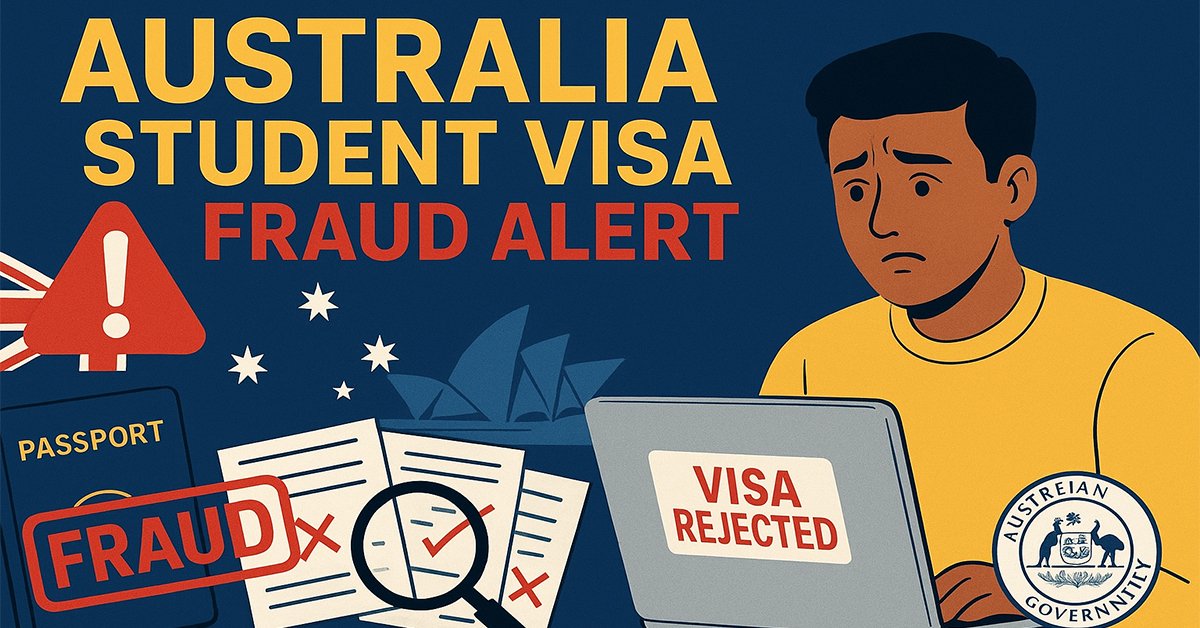

Department of Home Affairs Warns Universities After Sharp Rise in Fraudulent Applications from South Asia
Australia’s international education sector is facing its most serious integrity crisis in recent years. The Department of Home Affairs (DHA) has issued a “Student Visa Integrity Alert” to Australian universities and colleges following a sharp rise in falsified passports, financial statements, and English-test results in Subclass 500 applications lodged since September 2025.
This development has sent shockwaves through the international student community, particularly affecting applicants from India, which represents Australia’s second-largest source of international students with 1.40 million students enrolled.
Understanding the Student Visa Integrity Alert
What Triggered the Warning?
The alert details multiple cases where applicants used fake passport details to obtain Confirmations of Enrolment (CoEs), including at institutions within the Group of Eight, such as the University of Melbourne, the University of Sydney, and the Australian National University.
The Department of Home Affairs confirmed the alert on November 19, 2025, marking an escalation in the government’s response to widespread document fraud that has been undermining Australia’s student visa system.
Key Fraud Types Identified:
- Falsified passport identity pages
- Forged financial statements and bank letters
- Fake English proficiency test results (IELTS, TOEFL, PTE)
- Fraudulent academic transcripts and certificates
- Misrepresented employment documentation
Geographic Focus: South Asian Markets Under Scrutiny
DHA investigators say fraud trends are escalating fastest in South Asia, with several files showing forged bank letters claiming balances in excess of the new AUD 29,710 savings benchmark.
India and China are classified under Australia’s Evidence-Level (EL) framework as EL-2 countries, meaning they face moderate documentary scrutiny. However, the recent spike in fraudulent applications has prompted more intensive verification processes.
States Most Affected by Enhanced Scrutiny:
Multiple Australian universities have imposed additional verification requirements or temporary restrictions on applications from six Indian states:
- Punjab
- Haryana
- Gujarat
- Uttar Pradesh
- Rajasthan
- Jammu & Kashmir
Reports indicate approximately 25% of student visa applications from India are now considered fraudulent or non-genuine, a statistic that has alarmed both Australian authorities and the legitimate international student community.
The Role of Education Agents in the Fraud Crisis
Agent-Driven Document Falsification
The alert singles out cases where agents supplied fake identity pages to secure Confirmations of Enrolment (CoEs) at Group-of-Eight institutions. This has exposed systemic vulnerabilities in how some education providers verify applicant credentials.
DHA noted that “agents are being incentivised by some EPs to facilitate applications regardless of supporting documentation to drive demand for their institution, irrespective of the long-term effect on their attrition/retention rates”.
Historical Context of Agent Fraud
One Indian agent told The Indian Express newspaper in June that the DHA detected approximately 600 fraud cases from the Haryana and Punjab regions of India that had been submitted via agents.
The problem extends beyond isolated incidents. Migration agents have confessed to their role in the scam, with one agent revealing he had sent over 250 students to Australia under such arrangements before shutting his operations.
The “Ghost College” Problem
Vocational Education Sector Exploitation
Australia’s crackdown has also exposed a parallel problem: dodgy vocational education providers operating as “visa factories.”
In August 2023, the government announced the closure of 150 fake education providers and issued warnings to 140 others, labelling them as “visa factories”.
Student Admissions of Fraud
Many students from the North Indian state of Punjab admitted to The Tribune that they have enrolled in these colleges not for education but to work full-time while their attendance records and course certificates were falsified.
One student stated: “I was assured my attendance would be handled while I worked,” revealing the systematic nature of the deception.
Consequences for Universities and Education Providers
Risk to Institutional Standing
DHA warned that admitting students on the basis of fraudulent or unverifiable documents can result in visa refusals, extended processing times, cancellations, course discontinuations and increased provider hopping—outcomes that can weaken an institution’s standing and recruitment capability.
Potential Penalties for Non-Compliant Providers:
- Loss of priority visa processing allocation
- Increased scrutiny of all future applications
- Higher visa refusal rates for enrolled students
- Reputational damage affecting international rankings
- Potential suspension from accepting international students
- Financial losses from refunded tuition fees
Universities have been warned that failure to strengthen verification could lead to visa refusals, cancellations and loss of their precious ‘priority’ processing allocation.
High-Profile Institutions Affected
The fact that Group of Eight universities—Australia’s most prestigious institutions—have been targeted demonstrates that no provider is immune to fraud attempts. These elite universities include:
- University of Melbourne
- University of Sydney
- Australian National University
- University of Queensland
- Monash University
- UNSW Sydney
- University of Adelaide
- University of Western Australia
What Universities Must Do: DHA Requirements
Mandatory Verification Procedures
The Department of Home Affairs has outlined specific actions education providers must implement immediately:
1. Passport Verification Education providers must ensure students submit their passport during the admission stage and check that it will remain valid for visa lodgement and travel.
Providers should also insist that students who do not have a passport at the time of application provide one before CoE issuance.
2. Document Cross-Verification Providers must review the passport country alongside the origin of academic, financial, employment and English-language documents to identify inconsistencies.
3. Video Interview Requirements Institutions should conduct interviews, preferably via video, to verify identity and assess whether the applicant is a genuine student.
4. Financial Evidence Validation Education providers must confirm that all students meet English-language and financial requirements, regardless of their EL classification.
While streamlined applications may not require documentation at the time of lodgement, DHA can request evidence at any point during processing.
5. Enhanced Due Diligence Practices Best practice now includes digital bank-statement verification, biometric ID cross-checks and mandatory video interviews to confirm English proficiency.
Australia’s Evidence Level Framework: What Changed?
September 2025 Reforms
Australia recently updated its Evidence Level (EL) risk framework, which classifies countries and institutions based on visa compliance history and fraud risk.
The Three-Tier System:
- EL-1: Lowest risk – Minimal documentation required
- EL-2: Moderate risk – Standard documentation required (India, China, Nepal)
- EL-3: Highest risk – Comprehensive documentation required
Risk weightings for students from South Asia and some other nations have been lowered, meaning applicants from countries like India, Nepal, Bangladesh, and Sri Lanka are now considered lower risk, resulting in faster processing and fewer evidentiary burdens.
Misinterpretation of Reforms
The warning lands at a time when reports suggest some overseas intermediaries are misrepresenting Australia’s updated Evidence Level (EL) framework, claiming that the September 2025 changes have made student visas easier.
DHA warns that the easing of risk-weightings for universities and countries has been used by “some bodies” as “evidence that Australia’s Student Visa Program is open to non-genuine students”.
This misrepresentation has contributed to an increase in fraudulent applications from individuals who believe reduced documentation requirements mean reduced scrutiny.
Financial Requirements: The AUD 29,710 Threshold
Increased Financial Evidence Standards
As of 2025, international students must demonstrate access to significantly higher funds than in previous years.
Current Financial Requirements:
- Minimum savings: AUD 29,710 (approximately ₹16.3 lakh or USD 19,500)
- Purpose: Living expenses for one year in Australia
- Plus: Full tuition fees for first year
- Plus: Return airfare costs
Several files showed forged bank letters claiming balances in excess of the new AUD 29,710 savings benchmark, highlighting how fraudsters are adapting to increased requirements.
Visa Application Fee Increases
In July 2024, the student visa fee more than doubled—from AUD 710 to AUD 1,600 (₹39,546 to ₹89,118).
Combined with tuition increases at major universities—where engineering degrees now cost ₹30.36 lakh annually and clinical medicine reaches ₹60.66 lakh—the total cost of Australian education has become substantially more expensive.
Impact on Genuine Indian Students
Collateral Damage from Fraud Crackdown
The fraud crisis has created significant challenges for legitimate applicants from affected regions.
Visa consultant Lalit Advani claims, “The decision by Australian universities to restrict applications from certain regions within India will impact genuine students. The majority of applicants are sincere, and they can be easily identified based on their academic scores, background, and intent. Blanket bans only add to the frustration”.
Challenges Faced by Legitimate Students:
- Extended visa processing times (3-6 months vs. 1-2 months previously)
- Increased documentation requirements
- Additional interview rounds
- Higher rejection rates despite meeting all criteria
- Difficulty securing Confirmations of Enrolment from cautious universities
- Reputational stigma based on geographic origin
Regional Variations in University Policies
The Australian government has no nationwide ban, and policies differ by university. Affected students should check each institution’s requirements and explore available opportunities to study in Australia.
Universities with Enhanced Scrutiny (Reported):
- Federation University
- Western Sydney University
- Victoria University
- Southern Cross University
Not all Australian institutions have implemented regional restrictions. Many universities continue accepting applications from all Indian states while employing enhanced verification procedures.
Government Response and Anti-Fraud Measures
International Fraud Awareness Week Initiative
The Australian High Commission in India, working with its international partners, is raising awareness about visa scams and fraudulent migration practices as part of International Fraud Awareness Week, observed since November 18 and continuing until November 22, 2025.
This global initiative encourages governments, businesses, and community organizations to collaborate in reducing fraud impact through education and outreach.
Technology-Driven Verification Solutions
The crisis has accelerated development of technological solutions to combat document fraud.
Emerging Verification Tools:
New verification tools are being developed, with one platform set to launch by year’s end providing a secure, one-click verification system for multiple key documents.
UniReady Global recently launched an AI-driven admissions verification platform where students fund their own verification, removing institutional overheads.
These platforms aim to provide:
- Real-time document authentication
- Digital bank statement verification
- Biometric identity verification
- Educational credential validation
- English proficiency test score verification
Legislative Reforms
The Albanese government has implemented stricter regulations, including increasing financial requirements for visa applicants and using new legal powers to suspend rogue institutions.
The Education Legislation Amendment (Integrity and Other Measures) Bill 2025 is currently under Senate committee examination, with stakeholders submitting their perspectives on proposed changes.
The Nixon Review and Vocational Education Concerns
This crackdown follows warnings in the March 2023 Nixon Review, which identified “high-risk” vocational education providers as key players in the visa exploitation scheme.
The Nixon Review highlighted systemic problems in Australia’s vocational education and training (VET) sector, where some providers operated primarily to facilitate visa access rather than deliver quality education.
Key Nixon Review Findings:
- Inadequate monitoring of provider compliance
- Weak attendance and academic progress tracking
- Insufficient verification of student identity
- Limited consequences for non-compliant providers
- Financial incentives favoring quantity over quality
International Education Sector at Crossroads
Economic Significance
Minister for Education Jason Clare has remarked: “International education is an immensely valuable national asset… However, there are ongoing challenges. The return of students has also seen the re-emergence of dodgy and unscrupulous operators seeking to exploit them”.
Economic Impact of International Education:
- Third-largest export sector for Australia
- Contributes over AUD 40 billion annually to economy
- Supports approximately 250,000 Australian jobs
- Generates significant tax revenue
- Enhances Australia’s soft power and regional influence
Enrollment Statistics
During January–September 2025, Australia recorded 8.21 million international students. China led with 1.89 million students, including around 46,000 new enrolments. India followed with 1.40 million students, of whom 30,239 were new entrants.
These numbers demonstrate the scale of Australia’s dependence on international education and the potential economic consequences if integrity issues undermine the sector’s reputation.
Regional Competition: Canada and UK Context
Canada’s Parallel Crackdown
These reforms have arrived at the same time as Canada has severely cut back student visas, creating a competitive landscape where traditionally popular destinations are simultaneously restricting access.
Canada has implemented:
- Provincial attestation letter requirements
- Reduced study permit allocations (35% decrease for 2024)
- Enhanced financial requirements
- Stricter post-graduation work permit criteria
Global Student Mobility Implications
The simultaneous tightening of policies across major English-speaking destinations (Australia, Canada, UK, USA) is reshaping global student mobility patterns. Prospective students face:
- Reduced acceptance rates across multiple countries
- Higher application costs and requirements
- Longer processing timelines
- Increased competition for limited spots
- Greater emphasis on demonstrating genuine student intent
What Genuine Students Should Do Now
Immediate Action Steps
1. Verify Your Education Agent
- Check if your agent is registered with relevant authorities
- Verify their track record and success rates
- Request references from previous clients
- Avoid agents promising guaranteed approvals
- Never submit false documents, even if suggested
2. Prepare Authentic Documentation
- Obtain official transcripts directly from institutions
- Use only legitimate English proficiency tests
- Secure genuine bank statements with verifiable details
- Gather authentic employment letters if applicable
- Keep copies of all original documents
3. Be Interview-Ready
- Prepare to explain your study plan and career goals
- Research your chosen program and university thoroughly
- Demonstrate knowledge of Australian education system
- Be ready to discuss financial arrangements honestly
- Practice video interview skills
4. Monitor University Policies Check each university’s policy, as policies differ at each school. Always look up and contact each university directly to ask about their rules.
5. Demonstrate Genuine Student Intent
- Show clear educational progression
- Explain how your degree aligns with career goals
- Demonstrate strong ties to home country
- Present realistic post-study plans
- Provide evidence of academic capability
Red Flags to Avoid
Warning Signs of Fraudulent Agents:
- Guarantees of visa approval
- Offers to submit applications without original documents
- Suggestions to falsify financial information
- Promises of work arrangements instead of study focus
- Unusually low fees compared to registered agents
- Pressure to sign agreements quickly
- Lack of transparent communication
Never use fake documents or information. Policies are strict and fraud could get you banned from applying in the future or cause problems with immigration authorities.
Long-Term Implications for Indo-Australian Relations
Educational Diplomacy at Risk
These restrictions—negatively impacting legitimate students and straining Indo-Australian educational ties—may have become difficult to remove unless addressed through diplomatic or policy interventions.
The fraud crisis threatens to damage:
- People-to-people connections between nations
- Alumni networks supporting bilateral relations
- Research collaboration partnerships
- Cultural exchange programs
- Trade and economic ties facilitated by education
Potential Solutions Requiring Bilateral Cooperation
Government-to-Government Initiatives:
- Enhanced document verification systems
- Direct institutional partnerships bypassing agents
- Standardized credential verification platforms
- Joint task forces targeting fraudulent operators
- Information sharing on known fraud networks
Industry-Led Reforms:
- Mandatory agent registration and certification
- Code of conduct enforcement
- Regular audits of agent operations
- Penalties for non-compliant agents
- Reward systems for ethical practice
Industry Expert Perspectives
Phil Honeywood, CEO of the International Education Association of Australia, acknowledged that “Australia’s Department of Home Affairs has recently been concerned about applications involving fraudulent documents originating from certain states in India”.
Honeywood noted: “As Australia has traditionally relied more heavily than most on education agent auspiced visa applications, we are at least able to quickly identify where falsified documents are being used by a particular agency. We are optimistic that this unfortunate situation will be rectified very soon”.
Catriona Jackson, chief executive of Universities Australia, said that the body was “aware of this matter and understand it to be occurring across all educational sectors, not just Australia’s universities”.
Corporate Sponsorship and Future Immigration Implications
For corporates, the alert foreshadows broader compliance pressure: sponsored employees who first enter on student visas will face increased background scrutiny, and any historic irregularity—even agent-driven—could jeopardise future skilled-visa or permanent-residency pathways.
Implications for Employers:
- Enhanced verification of sponsored employees’ education credentials
- Risk assessment of employees with student visa history
- Potential complications in skilled visa nominations
- Need for comprehensive background checks
- Documentation retention requirements
Companies should ensure that sponsored graduates can produce genuine academic records and financial documents if requested during later visa stages.
Timeline: When Will Restrictions Ease?
No one knows yet how long these bans and stricter checks will last. It is likely that universities will review their results over the next months. If fraud is reduced and dropout rates fall, some rules may be relaxed.
Factors That Could Lead to Policy Relaxation:
- Demonstrable reduction in fraudulent applications
- Improved retention and completion rates
- Enhanced agent verification systems
- Successful implementation of technology solutions
- Positive diplomatic engagement between governments
Factors That Could Intensify Restrictions:
- → Need a Passport Fast? How to Expedite Your U.S. Passport Renewal Step-by-Step
- → Want a $60K+ Salary Without a 4-Year Degree? 15 Certificates You Can Finish in Under a Year
- → Planning a Trip to Europe? 6 Essential Entry Rules to Avoid Denial at the Border
- → Heading to Border Control? Key Immigration Questions You Must Be Ready to Answer
- → Planning a European Trip? What Starkville’s Indian Community Should Know About Schengen Visas
- → 11 Countries Offering Funded Ph.D. Programs for International Students
- → U.S. Dollar Reaches Two-Week High Driven by Middle East Tensions and Fed Policy Outlook
- Continued high fraud detection rates
- Increased dropout and provider-hopping
- New fraud methodologies emerging
- Public pressure on immigration policy
- Political priorities around migration numbers
Frequently Asked Questions
Q: Does Australia have a blanket ban on students from certain Indian states?
The Australian government shows no sign of creating a national ban or state-based restriction on Indian students. Each visa application is judged on its own merits, and there is no official discrimination based on home state.
However, individual universities have implemented their own enhanced scrutiny or temporary restrictions.
Q: How long does student visa processing take now?
Processing times have increased significantly for applications from affected regions. While previously averaging 4-6 weeks, many applications now take 3-6 months due to enhanced verification procedures.
Q: Can I switch to a different education agent if I suspect fraud?
Yes, and you should immediately if you have concerns. However, ensure that all documents submitted through the previous agent were authentic, as you remain responsible for all application materials.
Q: Will this affect my chances of permanent residency later?
Any historic irregularity—even agent-driven—could jeopardise future skilled-visa or permanent-residency pathways. Ensuring complete honesty and authenticity in your initial student visa application is crucial for your long-term immigration prospects.
Q: Are other countries experiencing similar fraud issues?
Yes. Canada, the UK, and the USA have all reported increased student visa fraud, particularly from similar source markets. This is contributing to globally tightened policies.
Conclusion: Protecting Australia’s Education Reputation
The student visa integrity crisis represents a critical juncture for Australia’s international education sector. While the immediate focus is on fraud detection and prevention, the long-term success depends on balancing security with accessibility for genuine students.
Key Takeaways:
- For Students: Only work with registered, reputable agents and never submit false documents
- For Agents: Implement robust verification procedures and prioritize ethical practice
- For Universities: Enhanced due diligence is now mandatory, not optional
- For Governments: Bilateral cooperation and technology solutions are essential
Australia does not want to close its doors to all Indian students. The current measures aim to preserve the integrity of the system while continuing to welcome legitimate international students who contribute to Australia’s educational excellence and cultural diversity.
The path forward requires collaboration among students, education providers, agents, and governments to restore confidence in the system while protecting the interests of genuine students seeking quality Australian education.
Disclaimer: Student visa policies and requirements change frequently. Always verify current information through official Department of Home Affairs channels and consult with registered migration agents. This article provides general information and should not be considered immigration advice.
