

Overview: What’s Changing in Canadian Immigration
Canada is implementing significant immigration reforms in 2026 that will reshape opportunities for international students and temporary foreign workers. Based on the 2026-2028 Immigration Levels Plan and Budget 2025, these changes reflect the federal government’s strategic shift toward sector-specific immigration, reduced temporary resident numbers, and accelerated permanent residency pathways for workers already contributing to the Canadian economy.
Critical Timeline: Most changes take effect January 1, 2026, with some announcements expected in early 2026.
This comprehensive guide explains every major change, who it affects, and how to prepare for Canada’s evolving immigration landscape.
Major Changes for Temporary Foreign Workers in Canada
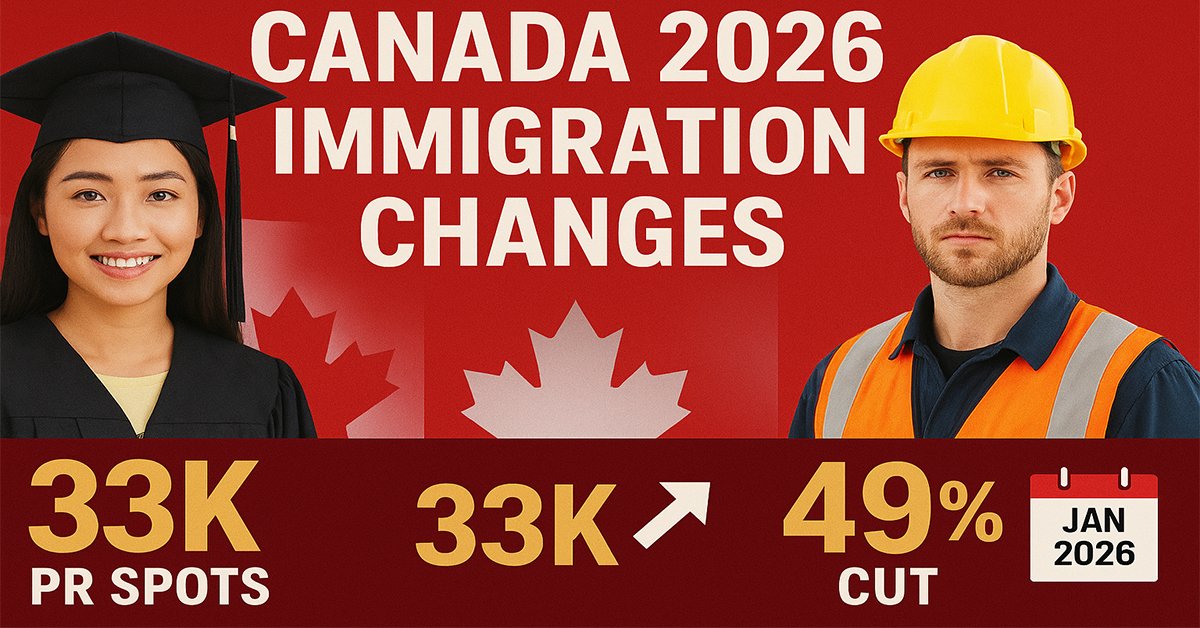
1. Accelerated Pathway to Permanent Residence (33,000 Spots)
What’s Happening: Immigration, Refugees and Citizenship Canada (IRCC) announced plans to transition up to 33,000 temporary workers to permanent residency in 2026 and 2027 through an accelerated pathway.
Who Qualifies: While specific eligibility criteria haven’t been released, IRCC indicated the program will target workers who:
- Hold valid work permits in Canada
- Have established strong community roots
- Pay Canadian taxes
- Work in specific in-demand sectors
- Contribute to building a stronger economy
Historical Context: In 2021, IRCC launched a limited-time temporary resident to PR pathway that reached its application cap on the first day, demonstrating massive demand for such programs.
Recent Trends: According to the Express Entry Year End Report, 64% of candidates invited to apply for permanent residence in 2024 had at least one year of eligible Canadian work experience. This trend signals IRCC’s preference for candidates already integrated into the Canadian workforce.
What This Means: Temporary foreign workers currently in Canada are in a favorable position. Those working in priority sectors should prepare their documentation and monitor IRCC announcements closely for program launch details.
2. Tightened Temporary Foreign Worker Program (TFWP) Requirements
Government’s New Direction: Prime Minister Mark Carney announced in September 2025 that the TFWP “must have a focused approach that targets specific, strategic sectors, and needs in specific regions.”
Key Changes:
Reduced Admission Numbers:
- 2025 Plan: 82,000 TFWP arrivals
- 2026 Plan: 60,000 TFWP arrivals (27% reduction)
Labour Market Impact Assessment (LMIA) Restrictions: The government implemented a pause on processing LMIAs in regions with unemployment rates of 6% or higher. An LMIA is a prerequisite document employers must obtain before hiring foreign workers through the TFWP.
What to Expect:
- Stricter eligibility criteria for LMIA applications
- Greater focus on high-demand sectors
- Regional targeting based on local labour market conditions
- Increased scrutiny of employer applications
Impact on Workers: Foreign workers seeking new TFWP positions may face increased competition. Those already working in Canada should consider transitioning to permanent residency pathways or sector-specific streams.
3. New Sector-Specific PR Pathways and Work Permit Streams
Canada is launching multiple targeted immigration streams to address specific labour market needs:
H-1B Visa Holder Pathway (Tech Talent)
Target Sectors:
- Healthcare professionals
- Research and advanced industries
- Key technology sectors
Purpose: Budget 2025 announced this accelerated pathway to attract highly skilled tech talent, particularly from the United States. This program aims to capitalize on uncertainty in other countries’ immigration systems by offering Canadian permanent residency to qualified professionals.
Ideal Candidates: Tech workers currently on H-1B visas in the U.S. or other skilled professionals in healthcare and advanced research fields.
Construction Worker PR Pathway (6,000 Spaces)
Announcement: In March 2025, IRCC committed to reserving immigration spaces for up to 6,000 undocumented construction workers currently in Canada.
Significance: This pathway acknowledges the critical shortage in Canada’s construction sector and provides a regularization path for workers already contributing to the industry.
Who Benefits: Construction workers currently in Canada, even those working without proper documentation, may have an opportunity to regularize their status and obtain permanent residency.
Agriculture and Fish Processing Stream
Details: The 2025-2026 Departmental Plan revealed IRCC is developing a dedicated stream for foreign workers in:
- Agriculture sector
- Fish processing industry
Features:
- Sector-specific work permit
- Corresponding PR pathway
- Designed to address chronic labour shortages in these essential industries
Advantage for Current Workers: Temporary foreign workers already employed in agriculture or fish processing will be prime candidates, as Canadian work experience is highly valued.
4. Reopening Immigration Pilots: Home Care Workers
Program Return: The Home Care Worker Immigration pilots will reopen for fresh intake periods in 2026.
Target Occupations:
- Home care workers
- Home support workers
- Caregivers
Why It Matters: Canada’s aging population creates ongoing demand for home care professionals. This pilot offers a direct pathway to permanent residency for workers providing essential caregiving services.
Major Changes for International Students in Canada
1. Drastically Reduced Study Permit Cap
Current Situation: The federal government has capped study permit applications for the past two years. The next update arrives in January 2026.
Projected Changes:
2025 Immigration Levels Plan: 305,900 new international student arrivals 2026 Immigration Levels Plan: 155,000 new international student arrivals
- → Need a Passport Fast? How to Expedite Your U.S. Passport Renewal Step-by-Step
- → Want a $60K+ Salary Without a 4-Year Degree? 15 Certificates You Can Finish in Under a Year
- → Planning a Trip to Europe? 6 Essential Entry Rules to Avoid Denial at the Border
- → Heading to Border Control? Key Immigration Questions You Must Be Ready to Answer
- → Planning a European Trip? What Starkville’s Indian Community Should Know About Schengen Visas
- → 11 Countries Offering Funded Ph.D. Programs for International Students
- → U.S. Dollar Reaches Two-Week High Driven by Middle East Tensions and Fed Policy Outlook
Impact: 49% reduction in international student admissions
What This Means:
- Significantly more competitive application environment
- Higher standards for study permit approval
- Greater emphasis on application quality and documentation
- Potential preference for students in high-demand fields
Important Context: Canada fell short of its 2025 international student admission targets, suggesting actual impact may be less severe than numbers indicate. However, prospective students should prepare thoroughly and apply early.
2. Graduate Students Exempted from Study Permit Cap
Major Relief: Starting January 1, 2026, Master’s and doctoral degree students are exempt from the study permit cap.
Key Benefits:
No Provincial Attestation Letter Required: Graduate students no longer need a Provincial Attestation Letter (PAL) or Territorial Attestation Letter (TAL), streamlining the application process significantly.
Expedited Processing:
- Doctoral students: Study permit processing in as little as 2 weeks
- Family members: Accompanying family members also receive expedited processing
Strategic Advantage: Graduate programs become more accessible while undergraduate programs face tighter restrictions. Students considering advanced degrees gain a significant advantage in the Canadian immigration system.
3. Post-Graduation Work Permit (PGWP) Program Changes
Timeline of Changes:
June 2025: IRCC announced removal of 178 study programs from PGWP eligibility
July 2025: Implementation postponed to “early 2026”
Current Status: These 178 programs remain PGWP-eligible until the announcement in early 2026
What’s at Stake: The PGWP allows international students to work in Canada after graduation for up to three years, depending on program length. This work experience is crucial for qualifying for permanent residency through programs like Canadian Experience Class.
Programs Affected: Specific program list has not been fully published, but changes likely target programs with:
- Lower employment outcomes
- Questionable educational value
- Minimal connection to Canadian labour market needs
Critical Advice for Students: When selecting a study program, verify PGWP eligibility before enrollment. Students planning to work in Canada after graduation must choose programs that remain eligible for post-graduation work permits.
How to Verify Eligibility:
- Check IRCC’s official Designated Learning Institutions list
- Confirm program appears on PGWP-eligible programs
- Consult with school’s international student office
- Monitor IRCC announcements in early 2026
Understanding Canada’s Immigration Strategy Shift
From Volume to Selectivity
Canada’s immigration approach is evolving from high-volume temporary residents to selective, sector-specific admissions aligned with economic needs.
Key Principles:
- Prior Canadian Experience: Preference for candidates already working or studying in Canada
- Sector Alignment: Focus on healthcare, technology, construction, agriculture, and caregiving
- Regional Needs: Immigration decisions based on local labour market conditions
- Integration Success: Prioritizing candidates with established community ties and tax contributions
The Numbers Behind the Changes
Temporary Foreign Workers:
- 2025: 82,000 planned arrivals
- 2026: 60,000 planned arrivals
- Change: -22,000 (-27%)
International Students:
- 2025: 305,900 planned arrivals
- 2026: 155,000 planned arrivals
- Change: -150,900 (-49%)
New PR Pathways:
- Temporary workers to PR: 33,000 spots (2026-2027)
- Construction workers: 6,000 spots
- Graduate students: Exempted from caps
How to Prepare for These Changes
For Temporary Foreign Workers Currently in Canada
Immediate Actions:
- Document your Canadian work experience thoroughly
- Maintain valid work permit status and tax compliance
- Build community connections and gather supporting evidence
- Monitor IRCC announcements for the 33,000-spot PR pathway details
- Consider sector-specific streams if you work in healthcare, tech, construction, agriculture, or caregiving
- Improve language test scores (IELTS/CELPIP for English, TEF for French)
- Calculate Express Entry CRS score and identify improvement areas
For Prospective Foreign Workers
Strategic Planning:
- Target in-demand sectors: Healthcare, technology, construction, agriculture
- Research regional labour needs and unemployment rates
- Secure job offers from employers willing to pursue LMIAs
- Consider graduate studies as an alternative entry pathway (exempt from caps)
- Develop skills aligned with sector-specific streams
For Current International Students
Action Steps:
- Verify PGWP eligibility of your current program
- Plan work experience acquisition during and after studies
- Build Canadian connections through co-op, internships, volunteering
- Explore PR pathways available to graduates in your field
- Consider graduate studies to bypass new study permit restrictions
- Maintain excellent academic standing and full-time status
For Prospective International Students
Application Strategy:
- Apply early for January 2026 intake
- Target graduate programs (exempt from caps) if qualified
- Choose PGWP-eligible programs verified through IRCC
- Select in-demand fields aligned with Canada’s labour market needs
- Prepare comprehensive applications with strong documentation
- Consider alternative pathways if study permits become too competitive
Provincial and Territorial Considerations
Provincial Nomination Programs (PNPs)
Many provinces operate their own immigration streams with specific criteria:
Ontario Immigrant Nominee Program (OINP):
- Tech draws for IT professionals
- In-demand skills streams
British Columbia Provincial Nominee Program (BC PNP):
- Tech pilot for technology workers
- Healthcare professional priority
Alberta Advantage Immigration Program (AAIP):
- Express Entry stream
- Rural renewal stream
Atlantic Immigration Program (AIP):
- Lower barriers for Atlantic provinces
- Employer-driven program
Provincial Attestation Letters (PALs)
While graduate students are exempt starting January 2026, undergraduate students still require PALs from their province or territory of study. Requirements vary significantly by province.
Frequently Asked Questions
When do the 2026 immigration changes take effect? Most changes take effect January 1, 2026. The study permit cap announcement is expected in January 2026, while PGWP program changes will be announced in early 2026.
Are graduate students really exempt from study permit caps? Yes, starting January 1, 2026, Master’s and doctoral students are exempt from study permit caps and no longer need Provincial Attestation Letters.
How can I qualify for the 33,000-spot temporary worker to PR pathway? Specific eligibility criteria haven’t been announced yet. Generally, you’ll need a valid work permit, Canadian work experience, tax compliance, community ties, and employment in an in-demand sector. Monitor IRCC announcements for official details.
Will my study program still be PGWP-eligible in 2026? Check IRCC’s official list of Designated Learning Institutions and PGWP-eligible programs. If your program is among the 178 being removed, it remains eligible until the official change is announced in early 2026.
Can construction workers without status apply for the 6,000-spot pathway? IRCC indicated the pathway is for “undocumented construction workers within Canada,” suggesting workers currently in Canada without proper status may be eligible. Official details are pending.
What sectors are considered “in-demand” for the accelerated PR pathway? While not officially confirmed, Budget 2025 and departmental plans highlight: healthcare, technology, construction, agriculture, fish processing, and caregiving.
Will the H-1B pathway only accept U.S. workers? The pathway targets “tech talent” broadly, with particular focus on H-1B holders. Qualified professionals in healthcare, research, and advanced industries from any country may be eligible.
How competitive will study permits become in 2026? With a 49% reduction in target admissions, competition will increase significantly. However, Canada fell short of 2025 targets, so actual impact may be less severe. Strong applications with clear study plans and financial documentation will be essential.
Expert Tips for Success
Maximizing Your Canadian Immigration Chances
1. Gain Canadian Experience: Whether through work permits, co-op programs, or internships, Canadian experience dramatically improves PR prospects.
2. Improve Language Proficiency: Higher English or French test scores significantly boost Express Entry rankings and pathway eligibility.
3. Network Actively: Build professional connections, join industry associations, and establish community ties that demonstrate integration.
4. Stay Informed: Immigration policies evolve rapidly. Follow IRCC announcements, subscribe to updates, and consult immigration lawyers for major decisions.
5. Document Everything: Keep meticulous records of work experience, tax filings, educational credentials, and community involvement.
6. Consider Multiple Pathways: Don’t rely on a single immigration route. Explore federal programs, PNPs, and sector-specific streams simultaneously.
7. Act Quickly: When new pathways open, they often reach capacity rapidly. Prepare documentation in advance so you can apply immediately.
Conclusion: Navigating Canada’s Changing Immigration Landscape
The 2026 immigration changes represent Canada’s most significant policy shift in years, moving from high-volume temporary admissions to strategic, sector-specific selection. While these changes create new challenges—particularly for prospective international students—they also open valuable opportunities for temporary workers already contributing to Canadian communities.
Key Takeaways:
- Temporary foreign workers currently in Canada are in an advantageous position with multiple new PR pathways
- Graduate students gain exemption from study permit caps and expedited processing
- Sector-specific streams prioritize healthcare, tech, construction, agriculture, and caregiving workers
- PGWP eligibility changes require careful program selection for international students
- Early preparation and comprehensive applications will be essential in more competitive environment
Whether you’re a temporary worker seeking permanent residency, a current student planning your post-graduation career, or a prospective applicant considering Canada, understanding these changes and preparing strategically will be crucial to immigration success.
Stay updated through official IRCC channels, consult qualified immigration professionals for personalized advice, and take proactive steps to position yourself favorably under Canada’s evolving immigration system.
