

Canada Immigration Applications Backlog Reaches Highest Level Since November 2024
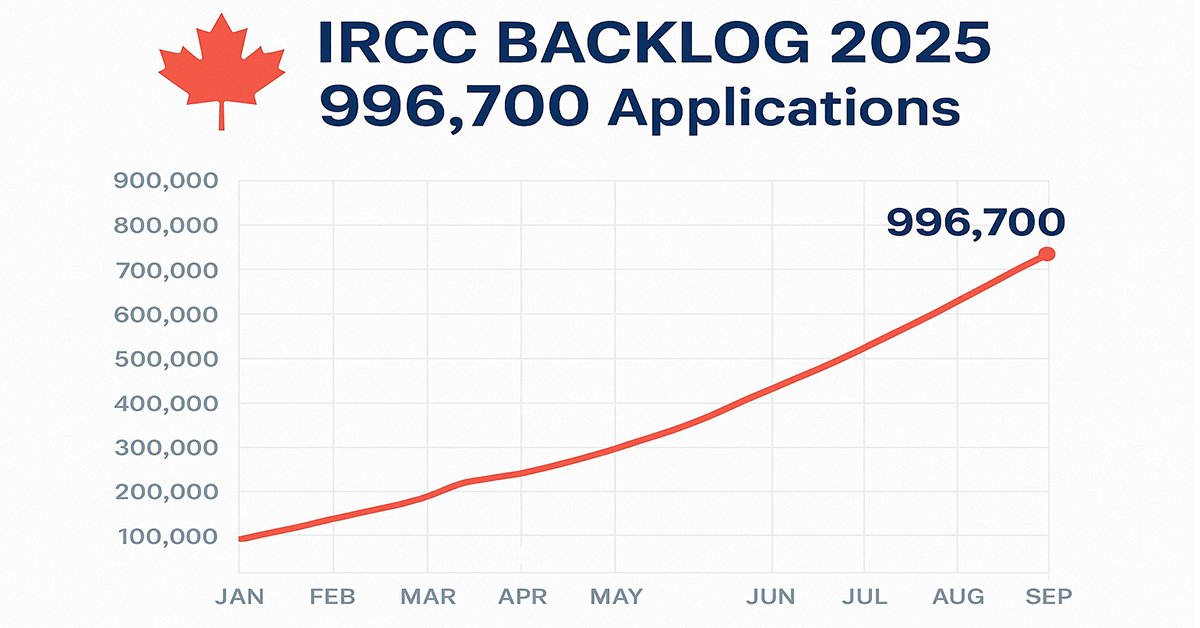
As of September 30, 2025, Immigration, Refugees and Citizenship Canada (IRCC) reported a total application backlog of 996,700 cases — the highest level recorded since November 2024. This represents a significant increase from August 2025’s 958,850 backlog, marking a 3.95% month-over-month increase.
The expanding backlog reflects mounting pressure across all application categories, with study permit applications experiencing particularly steep growth at 10% month-over-month — the largest increase among all immigration program types.
IRCC Backlog Overview: September 2025 Statistics
Total Application Volume
As of September 30, 2025, IRCC’s total application inventory stood at 2,200,100 applications across all categories. Of these:
- 1,203,400 applications (55%) were processed within service standards
- 996,700 applications (45%) remained in backlog status
- Backlog continues upward trajectory from earlier months in 2025
What Is IRCC Backlog?
An immigration application is classified as backlog when processing time exceeds IRCC’s published service standards. These standards represent target completion times established by the department:
Standard processing timeframes by category:
- Express Entry: 6 months
- Family Sponsorship: 12 months
- Study Permits: Not specified (variable)
- Work Permits: Not specified (variable)
- Visitor Visas: Not specified (variable)
IRCC aims to complete 80% of all applications within service standards, acknowledging that the remaining 20% involve complex situations requiring additional documentation, detailed review, or extended decision-making.
IRCC Backlog by Month: 2025 Trend Analysis
Monthly Backlog Growth Comparison
| Month | Backlog Total | Month-over-Month Change | Trend |
| January 2025 | 891,100 | -5.33% | Declining |
| February 2025 | 821,200 | -7.95% | Declining |
| March 2025 | 779,900 | -5.03% | Declining |
| April 2025 | 760,200 | -2.53% | Declining |
| May 2025 | 802,000 | +5.5% | Rising |
| June 2025 | 842,800 | +5.02% | Rising |
| July 2025 | 901,700 | +6.98% | Rising |
| August 2025 | 958,850 | +6.33% | Rising |
| September 2025 | 996,700 | +3.95% | Rising |
Key Findings
First half of 2025: Steady decline from 891,100 (January) to 760,200 (April) — a 14.7% reduction
Second half of 2025: Consistent growth from May onwards, with backlog increasing 31% from April’s low point
Recent acceleration: August to September saw a smaller increase (3.95%), suggesting potential stabilization, though backlog remains near historical highs
Permanent Residence Applications: Backlog Analysis
PR Application Statistics (September 30, 2025)
Total PR applications in inventory: 913,800
Processing status breakdown:
- Within service standards: 431,400 (47%)
- In backlog: 482,400 (53%)
PR Backlog Change from August to September
The PR application backlog increased by 12,100 applications, rising from 470,300 (August) to 482,400 (September). This represents a 2.6% month-over-month increase.
Express Entry Backlog Status
Express Entry applications backlog: 21% of applications exceed the 6-month service standard
- Previous month (August): 20%
- Change: +1 percentage point
Impact: Only 1 in 5 Express Entry applications now exceed the standard 6-month processing timeline, though this is slightly worse than the previous month.
Processing reality: While IRCC targets 6 months for Express Entry, actual processing times have shown variability, with some applications being processed faster and others significantly delayed.
Express Entry-Aligned PNP Applications
PNP backlog percentage (September): 47%
Previous month (August): 48%
Change: -1 percentage point (slight improvement)
Significance: This represents the lowest backlog percentage for PNP applications since March 2025, suggesting improved processing efficiency in provincial nominee programs.
Family Sponsorship Applications
Family sponsorship backlog (September): 19% of applications
Previous month (August): 17%
Change: +2 percentage points
Concern alert: This is the highest family sponsorship backlog percentage since June 2023, indicating significant delays in spousal, common-law partner, and family member sponsorship applications.
Processing impact: Family sponsorship applications targeting 12-month service standards are experiencing increased backlogs, affecting couples seeking to reunite and families bringing in relatives.
Temporary Residence Applications: The Surge in Study Permits
Temporary Residence Overview
Total temporary residence applications (September 30): 1,028,500
Applications within service standards: 567,400 (55%)
Applications in backlog: 461,100 (45%)
Categories included: Work permits, study permits, visitor visas
Study Permit Backlog Crisis
Study permit backlog (September): 42% of applications
Previous month (August): 32%
Month-over-month increase: +10 percentage points (largest increase of any category)
IRCC’s projected backlog target: 34%
Variance from projection: +8 percentage points above target
Study Permit Applications Surge
Study permits recorded the largest month-over-month increase of all application types in 2025 at 10% growth in September alone. This dramatic increase represents several concerning trends:
- → New Canada Benefit Payments Arriving This Week in May 2026
- → Canada Bread Settlement Payments Begin Rolling Out Across Canada in 2026
- → Canada Immigration Backlog Update 2026: IRCC Application Inventory Crosses 2.15 Million
- → Canada Expands Visa-Free Travel Access for Citizens of Indonesia and Malaysia in 2026
- → Canada’s 365-Day Maintained Status Work Rule in 2026: What Foreign Workers Need to Know
- → Canada Launches Early Retirement Incentive Program in 2026: Eligibility, Benefits, and Application Process Explained
- → Bringing Your Family to New Zealand on a Work Visa: Complete 2026 Guide
Why study permit backlog is rising:
- Increased application volume – More international students applying to Canadian institutions
- Policy changes – Recent amendments to study permit eligibility requirements
- Document verification – Extended screening for international student applications
- Institutional complexity – Designated Learning Institution (DLI) status verification delays
Historical context: The September 2025 backlog of 42% represents the highest study permit backlog since February 2025, indicating ongoing capacity challenges.
Work Permit Backlog Analysis
Work permit backlog (September): 48% of applications
Previous month (August): 45%
Change: +3 percentage points
IRCC’s projected backlog target: 28%
Variance from projection: +20 percentage points significantly above target
Implications: Nearly half of all work permit applications are exceeding processing standards, creating challenges for employers and skilled workers awaiting authorization.
Visitor Visa Backlog
Visitor visa backlog (September): 57% of applications
Previous month (August): 60%
Change: -3 percentage points (slight improvement)
IRCC’s projected backlog target: 53%
Variance from projection: +4 percentage points above target
Analysis: While visitor visa backlog improved slightly month-over-month, it remains above projected levels, indicating ongoing processing delays for tourist, business, and family visit applications.
Citizenship Applications: Moderate Backlog
Citizenship Application Statistics
Total citizenship applications (September 30): 257,800
Applications within service standards: 204,600 (79%)
Applications in backlog: 53,200 (21%)
Month-over-Month Citizenship Backlog Change
August 2025 backlog: 20%
September 2025 backlog: 21%
Change: +1 percentage point
Trend: Citizenship applications showed a slight increase in backlog, though processing rates remain relatively strong at 79% on time.
Why Is IRCC Backlog Growing in 2025?
Contributing Factors
1. Application Volume Surge
- Increased international student applications
- Higher work permit applications from temporary resident pathways
- Family sponsorship applications responding to policy changes
2. Policy Changes and Implementation
- New study permit eligibility requirements
- Revised processing criteria for international students
- Changes to work permit categories and conditions
3. Administrative Capacity Constraints
- IRCC staffing limitations despite recent hiring
- Complex verification procedures for international applications
- Integration of new security screening protocols
4. Documentation and Verification Issues
- Extended document verification from educational institutions
- International credential assessment delays
- Background check requirements for expanded applicant pools
5. System Infrastructure Challenges
- Processing system capacity limitations
- Data management and application tracking
- Integration of new digital processing tools
Impact of IRCC Backlog on Applicants
Express Entry Applicants
Primary concern: 6-month processing standard no longer guaranteed
Affected groups:
- Federal Skilled Worker Program (FSWP)
- Federal Skilled Trades Program (FSTP)
- Canadian Experience Class (CEC) applicants
Consequences: Employment offers may expire, work authorizations may lapse, family reunification timelines extended
Family Sponsorship Applicants
Primary concern: 12-month target increasingly difficult to meet
Affected groups:
- Spouses and common-law partners
- Dependent children
- Parents and grandparents
Consequences: Family separation extends, household planning complicated, emotional stress increases
Study Permit Applicants
Primary concern: Study permit approval may not arrive before program start date
Affected groups:
- New international students
- Students extending study permits
- Pathway applicants transitioning to work permits
Consequences: Students may miss program intake dates, defer enrollment, face financial losses, require additional certifications
Work Permit Applicants
Primary concern: Employment may be delayed or opportunities lost
Affected groups:
- International Mobility Program (IMP) participants
- Open work permit applicants
- Bridging work permit seekers
Consequences: Employers unable to fill positions, worker financial security compromised, business operations delayed
IRCC Processing Standards: Service Level Targets
How IRCC Service Standards Work
IRCC publishes service standards for each immigration program category, representing the timeframe within which the department aims to process 80% of applications. These targets guide performance expectations but are not guaranteed.
Current Service Standard Targets
| Application Type | Service Standard | Percentage Within Standard (Sept 2025) |
| Express Entry | 6 months | 79% |
| Family Sponsorship | 12 months | 81% |
| Study Permits | Varies | 58% |
| Work Permits | Varies | 52% |
| Visitor Visas | Varies | 43% |
| Citizenship | Varies | 79% |
Overall processing rate: 55% of all applications processed within service standards
80% Processing Target
IRCC targets completing 80% of applications within published service standards. Current performance (55% overall) falls significantly short of this target for temporary residence categories, indicating systemic processing challenges.
What Applicants Should Know About Backlog Status
Application Backlogs Do Not Mean Rejection
Being in backlog status indicates the application is taking longer than standard processing time, not that it will be rejected or denied. Backlog status simply means extended processing.
Factors Causing Extended Processing
Applications may exceed service standards due to:
- Missing documentation – Incomplete applications requiring additional materials
- Complex cases – Applications involving special circumstances or additional verification
- Background checks – Security and criminality screening requirements
- Reference checks – Contacting previous employers, educational institutions
- Interview requirements – Additional interview or personal appearance needed
- Quality assurance – Final review and verification of decision
Remaining Patient vs. Seeking Updates
Do:
- Check your application status through GCKey online
- Ensure all required documents were submitted
- Monitor email for IRCC requests
- Review application instructions for common issues
Don’t:
- Contact IRCC repeatedly for status updates (delays responses)
- Resubmit documents already provided
- Make unauthorized changes to your application
- Ignore IRCC communications requesting additional information
Improving Processing Efficiency: Government Initiatives
IRCC Efforts to Reduce Backlog
1. Staffing Expansion
- Hiring additional processing officers
- Training support staff for application review
- Recruiting temporary staff for peak periods
2. Process Improvements
- Digitalization of paper-based processes
- Automation of routine document verification
- Enhanced system integration
3. Policy Adjustments
- Streamlined requirements for certain categories
- Reduced documentation needs where possible
- Updated eligibility criteria for faster processing
4. Prioritization Framework
- Focusing on time-sensitive applications
- Processing applications with complete documentation first
- Prioritizing applications meeting critical thresholds
Looking Ahead: IRCC Backlog Projections
Expectations for Q4 2025
Potential scenarios:
Optimistic: Backlog stabilizes around 950,000-1,000,000 as processing catches up Realistic: Backlog continues gradual growth to 1,050,000-1,100,000 Concerning: Backlog reaches 1,150,000+ if application volume surges continue
Factors That Could Reduce Backlog
- Increased IRCC staffing capacity coming online
- Implementation of new automated processing systems
- Reduced application volume if policy changes deter submissions
- Operational efficiency improvements yielding results
Factors That Could Worsen Backlog
- Continued surge in international student applications
- New policy changes requiring additional verification
- Staff shortages or turnover affecting capacity
- Unexpected security screening requirements
- System failures or technology issues
Strategies for Applicants Dealing with Backlog
For Express Entry Applicants
Actions to take:
- Ensure profile completeness and accuracy before submission
- Prepare all supporting documents before Invitation to Apply (ITA)
- Review document checklists thoroughly
- Submit applications as quickly as possible after ITA
- Maintain eligibility throughout processing
- Be prepared for the possibility of 6-month timeframe extending to 8-12 months
For Family Sponsorship Applicants
Actions to take:
- Begin sponsorship process immediately — don’t delay
- Ensure sponsor eligibility before application
- Gather all required family documentation in advance
- Consider hiring a regulated immigration consultant
- Be prepared for processing to exceed 12-month target
- Maintain contact information for potential IRCC requests
For Study Permit Applicants
Actions to take:
- Apply for study permits as early as possible after acceptance
- Ensure institution holds valid Designated Learning Institution (DLI) status
- Prepare financial proof documents thoroughly
- Apply well before program start date (minimum 4-6 months recommended)
- Monitor application status through GCKey
- Have backup plans if approval arrives after start date
For Work Permit Applicants
Actions to take:
- Apply immediately after job offer received
- Ensure employer has completed LMIA if required
- Prepare all employment offer documents
- Consider bridging work permits if applicable
- Communicate with employer about realistic timelines
- Prepare contingency plans if processing exceeds expectations
Key Takeaways: IRCC Backlog September 2025
✓ IRCC backlog reached 996,700 applications — approaching 1 million and highest since November 2024
✓ Study permits recorded largest increase — 10% month-over-month with 42% backlog rate
✓ Temporary residence applications most affected — 45% of temporary applications in backlog
✓ Express Entry showing resilience — Only 21% in backlog despite increased volume
✓ Family sponsorship deteriorating — 19% backlog is highest since June 2023
✓ Work permits under strain — 48% backlog significantly exceeds 28% target
✓ Visitor visas improving slowly — 57% backlog down from 60% but still above target
✓ Citizenship processing strong — 79% processed on time, 21% in backlog
✓ Overall system strains evident — Only 55% of all applications meeting service standards vs. 80% target
