
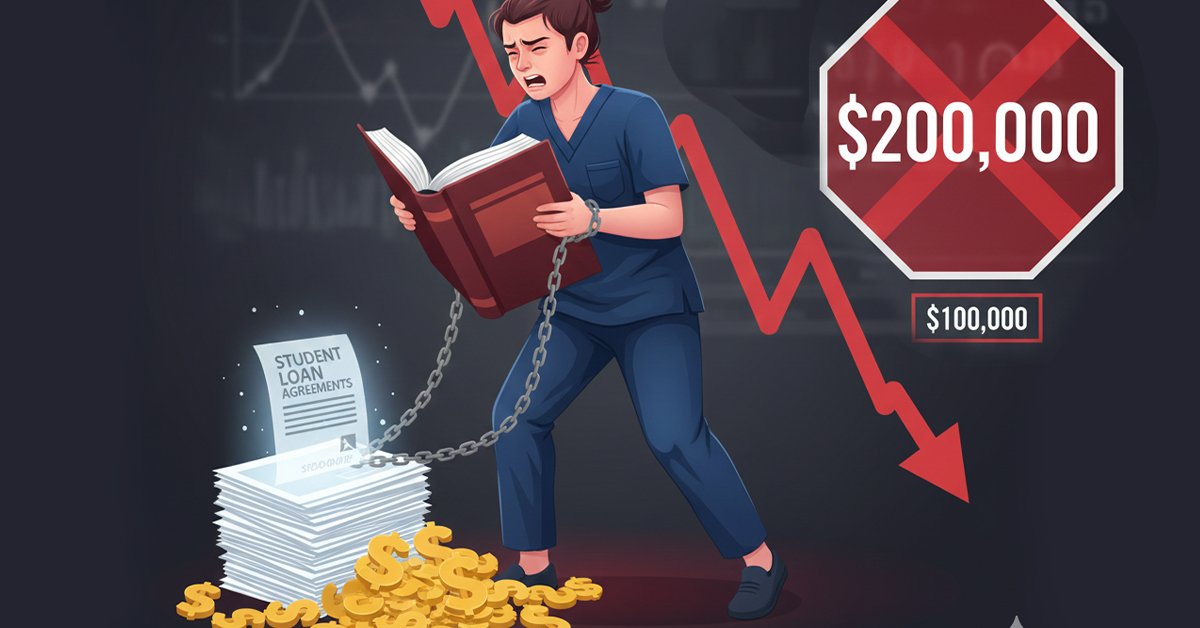

The Loan Crisis: New Federal Rules Hit Nursing Education Hard
A recent decision by the Department of Education (DOE), enacted under President Donald Trump’s “One Big Beautiful Bill,” has ignited a significant funding crisis for aspiring nurses and graduate nursing students across the United States. The core of the issue: the DOE has formally reclassified nursing—along with several other crucial healthcare fields—as no longer qualifying as a professional degree program.3
This administrative change, effective following the bill’s signing in July of this year, has immediate and far-reaching financial implications, primarily by significantly weakening the access to federal student loan funding for students committed to entering the demanding healthcare field.
The implications of this policy shift are not merely bureaucratic; they are existential for many students and pose a serious threat to the nation’s capacity to address its deepening healthcare worker shortage.
The Financial Fallout: $100,000 Cap and the End of Grad PLUS
The reclassification of nursing directly impacts two critical areas of federal financial aid, fundamentally altering the economics of pursuing an advanced degree in the field:4
1. Lifetime Borrowing Caps Slashed
The “One Big Beautiful Bill” introduces differential lifetime caps on federal loan borrowing for graduate and professional students:5
| Student Category | Annual Borrowing Limit | Lifetime Borrowing Cap |
| Professional Students (e.g., Law, Medicine) | Up to $50,000 | $200,000 |
| Graduate Students (New Nursing Classification) | Up to $20,500 | $100,000 |
By moving nursing programs (such as the highly specialized Master of Science in Nursing, or MSN) from the Professional category to the standard Graduate category, students will now face a harsh reality: a $100,000 lifetime cap, half the amount available to their counterparts in medicine or law. Furthermore, their annual borrowing capacity is reduced by over 50%.
2. The Elimination of Grad PLUS Loans
Perhaps the most devastating impact is the scheduled elimination of the Grad PLUS loan program, effective starting July 1, 2026.6
Grad PLUS loans have historically been the backbone of funding for graduate students, allowing them to borrow up to the full cost of attendance (minus other aid).7 These loans have been essential for covering tuition and living costs not met by the $20,500 annual Stafford Loan limit. The complete end of this program leaves a massive, unfillable gap in financial aid, forcing students to rely on private, often higher-interest, loans or to abandon their educational goals entirely.
The Industry Reaction: A Threat to Patient Care
The American Nurses Association (ANA), representing the nation’s 4.4 million registered nurses, has voiced sharp criticism of the DOE’s policy shift, warning of catastrophic consequences for the healthcare system.8
Jennifer Mensik Kennedy, President of the ANA, issued a statement lamenting the short-sighted nature of the bill:
“At a time when healthcare in our country faces a historic nurse shortage and rising demands, limiting nurses’ access to funding for graduate education threatens the very foundation of patient care.”
The message is clear: advanced nursing degrees—such as the MSN required for Nurse Practitioners (NPs), Clinical Nurse Specialists (CNSs), and nurse educators—are crucial for filling gaps in primary care and teaching the next generation of nurses. Restricting access to these degrees directly exacerbates the healthcare labor crisis, ultimately harming patient outcomes.9
The Financial Reality of Nursing Education
The new borrowing caps are particularly problematic when measured against the escalating cost of nursing education. While entry-level certifications remain relatively inexpensive, advanced degrees—the very programs targeted by the new rules—carry steep price tags.10
| Program Type | Typical Annual Tuition Range |
| CNA Certificate | $600 to $2,000 (Total) |
| Associate Degree in Nursing (ADN) | $3,000 to $17,000 per year |
| Bachelor of Science in Nursing (BSN) | $6,000 to over $60,000 per year |
| Master of Science in Nursing (MSN) | Starting at $12,000 to well over $100,000 |
The lifetime cap of $100,000 for graduate students will barely cover two or three years of study at many private MSN programs, and may not even cover the full tuition and fees for highly specialized Doctor of Nursing Practice (DNP) programs, which prepare NPs for independent practice. Given that public universities, while cheaper, are often oversubscribed, the only recourse for many students will be highly expensive private loans.
This funding squeeze comes despite a robust demand for nursing education. According to the ANA, there are currently more than 260,000 students enrolled in entry-level BSN programs and approximately 42,000 students in ADN programs, demonstrating the strong national interest in the profession that the new policy threatens to undermine.
Defining the Professional Divide: Who Made the Cut?
The DOE’s update hinges on a revised, narrow definition of what constitutes a professional degree.
What is a Professional Degree?
Traditionally, a professional degree is an advanced, post-undergraduate program designed to emphasize hands-on training and practical skills, preparing the student for a specific, licensed career.11 These programs are distinct from research-focused academic degrees.
The New DOE Professional Program Exclusivity List:
The DOE’s new definition now only grants the favorable $200,000 borrowing cap and annual limits to programs in:
- → Need a Passport Fast? How to Expedite Your U.S. Passport Renewal Step-by-Step
- → Want a $60K+ Salary Without a 4-Year Degree? 15 Certificates You Can Finish in Under a Year
- → Planning a Trip to Europe? 6 Essential Entry Rules to Avoid Denial at the Border
- → Heading to Border Control? Key Immigration Questions You Must Be Ready to Answer
- → Planning a European Trip? What Starkville’s Indian Community Should Know About Schengen Visas
- → 11 Countries Offering Funded Ph.D. Programs for International Students
- → U.S. Dollar Reaches Two-Week High Driven by Middle East Tensions and Fed Policy Outlook
- Medicine
- Pharmacy
- Dentistry
- Optometry
- Law
- Veterinary Medicine
- Osteopathic Medicine
- Podiatry
- Chiropractic
- Theology
- Clinical Psychology
The Healthcare Exclusion List:
Conspicuously absent from this list, and thereby relegated to the less-funded Graduate Student category, are programs for:
- Nurse Practitioners (NPs)
- Physician Assistants (PAs)
- Physical Therapists
- Audiologists
This exclusionary list has drawn fire for seemingly ignoring the practical, clinical, and licensing requirements that make degrees like the MSN or DNP undeniably “professional.” Nurse Practitioners, for example, often perform roles that overlap with those of physicians, require extensive clinical hours, and must pass rigorous state and national board certification exams to practice. The DOE’s decision appears to disregard the modern reality of professional healthcare delivery.
The Path Forward: What Happens Now?
The legislative change sets a difficult course for prospective nursing students:
- Increased Financial Burden: Incoming graduate nursing students must immediately reassess their financial plans, recognizing they must secure significantly more private funding or face reduced access to higher-cost programs.
- Advocacy Push: The American Nurses Association and other professional healthcare bodies will likely intensify lobbying efforts to pressure Congress and the DOE to reclassify the excluded programs before the Grad PLUS deadline in 2026. Arguing that NPs and PAs are essential primary care providers, especially in underserved areas, will be central to this effort.
- Institutional Strain: Universities may need to increase their institutional scholarship funds for nursing students or risk seeing their advanced nursing programs shrink, further constraining the supply of nurse educators and advanced practice nurses needed nationwide.
The “One Big Beautiful Bill” may simplify some aspects of federal loan policy, but for the crucial and understaffed field of nursing, it has created a dangerous financial hurdle that threatens to derail careers and deepen the national healthcare crisis.
