
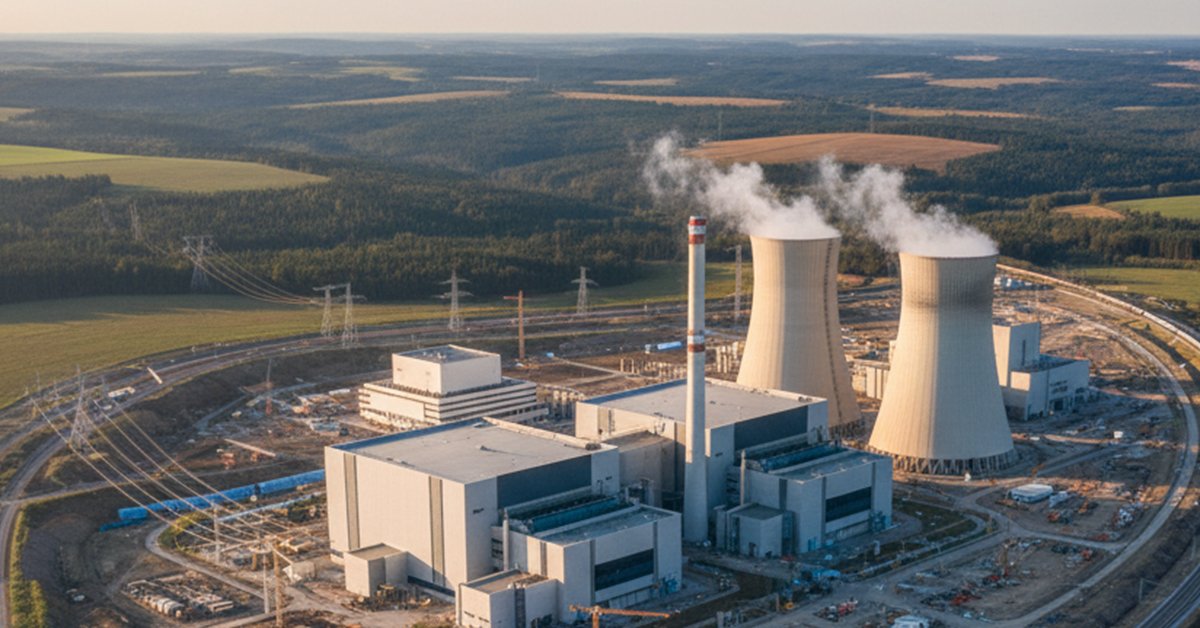

The Czech Republic is embarking on one of Europe’s most ambitious nuclear energy expansion programs, committing $19 billion to dramatically increase its atomic power capacity over the coming decades. This bold strategy positions the nation to become among Europe’s most nuclear-dependent countries while eliminating its substantial reliance on coal-fired power generation.
At the Dukovany nuclear power plant, where eight massive cooling towers dominate the landscape, mobile drilling rigs are already extracting geological samples 140 meters below ground. This preparatory work lays the foundation for two new reactors that will fundamentally reshape the country’s energy portfolio and contribute to broader European climate goals.
The Dukovany Expansion: South Korea Wins Historic Contract
In a significant decision that reflects shifting global nuclear industry dynamics, South Korea’s Korea Hydro & Nuclear Power (KHNP) emerged victorious over France’s EDF in the competitive tender to construct Dukovany’s expansion. This selection marks a notable win for South Korean nuclear technology in the European market.
Technical Specifications and Timeline
The winning proposal includes two advanced reactors, each capable of generating over 1,000 megawatts of electricity. These modern units will complement Dukovany’s existing four reactors, which produce 512 megawatts each and have operated since the 1980s.
Current projections indicate the new reactors will become operational in the second half of the 2030s, providing a crucial bridge as older coal plants are decommissioned and electricity demand continues growing. The extended construction timeline reflects both the complexity of nuclear projects and the rigorous safety standards required for such facilities.
Future Expansion Options
The KHNP contract includes strategically important options for additional construction. The Czech government secured provisions to build two more units at Temelín, the country’s other major nuclear facility, which currently operates two 1,000-megawatt reactors.
Beyond traditional large-scale reactors, Czech energy planners are positioning the country to adopt small modular reactors (SMRs)—an emerging technology that promises greater flexibility, lower upfront costs, and potentially faster deployment than conventional nuclear plants.
Projected Nuclear Output: 50-60% by 2050
Petr Závodský, chief executive of the Dukovany expansion project, outlined the transformative vision driving this nuclear commitment in an interview with The Associated Press.
“Nuclear will generate between 50% and 60% around 2050 in the Czech Republic, or maybe slightly more,” Závodský stated, highlighting the dramatic shift planned for the national energy mix.
This projection represents a substantial increase from current levels, where nuclear power accounts for approximately 40% of Czech electricity generation. Achieving this target requires not just the Dukovany expansion but the full realization of additional nuclear capacity at Temelín and potentially SMR deployment.
Strategic Drivers Behind Nuclear Expansion
The Czech nuclear strategy responds to multiple converging pressures that are reshaping European energy policy and creating urgent demands for reliable, low-carbon electricity sources.
Coal Phase-Out Imperative
Currently, coal-fired power plants generate approximately 40% of Czech electricity—the same proportion as nuclear. European Union climate commitments and national environmental goals mandate eliminating this coal dependency, creating an enormous replacement capacity requirement.
“Today, we get some 40% electricity from nuclear, but we also currently get another 40% from coal,” Závodský explained. “It’s clear we have to replace the coal.”
Unlike some European nations that can rely primarily on renewable energy sources like wind and solar, the Czech Republic’s geography and climate make nuclear power an essential component of any realistic decarbonization strategy.
Energy Security Considerations
Recent geopolitical events, particularly Russia’s invasion of Ukraine, have dramatically highlighted European energy security vulnerabilities. The Czech nuclear expansion reduces dependence on imported fossil fuels while creating reliable domestic electricity generation immune to international supply disruptions.
Notably, Russia’s Rosatom and China’s CGN were excluded from the Dukovany tender specifically on security grounds following the Kremlin’s Ukrainian invasion, demonstrating how energy infrastructure decisions now explicitly incorporate geopolitical risk assessments.
Meeting Growing Electricity Demand
Beyond replacing coal capacity, the Czech expansion anticipates significant electricity demand growth driven by:
Data Centers: Digital infrastructure expansion requires enormous amounts of reliable electricity, with major tech companies seeking locations with stable, affordable power supplies.
Electric Vehicle Adoption: Transportation electrification will substantially increase electricity consumption as internal combustion vehicles are replaced by battery-electric alternatives.
Industrial Electrification: Manufacturing processes transitioning from fossil fuels to electricity will create additional demand.
Heat Pumps: Building heating electrification through heat pump adoption represents another major demand driver.
Nuclear power’s ability to provide consistent baseload electricity makes it particularly well-suited to meeting these growing demands at reasonable costs while maintaining grid stability.
Europe’s Nuclear Renaissance
The Czech expansion occurs within a broader European context where nuclear energy is experiencing renewed interest after years of skepticism and declining investment.
EU Policy Shift
The European Union’s decision to include nuclear power in its taxonomy of environmentally sustainable economic activities marked a watershed moment. This classification opens nuclear projects to green financing mechanisms, dramatically improving their economic viability.
This policy shift particularly benefits Czech Republic, Slovakia, Hungary, and France—nations with existing nuclear programs that can now access favorable financing for expansion projects. The EU generated 24% of its electricity from nuclear sources in 2024, a proportion expected to increase as new projects come online.
National Policy Reversals
Several European nations have recently reversed previous nuclear phase-out decisions:
Belgium and Sweden both scrapped plans to eliminate nuclear power, recognizing its role in meeting climate goals while maintaining energy security.
Denmark and Italy are reconsidering nuclear adoption despite previously rejecting the technology.
Poland is actively entering the nuclear club, having signed agreements with U.S.-based Westinghouse to construct three nuclear units.
United Kingdom’s Nuclear Revival
Britain exemplifies Europe’s nuclear renaissance, signing a cooperation deal with the United States that Energy Secretary Ed Miliband described as leading to “a golden age of nuclear in this country.”
The UK government committed £14.2 billion ($19 billion) to construct the Sizewell C nuclear power plant—the first British nuclear facility since 1995. This investment mirrors Czech commitments and demonstrates widespread recognition that nuclear power is essential for meeting climate targets.
Small Modular Reactors: The Next Phase
Beyond conventional large-scale reactors, Czech energy strategy embraces small modular reactors as a complementary technology. CEZ, the dominant Czech power company with 70% government ownership, partnered with Britain’s Rolls-Royce SMR to develop and deploy this emerging technology.
SMR Advantages
Small modular reactors offer several potential benefits:
Lower Capital Costs: Smaller units require less upfront investment than gigawatt-scale reactors.
Faster Construction: Factory fabrication and modular design potentially reduce construction timelines.
Flexibility: Smaller capacity increments allow more precise matching to demand growth.
Site Versatility: Compact designs enable deployment at locations unsuitable for large reactors.
While SMR technology remains under development with limited commercial deployment, Czech planners view it as a valuable tool for achieving 2050 nuclear targets.
Financial Structure and EU Approval
The Dukovany expansion’s estimated $19 billion cost requires sophisticated financing arrangements given the project’s scale and multi-decade timeline.
Government Investment and Guarantees
The Czech government agreed to acquire an 80% majority stake in the new plant, demonstrating national commitment while maintaining CEZ operational involvement. The government will secure loans for construction that CEZ will repay over 30 years, spreading costs across the facilities’ operational lifetime.
Crucially, the state will guarantee CEZ a stable income from electricity production for 40 years. This revenue certainty addresses investor concerns about electricity price volatility and regulatory changes that could affect project economics.
EU Approval Process
The financing structure requires European Union approval, given state aid rules and the need to ensure competitive markets. However, Závodský expressed confidence about securing this approval.
“We’re in a good position to argue that we won’t be able to do without new nuclear units,” he stated, noting the impossibility of meeting climate targets without replacing coal generation.
- → Need a Passport Fast? How to Expedite Your U.S. Passport Renewal Step-by-Step
- → Want a $60K+ Salary Without a 4-Year Degree? 15 Certificates You Can Finish in Under a Year
- → Planning a Trip to Europe? 6 Essential Entry Rules to Avoid Denial at the Border
- → Heading to Border Control? Key Immigration Questions You Must Be Ready to Answer
- → Planning a European Trip? What Starkville’s Indian Community Should Know About Schengen Visas
- → 11 Countries Offering Funded Ph.D. Programs for International Students
- → U.S. Dollar Reaches Two-Week High Driven by Middle East Tensions and Fed Policy Outlook
The EU’s 2050 climate neutrality goal essentially requires member states to eliminate fossil fuel electricity generation, strengthening the case for nuclear investments as necessary climate infrastructure.
Fuel Supply and Energy Independence
Beyond construction contracts, the Czech Republic is strategically addressing nuclear fuel supply chains to eliminate Russian dependencies.
CEZ signed agreements with Westinghouse and France’s Framatome to supply nuclear fuel for both Dukovany and Temelín plants. These contracts eliminate previous reliance on Russian fuel supplies—a critical independence measure given current geopolitical tensions.
The KHNP construction contract includes fuel supply provisions for 10 years, providing additional supply security as new reactors become operational.
Opposition and Challenges
Despite broad public support for nuclear energy in the Czech Republic, the expansion faces both domestic and international skepticism.
Environmental Concerns
Friends of the Earth and other environmental organizations argue that nuclear expansion is too costly and that resources would be better invested in energy efficiency improvements and renewable energy sources.
A significant unresolved issue is permanent storage for spent nuclear fuel. While the Czech Republic operates interim storage facilities, no permanent repository exists—a problem facing most countries with nuclear programs.
Austrian Opposition
Geography creates particular tensions with Austria, whose border lies near both Czech nuclear plants. Austria abandoned nuclear energy following the 1986 Chernobyl disaster and remains deeply skeptical of atomic power.
In 2000, disputes over the Temelín plant triggered a political crisis with blocked border crossings lasting weeks. Austria’s lower house of Parliament has already rejected Czech SMR plans, demonstrating continued opposition.
As the most nuclear-skeptical EU member, Austria may attempt to influence European-level decisions affecting Czech nuclear financing or regulatory approvals, though its ability to block projects has diminished following the EU’s nuclear taxonomy inclusion.
Financing History and Delays
The current expansion overcomes significant historical obstacles. In 2014, CEZ canceled a tender for two Temelín reactors after the government refused financial guarantees. This uncertainty delayed Czech nuclear expansion by a decade.
The current project’s explicit government financial commitments address these previous failures, though critics argue the state guarantees represent inappropriate subsidies that distort energy markets.
Conclusion: Nuclear-Powered Transition
The Czech Republic’s $19 billion nuclear expansion represents one of Europe’s most ambitious energy transformation programs. By committing to double nuclear capacity and targeting 50-60% nuclear generation by 2050, the country is charting a course toward decarbonization that relies heavily on atomic energy.
This strategy reflects pragmatic recognition that Czech geography, existing infrastructure, and electricity demand growth make nuclear power essential for replacing coal while maintaining energy security and affordable electricity.
As Europe grapples with climate targets, energy independence concerns, and growing electricity demand, the Czech model may provide a template for other nations considering nuclear expansion. Success in delivering these projects on budget and schedule will significantly influence broader European energy policy debates and demonstrate whether nuclear renaissance rhetoric can translate into operational reactors meeting 21st-century needs.
