
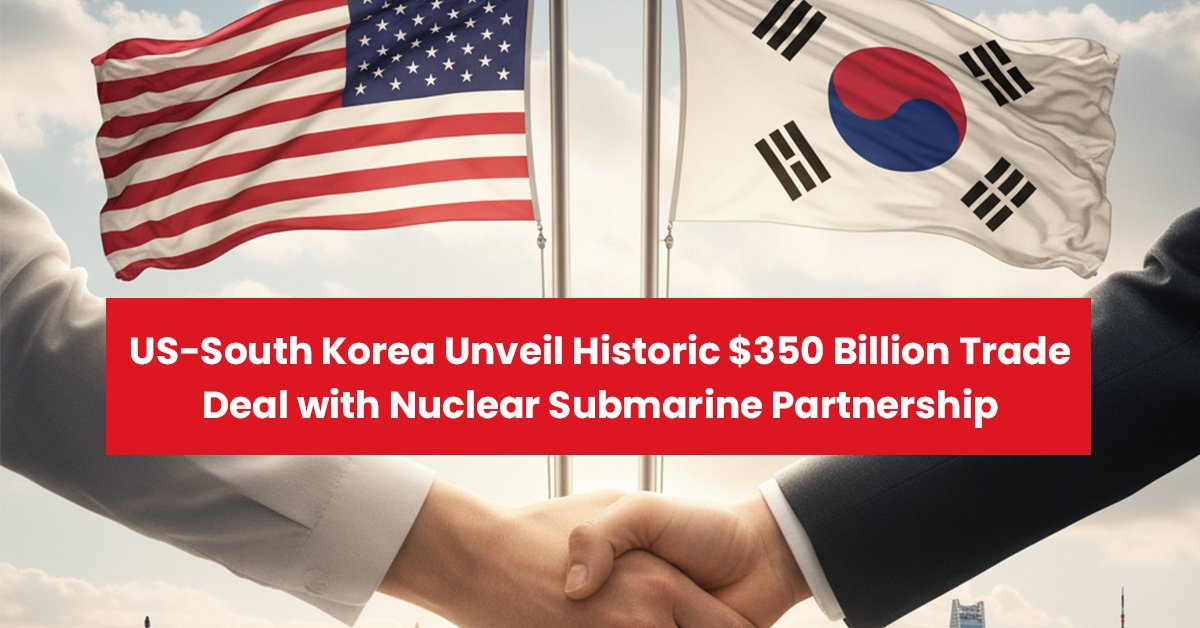

The United States and South Korea formalized a comprehensive trade agreement on Friday that includes $350 billion in Korean investments across American industries, significant tariff reductions, and groundbreaking security cooperation including approval for South Korea to develop nuclear-powered submarines.
The deal, signed by South Korean Industry Minister Kim Jung-kwan and US Commerce Secretary Howard Lutnick, represents the culmination of intensive negotiations that began following President Donald Trump’s implementation of widespread tariffs targeting trading partners worldwide. For South Korea, the agreement transforms what began as an economic threat into a strategic opportunity for enhanced bilateral cooperation.
Breaking Down the Investment Commitments
The financial scope of this agreement is substantial, with Korean investments divided into two major components that will reshape American industrial capacity.
Shipbuilding Sector Investment
South Korea has committed $150 billion specifically to the American shipbuilding industry, marking one of the largest foreign investments in this strategic sector in US history. This commitment addresses long-standing American concerns about the decline of domestic shipbuilding capabilities while leveraging South Korea’s world-class expertise in naval construction.
The investment will likely focus on modernizing shipyard facilities, incorporating advanced manufacturing technologies, and expanding production capacity for both commercial and military vessels. South Korea’s shipbuilding industry ranks among the world’s most advanced, and this partnership could revitalize American maritime manufacturing.
Broader Industrial Investment
An additional $200 billion is earmarked for various industrial sectors, including artificial intelligence, nuclear energy, and advanced manufacturing. This diversified investment strategy ensures benefits spread across multiple American regions and industries.
Notably, Washington accepted South Korea’s request to structure these investments in installments no larger than $20 billion annually. This measured approach aims to maintain stability in the Korean won and prevent currency market disruptions that could undermine the agreement’s economic benefits.
Tariff Reduction Framework
The centerpiece of trade normalization is the reduction of American import duties on South Korean products from 25% to 15%. This substantial decrease places South Korea on competitive footing with other major trading partners and provides relief to key export sectors.
Automotive Sector Relief
The automotive industry, one of South Korea’s most important export sectors, will benefit directly from the reduced tariff rate. Korean manufacturers like Hyundai and Kia, which have significant market share in the United States, can now price their vehicles more competitively while maintaining profitability.
Semiconductor Provisions
The agreement ensures that semiconductors from South Korea will receive tariff treatment “no less favorable” than those from Taiwan, according to a presidential adviser. This provision is crucial given South Korea’s position as a global semiconductor powerhouse, with companies like Samsung and SK Hynix playing vital roles in global chip supply chains.
This semiconductor clause addresses American concerns about supply chain security while recognizing South Korea’s strategic importance in the global technology ecosystem.
Revolutionary Security Cooperation: Nuclear-Powered Submarines
Perhaps the most strategically significant element of this agreement is US approval for South Korea to build nuclear-powered submarines. This marks a major shift in American policy regarding nuclear propulsion technology sharing.
- → Need a Passport Fast? How to Expedite Your U.S. Passport Renewal Step-by-Step
- → Want a $60K+ Salary Without a 4-Year Degree? 15 Certificates You Can Finish in Under a Year
- → Planning a Trip to Europe? 6 Essential Entry Rules to Avoid Denial at the Border
- → Heading to Border Control? Key Immigration Questions You Must Be Ready to Answer
- → Planning a European Trip? What Starkville’s Indian Community Should Know About Schengen Visas
- → 11 Countries Offering Funded Ph.D. Programs for International Students
- → U.S. Dollar Reaches Two-Week High Driven by Middle East Tensions and Fed Policy Outlook
Strategic Implications
South Korea’s national security adviser confirmed that discussions proceeded on the “premise” that these vessels would be constructed domestically in South Korea. However, President Trump previously indicated that construction might occur at a Korean-owned shipyard in Philadelphia, suggesting potential flexibility in implementation.
Nuclear-powered submarines represent a significant capability upgrade over conventional diesel-electric vessels. They can remain submerged indefinitely, have virtually unlimited range, and provide superior strategic deterrence—particularly relevant given regional security dynamics on the Korean Peninsula.
Fuel Supply Considerations
The White House fact sheet indicated that both countries will work closely to identify “avenues to source fuel” for these nuclear submarines. This cooperation extends beyond submarine construction to include the complex logistics of nuclear fuel supply chains.
Additionally, the US pledged cooperation on uranium enrichment and spent nuclear fuel reprocessing—sensitive technologies that have been restricted due to nonproliferation concerns. This unprecedented access demonstrates the depth of the strategic partnership.
Implementation Framework and Safeguards
The memorandum of understanding signed Friday outlines a 27-point implementation framework, though it remains non-binding. The structure provides both flexibility and accountability mechanisms.
Project Selection Process
Specific projects will be selected by the US president following consultations with South Korea. Once decisions are made, Seoul is required to transfer funds within 45 days, ensuring rapid implementation while maintaining governmental oversight.
Currency Stability Provisions
Recognizing potential economic disruptions, the agreement includes provisions addressing foreign exchange stability. If market instability appears, South Korea can request adjustments to investment amounts and timing, with the United States committed to considering such requests “in good faith.”
This flexibility acknowledges the complex relationship between large capital flows and currency markets, protecting both countries’ economic interests.
Political Context and Diplomatic Victory
For South Korean President Lee Jae Myung, this agreement represents a significant diplomatic achievement. Taking office just five months ago following political turmoil from his predecessor’s failed martial law attempt, Lee needed an early win to establish credibility.
“Finally, the South Korea-U.S. trade, commerce, and security negotiations, which were among the biggest variables affecting our economy and security, are concluded,” Lee stated. He credited “President Trump’s rational decision” in achieving meaningful agreement.
Lee emphasized that this partnership allows South Korea to help the United States “rebuild crucial industries just as the U.S. helped South Korea in the past,” framing the agreement as reciprocal support between allies.
Expert Analysis and Concerns
While the agreement addresses immediate concerns about tariffs and opens new strategic opportunities, analysts suggest caution in declaring unqualified success.
Kim Dong-yup, a former Navy officer now at Kyungnam University, noted that while the nuclear energy and security provisions are significant, Seoul is essentially paying substantially more for defense capabilities. He characterized Lee’s decision as “inevitable” given the circumstances.
Other analysts indicated it’s premature to determine whether South Korea secured better terms than Europe and Japan, which negotiated their own agreements with the Trump administration. Comparative analysis will require examining implementation details and long-term economic impacts.
Conclusion: A New Chapter in Alliance Relations
This comprehensive agreement extends far beyond traditional trade deals, interweaving economic investment, industrial cooperation, and strategic security partnership. The $350 billion investment commitment represents one of the largest bilateral economic agreements in recent history, while nuclear submarine approval marks a significant evolution in US technology sharing.
As implementation proceeds over the coming years, this framework may serve as a template for how allied nations navigate complex economic and security relationships in an era of great power competition and technological transformation. For both countries, success depends not just on the agreement’s terms, but on effective execution of these ambitious commitments.
