
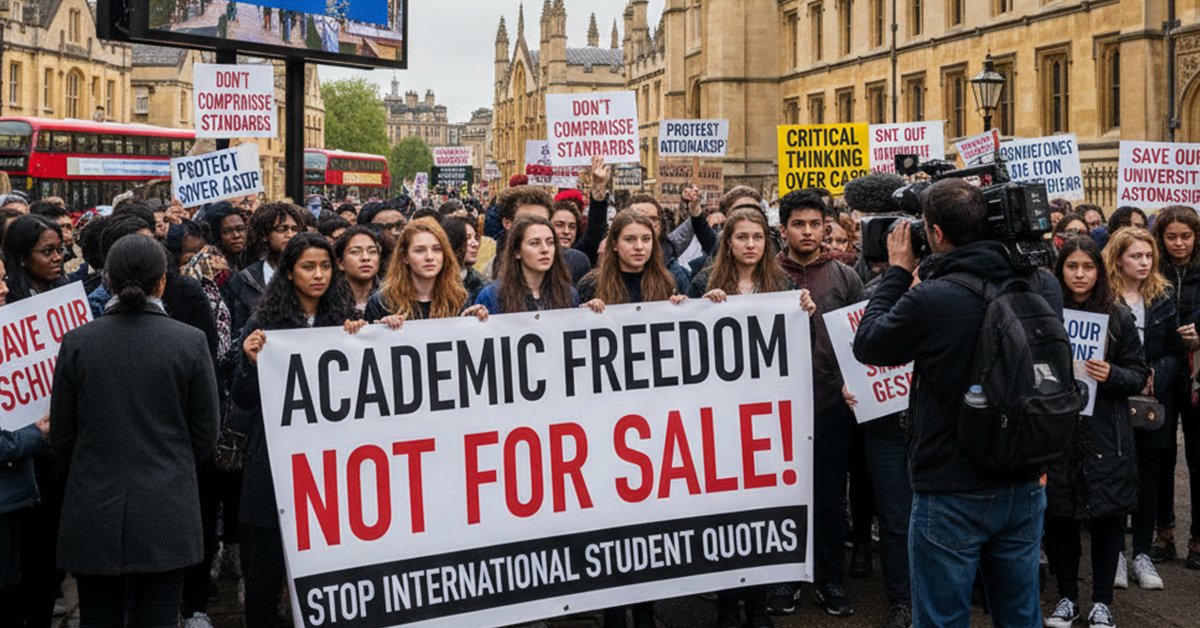

The UK’s higher education system has become increasingly commercialized and dependent on international student fees, creating growing tensions between academic integrity, institutional independence, and financial survival.
In the 2023–24 academic year, one in every four students enrolled in UK higher education came from outside the country — a significant increase from one in five in 2019–20. These students contribute over £10 billion annually in tuition fees, making them a financial lifeline for universities struggling with government funding cuts and capped domestic tuition rates.
However, the growing reliance on international student income is putting unprecedented pressure on universities’ academic freedom and decision-making. Allegations such as those involving Sheffield Hallam University, where an academic’s research was reportedly influenced by pressure from China, have reignited debates about the ethical and intellectual costs of this financial dependence.
Although Sheffield Hallam has denied that commercial interests played any role, the incident underscores a broader and uncomfortable truth: the marketization of higher education is reshaping universities into competitive businesses, prioritizing revenue over academic values.
The Rise of the Marketized University
The marketization of UK higher education began with successive reforms that encouraged universities to operate like private enterprises. Institutions were told to compete for students — domestic and international — in an environment where tuition fees replaced state funding as the primary source of revenue.
Yet, the fees paid by UK students are tightly regulated and, in many cases, insufficient to cover the actual cost of delivering courses, maintaining staff, and funding research. To fill the gap, universities have increasingly turned to international students, whose fees are uncapped.
For example, while home students typically pay £9,250 per year, international students can be charged anywhere from £15,000 to £35,000, depending on the course and institution. The result is a system where financial viability depends on foreign enrolments, particularly from high-demand markets like India and China.
In 2016–17, international fees accounted for 15.2% of total university income. By 2022–23, that figure had surged to 24.6%, highlighting the growing imbalance in funding sources.
How Rankings and Revenue Drive Recruitment
The reliance on international students is also reinforced by global university ranking systems, which reward institutions for their international diversity and staff-to-student ratios.
Recruiting high-fee-paying students allows universities to hire more staff and maintain smaller class sizes, boosting their ranking metrics and making them appear more prestigious to future applicants. This creates a feedback loop — the more international students an institution attracts, the better it performs in rankings, and the more international students it draws in return.
But this competition comes at a price. The need to sustain income and rankings often overshadows academic priorities, leaving departments vulnerable to closure if they fail to attract enough fee-paying students, regardless of their scholarly or social importance.
The Financial Risk: Overdependence on Foreign Markets
While international students are vital to the financial health of UK universities, overreliance on specific markets introduces significant risks.
According to the Higher Education Statistics Agency (HESA), India and China together account for nearly half of all international students in the UK. In 2023–24, India sent 107,480 students (25.1%), while China contributed 98,400 (23%). This dependence on two countries makes the system highly vulnerable to policy shifts, diplomatic tensions, or visa restrictions that could disrupt enrolments overnight.
Unlike domestic government funding, which is usually stable and predictable, international recruitment can fluctuate sharply due to global events, currency changes, or competition from other destinations like Canada or Australia. The impact on university budgets can be immediate and severe — and this financial volatility is now a central factor in the ongoing higher education funding crisis.
Cuts, Closures, and the Erosion of Academic Freedom
To manage financial instability, universities are resorting to budget cuts, course closures, and redundancies, with thousands of staff members losing their jobs.
- → Need a Passport Fast? How to Expedite Your U.S. Passport Renewal Step-by-Step
- → Want a $60K+ Salary Without a 4-Year Degree? 15 Certificates You Can Finish in Under a Year
- → Planning a Trip to Europe? 6 Essential Entry Rules to Avoid Denial at the Border
- → Heading to Border Control? Key Immigration Questions You Must Be Ready to Answer
- → Planning a European Trip? What Starkville’s Indian Community Should Know About Schengen Visas
- → 11 Countries Offering Funded Ph.D. Programs for International Students
- → U.S. Dollar Reaches Two-Week High Driven by Middle East Tensions and Fed Policy Outlook
The Universities and Colleges Union (UCU) estimates that around 15,000 positions have been lost in recent years as institutions scramble to reduce costs. Departments in the humanities, social sciences, and pure research — traditionally less lucrative — have been disproportionately affected.
These cuts not only harm staff and students but also threaten the intellectual diversity that defines higher education. When universities operate like profit-driven businesses, disciplines that don’t generate revenue risk extinction, and academic freedom becomes a casualty of financial expedience.
Industrial action has already disrupted teaching, research, and public engagement, deepening concerns about the long-term sustainability of UK academia. What was once a public good is increasingly treated as a market commodity.
The Policy Response: A 6% Levy and Its Consequences
The UK government’s current policy stance suggests little appetite for reversing the market-driven model. Instead, new measures such as a proposed 6% levy on international student fees aim to encourage universities to diversify their income sources.
However, the Higher Education Policy Institute (HEPI) warns that this levy could cost the sector over £621 million, worsening financial strain rather than alleviating it.
In reality, the levy may push universities to recruit even more international students to make up for the lost income — further entrenching the dependence it was meant to reduce.
Meanwhile, the idea of raising domestic tuition fees remains politically sensitive, and with public funding unlikely to increase, institutions are left trapped in a cycle of short-term financial fixes and long-term instability.
Capital Projects and the Debt Dilemma
In the race to attract students, many universities have invested heavily in capital projects — new campuses, state-of-the-art facilities, and luxury student accommodations — to market themselves as modern, competitive, and globally appealing.
While such developments can enhance student experience, they have also drained reserves and increased debt, leaving universities financially exposed. When international student numbers dip, institutions struggle to service these obligations, leading to further austerity measures.
This “build-to-compete” mentality reflects the market logic that now governs higher education, where universities must constantly sell themselves as premium brands rather than centers of critical thought and public service.
Academic Integrity vs. Commercial Interests
The reported case at Sheffield Hallam University — though denied by the institution — illustrates the delicate balance between financial interest and academic freedom. When universities rely on particular countries for a significant portion of their revenue, they may face subtle pressure to avoid offending those markets through research, public statements, or policy positions.
Whether or not such pressures result in overt censorship, the mere perception of influence can undermine public confidence in the independence of UK universities.
As global education becomes big business, academic inquiry risks being shaped by geopolitical and financial considerations, rather than intellectual curiosity or public need.
The Way Forward: Reimagining the University
The challenges now confronting UK universities are not rooted in isolated decisions but in a structural dependence on market forces. Unless new incentives for sustainable funding and public investment are introduced, the cycle of volatility, cuts, and compromise will persist.
What’s needed is a reimagining of the university’s role — not as a profit-generating enterprise, but as a public institution that safeguards knowledge, critical thinking, and academic freedom.
That means policymakers must:
- Reinstate meaningful government funding;
- Reduce tuition fee volatility;
- Support research-driven teaching;
- Protect staff rights and academic independence;
- Diversify recruitment without compromising integrity.
Until then, capital will remain king in higher education, and universities will continue chasing financial survival at the expense of their founding ideals. The result? A system where “remaining in the game” takes precedence over advancing knowledge — and the very essence of the university stands at risk.
